Today, a further hardware tip.
One of the lenses I had looked at by Keno-san of Canada Camera Repair (see prior post) was my 50mm f/1.2L prime lens. It was never the sharpest, and I figured a $2,000+ lens should be pretty sharp even wide open. The inspection turned into a repair, but not a very expensive one – under $175 for the repair, including a new rear lens element.
Good news: it is indeed sharper than before: I can now use this lens in available light situations. (The lesson in this: lenses should last forever and a well adjusted lens is worth having – lenses are therefore worth inspecting and repairing.)
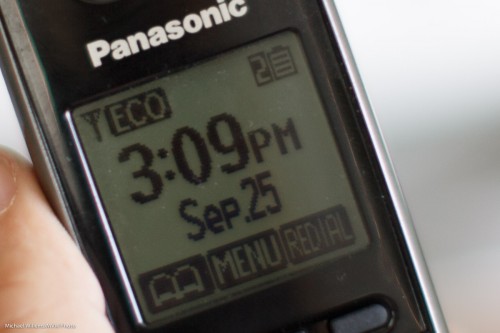
Here’s a handheld (both) shot at f/1.2:
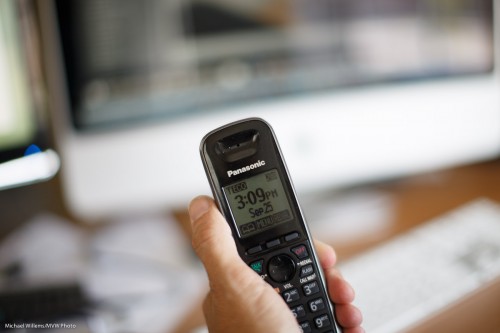
And detail:
The testing process also prompts me to remind you of a few important things:
- First of all: Do not be too critical. 50mm at f/1.2 is silly if you want more than a few millimeters of depth of field.
- Best use a lens test kit.
- Use a very small focus area to test focus. I used the “spot focus” option on the 1Dx.
- Focus elsewhere, then come back and focus on your subject
- Eliminate shake issues by using a tripod or fast shutter speed.
- Avoid “fully open”. Every lens is better when stopped down a little. That is why you buy an f/1.2 lens: not just to use at f/1.2, but also so it’s sharp at, say, f/2.0. (just like an f/1.8 lens would be sharp perhaps at f/2.8).
- Learn how consistent any issues are. A little back focus is fine, for instance, if your camera has a micro-adjust setting. But only if it is consistent.
- Focus in bright light. Use your center focus point; have the camera perpendicular to the surface you are focusing on.
- Focus is dependent on aperture, on distance from your subject, and on light intensity. If I adjust for close-by shots in my office, I need -15 on this lens; but at a distance, zero is what is needed. You need to adjust to an average that reflects what you shoot. Like (1 metre distance at f/2.8 in bright open shade”. Yes, this is complicated!
I used this setup:
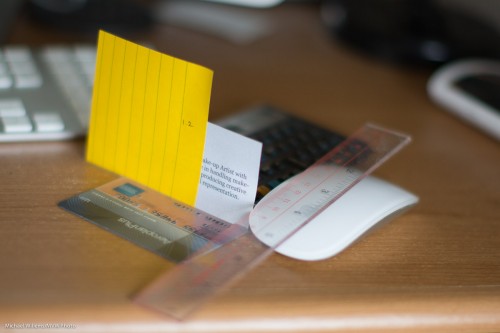
That gets me to a micro-adjustment of around -15 for close-by shots (on a scale of -20 to +20): I focused on the “o”.
As said, this is complex. I would keep it simple; avoid shooting too wide open, shoot at least 1 metre away, say; and adjust lenses to an average (for you) situation.
For my 50mm lens, the conclusion is clear: “When shooting wide open, if the subject is very close by, apply a -10 to -15 micro-adjustment. But for subjects far away, or for shots at f/4 or smaller, apply no auto-adjustment. By default, therefore, leave it off.”
Yes, this stuff is indeed complicated. But so is flying an airplane: complexity is sometimes necessary for best results.