'Alo alo… an important 1D MkIV tip

For those of you lucky enough to have a 1D Mark IV, here as a follow-up to my review a few days ago is another tip.

Canon by default has the “Auto Light Optimizer” set to “ON”, and this is a custom function you may well miss.

If you shoot RAW (as you really ought to), go into custom functions II, function 4, and take that off zero (0=”standard” Auto Lighting Optimizer” setting) and turn that to custom setting 3 (“Disable”).

What does ALO do to your RAW image? Nothing. And you shoot RAW. So why does it matter? Here’s why.

If you set ALO to ON, your camera will, where necessary, apply “fill light” to the data that comes from the sensor, and use the result to make its little embedded JPG. That will make dark areas lighter.

And that little embedded JPG is what you see on the back of your camera.

So when you look, you will see a well-exposed picture. Happily, you shoot more. But in fact, unbeknownst to you, the actual data is darker. You may well be underexposing the dark areas of your picture!  And like me. you wonder why when you import your image into Lightroom (which does not honour that same “fill light” setting) it looks so much darker than on the camera. Or rather, you wonder why the histograms are so different (you should probably not judge exposure just by the image on the LCD).

So when you turn ALO off, the camera no longer shows you an “enhanced mini JPG”; instead, it shows something closer to the real RAW image. And if that is dark, you can fix it by adding light, not by tweaking bits (which can add noise).

UPDATE: Chuck Westfall agrees. See the comment below.

Betteries

Batteries have come a long way. But I notice that not everyone knows this.

Modern cameras overwhelmingly use Lithium Ion batteries:

They are recognisable by the word “LiIon” on the battery.

These batteries are fundamentally better than Nickel Cadmium (NiCad) or Nickel Metal Hydride (NiMH) batteries, all of which suffer to some extent from what we call the “memory effect”: if you do not discharge them fully at regular intervals, their capacity diminishes.

LiIon batteries, on the other hand, like to be kept charged. You can charge them daily and this does not harm them or diminish their capacity. So every day when you get home, charge your camera’s battery, so that you have a full charge when you leave the next day.

(And you always have a spare at hand, too – right?)

LiIon batteries also have a low rate of self-discharge: they keep their charge for a longer time without running down by themselves.

This is why I call them “betteries”.

Again, why "fast" lenses?

A tip for newcomers to SLR photography.

I often hear: “Why do I need so-called “fast” lenses – like the 50mm f/1.8 lens Michael keeps talking about? Surely my 18-55 lens also covers 50mm?”

Well yes it does. But:

  1. Less sharply. A “prime” (i.e. non-zoom) lens is sharper.
  2. A prime lens is also smaller and lighter.
  3. And especially: the prime lens has a lower minimum “F-number” – i.e. a larger aperture. The lower the “F”-number, the better. Your kit lens is f/3.5-5.6 (meaning zoomed out it can go as low as 3.5; zoomed in it can go only as low as 5.6. The 50mm f/1.8 can go as low as 1.8).

Why is this important?

So in today’s class I took two shots of a student in available room light. One at f/5.6, and that is what you would get with your standard “kit”-lens. It looks like this:

Two things happen:

  1. Because of the small aperture (high “F-number”), the camera has to keep the lens open for a long time. This means that unless I use a tripod and tell the subject not to move, in indoors light I will get camera shake (the shot needed 1/10th of a second). And sure , do.
  2. The lower the “F” number, the shallower the depth of field, i.e. the blurrier the background. The higher the F-number, the sharper the background.F/5.6 gives a background that is somewhat blury.

Now look what happens when I use an aperture of f/1.8 (for which you need a lens that can do that, like the 50mm f/1.8 lens):

Much better – a pretty dramatic difference on both counts!

So the best way to immediately get great portrait shots is to:

  1. Get yourself a 50mm lens. On most cameras this is simple; do note that on a Nikon D40/D60/D3000/D5000 you need to manually focus this lens (that is why I recommend Canon cameras at the entry level).
  2. Learn Aperture Priority mode (A/Av) and use a low “F-number”.
  3. Turn the camera sideways and get close!

Have fun.

(Wow, three numbered lists in one blog post!)

1D Mk IV: My Hands-on Impressions

An admission. In terms of cameras, I have an embarrassment of riches to choose from.

As an educator, photojournalist, and general purpose photographer who gets called on for all manner of shoots, I “need” (euphemism for “I rationalize my way to”) the best equipment. It’s just a cost of doing business. I have a Canon 1Ds Mark III, a 7D, and a new 1D Mark IV. I am also familiar with the 1D Mark III, which I recently sold even though it was only lightly used – this having been my favourite camera.

I have done mini reviews of the 7D on this blog – now I thought it might be good to compare the 1D Mark IV to the previous Mark III, and to my other cameras. Here is my 1D Mark IV pictured a few hours ago:

The following is not a thorough technical review.While I am of course thorough in trying all the camera’s functions, I think there is enough material on the web, including Canon USA’s excellent 123-page white paper, to outline all the functionality and changes. Also, this is not an exhaustive image comparison. There’s enough of that already, too.

Instead, this is the real-life impressions of an actual user – and one who has recently owned or used all other recent Canon cameras, as well as Nikon, Sony, Olympus, and Pentax cameras.

So, continue after the click…

Continue reading

12800

A quick snap from my Canon 1D Mark IV taken at 12800 ISO. I applied very slight noise reduction in Lightroom and upon export, reduced the size to 1200 pixels wide.

If I had not mentioned it, would you be able to tell that was taken at such high ISO?

For high ISO shots, it is imperative that you light the shot well. Remember Willems’s Law: “Bright Pixels are Sharp Pixels”.

I shot that with the 1D Mark IV, at 12800 ISO, with the 100mm EF [corrected!] Macro lens, and shot at 1/60th sec handheld at f/2.8. A slow shutter speed like that (lower than one divided by the lens length) needs a steady hand and a bit of luck – oh and shoot ten pictures to get a few very sharp ones.  Better still, use a tripod.

A Point about Focus

When you auto-focus, do you use one focus point?

You should. That way you, not the camera, determines where sharpest focus is achieved. Wherever that may be.

But you may not know this:

    1. You need light, distance, and a subject (with horizontal/vertical lines) in order for your camera to focus.
    2. Focus points are sensitive to horizontal or vertical lines.
    3. Some, like the point in the middle, is sensitive to both horizontal and vertical lines.
    4. Some cameras have multiple such both0way sensitive focus points.
    5. Some cameras enable more focus points to become both-way sensitive when faster lenses (like those with apertures of f/2.8 or better) are in use.

      Yes, knowing all that technical stuff will make you a better focuser.

      Kodiak

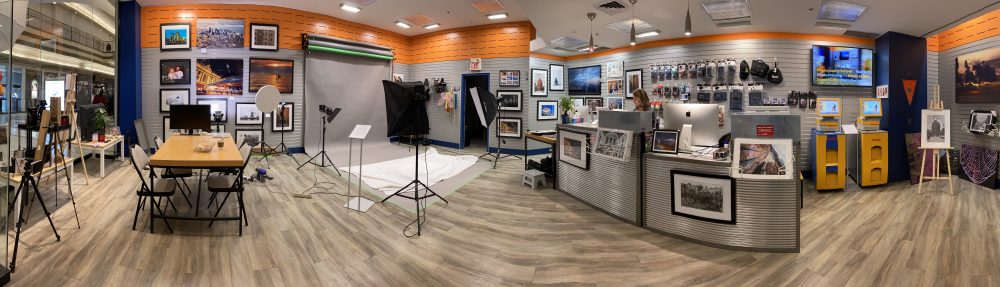
      A snapshot: here’s Gregory Talas, owner of The Kodiak Gallery in Toronto’s Distillery District (55 Mill Street, Building 47, tel. 416 640 0064 ), where some of my art work is exhibited:

      Gregory is a Jazz musician as well as a very experienced and artistic European photographer.