If you want to take portraits like mine outdoors, like the one below, in conditions of bright sunlight, what do you need?
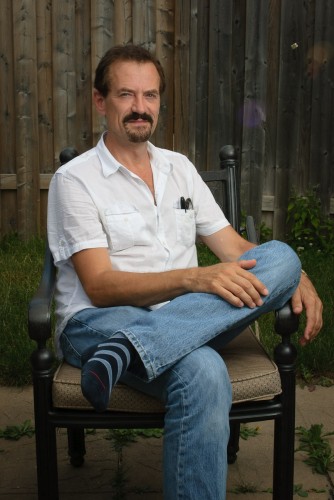
After the click, I shall outline it all for you. Good news: it’s not expensive.
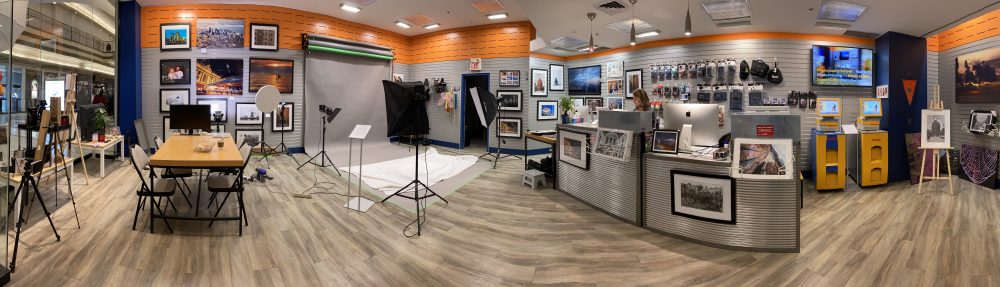
If you want to take portraits like mine outdoors, like the one below, in conditions of bright sunlight, what do you need?
After the click, I shall outline it all for you. Good news: it’s not expensive.
….then you use the Gary Fong Lightsphere. As I am doing here, in a recent wedding (the shot, in the church, is by my assistant that day, Merav):
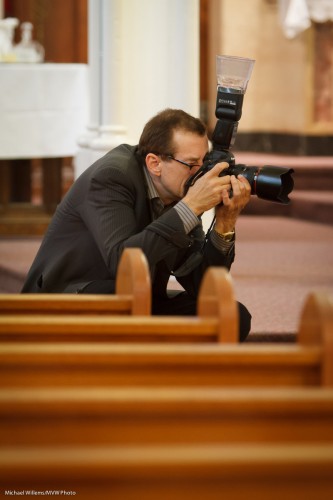
You see, normally when using flash I want to direct the light – tell it where to go. I don’t want to just bathe the room in photons – and yet that is all I can do here with a Lightsphere.
But sometimes it is the only choice: namely, when there is no single good bounce surface, sending light everywhere can be better, and usually is better, than direct flash. You may need to increase your ISO to allow for losses, and watch for light going forward directly (I cover the front sometimes).
So while the Lightsphere is the antithesis of creative light, it is sometimes the only thing that will get you good photos. That’s why I carry one in my bag. I don;t use it much, but when I need it, I need it!
A quick word about inkjet printers today.
My Canon Pixma Pro 9500 13×19″ art printer broke recently as you will have read – so I bought a Pixma Pro 9500 Mark II printer. These are pigment printers, as opposed to the more usual dye printers.
What is the difference?
Dyes, which are absorbed by the paper they are printed on, are easier to keep predictable in terms of colour, and hence are cheaper; pigments, on the other hand, which sit “on top of the paper”, whilst more expensive ($200+ for all ten cartridges on my printer) are permanent. Pigment inks can last more than 200 years on some paper types under ideal (museum-quality lighting and framing) conditions; dye inks fade quickly (sometimes in as little as days; usually in 20-30 years). Which is why art prints are made on pigment printers: you presumably want a piece of art to last forever.
When you use a pigment printer, you need to make sure that you use paper suitable for pigment printers. Good papers (like the Inkpress pro Silky I like to use for photos, or the Hahnemülle Fine Art papers) will say on the box when they are suitable for both dye- and pigment-printers. Pigments combined with long-lasting natural-fibre Fine Art papers, once you get all the settings and drivers right, give you extremely consistent, predictable, and lasting museum-quality prints.
Also, my Pixma printer accommodates Fine Art papers by having a straight (flat) paper path – this requires a complicated feeding procedure that takes time, and only individual art sheets can be loaded, but it is worth is since it does not bend the paper.
So when anyone asks “why does a print cost like $80?”, the answer is above. The cost of supplies, paper and printer, combined with the time needed to make a pro print, combine to make the finished product not cheap. But it is “museum quality” and lasts forever.
So before you go to Wal-Mart for a quick print – do some research, and consider having it done by a pro using pro pigment inks and art papers – or buy your own, and do the work to set it all up. There’s nothing like a quality, lasting print to show off your work!
Remember the main aperture numbers? f1.4, f2.0, f2.8…
No, let’s do that again properly:
f/1.4, f/2, f/2.8, f/4, f/5.6, f/8, f/11, f/16, f/22, f/32, f/45, and so on.
(Note: Corrected the f/35, my typo)
The last list is correct since an aperture number is a fraction. Strictly speaking, it is not “f 8”, but “f divided by 8”. Where, simply explained, f is the focal length of the lens and the result of the fraction is the diameter of the lens opening.
Why are these numbers important?
Because every next number is a stop darker (or when you move to the left in the list, a stop brighter) than the previous number.
A stop means halving or doubling the light. Hence the funny numbers; the ratio between these numbers is √2, or around 1.4, since to halve a circle’s area you reduce its radius by √2; halving the radius would instead you a quarter of the area (πr2).
So why are these numbers good to know? Well, imagine you are shooting at f/5.6 and 1/50th of a second. If instead I wanted to go to 1/100th second, what f-number would give me the same exposure?
The answer: 1/50th to 1/100th sec is one stop less light. So the aperture needs to provide one stop more light. Which means f/4, and you can set that instantly if you know the table of main values. Hence its importance!
Happy July 4th, US friends!
Not! A light meter is an indispensable tool if you want to ace your exposures first time.
Take this scene (taken, incidentally, amidst a whole bunch of naked people):
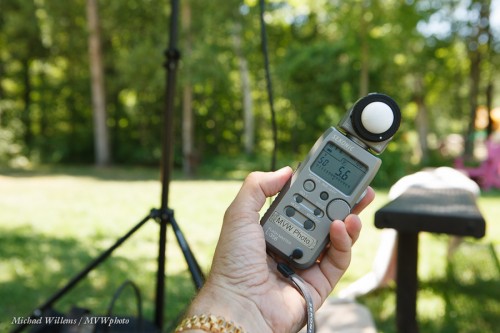
That meter is well exposed. Perfectly, in fact. Values were 100 ISO, f/5.6 at 1/50th second.
How? By reading the values off the incident light meter (a meter you hold where the subject will be):
With the camera’s built-in light meter, however, the exposure came out like this, since the light background was also read by the meter:
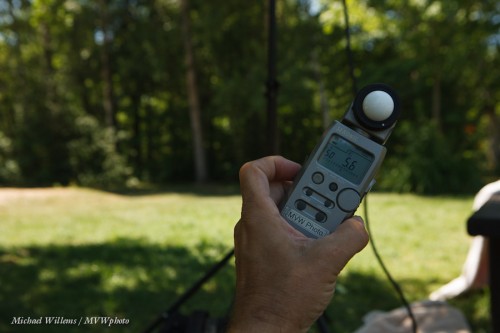
That’s nice for the background, but if the meter is the subject, this exposure is all wrong – 2 stops too dark (the camera thought 1/200th was the correct shutter speed). You would now have to adjust the exposure manually, or instead aim your camera, set to spot metering, at a gray card held there. Which is less convenient.
And that is why light meters are far from old hat. Pros use them all the time, even as ambient light meters as here.
We had July 1st in Canada yesterday, and our US friends have July 4th in a few days.
This is from our Canadian July 1st celebrations, in Newmarket, Ontario:
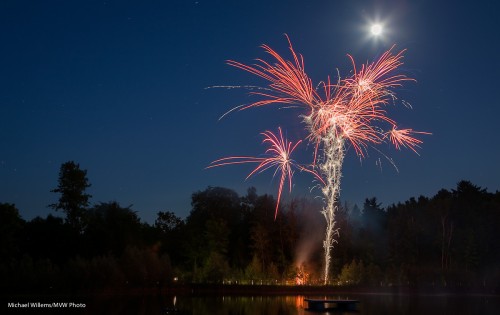
Technical tips:
And the usage tips:
Because it was an extremely dark country setting, the venue yesterday needed 30-60 seconds per shot to get any light into the background at all, so you can imagine I was happy that there was a short break between firework volleys going off, so each time I was able to open the lens for 30 seconds prior to the fireworks. Otherwise the background here would be pitch dark.
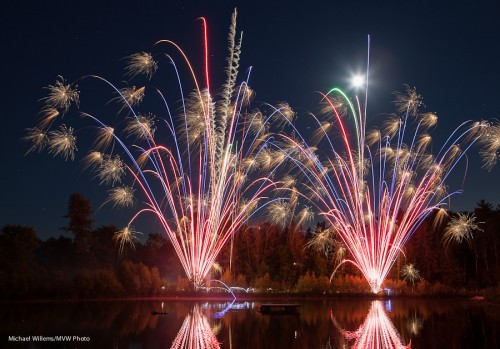
Try it out – above all, have fun, and happy 4th of July!
Happy Canada Day!
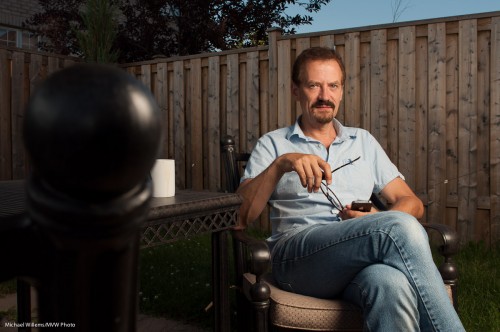
So why do I do this, people ask – this daily blog? Give away all my knowledge? Like how to take dramatic portraits like this (thanks, Mel) on a sunny day?
(Hint: 200 ISO/ 1/200th second, f/11, and a speedlight in an umbrella. See if you can work out why those particular settings? )
I do this teaching blog for a number of reasons.
First, because I am passionate about photography. We should all document our lives with artistic photos – the only time travel we ever get to do.
Second, because if I don’t, someone else will, and I’d rather you learned from me since I believe I know what I am talking about. I am a full-time photographer and photography coach and teacher, so I live and breathe this.
Third, because many of you come to me for private training sessions. A few two- or three-hour sessions and you will know so much more than before – all this theory here wil click into place and whatever aspect of photography you need help with, we can teach you quickly. From portfolio reviews ove rthe internet to live workshops here in Oakville, Ontario or actoiss the Toronto area and nerby, I’m your guy. You won’t believe the improvements to your photography!
Fourth, because some of you will come see me at venues such as my Vistek Mississauga seminars, and at the five-day August Niagara School workshop at Brock University (there’s still some space).
Fifth, because if you like my photos, you may engage me for your portraits, wedding, event, party, industrial, nudes, or whatever-else-you-want-documented-photography. I;m good, and while not the cheapest, I am sure you will be delighted with the iamges.
And finally – last but not least: becuase I love teaching. We are here only once and we may as well share.
Hope you enjoy. This blog is free and always will be. Updates are daily – with a few exceptions when I am travelling and so on.
And if you do feel like contributing: make a contribution at my site and I will send you a personal preview draft of my Photography Recipe e-Book (in convenient PDF format) as a sign of my gratitude!