
….sharp pixels!
When your subject is brighter than the background,
- it stands out more.
- it has more detail,
- and above all, it has less noise.
Noise, like cockroaches and bedbugs, hides in the darkness.
I could give you engineering, math, signal-to-noise-ratios, and so on (yes, I am an engineer), but just take it from me.
And often, making your subject brighter is easy to do.
Here is a glass on a table, as you can see.

Glass, lit by general light
Now again, but this time with a TTL flash from out left, and no flash on the camera:
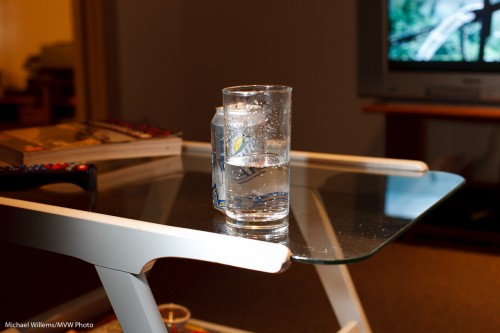
Glass, lit by side light
And as you see, the second one is more dramatic, the glass looks better.
Note that in the second image, I set ambient exposure to minus two stops. In other words, in manual mode, I adjusted ISO, aperture and shutter until the meter read -2. (Alternately I could have used program mode or aperture mode, and adjusted exposure compensation to -2 stops).
Why? Because I do not want the background to be totally dark.
My advice: try this yourself, right now. If it does not work, fiddle around until it does. Or ask me.
Hi Michael,
Your website is very informative. I am impressed with the information it contains. I have bookmarked it.
I tend to use flash in various angles to bounce. If the ceiling is coloured or too high, I use the wall. If none of them is possible I would use bounce cards and multiple flashes to light any shadows that could form behind a subject, due to the main flash which would be diffused. I like to play with light.
Which is the best way to avoid noise grain in low light black or dark BGs please.
I came as close by using slow shutter speeds, but too low may effect detail.
Thanks,
Simon.
Hi Simon,
Well, there are many ways to improve them. High ISO – 800-1600 is OK nowadays. Fast lenses: a dark even should be shot at f/2.8 or even f/1.4-f/2. The final one is slow shutter speeds: one divided by the lens length. So perhaps a 35mm lens at 1/30th second or even 1/15th.
Read some of the posts on this blog that mention “flash” and “events” for a start, and then we take it from yhtere!
Pingback: How do you get the eyes extremely sharp in the photo? | Everyday I'm taking a photo