Photojournalism is dangerous

Especially so in Iraq, as PDN points out in this article, about the 2007 killing by a US helicopter crew of a Reuters journalist and his companions – 12-15 people died. The salient point is that they died because the soldiers mistook cameras and lenses for rifles and RPG launchers.

The army, of course, is in a difficult situation in Iraq. It concluded that “the soldiers had acted according to the rules of military engagement”. WikiLeaks disagrees: watch the entire video on http://www.collateralmurder.com/

And a note to Dave Honl: if you’re a journalist working in Iraq, be careful.

Reader question

Reader Ray asks:

I know you have many cameras: as a pro you need them, I understand that. But why do you have, or what’s the reason behind your thoughts for having, a crop camera when I am sure you have many full frame cameras.  I would like to hear your the take on this, I know why I have a crop camera…lol

A-ha. A good question. Indeed, why do I ever shoot with a Canon 7D (1.6 crop factor, i.e. the sensor is 1.6 smaller than a 35mm negative), and a Canon 1D Mark IV (crop factor 1.3), rather than just using my top-of-the-range full-frame 1Ds Mark 3?

Well, there are several reasons.:

  1. Crop factor cameras make lenses appear longer. So a 200mm lens appears like a 320mm lens on the Canon 7D (200 x 1.6 = 320).
  2. I like lighter cameras… the 7D weighs half what the 1D weighs, and sometimes that is important. It is also smaller, which makes some types of photography, like street photography, easier.
  3. The 1D Mark IV is more modern. Sometimes you take the more modern camera because you need its functions.
  4. Sometimes you take a camera with fewer pixels like the 1D Mark IV, because it means smaller files.
  5. The 1D Mark IV is faster (10 frames per second, as opposed to 5 on the 1Ds and 8 on the 7D).
  6. Quite often, good enough is good enough.

I hope that explains that as with so many things in life, nothing is simple. Sensor size is not everything, just like pixels aren’t everything!
As promised

…so what is the deal with image stabilization/vibration reduction (IS/VR), if your lens or camera has it?

  • Use it! It is a great feature: it adds several stops to your ability to take low shutter speed.
  • If your camera is on a tripod, do not use it. It does not good and may do harm (like wearing our your battery).
  • If you are shaking wildly because you are following something, do not use it.
  • If you are tracking a subject that moves in a linear direction, like yesterday’s aircraft, use it – if you have a “mode 1/mode 2” or “active/passive” switch, which you have on high-end lenses. Mode 2/Active means “I am tracking something on one direction, so only stabilise in the direction perpendicular to my tracking”.

On Nikon and Canon, you have VR/IS in the lens. Sony does it in the body: cheaper, but less optimized to the lens length, and you can’t see the effect.

Landing

At this point, ladies and gentlemen, please ensure that your trays are stowed and your seats are in the upright position. Please ensure that all your luggage is securely stowed: heavier items underneath the seat in front of you, lighter items in the overhead bins bla blabla  bla shifted in flight blablabla

I have a point in telling this and showing this picture of my friend James arriving in Toronto last Saturday night. Coming up tomorrow: for those of you with a stabilised (VR/IS) lens with TWO positions, what is the difference? When do you you which one? More on that tomorrow.

Now first I go take a few pictures of old Montréal, if I have the energy and my knee holds out and it does not start raining.

Shutter speed?

Quick rule of thumb:

  • Stay roughly at 1/lens length or faster to be sure your pictures are not shaky. Roughly! So for a 100mm lens, stay faster than 1/100th.And so on.
  • Hold your lens at the end.
  • Take 5 or more pictures – one will be sharp.

Quick, as rules of thumb are. But useful!

Flash from behind

Look at this picture, which a student took of me in a class the other day:

Michael Teaching

Can you see how she turned her flash behind her, so it aimed at the wall above her, which in turn lit me with soft, gentle light? Otherwise, if she had aimed it at me directly, we would have seen all the things that people hate in flash:

  • oily skin
  • flat face
  • dark background
  • overexposed subject
  • shadows under the chin

Instead, we get soft, natural looking light.  And it’s easy: turn the flash so that the light bounces behind you. With TTL, it’s easy: the camera does the math. You just push the button.

Sometimes you make do

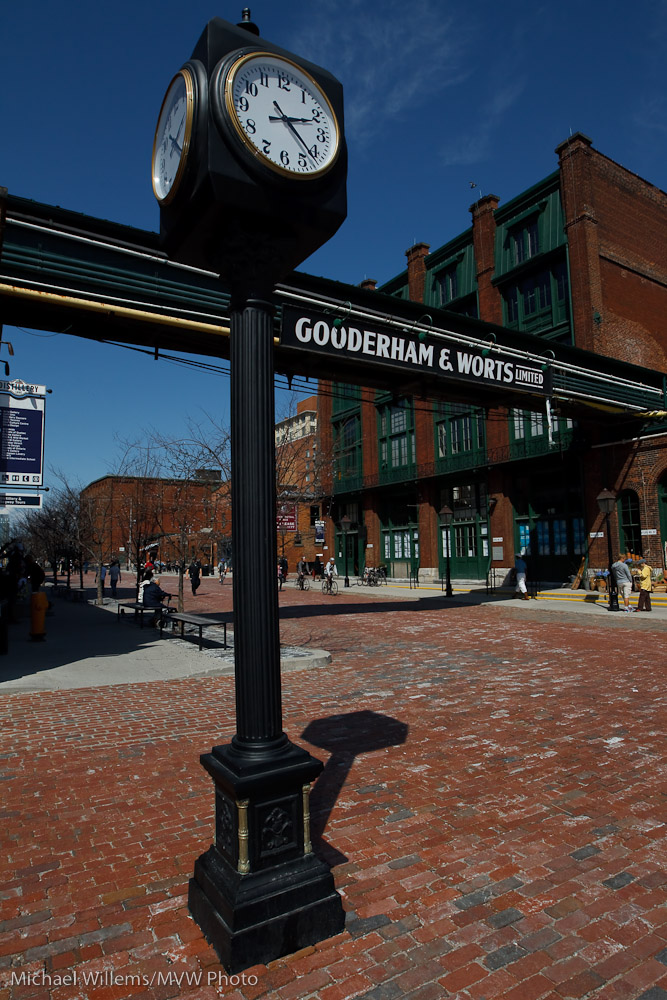
…with a hand, if you want a foreground object to light up with your flash, when for effect the background needs to be darker. Like just now in The Distillery District in Toronto:

Another snap:

Again, using flash for lighting up the foreground, while exposing down to saturate the background on a bright day around noon. Sure you can take pictures at mid-day.