Why I shoot stills

I am sometimes asked “why don’t you shoot more video? Why stills? Video is much richer, no?”

In my opinion: not necessarily so.

First, there are the practical issues:

  • Video is harder to shoot.
  • You need more equipment (stabilizing rigs, audio systems, focus systems).
  • It is much larger, mening slow to transfer and needing much larger hard disk space.
  • You need much (much) more time to edit.

But there is another reason. Still photos give you time to look.

A video is like a collection if stills where you only get 1/30th second to study each one. A still photo, on the other hand, is something you can ingest, savour, distill, and study.

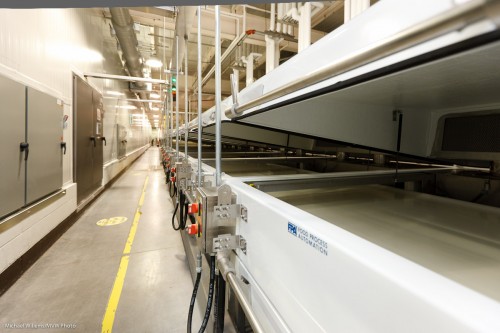
The need to do this is easily seen in complex photos, like this recent wide angle factory shot:

Food manufacturing facility (Photo: Michael Willems)

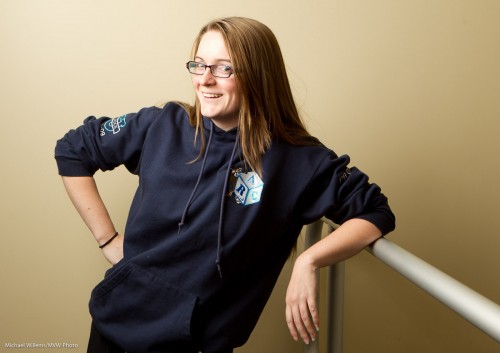
But the same is true for every photo. Even a simple portrait (of Courtney, my recent assistant, during a recent Sheridan College course I taught) can make you look, and look again; work out the story; get to the person in a way video cannot easily do.

Courtney Craig (Photo: Michael Willems)

Video chews it all for you; stills make you do some of the work.

My analogy: looking at stills is more like reading a book instead of watching the movie. And I like reading books.


Merry Christmas

To those of you who celebrate it: Merry Christmas. To those of you who celebrate Hanukkah: Happy Hanukkah. To those of you who celebrate yet other holidays: enjoy them.

And to those of you who just like to have a good time: Enjoy, but enjoy responsibly.

Christmas tree decorations (Photo: Michael Willems)

And try to take some pictures like this, where the many lights you see in this season are thrown out of focus. As said here before: when your aperture is wide open, they become circles (except near the edge where the can be part circles; when the aperture is stopped down, however, you will see the shape of the aperture (a hexagon, usually).

Enjoy, and see you back here tomorrow.


Open wide!

I mean – wide angle lenses are more useful than most people realize. As frequent readers here know, I do tend to say this over and over. And let me reiterate it here, again.

Last week I shot an industrial food facility. And again, the shots I like most are the wide angle shots – like 16mm on a full-frame camera (that is 10mm on your crop DSLR).

And that gets us shots like this:

Industrial Food Facility (Photo: Michael Willems)

Industrial Food Facility (Photo: Michael Willems)

Industrial Food Facility (Photo: Michael Willems)

A wide angle lens, especially when you get close, introduces – you know it – depth, three-dimensionality, perspective, size, and hence drama; and above all, it gives a 2-D still photo credibility.

So if you do not have one yet, ask Santa now (*and you can also ask him for a gift certificate for personal training while you are at it – ask me how).

A “wide” lens is a 10-20mm lens, that order, when you are using a crop DSLR, or a 16-35 or 17-40 when using a fill-frame camera.


Of mice and men

That above-mentioned book, by Steinbeck, was challenged many times for its alleged vulgarity. As was “Lady Chatterley’s Lover” by D.H. Lawrence. As was “Ulysses” by James Joyce. And the list goes on: many works of art, visual and written, have been seen by the narrow-minded as vulgar.

As was mine today.

I do not of course want to put myself in the same category as those giants, but nevertheless the effect of such narrow thinking is still here. You see, today I was banned from Facebook for 24 hours (so far – it could get worse) for posting an image, in a closed, secret, invitation-only group for professional photographers. An image just like this one, from the same shoot:
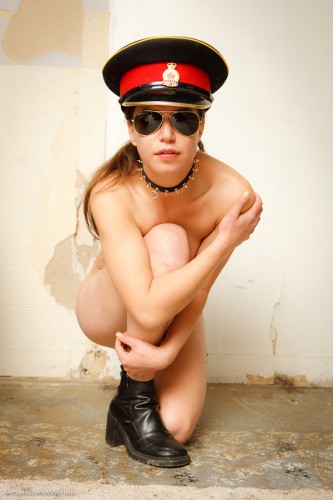
Model Kim by Michael Willems

I see this:

Ever noticed that when someone says “Policy”, something bad follows, that you cannot argue with?

Now yes, I do know the Facebook terms of use. In keeping with the 1950s morality that rules much of the religious south, they say there must be no nudity.

That would exclude much renaissance art, of course. But the restriction is not a big deal in practice for images – the way I look at it, nudity must involve something other than arms, legs or shoulders.

And yet I was banned. In a very worrying process: there is no recourse, no debate, no indications of who complained (in a closed secret group like that, the way to get banned is if someone “reports” your image as wrong).

This process is wrong because:

  • As said, is no debate or recourse, no-one to talk to.
  • There is no indication of who your secret accuser is.
  • This process of “report and we basically ban if it offends anyone” drags everything down to the lowest common denominator. Another group I used to be on used to ban people for showing tattoos, since the Lord, in the Bible, apparently prohibits them. This is 2011 USA, not 1500 Europe or Saudi Arabia.
  • Nudity is not wrong! it is beautiful. Violence is wrong – and yet that is allowed all over the place.
  • Not  that there was, in my opinion, nudity here – if even implied nudity is nudity, then heck, we might as well veil our women.
  • Facebook is an important part of a photographers’ business. If Facebook has the right to cancel or ban people with no due process of any sort, that gives them a worrying amount of monopoly power. And absolute power, as we know, corrupts.

But above all – censorship does not work. The people on the closed group all wanted to know more, and all headed to my Tumblr site, which is not run by mice, but by men. And the 150 people in that group can no longer see my image on Facebook, but the many thousands of readers here can now all see it.

 

Environment

I like people in their environment, and I like to picture them in it. A short word about that, today.

Last night, I made kid and family portraits of a very nice family. Mostly straight four-light portraits against a backdrop, like this:

But at the end, I did some family photos. For which I chose a more “real” backdrop.

No, I do not mean a “bursting through the reality envelope” setting like this (although in a strange way I do like it):

Family photo (Photo: Michael Willems)

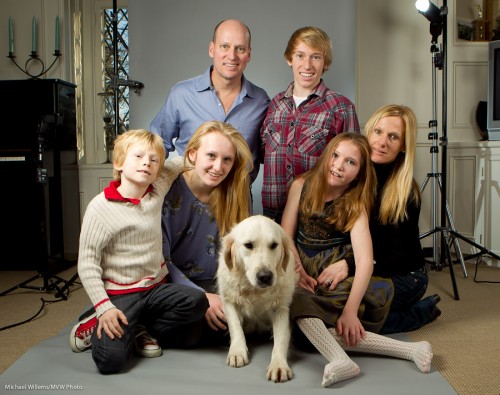
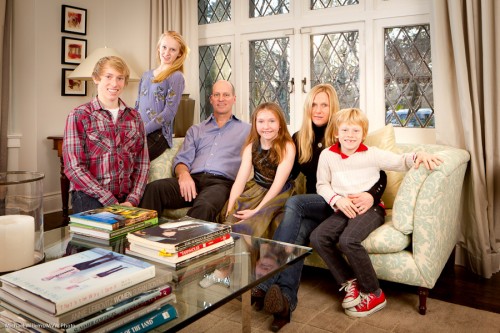
But I mean this: a shot of the family in their home, with real items that make it home (the books, the window):

Family photo (Photo: Michael Willems)

I would call this a semi-environmental image. It is environmental in the sense that this is their home, and that I am balancing available light with flash light from my strobes. It is, however, also a studio shot, in the sense that it is posed, and this is the living room (which is never used in most home – a decorative room), and that I set it up and used it as a studio. I used lots of studio techniques – like strobes, and I flashed small speedlites at the ceiling in order to create the catchlights in the subjects’ eyes.

This image also needed a small amount of post work:

  • A little vignetting around the group
  • A part of one of my umbrellas showed as a reflection.
  • I increased exposure a little, also.

In a shoot like this, it is perfectly OK to do such post-work in Photoshop or Lightroom or in what software you choose to use. Don’t sweat it: shoot a competetnt image, then finish it in post.


Ph(x)=Fn(p)

In my nonsense shorthand, this means “photography is problem-solving”. And it always is.

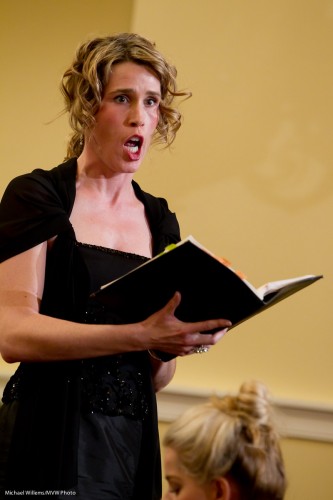
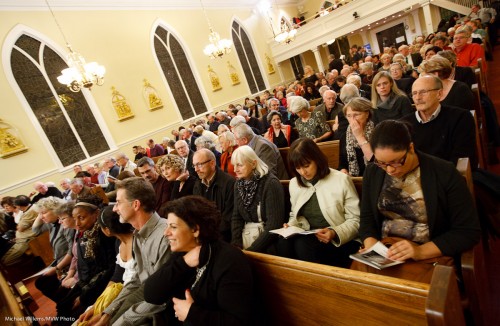
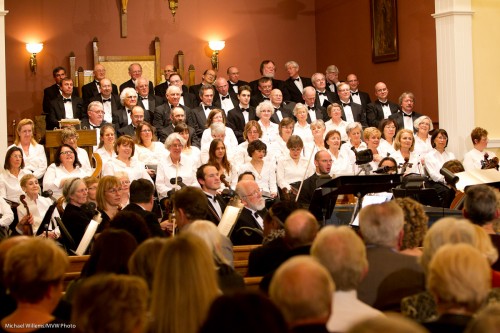
Take the other night, when I shot a classical concert – Händel’s Messiah, by Masterworks of Oakville. Among my challenges were:

  • Low light!
  • The required white balance is non-standard.
  • No flash allowed.
  • Close-ups and long shots both needed.
  • You do not want to get in the way of the audience.
  • Finding the right position – be close.
  • The organizers had made it known that I was not to move around…
  • The conductor had asked me not to make clicking sounds! Ouch.

As you see, I had my work cut out for me. So how did I handle all this?

  1. I used the right equipment – only f/2.8 lenses. 16-35 f/2.8, 70-200 f/2.8 and I had primes and a small camera.
  2. I shot everything at 1600 ISO. f/2.8 and 1600 ISO gave me acceptable shutter speeds.
  3. I arrived early, so I was right behind the orchestra, about 30cm from the soloists.
  4. I had three cameras. My main cameras had a 16-36 wide and 70-200 long lens.
  5. I set these two big Canon 1D4/1Ds3 cameras to “silent” shutter (a little quieter than normal).
  6. I also disabled all beeps.
  7. But I shot all shots of quiet passages with my Fuji X100, which is totally silent.
  8. I shot RAW, allowing me to tune white balance afterward.
  9. I angle shots to ensure the size of the crowd is emphasized.
  10. Shoot detail.
  11. Show all angels – choir, soloists, audience, the works.
  12. Fill the frame!
  13. Shoot the right moments. Emotion is good…

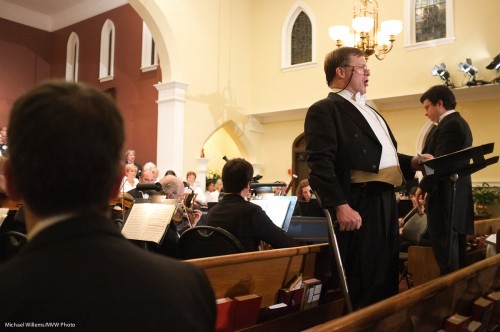
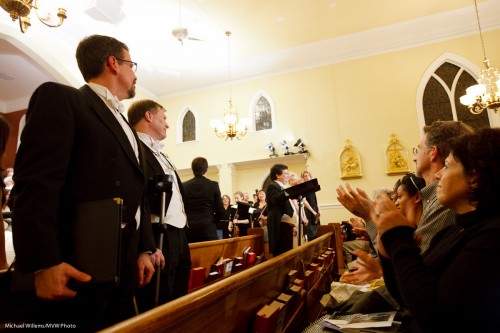
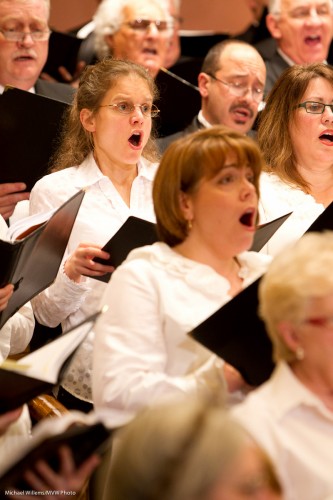
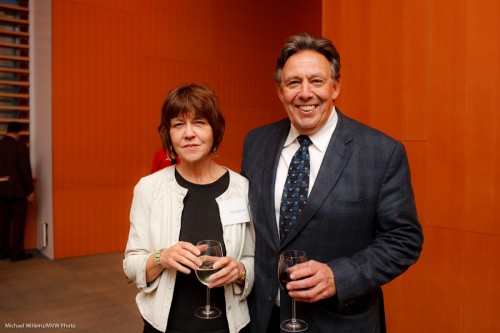
A few of the resulting images:

Masterworks of Oakville - Messiah (Photo: Michael Willems)

Masterworks of Oakville - Messiah (Photo: Michael Willems)

Masterworks of Oakville - Messiah (Photo: Michael Willems)

Masterworks of Oakville - Messiah (Photo: Michael Willems)

Masterworks of Oakville - Messiah (Photo: Michael Willems)

Masterworks of Oakville - Messiah (Photo: Michael Willems)

Final note: also shoot “establishing shots”: the venue, the show notes, and so on.

Shooting converts is fun if stressful – and using techniques like these, that stress can be handled.


Mountains. Move them.

You know the saying, attributed to Francis Bacon? “IF THE MOUNTAIN WILL NOT COME TO MOHAMMED, MOHAMMED WILL GO TO THE MOUNTAIN”.

Photographers know this too – but we sometimes forget it. So let me remind you. When you have a background you do not like, or a wall with the wrong colour, or a ceiling that is too high, you can try to deal with it the best way you can.

You know how, right? So you read my blog – you know this. 4 -40- 400!

  • 400 ISO
  • 1/40th sec
  • f/4

And the flash aimed behind you.

Nice, but.. if you have a better background or a better wall, why not use that?

Ask your subjects to move.

And then you get..

So.. please remember that as a photographer, you can shape your environment. Do it, and your pics will be better.


Mood and meaningful

Try to do the following: create an image that evokes a mood. And your images are more valuable if they convey mood and have meaning more than the strictly documentative and factual.

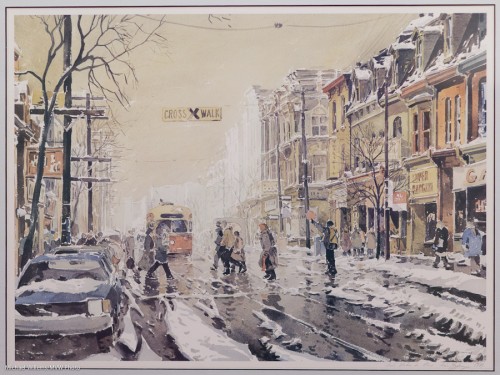
Images, more than any other artistic expression except perhaps the written word, can do that. The other day, I was in a venue that had art on the wall, and I came across a water colour that more than anything evokes “depressing”… a scene, incidentally, that we in Toronto will see soon enough:

So your challenge is to do the same in a photograph.

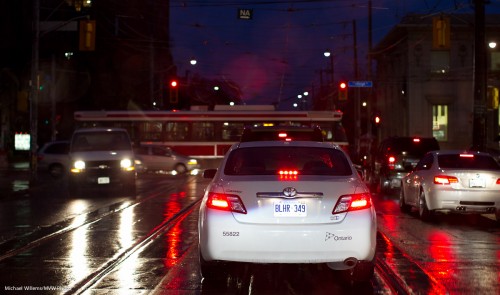
An example snap to get you started: in mine, too, weather plays a role, but traffic, my nemesis, does as well:

See what you can come up with: a good exercise in any case.


I wanna know…

….haveyou ever seen the rain?

With a tip of the hat to CCR, I do wonder if we look at rain the right way. Rain, especially in winter or at night, is great weather to take pictures.

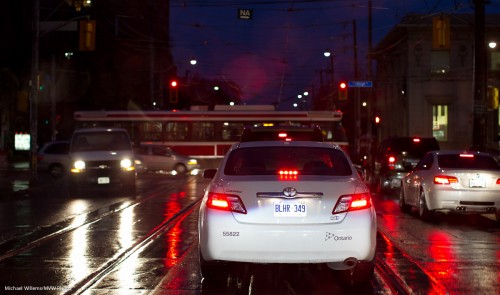
This snap, although it is just a snap, and I clearly did not take it while driving a motor vehicle since that would have been illegal, shows us why.

Saturated colours. Colours, those of brake lights and umbrellas, street lights and human activity. Reflections, of all the lights and colours. Textures. And the mood corresponding with rain.

So next time it rains, go out and take some pictures. Your camera will be fine: just keep it a little dry with a cloth.


The best camera…

…it is often said, is the camera you have on you.

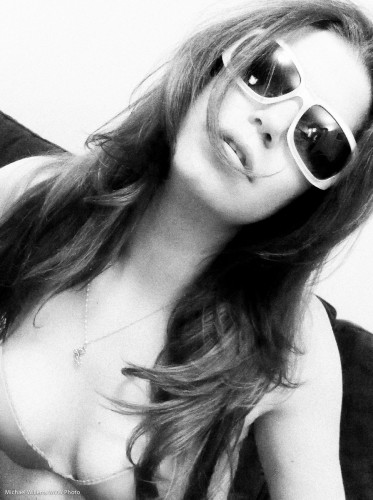
But you need to use it well. I shall share with you an example of an iPhone picture I took, to illustrate this.

To do an iPhone picture is easy. But to do it well, you need to:

  1. Compose well. Do not take a pic with the subject in the centre – use the Rule of Thirds, tilt, get clos, do what you need.
  2. But do not get too close or you will distort.
  3. Light well. Not the intensity – this pic was taken in very low light with no flash – but the direction (I turned the subject to the light and tilter her head up to catch that light)
  4. Post-process – in my case, in Lightroom. First, I converted the image to black and white.
  5. Then I applied an enhanced contrast style.
  6. Then I reduced the noise
  7. But then I applied lots of film grain. Love that grainy look (view full size to see it):

The result:

Model Kim Gorenko (Photo: Michael Willems)

Not a bad shot eh, and taken with an iPhone in low light.

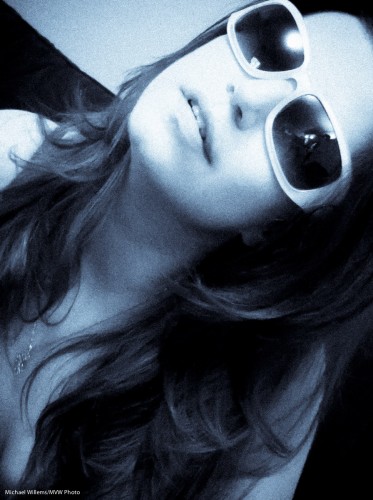
Here is another example, with Selenium Tone style applied (and the same other tuning done):

Model Kim Gorenko (Photo: Michael Willems)

So do not make the mistake of thinking a good photographer is nothing without great equipment. Yes, it expands your possibilities, but if all you have is an iPhone, use it well!