
Nuking the sun

Daniel Alamo

My trip to Texas brought it home again – or it would have, if it weren’t already firmly home. Flash, especially in bright weather, is essential.
I thought it might be good to illustrate this once more by way of example, using some of last week’s Texas pictures.
When, then, do you need flash? Leaving aside the obvious “when it is dark”, I will concentrate on three more interesting cases, both to do with mixing light.
Case 1: to light backlit subjects. Look at Jason in Little Rock, Ark (on our way home). In image one, he is backlit, so while the background is exposed properly, he is too dark. Short of putting him into the sun, there is no way of escaping this problem other than by metering off him or using “+” exposure compensation (which would make the background way too bright), or by using what we call “fill flash”.

No Flash
You can even use your popup flash for this: it gets you from image one to image two, where Jason is lit properly:

Flash

Look how much better that looks. And note that in this case, where the flash is adding to existing light it is OK to aim straight at the subject.

Case 2: to darken the background; in particular, the sky. It comes as an epiphany to most photographers when they realise that you can make a blue sky anything from deep brooding dark blue to milky white, just by adjusting the exposure. Turning the sjy dark by overpowering (or “nuking”) the sun is a very powerful creative technique.
The picture of Daniel above, at The Alamo, illustrates this. I metered using the fully automatic evaluative (Nikon would call this “3D Matrix”) metering, and I used an exposure compensation setting of minus 1 stop. That darkened the sky. Then I used my 580EX MkII flash to add light to Daniel’s face, which would otherwise be way too dark. The shutter speed was 1/250th second (the 1Ds’s maximum sync speed) at f/14 at 100 ISO.
Case 3: to add colour. The BBQ picture below shows how this is done. Available light alone would not have made the meat (and Texas is all about meat) look at bright, vibrant, and if you are a carnivore, inviting. Adding flash (and in this case, bouncing it off the wall to avoid shadows) adds vibrancy to the colour that you would otherwise miss dearly.

BBQ

So turn on your flash and have fun!
Know your A:B C

MVW_9056-1200If you use Canon’s excellent multi-flash E-TTL II, you can get great results with simple speedlites like the 430EX.

But you have to know how the system works. There are a few gotchas – like the sensitivity of the E-TTL system to highlights: one reflecting item in your shot and the entire picture is underexposed. except that reflective item.

One other thing to know is the way you set ratios. This is under-explained in the existing literature, and yet, is very simple once you know it.

You can divide your remote flashes into “groups” A, B, and C. The options for setting up these groups are are A+B+C, A:B, and A:B C.

A+B+C simply means “fire all as one big group”.

A:B means “I have set one or more of my flashes (including the one on the camera, if that is enabled to flash) as group “A”, and one or more flashes as group “B”. I want to fire so that the ratio between group A and B is as set; e.g. if I set 4:1, then the “A” flashes fire four times more brightly than the “B” flashes”. So unlike the Nikon CLS system, which sets “stops with respect to neutral exposure”, the Canon system sets “ratios with respect to each other”. Not difficult: just another way of looking at it.

The one mode that gets most people is A:B C. (Note, just a space between the B and the C). This option simply means “A and B are as before, but any flashes in group “C” will fire at high power and this group will not be taken into account when calculating overall picture exposure”. This means you use group “C” to light up a white background.
Like in the pictures here of my son Jason, which I took in five minutes this morning before work. Including setting it all up. Pictures like this one:

MVW_9055-1200

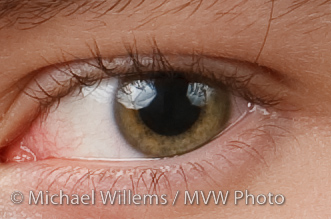
This picture was shot as follows: on our left, the “A” flash firing through an umbrella. On our right, the “B” flash also firing into an umbrella (you can see that in the reflections in his eye – you do always focus on the eyes, right?). And behind Jason firing at the white wall behind him, the “C” flash, aimed at the wall. All three of these are 430EX speedlites. On the camera, a 580EX II speedlite. This on-camera flash is disabled; it simply drives the three 430s. The system is set to A:B C, with an A:B ratio of 4:1 (the camera left side of the face is four times, i.e. two stops, brighter than the camera right side).

MVW_9055

Simple, really.

If you want to learn more about this subject, Michael teaches Flash at Henry’s School of Imaging, or for more in-depth or customised training, privately, to a wide range of clients.