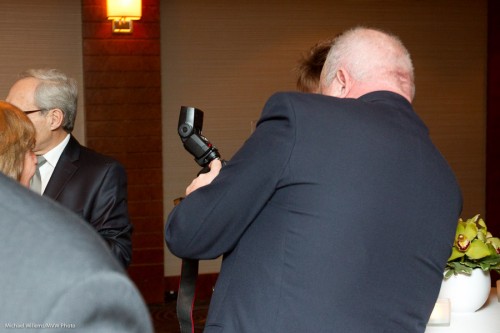
More “simple light”.

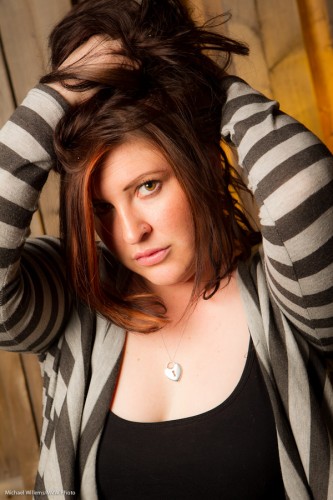
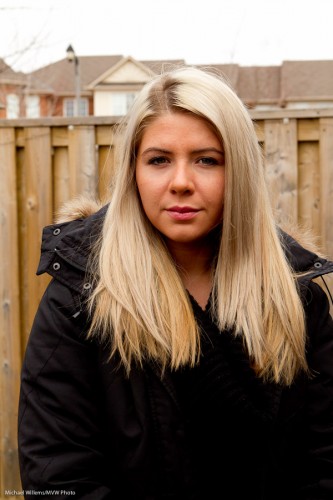
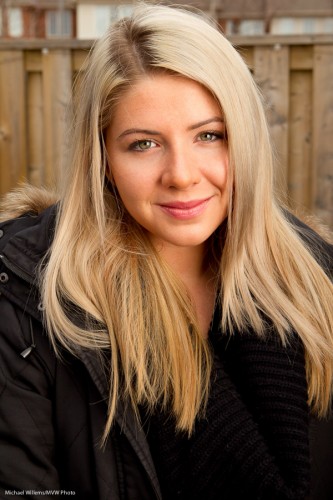
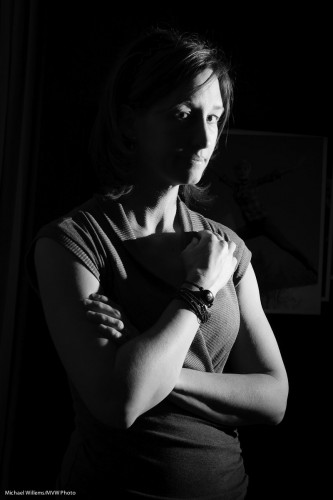
Here’s student Brittney, in a Seneca College workshop I did the other night:

Again: simple light: one off camera flash.

  • From yesterday’s post you will remember that I first thought about the background, then about the flash. In this case I set my camera (in manual exposure mode of course) to give me a very dark background. I wanted no ambient light.
  • And yes, you can use direct flash. I had a honl photo grid on a 430EX flash, driven by the camera’s 580EX.
  • The 580EX was disabled from contributing to the actual shot: all it did was fire commands.

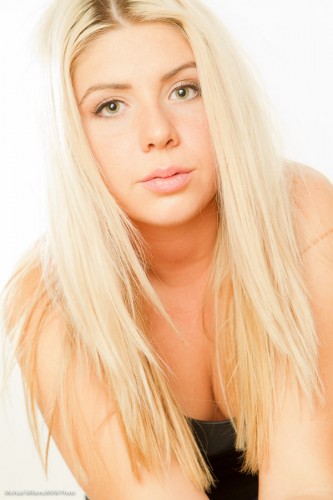
Another student – and here I added a background light too:
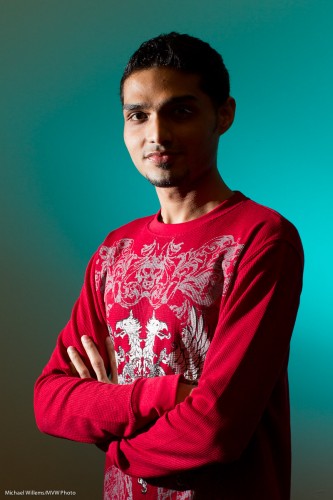
How did I do that?
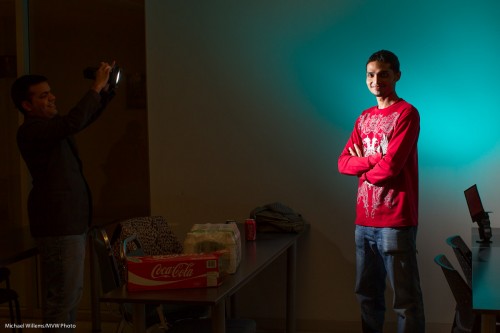
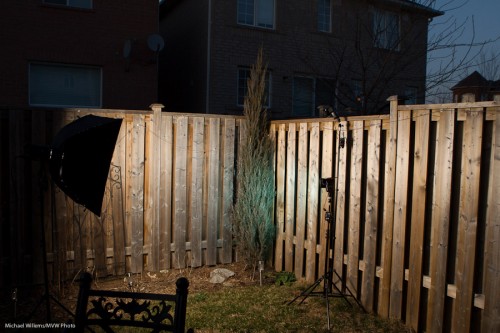
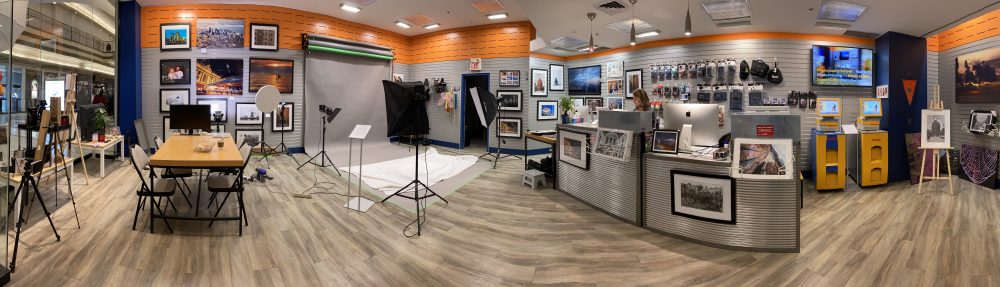
TIP: always do a “pull-back shot”, where you see your setup.

As you see, here I asked a student to hold the gridded main flash; then I used a second flash with a gel and, to prevent the color from hitting the subject or shining into my camera, a flag (a gobo – “go between objects” – the Honl bounce cards are also gobos/flags.


Who does the work?

First question I always ask myself when taking a flash picture is: “who does the work?”.

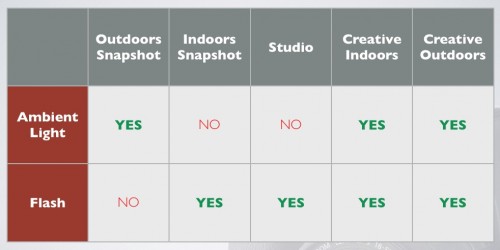
What I mean is: is the light in the image just from the flash? Or just from ambient? Or from both?

Clearly :

  • When it is just from flash, the ambient needs to be dark (so I set my exposure for that).
  • When it is mixed, I set the ambient so that is is the right level compared to the flash.
  • In a mixed environment, sometimes I want to turn ambient UP (as in a party indoors), and sometimes DOWN (as in a dramatic portrait).  The principle, however, is always the same: worry about what you need from ambient (from all-dark to bright), then worry about the flash.

And mixing is essential. This is how I look at most of my images:

WHICH LIGHT DOES THE WORK:

As you see, in most creative work, I like to mix the two light sources.

If you do not think of this, you will get unpredictable results.

So before hitting that flash, always ask first:

In this picture, do I want to mix light, and if so, what should the ambient light look like?


A simple chiaroscuro portrait or two

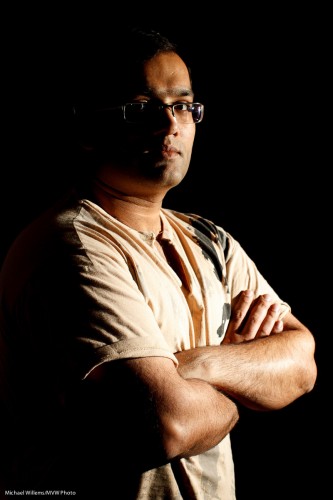
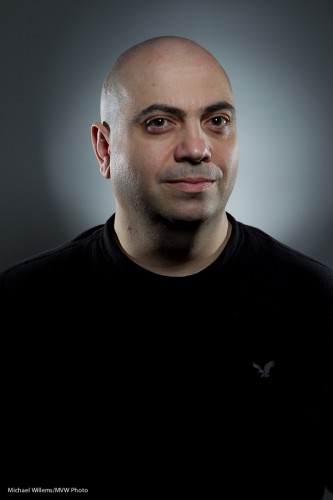
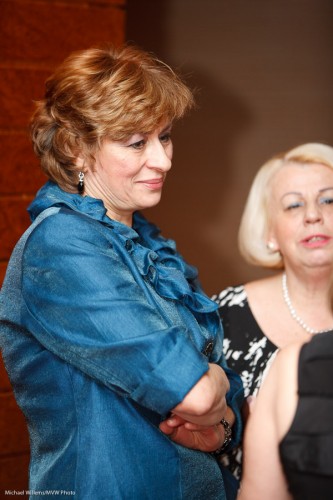
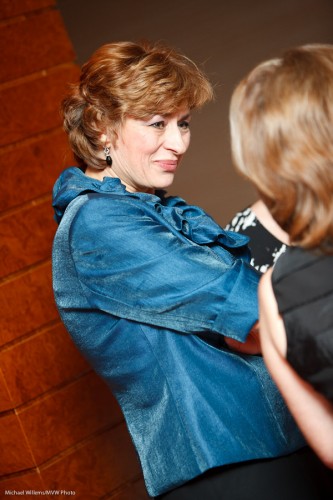
In the last few days I took two people’s portraits using just one off camera flash. Here’s Michelle and Adnan, respectively:

How did I take those?

First, I set the camera so that the ambient light looks dark. The room was not dark – it just looked dark to the camera, because I had set the camera up specifically to achieve that. 100 ISO, f/5.6, 1/200th second. You could use any combination of ISO-Apertyure-Shutter that gives the same brightness, but keep in mind:

  • High aperture or low ISOs mean the flash has to work harder, and it may not have enough light
  • The shutter speed cannot achieve 1/200th second; your camera’s fl;ash sync speed.

Then I added the flash. I used an off-camera speedlight on our right. I could have used TTL remote control or pocketwizards: I used TTL in Michelle’s portrait and Pocketwizards in Adnan’s. Light is light! Note that I put a Honlphoto Grid on the fl;ash, else the light would have lit up the background too. The flash (fitted with the grid) was aimed directly at the subject. To get the right exposure, I metered the Pocketwizard-driven flash, and I “flash exposure compensated” the TTL-driven flash.

Then I positioned the subject properly. I wanted the light to hit them just about from their front, with their face turned to get short lighting. I also wanted to see both eyes, even if one is only just visible.

And that was all. A one minute portrait, and a pretty cool one, no?


What’s in YOUR bag?

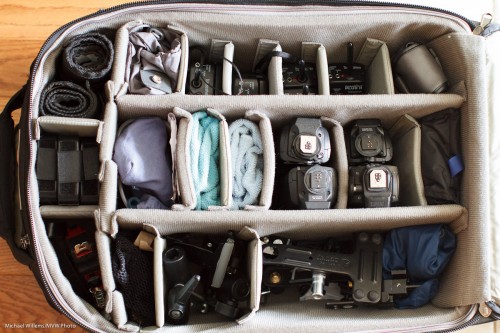
My flash/lighting bag as it is today:

It contains, from top left:

  • Two rolls of Honl Photo gels
  • Flashzebra Cables to connect Pocketwizards to speedlights
  • Six pocketwizards
  • Light meter (and spare battery)
  • Three Honl Photo grids (2×1/4″ and 1×1/8″)
  • Cables and a Fong thing
  • Speedlite feet and a microfibre cloth
  • Trays for Pocketwizards, and a microfibre cloth
  • Four speedlights
  • Rain pouch
  • Knife, tape, tape measure
  • Three Ball heads
  • Flash/umbrella attachments for light stands
  • Grips, cables, “thingies”.

In addition to this I carry another speedlight, more Honl modifiers including the large and small Traveller softbox, a tripod, a bag of light stands and umbrellas, and up to four large lights (Bowens) with a softbox.

Pretty large kit but then, I need to light some pretty unexpected situations, and with this kit I know I can.


Light.. action!

I shot a few shots of Kelly, the hair stylist for a shoot the other night.

Here she is:

Nice. So how did I light that?

Here’s how.

I used my 1D Mk4 camera in manual mode, equipped with a Pocketwizard to drive the following flashes:

  • A 400 Ws Bowens light with a Bowens softbox. Powered by a battery (the Travel Kit); driven by a Pocketwizard.
  • A 430EX flash with a Honl Photo 1/4″ grid and a Honl Photo gel (green in the pullback shot above; egg yolk yellow in the real shot) to light up the background. This was also fired by a Pocketwizard, connected via a Flashzebra cable.

The other flash was a spare and I did not use it. I set y exposure for a dark background, then metered the flashes with a light meter. I used the speedlight to light up the background to provide hair separation, since I could not get it in the back aiming forward to light the hair, which I would otherwise have done.

A fairly simple setup for a nice shot, no?


Four flashes with David Honl

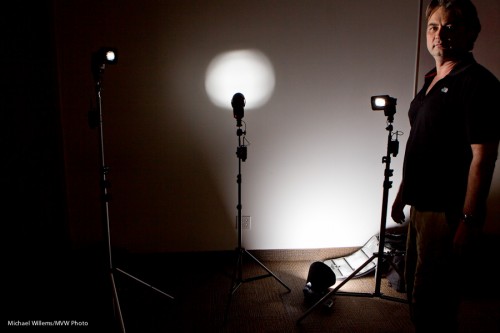
Last year, when I taught my flash workshop in Toronto I was joined by David Honl, of the excellent range of Honl modifiers I use. We set up a shot like this:

  • Background light with a short snoot;
  • Two gridded side lights (1/4″ grids) aimed forward from slightly behind;
  • One light on camera with a Traveller 8 softbox
  • All fired with Pocketwizards.

That looks like this (with Dave on the right):

And the resulting shot is this:

Now you know how those shots are done!


Advanced on-camera flash technique

I usually advocate not doing this:

But this instead:

Flash backward, because you want the light to come from 45 degrees above your subject. That’s usually the way, since we usually use wider lenses for people shots, meaning we are close.

However, when you are using a long lens, like a 70-200, then to get to that same 45 degree point, you may have to aim the flash forward 45 degrees.

The problem with this is that with any flash angle that is even slightly forward, some light goes forward, straight from that flash to your subject. So you get this, horrible shadow:

The solution: Flash forward, but use a gobo/card, or even your hand, to shield the inch or two straight in front of your flash. So now the light can still go up to the ceiling, but it can no longer go directly forward to the subject. You could even use a grid but that eats a little more light.

You now get this:

I used my hand here, holding it an inch or two in front of the flash to block the path straight to the subject. Result, a well lit shot!


Lighting

Here’s why you use proper lighting – with flash used for many outdoor shot too.

Say I shoot talented new model Anastasia outdoors using available light:

That is well exposed – but poorly lit. Even on an overcast day, there are shadows; no catch lights: not a great shot.

So now I do it again, with a big flash (a Bowens 400 Ws) with a softbox. I set the flash manually, using a light meter, as follows:

  1. First I meter, using the ambient light meter, for ambient light. I read, say, 1/100th second at f/8 at 100 ISO.
  2. I want the background to be darker than what I will light (remember Willem’s Dictum: “Bright Pixels Are Sharp Pixels”), so I actually set exposure to 1/250th second (still at f/8 at 100 ISO).
  3. I now switch the meter to flash meter mode. I set it to 100 ISO and 1/250th, and fire a test flash while holding the meter in the exact place the model will be. I adjust the flash level until the meter reads f/8.

That gives me this:

I think you will probably agree that this is a much better shot. And the procedure is simple. On an overcast day you can use speedlights too, if you prefer.


Reflect on this

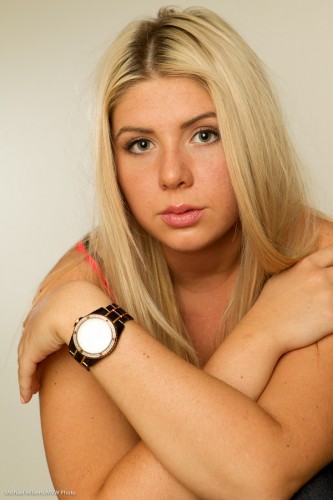
When you use TTL flash (automatically metered flash), you can get great images – I use TTL all the time. Like in this image of Anastasia:

But sometimes, oooh, it goes wrong and the image goes too dark. Like here:

What happened?

I’ll tell you what.  Your camera’s evaluative/3D Color Matrix metering tries to expose well, and to avoid over-exposed areas.

And that watch is reflecting the flash. So it would be over-exposed. So the camera tells the flash to fire at lower power- to avoid that. Hence, the rest of the image is underexposed.

Simple, once you know: in TTL flash images, avoid reflective surfaces like the watch!