What makes a shot?

What makes a shot? New photographers think “technique” – and that is understandable, since the weakest points are where you concentrate first.

But in the end, it is much more than technique.

As an illustration of some of the factors, take a shot like this, from that recent “autumn” magazine shoot in Oakville:
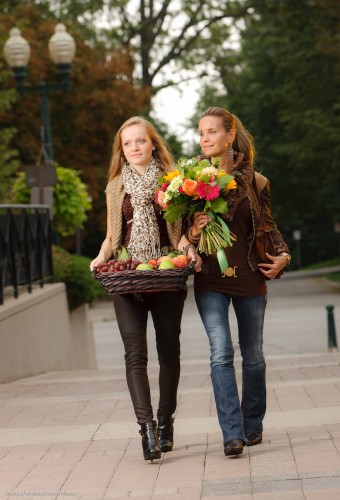
Vanessa and melony showing fashion (Photo: Michael Willems)

What had to happen for this shot?

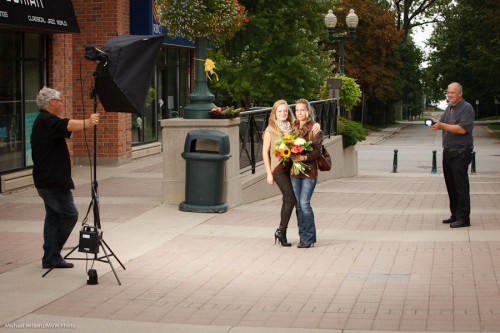
  1. Technique, of course. I described this in my post of 5 September. Two lights, and a gel on the light on our right (that autumn feeling!), and a long lens (70-200).
  2. People. Two models (thanks, Vanessa and Mel), an assistant (thanks Kurt), client for direction, and myself. Five people. And they all have to show up.
  3. The models. Modeling is a profession, and not everyone can do it equally well. Models have to look good, be the right types for the shoot, carry themselves well, and even have a good day. I am sure even supermodels have off-days, so it is something to keep in mind: you are shooting people.
  4. Clothing. The clothing here was from a great Oakville store – instant makeover. Without that, nothing.
  5. Props. The theme was “autumn”. So flowers and fruit personalized that very well – as well as introducing wonderful colour. Props are often forgotten but they can make (or break) a shot.
  6. Weather. Since I am using strobes and speedlights, I can do this in pretty much any light – but I still don’t want too much rain, and I do not want direct sunlight on the models if I can help it, and I sure don’t want sunlight into the models’ eyes-  they would squint.
  7. Location. I chose this location because it had many options, and settled quickly on this particular option – shows a “boulevard” type walk, shows trees, even shows autumn trees even though this was still summer. And those wonderful European-looking street lights.
  8. Moment. In this shoot, half the shots (40 out of 85) shots were unusable due to one or both  of the two models blinking. With two models, on a bright day, that happens! And some were not in sharp focus (6 out of 85) or were awkward moments.

Get all of the above working, and you get nice shots. It’s not just technique: subject and moment are important!
 

Flash restraints

When working out a photographic scenario, it is often useful to think in terms of restraints – i.e. “what to watch out for”. That can help you handle tough situations.

When using flash, especially in mixed light (e.g.outdoors) the following are the major restraints to watch for:

  1. Flash synch speed. When using flash, your camera cannot exceed the speed beyond which the shutter no longer fully opens. This is around 1/250th second on most SLRs. (Tip: open the aperture on your camera all the way at 1600 ISO and point at the sky. Check shutter speed. Now turn on the flash, and see what the shutter speed is now reduced to – that is your flash sync speed).
  2. Flash range. Your flash range gets smaller the more you close the camera’s aperture. The guide number divided by the aperture tells you the full power range. (Tip: the flash may display it on the back – most modern flashes do, when the head is pointed straight forward.)
  3. Usable Aperture Range. On the one hand, you want a small aperture number (a large aperture, say f/2.8) for blurred backgrounds – but that may be difficult due to constraint (1) above.  On the other hand, you may need a large aperture number (a small aperture, say f/11) to make backgrounds darker, but that may be difficult due to constraint (2)

Geez, life is full of impossibilities, isn’t it!

But if you keep those constraints in mind at all times, you will know when you are about to run into trouble – conversely, staying clear of those constraints guarantees trouble-free shooting. Like in this recent shoot:


A reminder: ISO start points.

You can use “auto ISO” if you like – but never in a studio or when using manual lights.

Otherwise, if you like, you can use it, since other than in terms of grain, ISO does not affect the essence of your image. (That to me is the measure of what you should do manually: anything that affects the look of your image.)

When you use manual ISO, here’s some simple starting points that will help you get off on the right foot:

  • Outdoors, or when using tripod: 200 ISO
  • Indoors, even when using flash: 400
  • “Difficult light”, or sports: 800
  • But.. go as high as you need to get acceptable shutter speed!

Those starting points are just that – but they will start you off not far from where you need to be.

ISO: raise it when your pictures get motion blurred. Lower it when you need great quality and have light or a tripod.


Dealing with motion

Dealing with motion can be complicated becuase it involves multiple aspects of photography:

  • Are we talking about your motion , or the subject’s motion?
  • Do you want to show motion, or freeze motion?
  • How do you Focus?

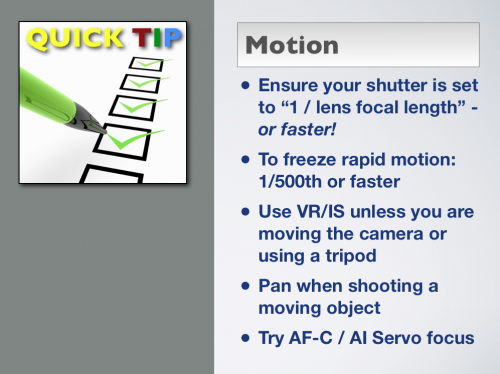
So here, in my usual quick tips format, are a few tips that may help:

These are simple pointers to good camera technique:

  • To avoid motion blur, ensure your shutter is set to “1 / lens focal length” – or faster! I.e. if using an 18mm lens. at least (roughly) 1/18th of a second; when using a 100 mm lens at least 1/100th of a second; and so on. Preferably twice as fast or better!
  • To freeze rapid motion, like a race car: 1/500th, or preferably faster, like 1/1000th.
  • Use VR/IS stabilization, it rocks – unless you are moving the camera or are using a tripod.
  • On that subject: tripods are cool – use one whenever you can.
  • Pan (follow the subject while pressing the shutter) when shooting a moving object.
  • Try AF-C / AI Servo focus if your subject’s distance from you varies (it is coming to you, or moving away from you).

Use of these techniques maximizes the chances of an image that uses, or freezes, motion the way you want it.


Unproductive Questions

One reason to learn in a formal setting is that it helps you ask the right questions.

“But surely, Michael”, you say, “there are no bad questions?”

True enough – but there are many questions that waste your time if you try to really answer them; that should not be pursued, but rather should be answered with “don’t do that”, or “do it another way” or “that is unimportant”. In that sense, they are simply the wrong questions.

I get many of those questions as a teacher, and of course students in a class will hear and understand the explanation and move on.  But if you take no classroom training you will spend much energy on those “wrong questions”.

I mean questions like:

  • I don’t like changing lenses, so which all-purpose lens can do all my photography? (Understandable, but wrong question. If one lens could do it all, I would own that lens. Except it would weigh 10lb and cost $5,000 and distort around the edges).
  • How can I take the same sports pictures you do, but with my kit lens? (Ditto. you simply cannot).
  • How do I best use my pop-up flash? (Not. Use an external flash: it is more powerful and you can direct its light elsewhere, and in any case it is farther from the lens).
  • What happens when I press exposure compensation while at the same time pressing exposure lock and the shutter? (Who knows! This is the kind of question that just wastes energy. Yours.)
  • How do I best mount two filters on top of each other: polarizer on top or polarizer on the bottom? (You don’t. Only one filter at a time).
  • How do I avoid flare without going through the effort of getting a lens hood? (Not very well. Use a lens hood.)
  • What is the highest zoom I can get? (Before answering, I would need to hear much more on why this is important to you.)
  • What lens/camera/flash should I buy? (That is an understandable question, but you should not expect a real answer, since only you can make that decision – after you understand the criteria for choosing!)

…the list goes on ad infinitum. Many of these are “wishful thinking” questions. Some are not. They are all questions that are easily answered, or at least countered, by a teacher-  but when you ask them without that formal training, you will waste half your energy (I bet you can find a dozen sites on the Internet that try to answer those unproductive questions.)

I have an interest in saying this, of course – I coach privately, I teach at the School of Imaging and at Sheridan College – but that’s not why I am stressing the point. I would not do this daily blog if it was. Instead, I am prompted by a closed Facebook group where thousands of pros and would-be pros converge and talk, and it amazes me that quite a few of the would-be pros proudly say “I don’t go for formal training”. That is a shame – because training, rather than giving you all the answers, helps you ask the right questions, and in doing that, saves you lots and lots of time.


Histogram Hints

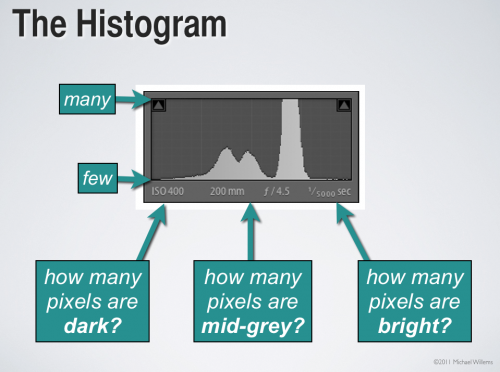
What is the graph you see on the back of your camera when you press the “DISP”, “INFO”, or “up” or “down” buttons on the back of your camera?

It is called the Histogram. It should really be called the “Exposure Histogram”.

It tells you about your exposure in much more detail than a light meter does. In a way, it is like 256 little light meters in one.

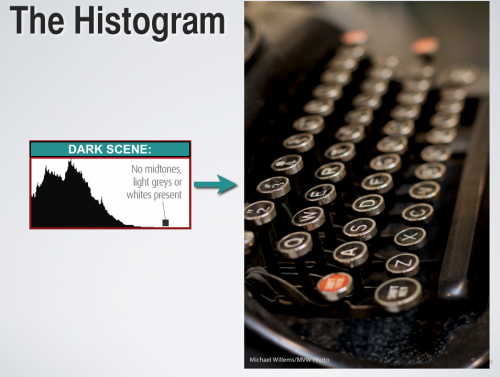
A histogram of a correctly exposed dark image would look like this (unless you are shooting RAW and “exposing to the right”, which is a good technique – but more about that again some other day):

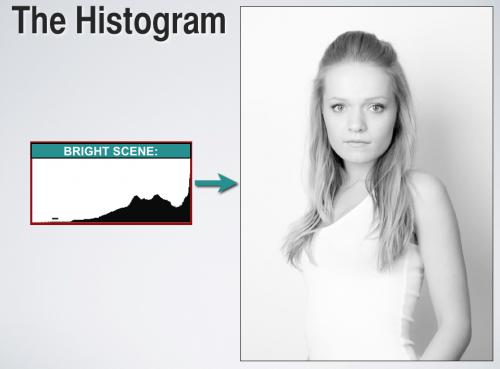
And a histogram of a correctly exposed overwhelmingly bright image might look like this instead:

The words “correctly exposed” are key. If you expose either of the images above incorrectly, you would see a different histogram than the ones above. And that is the power of the histogram: it helps you expose correctly.

Try it now: go shoot a black bag or coat or wall. Fill the entire viewfinder with that bag or coat. Now check the image – and the histogram. Then do it again, using exposure compensation to get a correct histogram.


Exposure lock

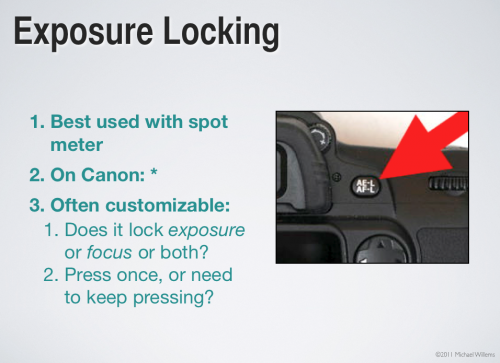
Beginners may wonder what the AE-L/AF-L or the “*” button on their camera is for.

Here’s what. It’s called “exposure lock”.

It allows you to do the following:

  1. Aim at something you want to expose well (a mid0greay object, ideally);
  2. Press the lock button;
  3. While still holding it down, now recompose (i.e. aim the camera at another area);
  4. The focus and click.

That way you get a picture that is focused on what you set as the final composition, but its exposure is based on where you were aiming earlier, when you pressed the lock button.

You might use this if shooting a person against a very white or dark wll. Aim at the person, lock, now aim back at the rest of the scene, now takethe image The exposure will be based on the person, not on the wall.

Two things you need to be sure to do for this to work:

  1. Set your meter to spot metering.
  2. While locking, be sure to aim at an object that is not very dark nor very light – an “18% grey” object, like a Grey Card or like Uncle Fred’s grey suit.

Do this and all your images will be exposed great.

So why do we not use this all the time? Simply because it takes time.


Close and fuzzy

A repeat post(*) about a beginners tip we all forget sometimes: there are several things that all contribute to the blurred backgrounds we all love (“narrow depth of field”). And they are….

  1. Selecting a larger aperture (a lower f-number)
  2. Zooming in (using a telephoto lens, not a wide angle lens)
  3. Getting closer

ALL those work. So why forget numbers 2 and 3? If you do not have an f/1.4 lens use an f/5.6 lens but get close!

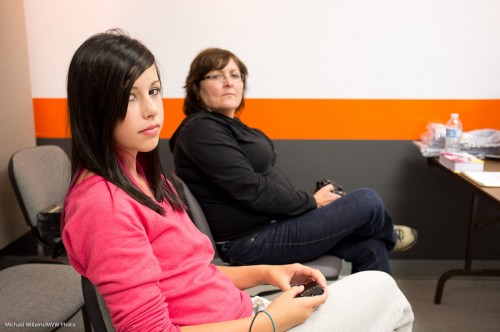
Here’s me demonstrating this point to two students the other night:

Some blurring of the lady in the background – but not a lot (that was f/2.8 on a point-and-shoot Fuji X100 camera- which gives a depth of field equivalent to around f/4.0 on a full frame camera).

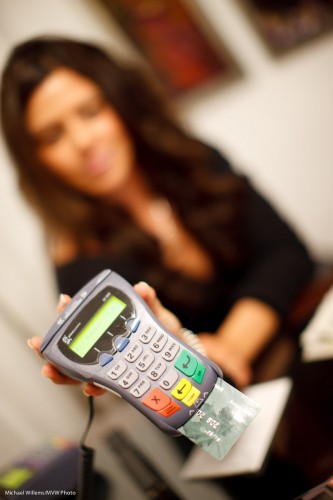
Now, same settings exactly, but let’s get close:

Hey presto – dramatic blurring of the lady in the background. It can be as simple as that.


(*) a repeat post on this subject – why? Simple: you learn by repetition. Also, of course not everyone has read all prior posts. Finally, you’ll see a slight difference in how I explain things, when I explain them several times, and that is a useful difference, designed to help you learn.


Sunny Sixteen

Why do you need to be able to operate a camera manually? Because it gives you an idea of what values might fit a situation. The same way you need to know arithmetic even if we have calculators.

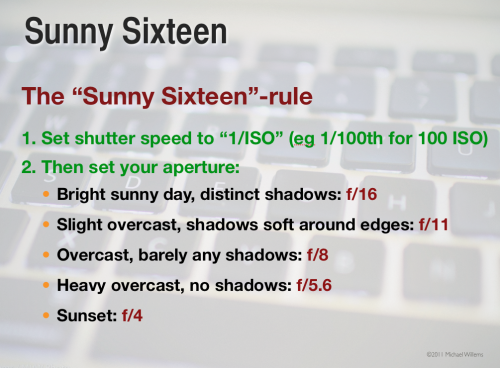
So here’s a rule all photographers need to know. A rule of thumb – that’s all it is of course – but a useful one. Namely, the “sunny sixteen rule” for exposures at mid-day:

Selecting these values will give you a “good standard exposure”. Of course you adjust when it is not mid-day, or you are a very high latitudes, and so on.

If you do not yet know it, learn this “rule” today. It’s great to be able to shoot without a light meter sometimes.


Nifty.

The 50mm lens continues to be a favourite, but not always for the same reason.

There are in fact four reasons people often say they like a 50mm lens:

  1. On a full frame camera, it has the width of view that our eyes see sharply. This gives it a natural look: no compressed perspective (telephoto lens), and no expanded perspective (wide angle lens).
  2. Or – on a crop camera, it is a 75/80mm lens, which makes it a great portrait lens.
  3. And most 50mm lenses are fast. Meaning a low “f-number”, meaning a wide aperture, meaning selective depth of field.
  4. And finally, that also gives you a nice fast shutter speed in low light without having to go to very high ISO values.

Those last two points are illustrated by this picture, 50mm at f/1.2:

Reem, by Michael Willems

Pay here!