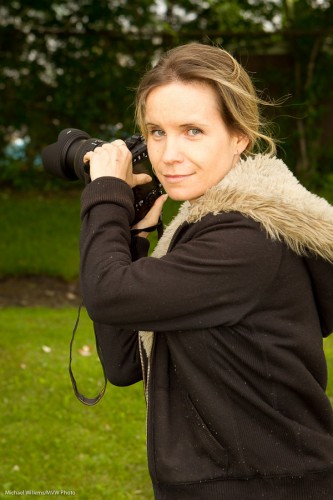
Beginners’ rules of thumb: Exposure

When shooting in auto modes (P, A/Av, S/Tv etc), you will need to adjust exposure often. How? Quick rules of thumb for you today.

What to adjust. If the non-flashed part of your pic (what’s lit by available light) is too light or too dark, use exposure compensation (the plus/minus symbol). If the flashed part of your picture (what’s mainly lit by your flash)  is too light or too dark, use flash exposure compensation (the plus/minus symbol with a lightning symbol next to it, or adjustable via the menu).

How to adjust. If what you see is too dark, use plus. If what you see is too light, use minus.

How to predict. When shooting a very dark subject or scene (coal mine), you will need minus. When shooting a very light subject or scene (snow scene), you will need plus.


CQ CQ CQ

Yes, I have hobbies, too. Like this:

Michael Willems VA3MVW (Photo: Michael Willems)

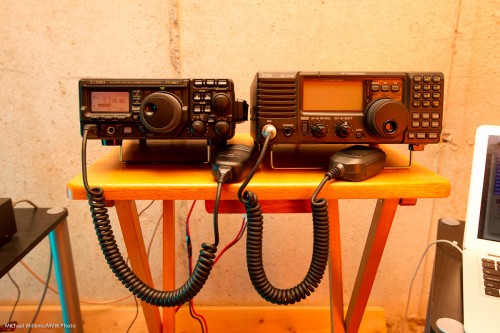
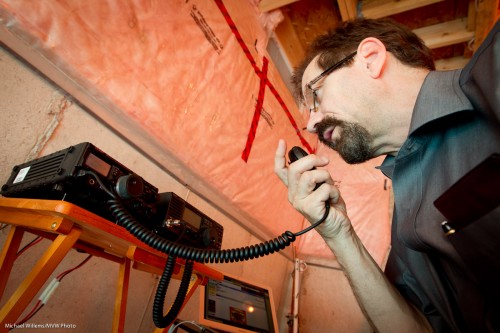
Yup, I am a licensed radio amateur, VA3MVW. That’s me a little while ago this evening, on a QSO (a call) with another amateur or two elsewhere in the world.

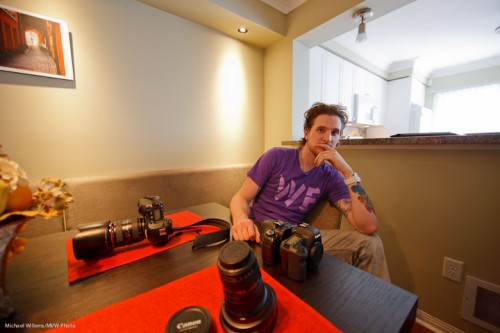
I used a wide angle lens (see yesterday’s post), and I lit this self-portrait with a flash. Bounced, using TTL. Wide angle to get those wonderful diagonals. I was holding the camera in my other hand, and had the camera select a focus point – I seldom do that but in this case it makes sense, since no-one is looking through the camera.

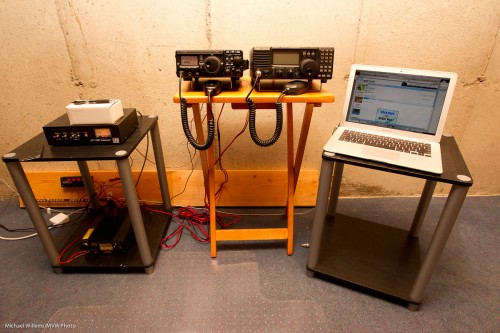
But I did not use just one flash. That would give me this:

Station VA3MVW (Photo: Michael Willems)

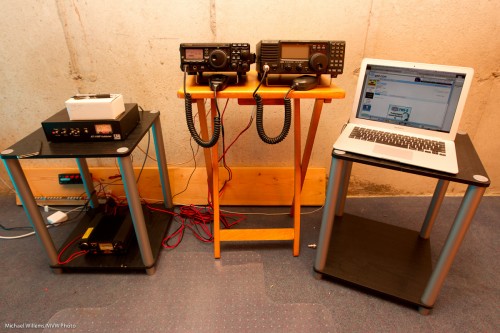
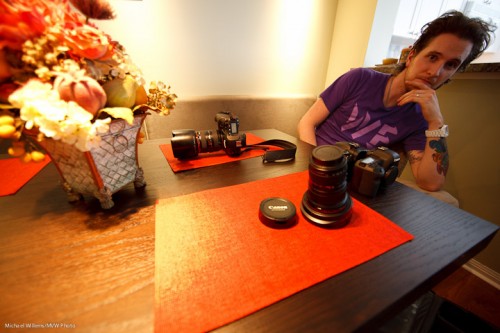
Nothing wrong with that. But I wanted to give the picture more dimension, more modelling, more of a live feel. Like this – compare the tables’ legs:

Station VA3MVW (Photo: Michael Willems)

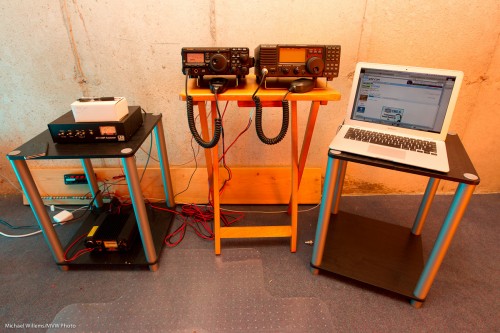
Or even more:

Station VA3MVW (Photo: Michael Willems)

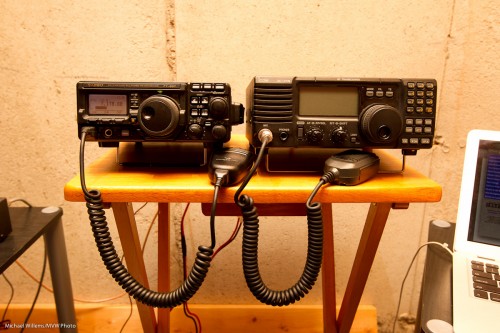
I used a 580EX flash on the camera, bounced behind me, and two off-camera  430EX flashes, each equipped with a Honl Gel (one greenish and one yellowish – some of the artistic colours I really like) attached to a Honl Photo speed strap.

I often add a splash of colour. Instead of this:

I happen to like this:

Now look again at the image on the top, and you will see the same orange-like colour (left) and blue-like colour (right) – subtle but it is there.

A little colour adds a lot, methinks. And with small speedlights, a little knowledge, and simple flash modifiers, this takes mere seconds to shoot.


Open wide

My friend Peter McKinnon, of himynameispeter.com, visited me tonight.

Peter is a very talented international photographer (and magician, as it happens: a skill that comes in handy during some of the wedding he shoots, I bet).

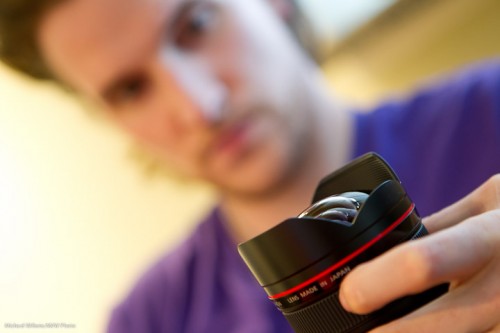
Peter and I share a love of wide angle lenses. Like the 14mm f/2.8 lens he shoots with – a lens that is on my wish list. Look at Peter here, holding that lens – all that glorious glass:

Peter shoots with this lens very often, even where others would shy from a wide lens – and I do not blame him: it is wonderful, rectilinear, and very, very sharp (especially when stopped down).

So – something to explain. Why do I say “some would shy away”?

Because some people think wide angle lenses distort.

So do they? Depends.

  • If you mean “make straight lines into curves” – a good lens is rectilinear. Meaning straight lines remain straight. So in that sense: no distortion.
  • Very wide lenses are, however, not entirely sharp at the very edge – in that sense, yes, some distortion, if you will.
  • What they do do is show perspective from the point of view. And if I get close to something, the scene will look dramatic in the corners and at the edges This is not, strictly speaking, distortion. It is showing me basic geometry. If I am one inch away from your nose, your nose will look extra big – that is not distortion, it is reality.

Regardless, for the last two reasons above you should avoid putting important objects at edges and in corners:

But provided you avoid that, a wide lens will work great:

That sense of space, of the subject being surrounded by his environment, is typical of extra wide angle lenses.

Another note. Prime lenses enforce discipline. Instead of zooming, you must move or turn.

And you have to get close. When people are reluctant to use wide lenses, it is because they are reluctant to get close to people. A wide lens forces you to get close – which is a good thing. Photographers need to interact with their subjects.

So I encourage you to go wide. Meaning as wide as 8-20 on a crop camera (equivalent to 14-35mm on a full-frame camera) – that sort of range.

And have fun!


Keepin’ it fresh

During a recent event shoot, which I greatly enjoyed doing, I thought a little about how to stay fresh.

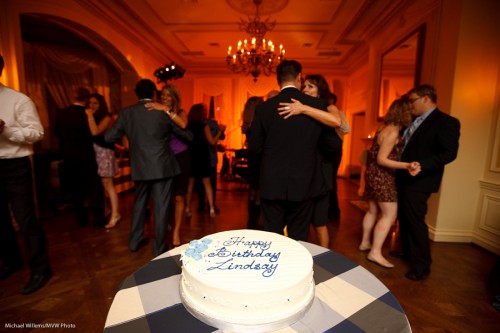
Event shoots do not naturally lend themselves to setting up creative lighting. But you can still do things like this:

How? Using a wide angle lens, close to the cake.

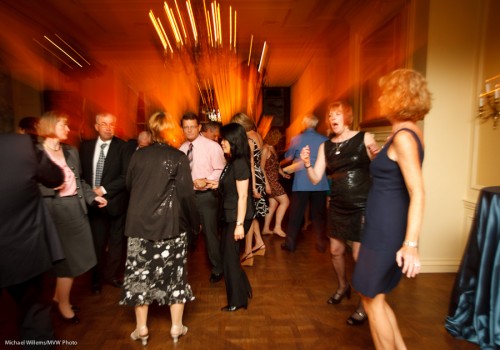
Or like this:

How? By setting shutter speed to 1/15th second, and zooming while shooting.

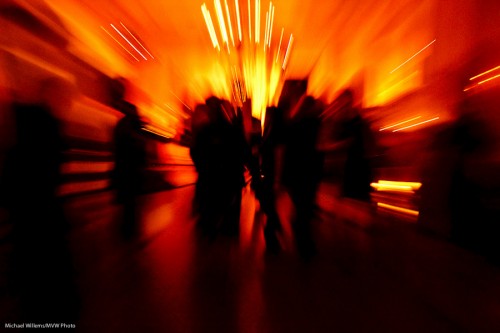
Or even this:

How? Essentially like before, but without flash.

The point: when you are shooting a routine thing, try to step outside the box a little. I do this by thinking “what would I normally do”, and then varying lens, aperture, shutter, composition, and so on, and just seeing what happens.

That way your shoot is more fun, and you might stumble upon new ideas or develop new techniques.


Practice makes perfect.

In photography, like in so many other endeavours, practice makes perfect.

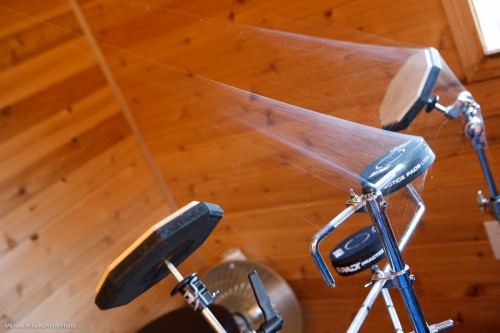
Just like in, say, drumming.

Don’t worry, the owner of those drums (you know who you are, Dan) is a very talented professional drummer who in fact practices several hours every single day. Just not on those practice pads.

He practices with his drums, just as I hope you do with your camera.  Whether you are a pro or a beginner, you need to practice.

As a beginner, you do this to make the theory, which you kind of understand after a good course, into something you feel. “Make it into your DNA”, we say. And we mean this – things like the aperture-shutter-ISO triangle should come to you naturally. And practice makes that happen. Shoot in manual mode all day tomorrow, then shoot in aperture mode all day the next day, and shoot in shutter priority mode the day after that.  That’s how you learn.  That is also why the photo walks I do are so good.

As a pro, you practice for different reasons:

  • In order to remember things. After you have not done something for a while, you forget how you did it last – even as a pro.
  • To keep up your muscular memory. Knowing things by feel is a valuable skill. I tend to work like that – hand me a camera and I do stuff without even thinking about how. Practice is key.
  • To ensure all your gear is working properly, batteries are charged, etc.
  • To see if you can do it differently; i.e. to develop new techniques and thus to stay fresh.

So whoever you are: if you have not touched your camera today, go take some pictures of your home today, or of your place of work. If  you are a beginner, go take some pictures in manual mode. If you are learning flash, then go take some pictures indoors by bright windows, using a flash to fill. You will have fun, learn new techniques, and strengthen existing skills.


Sports portrait tips

I shot baseball kids yesterday.

When I do this, I see a lot of parents photograph their own kids, and with some exceptions, most get, well, basically, um, everything wrong. Sufficient reason for me to write this post with tips.

I want to get pictures like this – photogapher Mel standing in for a softball kid (see how she is swinging the camera like a bat)  while I get my settings and light right:

And you might do this as follows.

  • Position the subject in indirect light.
  • Find a background with vegetation – green, in other words, if at all possible.
  • Use an SLR camera with longer lens – in the range of, say, 50-100mm.
  • Use a flash on the camera, without modifier.
  • Shoot at person level, with the camera parallel with the horizon- avoid shooting up or down much.
  • Focus on the eyes – the closest eye.
  • Leave sufficient margin for later cropping to various aspect ratios
  • Ensure the kid looks good: shirt tucked in, no watch, hat on but slightly up so you can see the eyes!

My camera settings starting point:

  • Shutter speed priority, 1/200th second, at 200 ISO.
  • Exposure compensation -1 stop (on Canon. On Nikon, you may not need any, or even slightly +).
  • Flash on, aimed straight at the subject.
  • White balance set to “flash”.
  • Flash compensation 0 stops (on Canon. On Nikon, you may well need compensation, perhaps -1 stop).

Now I aim for an aperture of f/5.6. If I do not get close to that, I change ISO or shutter speed (the latter must stay within the camera’s flash sync range, i.e. usually 1/200 or 1/250th second). Watch this regularly!

I shoot TTL in these shoots, so when the player wears white, I need to increase flash compensation. When a player wears black, I need to decrease it.

These techniques will get you started. Of course you can, and perhaps should, consider hiring a pro!


Lens reminder

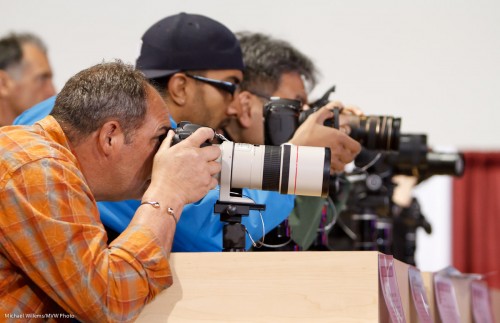
Choose your lenses wisely, like these people at the recent Imaging Show, where I spoke about lenses through the three days:

Your camera is just a box. The lens makes it into a great tool. So, be prepared to spend on your lens; and look at properties like:

  • Aperture – the lower the f-number, the better
  • Sealing against dust and moisture
  • Distortion: the lower the better, of course
  • Sharpness (both wide open and at, say, f/8)
  • Mechanical construction
  • Image Stabilization
  • Chromatic aberration
  • Resistance to flare
  • Focus system speed and noise – and accuracy
  • Consistency

These properties, and more, determine the quality, and cost, of your lens. And high cost is OK because the lens determines the shot – and a lens lasts decades, both in terms of usage and of value.

Now I am off to go shoot softball kid portraits!


Architectural

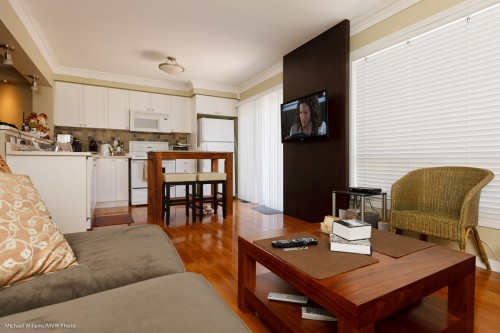
My living room prompts me to write a couple of words about indoors architectural photography:

Amberglen Court, Photo Michael Willems

To take architecture:

  1. Use a wide angle lens – 10-30mm on a crop SLR camera. That gets the rooms in.
  2. Not too wide though. If you shoot everything at 10mm, rooms will look huge, and people who see the home in real life will be disappointed. Underpromise and overdeliver is a good strategy.
  3. Focus a third of the way in – but when depth of field is not sufficient to get it all in, keep close objects sharp.
  4. Consider shooting from a lower vantage point. This makes rooms look bigger without exaggerating.
  5. Use bounced flash, if you use flash.
  6. Balance outside light with flash. Set aperture and shutter for outside, then fill rooms with flash.
  7. If that means slow shutter speeds, use a tripod.
  8. Keep the strongest verticals vertical.
  9. Compose to avoid clutter.
  10. Capture the feeling of the room.

Simple, really: these basic rules will make your architecture photos better. If you are bored today, and want a photo assignment: shoot your home indoors.


More business talk

All photographers, as I pointed out recently, should know about copyright. As reader Warren said recently in a comment on this blog:

“When a photographer shoots pictures for themselves, they own the copyright and they are the Author.[ ] If the photographer then uploads these pictures to someone else’s web site, the photographer may fall victim to the terms of use of that site and they may lose some rights. Read the terms of use!”

Very true. And potentially scary. Read what Facebook says:

“For content that is covered by intellectual property rights, like photos and videos (“IP content”), you specifically give us the following permission, subject to your privacy and application settings: you grant us a non-exclusive, transferable, sub-licensable, royalty-free, worldwide license to use any IP content that you post on or in connection with Facebook (“IP License”). This IP License ends when you delete your IP content or your account unless your content has been shared with others, and they have not deleted it.”

Ouch. Transferable? Sub-licensable? And to boot, Royalty-free? And “…on or in connection with Facebook” (my emphasis)? Geez. This post better not have a picture in it, or Facebook can use it or even resell it.

Thank God Facebook itself only allows (so far) uploads up to 720 pixels wide. Otherwise they could take my work and use it in an international ad campaign for Coca-Cola, say, for free. And this of course is why I embed my name, small but visible, in each picture I upload in Facebook.

Other sites can be as Draconian – or more so. Apple? No idea, since I have never actually read the 41-page “agreement” that you have to read and “agree to” before you can do anything (like upgrade iTunes). I am sure no-one has (lawyers excepted: they like that kind of thing).

BBC news, and other news outlets, use “user content” nowadays. That is content they do not pay for. Users are happy to work for free, and that means reporters no longer get paid, Fine, you may say – except the level and trustworthiness of the work goes way down.

So be careful with copyright. Make sure you have an explicit written agreement when shooting for someone: an agreement that gives you copyright (or that pays you very well, if you a “shooter for money” and do not end up with copyright). Photography is fun, but the equipment is not free. The time spent learning is not free, and time cannot be reclaimed. Your photos are valuable – copyright protects that value.

Working for free never works for a valuable skill that is hard to learn and expensive to use, and unless you are careful, without good agreements that is exactly what you will end up doing. My advice today: be careful where you upload photos.
 

Graduation season

It’s graduation season. Right? So many parents are out to shoot their kids’ ceremony. High School, Grade School, Music School, University: important moments in a life; milestones that really deserve to be photographed. And understandably, you ask “how”.

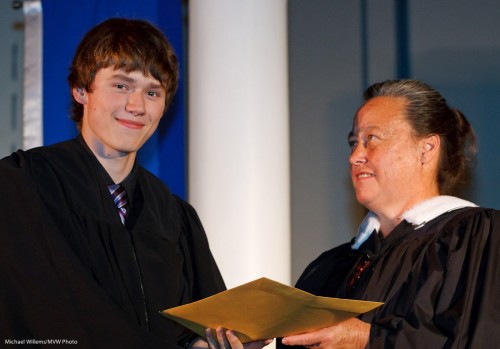
A High School Grad

A High School Grad

So in that context, here’s a few tips.

You want pictures of graduation ceremonies. Both the “handing out of the diploma” and the crowd going wild. Make it into a permanent memory. Shoot context, too. Challenges: The light is likely to be somewhat low.  Your position may not be great.

Solutions: Use high ISO, a “fast” lens, and shoot lots. Be sure to get the “required” shots – like the one where your graduate is being handed his or her diploma.

Equipment:

  • SLR
  • Long lens over 100mm) for diploma shots
  • Wide lens (24-35mm) for the  crowd shots
  • Use fast lenses (“Low f-number”)!
  • Bring a flash – you may or may not need to, and be able to, use it
  • Bring a Fong Lightsphere: bounceability may be bad, so if that is the case and the light is low, the Lightsphere may be a way out.
  • Consider bringing a monopod. Just in case!

Settings:

  • Mode: Manual
  • Shutter: usually 1/30th – 1/60th sec (see meter)
  • Aperture: f/2.8 or low as as possible
  • ISO: at least 400 (at f/2.8) or 800 (at f/4) or even 1,600 (at f/5.6)
  • Drive mode: Continuous, fast
  • Focus points: Centre focus point/area
  • Focus mode: One Shot/AF-S
  • Metering: Evaluative/3D Color Matrix, or spot

Situation tips:

  • Arrive early, to get a good seat.
  • Be ready for light changes (someone turns on or off the spot lights).
  • Practice on kids who are in the line before yours!
  • Find out if “getting up” and Flash are allowed, and act accordingly.
  • Shoot wide open (largest aperture), at the highest ISO you can stand. Use the centre focus point (it’s more sensitive in low light).
  • Try to catch the graduate on the way up to receive the diploma, and on the way out with it.
  • Tell your graduate to look at you after he/she is handed the diploma. They may forget – or they may not.
  • And especially, get “the money shot”, with the graduate shaking hands and being handed the diploma.
  • Then change to wide or normal lens to catch the crowd,or perhaps “caps in the air”.
  • Catch the exit line near the beginning – not near the end, where it degrades.

These tips should be enough to get you going. And don’t forget: enjoy these once-in a lifetime moments.