You can do a lot…

…in spite of conventional wisdom. Conventional wisdom has it that the Canon 7D is not the best for high ISO shots. And that you need twice the lens length, so 50mm on a crop camera needs 1/160th second..

So you could not possibly do a shot like this at

  • 3200 ISO
  • in available tungsten light
  • with a 50mm f/1.4 lens
  • set to f/2 at 1/40th sec0nd,
  • hand-held:

Cat, 3200 ISO, f/2, 1/40th sec, Canon 7D, 50mm

Yes you can. Hand held, slight noise reduction applied in Lightroom.

That wired effect

Here’s a picture I just took of my favourite patient model. I used some technique to get that dramatic “Wired” effect:

The way I made this picture:

Camera:

  • Camera: Canon 7D with 50mm f/1.4 lens
  • Set to Manual, 1/125th sec, f/8, 100 ISO

Flash:

  • Multi-flash TTL with one on-camera and two off-camera flashes.
  • One “A” Flash on the camera (580 EX) as fill flash and “commander”;
  • The main lighting was rim lighting: two 430 EX flashes either side of the model, slightly behind, set up as “B” flashes.
  • I was using a 1:8 A:B ratio.
  • The 430 flashes were each equipped with a Honl 1/4″ grid, to stop their light from hitting the entire room.
  • Flash compensation -1 stop to avoid overexposing the rims (this is common when your main flash lights only a small part of the picture).

Post:

  • And finally, I desaturated the colours in Lightroom: Presence +15, Vibrance -20 and Saturation -40. I also did a version where I desaturated only red and orange, and increased sharpness, which is the usual technique.

Try it yourself, or come to our two-day Light workshop 10+11 April to learn exactly how to do this.

Learning light

Here’s the workshop I taught last week in Phoenix, AZ, with David Honl, at Studio Moirae in Phoenix, AZ:
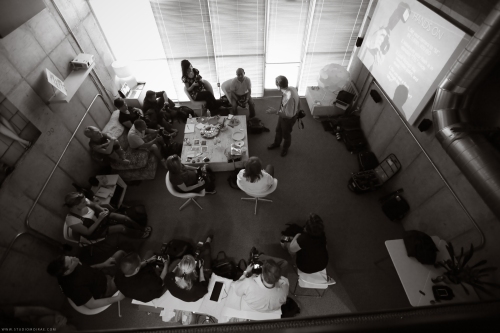
I like teaching small, intimate workshops like that, and Studio Moirae was a great environment for this.

So is my country home in 15 acres of Niagara Escarpment land in Mono, Ontario, an hour north of Toronto, where in a week’s time, Joseph Marranca and I are teaching a two-day all-in Weekend Workshop on Advanced Lighting: information here.

Good news: this too will be a small workshop, and there are still several spots available. This will be a very intense two-day workshop where participants will learn about lighting, including:

  • Available light
  • Available plus flash
  • Small speedlights
  • Studio strobes
  • Mixed light
  • One flash
  • Multiple flashes
  • Modifiers
  • Gels
  • Dramatic light
  • Action
  • High-Key and Low-Key

The emphasis is on doing, not just sitting and learning. A model will be provided to shoot.

The great benefit of these workshops is that they are two days of living, talking, breathing and doing photography. If you are interested and have an SLR and know how to use it, but want to learn contemporary pro lighting, this is your chance.  Go to the web page and sign up.
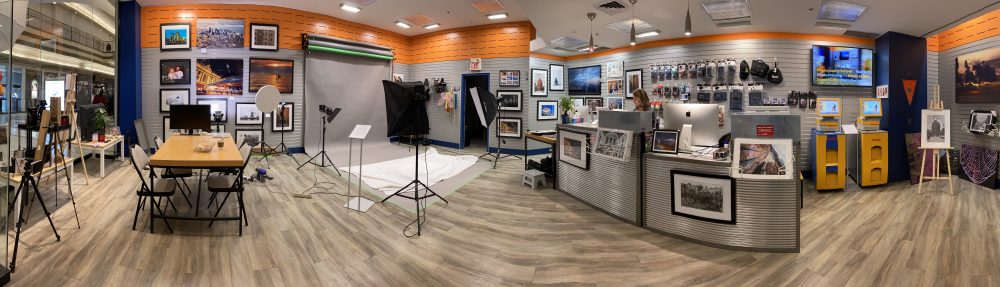
Best piece of advice about being a photographer?

A few months ago, NPAC (the News Photographers Association of Canada) featured me, here. An interview with some front pages like this:

Special to the Oakville Beaver/Michael Willems

But one question I was asked stuck with me. They asked for advice about being a photographer.

To me that is a metaphor for “doing with your life what you want to do with it”. So when I addressed a University of Toronto ball last night as keynote speaker, this is one of the things that came to my mind. Do what you want: try to find a way even when it is difficult.

This is the answer I gave NPAC:

I could sound cliché and say; “Don’t”, or “keep your day job”. But in fact it is the opposite: “go for it” was much better advice. When I went full time into photography I went down in income by, oh, 85%. But I went up in life enjoyment by about 500%. And although I now work 7 days a week (I shoot, and then evenings and weekends I teach, both at Henry’s and at my own outfit, www.cameratraining.ca, where I train pros), at least I can sleep in every day – I get up at 8-8:30 am. When we say things like “don’t”, we need to keep all aspects of the decision in mind. Not just money.


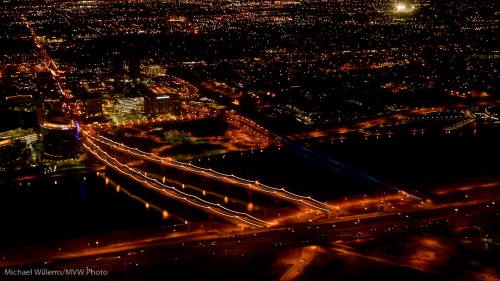
Night airplane

As we approached Phoenix last week, where I was teaching workshops (one with David Honl), I took this:

To do this:

  • Expose properly (several stops below metered).
  • Take many pictures.
  • Set ISO high to keep speed acceptable.
  • Aperture open (low “F-number”).
  • Be discreet in today’s nervous air travel environment

Do all that and you’ll get some cool pictures.

7D popup residual glow…

Look at this, from yesterday’s pic:

The Canon 7D can direct other flashes with its popup – unique for Canon, and that is what I was doing in this portrait (the main flash is a 430EX with a Honl reflector).

But when you do this, even when you turn the popup flash off (it only commands the other flashes), there’s a tiny residual glow! Every time. That is the little white dot.

Tip: cover it with your hand when shooting (or use Photoshop).

Portrait using two flashes

Here’s an impromptu portrait I took on Tuesday, of a lovely student who kindly volunteered to be the subject, in the Flash for Pros course:

And here’s how I did this:

  • Camera: The camera was a Canon 7D
  • Lens: I used a 50mm f/1.4 lens. (50mm on a crop camera, even the very cheap f/1.8 version, makes a great portrait lens).
  • Settings: The settings were Manual mode at 1/30th second, f/5.6, 400 ISO
  • Flashes: I used two 430 EX flashes on light stands, fired from the pop-up flash (like most Nikon cameras, the 7D allows this). Other than that, the pop-up flash was disabled. (I could also have used a 580EX on the camera as master.)

And how I used those flashes:

  • I used e-TTL, so I did not have to meter and set the flashes manually.
  • The main flash (“A”) was on camera left: a 430EX fired into a Honl gold/silver (half CTO) reflector. It was about a foot away from her.
  • The second flash was also a 430EX; this one fired straight at her from 45 degrees behind, through a Honl 1/4″ grid. This flash was also about a foot away from her.
  • I set an A:B Ratio of 4:1, so the main light was two stops brighter than the hair light.

Another student that night wrote a blog post, here, where you can see a few pics with some of the modifiers I used.

So it’s actually quite simple: now you go try. It is amazing what you can do in just a few seconds with just a couple of flashes (speedlites) and some small, light, convenient modifiers.

My "two stops" technique

Here’s a quick start tip for using flash indoors.

First, set your camera to:

  • Manual mode
  • f/4
  • 1/60th second
  • 400 ISO

Now check the light meter in your viewfinder. You want it to read about minus two if you point at a representative part of the room.If it reads higher or lower, adjust aperture and shutter speed until it reads -2. If possible, try to keep the shutter between 1/30th and 1/200th second.

By using this method, your ambient lights shows (avoiding black backgrounds), and it becomes your “fill light”, two stops below the key light. And of course while your ambient is set manually, the flash is still automatic.

And finally: bounce that flash off a wall or ceiling behind you!