From this (Phoenix):


To this (Indianapolis, on my way to Toronto):

Which was not, of course, altogether a great feeling.
From this (Phoenix):
To this (Indianapolis, on my way to Toronto):
Which was not, of course, altogether a great feeling.

Look at this recent portrait:

You will see standard lighting with a softbox on camera right, a fill light on camera left, a hair light behind him, using a Honl Snoot, and a background light aimed at the background.
This background light has a subtle blue Honl Photo gel on it. Can you see how much of a difference that makes? No gel would mean a grey background, and blue adds a touch of interest as well as a hint of corporate soldity.
Here’s me, shot by Christy Smith of Studio Moirae:
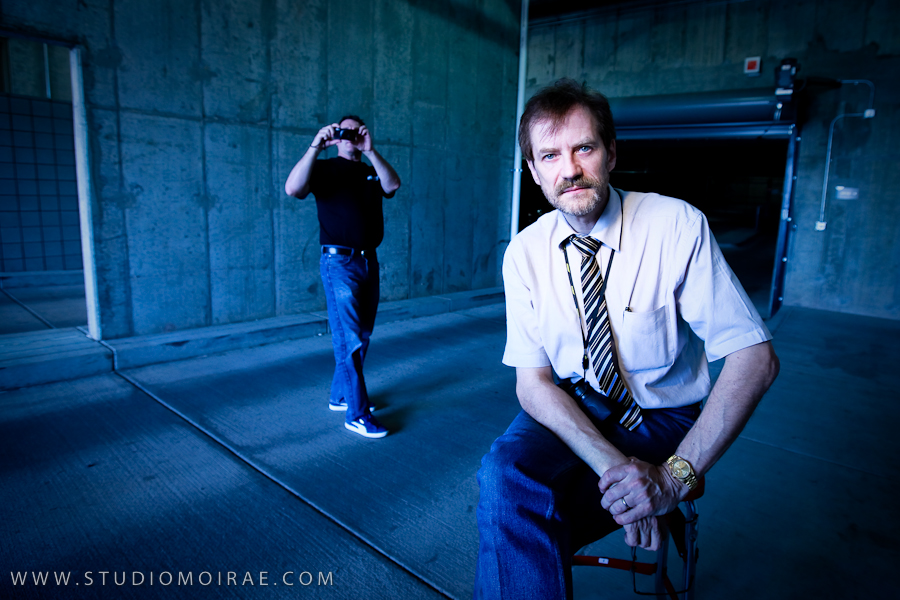
Yeah, I model too.
But wait. That cool blue urban look. Was it actually like that?
No. The actual scene was like this. Here’s Christy and David Honl taking a test shot:

So wait. How come it’s all blue?
That’s because Christy and Dave set their camera’s white balance to “Tungsten”. That will turn daylight blue.
But then I would be blue too!
Except they are lighting me with a flash with a CTO (“Colour Temperature Orange”, i.e. Tungsten-coloured) Honl gel and with a Honl Grid to make the light go mainly to my head and shoulders. The flash was aimed straight at me and set to manual, and it was fired with pocketwizards.
That’s the kind of cool technique Dave and I taught the participants who came to the workshops Monday and Tuesday in Phoenix, Arizona. If you have the chance, come to a future one: they’re fun and you will lean sooo much.
Today, part two of the Phoenix workshop at Studio Moirae. A repeat with a different emphasis; we go a bit deeper into the technology and we practice TTL multi-flash (both Nikon i-TTL/CLS and Canon E-TTL).
Yesterday, David Honl (yes, the David Honl) joined me, and he and I presented the workshop together. And we had fun: did we ever. A bright and energetic bunch of local photographers here in Phoenix.
Here’s David getting ready. In this shot I set my White Balance to “Tungsten”, which makes the background blue. Then a full CTO gel on the speedlite ensures that the subject, which after all is lit by the flash much more than by the ambient light, does not turn blue, but looks normal:

Here’s one of the set-up shots:
David setting up a speedlite, fired with a pocketwizard, with a half CTO-coloured Honl 8″ gold/silver reflector (while I blind Christy by actually firing the flash):

David carefully adjusting the subject’s head:

Tough job, but someone has to do it.
And here’s my shot of Christy, using this light:

All I can say is, I am glad the model we hired did not show up, because Christy is an amazing subject to work with. Which is rare for photographers.
And finally, fair’s fair: one more picture by Christy of David and me. Slow shutter, turning the camera during the shot.

Can you see that direct flash can be great light? And that shadows do not necessarily need to be avoided?
As you read this, I am in Arizona.
Here is a snap from my trip last December to Sedona:

What you can see in a simple snap like this is that:
A few simple guidelines can lead to better pictures. More of which soon, if I get a chance to take any!
….after teaching the “Advanced Flash” workshop in Phoenix today, at Studio Moirae:

This was shot using off-camera flash, of course. Using exposure compensation to set the background properly (about -2 stops).
Great workshop, great crowd: more details and shots later!
While I am in Phoenix, my shocking but hopeful and in the end, happy photojournalism exhibit “IV – Intravenous” is still on:
To see it, go to The Kodiak Gallery, 55 Mill Street, Building 47, in Toronto’s Historic Distillery District. It’s on until March 28!
One question you need to ask yourself is “how do I draw attention to my subject”.
One way to do that is to use colour, like in this image:

Red and green are opposing colours and add interest, but it is of course the yellow flower that draws our eye immediately. And notice how it is in the “rule of thirds” position?
Here’s another example. Can you see both the similarities and the differences?

So as a photographer, it helps if you can keep an eye open to colours.
…but not slippery enough to prevent me from getting through airport security. I am in the lounge waiting. Tethered, since Air Canada lounges now want $10 for Internet access.

Airport security is now very tough indeed in Toronto. Before even entering, every piece of hand baggage (one only) has to be fitted into the little metal frame. Mine does not (many cameras, lenses, etc) but amazingly, the person checking missed the bag on my shoulder.
Also, all passengers now get scanned by the full body scanner. You can refuse this – so I did, as a matter of principle. If I have done nothing wrong I refuse to be strip-searched, “virtual” or not.
But it is clear that this “right of refusal” is discouraged. The full body pat-down is extensive and pretty unpleasant, in front of everyone. This is going to be routine very soon, Militaristic commands, undressing, virtual stripsearches: any right of privacy and of respectful treatment has disappeared: we have given it up without a fight, it seems to me.
But at least I and my cameras and lenses and speedlites are now on our way to Phoenix.