Question answered – kind of

BKKphotographer asked:

“Which one living person would you most like to photograph? Which one place or event would you most like to photograph?”

Mmm. I would love to photograph so many people. How do I pick one? Impossible. But I tell you – I would love to shoot Patti Smith. I am reluctant to give the obvious answer of “a celebrity” – but it was her photo by Robert Mapplethorpe on the cover of “Horses”, almost 35 years ago, that awakened my interest in photography. Something that shaped me, in other words.

A place is easier. Again, there are many… but I would love to shoot Afghanistan. I have always thought I would like to be a war journalist: spending time in places like Iraq in the 1980s, when the Iran-Iraq war was on, made me think “the world should see this”. That is another thing that shaped me. So while it’s dangerous, I would do it in a heartbeat.

I’ll come up with others – there will be things that I hit myself over the head withfor forgetting – but these are two off the cuff.

And you?

Bad?

Annie Leibovitz shot the official Obama family portrait. You can see it here:

Obama Portrait

Discussion centres around how truly awful people think this picture is.

I think that is harsh.

The family group composition is good – background, not so much. That background could be more out of focus. And the picture right behind the younger daughter’s head is bad. The cut off picture frames at the top, too. Cut fingers, also. The verticals not being vertical on the right bugs me. Older daughter’s hair is not separated from the background. But awful? The family is nicely positioned. Expressions are good.

All in all, a nice picture that could be better but no doubt Annie had little time and no choice in the location. And the secret service men probably intimidated her. Unless you know the background: easy on Annie, everyone!

What do you think?

So how did the 7D do?

I shot an event yesterday, as said. In a club. A challenging environment.

More pics coming soon, but here’s one more, just to give you a taste of what a good camera and good glass can do.

TRIBE. 400 ISO, f/2.8, 1/60th, at 110mm (70-200 2.8L on a 7D), bounce flash

TRIBE. 400 ISO, f/2.8, 1/60th, at 110mm (70-200 2.8L on a 7D), bounce flash

I shot with two cameras:

  • The 1Ds MkIII with the wide lens (16-35 2.8L earlier, 35mm f/1.4 later)with a 580EX II flash.
  • The 7D with the long lens (70-200 2.8L) and a 430EX II flash.

And they did fine.

The 7D produced some wonderful images – to be posted here with technique tips in the next little while. I am very happy with it.

To start you off, some tips for club shooting:

  • Shoot wide. I needed f/1.4-f/2.8 at 1/30th or less at up to 1,600 ISO.
  • Bring a small LED flashlight so you can see your camera (thanks Alvin, for the tip)
  • Bring two cameras, one long for shots uch as the above, and one wide for the “grip and grins”. Wide should be 35mm on full frame or 24mm on crop cameras, and fast.
  • You can drag the shutter more if you have to.
  • Shoot people with some light in the background
  • Bring batteries
  • Bounce, or if you cannot, then use a Gary Fong lightsphere or a Honl bounce card with CTO gels

And of course: have fun.

Club shooting

Shot a club event last night. Wow, that was tough. No light and no bounce options, and inconsistent flash as a result. In the end, I used:

1Ds MkIII, 1600 ISO, f/1.4, 1/30th, Lightsphere

1Ds MkIII, 1600 ISO, f/1.4, 1/30th, Lightsphere

That is:

  • 1600 ISO
  • f/1.4
  • 1/30th second

That finally gave me the light I wanted. Without the 35mm f/1.4L lens I would have been dead in the water. The other shooters were having to aim their flashes straight at their subjects.. brrr.

Biggest problem all night by far: I could not see any of the controls on my camera. That is how dark it was. Rule of thumb: if you cannot see the camera controls, pictures will be difficult.

Sync or swim

A reminder to all flash photographers: you need your shutter speed to be below the camera’s flash synch speed.

What does this mean? Let me explain.

The flash fires for the briefest period, of course. Like 1/2000th of a second. That is why we call it a flash.

So when it fires, if the light is to reach the entire film or sensor, the shutter needs to be totally open at that point.

That much is obvious. But what is not obvious is that there is an engineering limitation in your shutter. Beyond a certain shutter speed, the camera’s synch speed, the shutter never totally opens. Instead, a small (increasingly narrow) slit travels across the shutter to give each pixel a brief exposure time.That’s cool – the shutter does not have to be super-fast and expensive and you get a fast shutter speed.

But this gets in the way when you are using flash. When you fire during those short exposure times (on most modern cameras, faster than about 1/200th second), the light does not reach the entire sensor. Look at this example I shot to illustrate this, at speeds from 1/200th to 1/1000th sec:

SHUTTER

You can see that as I exceed the sync speed, the light only reaches part of the shutter.

You should also note that especially when using external flashes with Pocketwizards or similar, flash takes time to set up. My 1Ds MKIII has a synch speed f 1/25oth second but as you see, at that speed it is already beginning to cut off. Best stay a bit below your synch speed (I typically set my shutter, when I am using studio flash, to 1/125th second).

(There is a way to overcome that: fast flash, which some high end flash units offer. This continuously, all the time that the shutter travels, pulses the flash at a very rapid rate, so that the slit, as it travels across the sensor, has light coming in throughout its travel time. It works great – do use it when taking flash images outside – but it uses a lot of energy, and hence decreases the range of your flash.)

(Advanced tip: I know of at least one photographer who uses this effect to introduce an electronic version of a neutral density filter or a barn door: he sets his camera to 1/320th second while using flash, and turns the camera upside down. That makes the top part of the image dark, at least as far as the flash part of the light is concerned!)
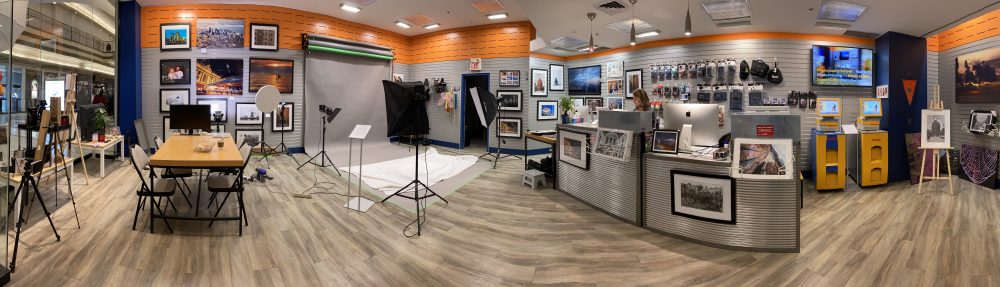
Studio simple

A studio need not be expensive. Even a light or two – affordable strobes – and a few reflectors and a backdrop will do it.

This is a setup I often take on the road:

  • Two or three strobes with stands
  • A reflector with stand
  • One softbox and one umbrella
  • Two pocketwizards
  • A tripod
  • A backdrop with stands, and a roll of grey paper.

IMG_1179-medium

Easier than it seems and this results in good pictures. Even, sometimes, when you use just one light and a reflector.

IMG_1167-1-medium

And instead of the light meter, consider using the histogram.

Since you asked:

Here are some shots at 100-800 ISO from both the 1Ds Mark III and the 7D. Studio, and to get to the next step, I just changed both ISO and Aperture up in both cases each time.

The shots below are a crop detail from this setup, lit with one umbrella and one softbox fired with pocketwizards. I used a 35mm prime lens on the 7D, and a 50mm prime on the 1Ds MkIII, in order to get the same field of view.

Important – click on each image to see a pixel-for-pixel real-size preview.

IMG_1802

So here we start at 100 ISO:

7D-100

7D- 100 ISO

1Ds MkIII - 100 ISO

1Ds MkIII - 100 ISO

Now take a look at 200 ISO:

7D - 200 ISO

7D - 200 ISO

1Ds MkIII - 200 ISO

1Ds MkIII - 200 ISO

Now up to 400 ISO:

7D - 400 ISO

7D - 400 ISO

1Ds MkIII - 400 ISO

1Ds MkIII - 400 ISO

And finally, 800 ISO. Now we start to see noise, but keep in mind, these are real-sized crops. In reality, even at 8″x10″ you would see little.

7D - 800 ISO

7D - 800 ISO

1Ds MkIII - 800 ISO

1Ds MkIII - 800 ISO

Tip of the day

This is one of those tips that is too simple to be written, almost – but that is enormously important.

IMG_1089

How do you hold your camera?

I ask because it is very important to hold it steady. Even a slight shake will result in blur.

And yes, that applies even if you have a stabilised lens (like a Nikon “VR” lens or a Canon “IS” lens), useful as they are (and they are). We often underestimate the effect of motion. Even at, say, 1/125th or 1/250th second. “Lens length times two”? That is a estimate, and a rough one. A starting point. But unless youthe more steady your camera, the better your pictures.

It all starts with you holding your camera steady. Of course a tripod is the gold standard. But failing that, hold your camera the way I am holding mine in the image above. If your lens is long, hold it as far forward as possible. In any case, hold it with your left hand as I am showing you here.

Simple but effective in reducing vibration to a minimum. Your photos’ sharpness will improve as a result. Visibly.