An Assignment

Some of you want more assigments! Well you shall have them. Here’s one for a start.

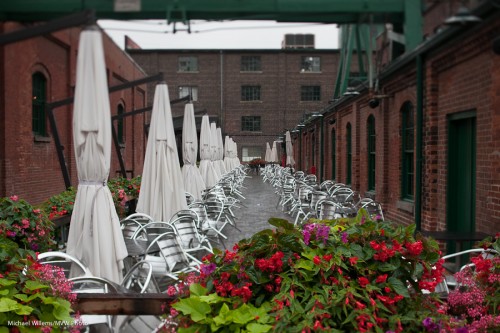
Go make an interesting picture. Use a “standard” lens. And “no flowers”.

Let me explain.

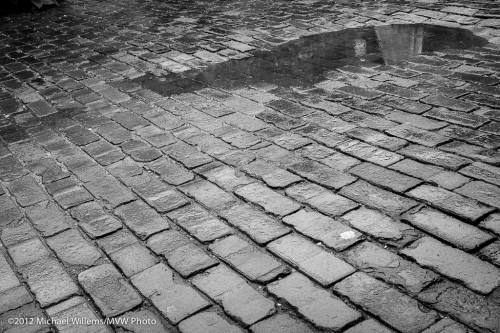
I.e. not this?

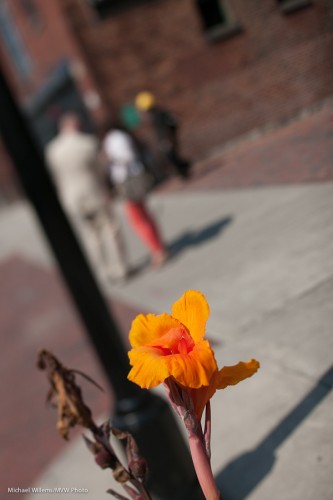
First, I would like you to go make a picture that is interesting in itself. Perhaps beautiful, even. And not because of the flower in it. The flower is already beautiful. You need you to make the picture impressive.

Hence also part two of the assignment: use a standard lens.

45mm lens

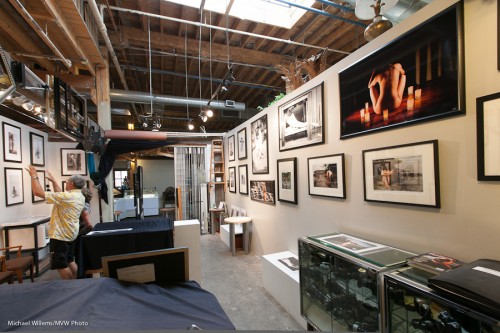
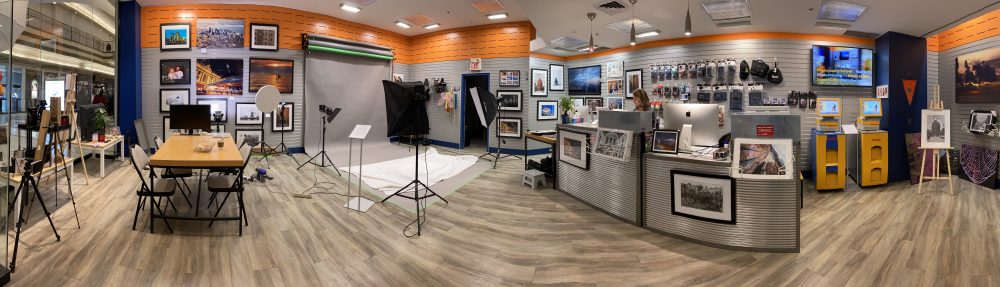
A standard lens, like my 45mm TS-E lens I used for the snap above, neither compresses perspective, like a telephoto lens does, or expand it, like a wide angle lens, as in the 16mm picture here (which I took at my art exhibit yesterday, and yes it is open this month):

16mm lens (on full frame)

So why is my 45mm lens a “standard” lens? A rule of thumb is that the diagonal size of the sensor is the focal length you should use to get a “normal” perspective. If you have a full-frame camera, with a 24x36mm “negative”, that is, if you remember Pythagoras:

√ ((242)+(362)) = 45.3

That’s why 45mm is “standard”. But it is subjective, so open to change within a range: back when, Leica chose 50mm as standard pretty arbitrarily. On your “crop” camera, 35mm is closer.

So if you use a 50mm (or if you have  “crop sensor” camera, 35mm) lens and avoid “flowers”, your work will be your work, and not the effect of cool stuff or weird angles. They have their place too – but not in this assignment. Go for it.


GR, a reader, asks:

____
Hi Michael,

a few weeks ago I attended one of your Nikon Workshops in Oakville. It was a great workshop and I took a lot of info home from it.

Now I’m in the market for my first Telephoto Lense and thought you could give me some help what to look for – just keep in mind I can’t afford a 2000$ lens like you prefer. I’m already looking around for a while and found 3 lenses, I would like your oppinion when you find a moment.

The two main reasons I’m looking for a tele lens are:  my boys play soccer, and we are going on vacation to Nova Scotia on August 9th.

First lense
Nikon AF-S DX 55-300mm VR 4.5-5.6G ED

In the online reviews I could find they say it’s a great beginner lens but it looses focus after the 200mm range. same goes for the next one

NIKON AF-S VR 70-300mm 4.5-5.6G IF-ED

Third lense
NIKON DX VR 55-200 F4.5-5.6G IF-ED

Can you give me some information what’s the difference between those lenses, which one you would recommend and why I should choose one over the other.

If you know off a lense in the same price range that would work better for my purposes, let me know.

Thank you for your help and see you at the NIKON 201 hopefully this fall


My reply:

I teach and coach privately – cameratraining.ca – and at Vistek Mississauga, and at Sheridan College.

In a word or two:

– The more a lens does, the more it is a compromise.
– The VR feature is important.

So the third lens looks like an option. Not too ambitious; good for outside where you do not necessarily need f/2.8…did you read the recent article on speedlighter.ca? A few days ago? This will help you make the decision, and only you can make it!

(All that said… For travel, I would usually prefer a very wide angle lens.)

Michael

New exhibit

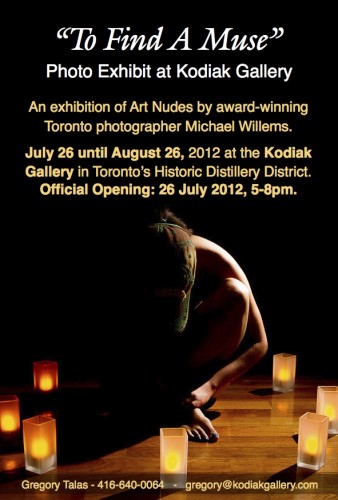
Shooting anything artistic is very rewarding, and I am once again sharing some of my work with the world: 26 uly-26 August in Toronto’s Distillery District, at the Kodiak Gallery. Curated by Gregory Talas, this exhibit will show (and sell) a number of my Art Nudes. Come see it!

I will even, for regular readers, throw in some hints and tips and short teachings. As always – you can’t stop me teaching!

All works are framed and for sale, and if you want one on your wall: if you quote this site you will get a discount. 🙂

Solo Exhibits

As you may have gathered, in the next few months I am putting on another two solo photography exhibits. One starts this weekend: an exhibit with a twist. A series of Fine Art Nudes, displayed in a naturist resort 40 minutes north of Toronto (just past Newmarket). See www.michaelsmuse.com for more details. The twist, of course, is that the audience will also have to be nude. (Try it: not weird, not threatening – and a whole new level of interaction with the subject matter – this is a unique experience – don’t miss it).

The second exhibit will be in the Kodiak Gallery in Toronto’s historic Distillery District, during all of August. Stand by for details soon.

So as for the first of these: why shoot Art Nudes?
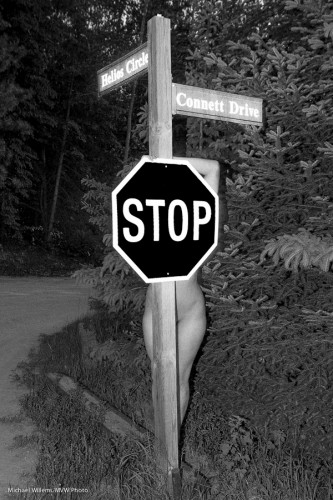
I wrote posts about that on my Tumblr.com feed, here and here (warning: you may encounter nudes). But let me summarise, including a repeat of some of what I said on Tumblr.

I shoot many things. Weddings. Parties. Events. Business portraits. Product. Industrial. News. Whatever you have, I’ll shoot it. But like most photographers, I also consider that there is a large art element in photography. And nudes bring that out more than most other types of photography. They are far from simple to do well: you have to know technique, composition, light, and especially, what people think.

  • “You just get a naked girl in front of your camera and click”, some people say.
  • Or “You sleep with your models”
  • Or, “It’s Porn”.

Let’s start with the latter: nope. It is not porn. Porn is pictorial depiction of the sex act. Nothing against the sex act or its depiction, but it is very limited in its expression of mood, story, emotion. These are pretty clear. I do not object to porn, but it is not that interesting: it is limited not because of what it does show, but of what it does not show. No story. No mystery. No beauty. No guessing. No freedom. Just sex: porn shows one subject only.

Sleep with models? Nope. If that is all you want there are much easier ways, I am sure, than by lugging around expensive and heavy camera and lighting gear. I think in general, it’s good to separate the personal and professional worlds.

Finally, the first part. No, it is not easy. When you picture someone nude, you picture their essence. You picture an emotion, an expression, a feeling, not encumbered by clothing, which restricts, ties to a certain time, sets a mood for you. You can picture many things, not just one. And best of all, a good nude is evocative. It raises questions. It tells a story, and best of all, it makes the viewer wonder what that story is; put it all together. That, in my mind, is the essence of an art nude. That is why it is art. Art Nudes are difficult but very rewarding.

When you want to achieve, you should challenge yourself. If you want to learn photography – and that is why you are here, I presume – you should definitely try nudes. They do not have to be 20-year old supermodels – on the contrary.

Oh… to see an illustration of how most Canadians get it, and are therefore relaxed about these things, go here (warning, nudity). From yesterday’s shoot.

Want to learn more? Give me a call or drop me a line, or better still, come to Never Not Naked: Natural Nudes, 22 June-8 August just north of Newmarket, Ontario. I promise that if you have the courage to turn up, if it is the first weekend I shall be there and I shall take the time to give you sufficient tips to get you started.
Direct light!

Her’s another post on the same subject.. flash. And why to use it.

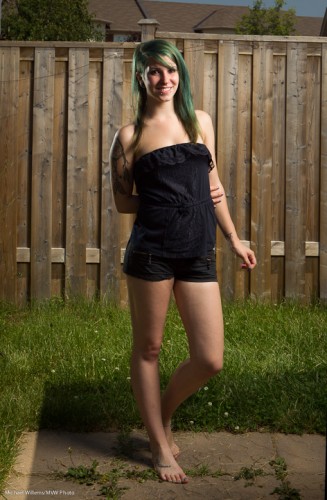
The big reason, as you know if you have been reading here, is to be able to balance foreground and background. As in this combination of “no flash” – “flash” pictures of new model Khoral, whose personality will see her go far.

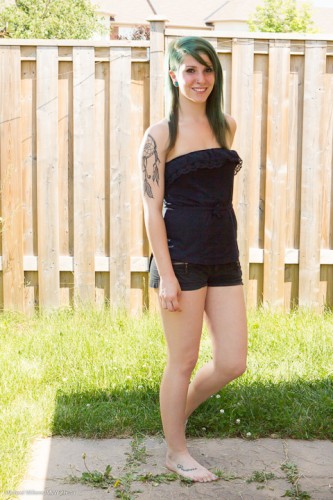
No flash gives you this:

While flash allows you to darken the background (ISO-Aperture-Shutter – The Triangle) while lighting up the subject with flash, which then gives you this:

But look closer. The other reason, the other difference you see: with directed light – your own light – you can shape. Legs look round, not flat. Faces look three-dimensional. Character comes out. I can light up certain parts (the person) and not other parts (the fence).  Flash gives you power to create, rather than just power to reflect what is there.


A few rules applied

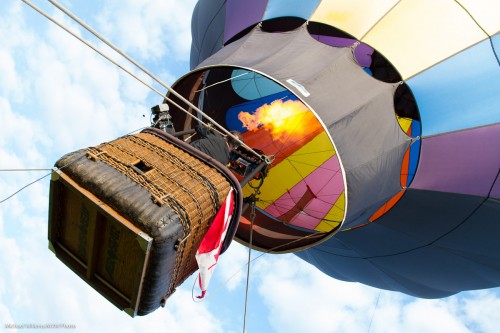
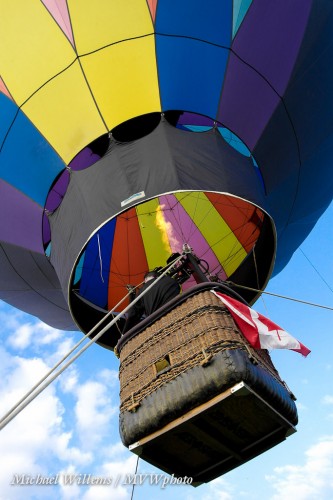
This morning, I shot a product introduction: Samsung’s NX-20 point-and-shoot camera. Here’s one shot:

For a shot like this, a few things need to come together.

  • Composition: Filling the frame, and using the rule of Thirds.
  • Exposure: Right for the balloon, and hopefully for the sky – in this case, both, because I poisitioned myself right w.r.t. the light
  • Moment: the moment the flame is visible is the moment to shoot.

Remember that a photo is a combination of light-subject-moment. Get all three and you have a worthwhile snap. A good subject certainly helps – but it is not enough.


IOU

Busy times here at Speedlighter Central… I owe you a couple of posts. They’ll come late today… meanwhile: shoot manual today.

Remember the “Sunny Sixteen” rule if  you are outside, or the Willems 4-4-4- rule if you are shooting indoors with flash.