A little known fact

When you shoot Nikon and use the CLS/iTTL systen, you can fire remote flashes and set them to manual instead of TTL. This is well known since you set the options through the on camera menu.

In the Canon world, this is not possible: remote flashes operated by light control must use TTL. Right?

Wrong. Canon too supports this functionality.

Here’s a TTL flash set to slave mode (a 430 EX in this case). The display looks like this: (And note that the “M” here refers to the flash’s zoom setting – nothing to do with flash mode):
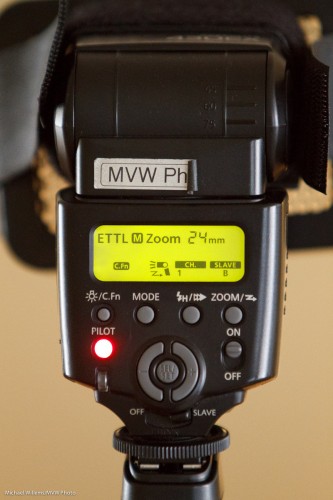
So it’s a TTL flash set to slave mode.

Now press and hold the MODE button. After a few seconds, you see this:
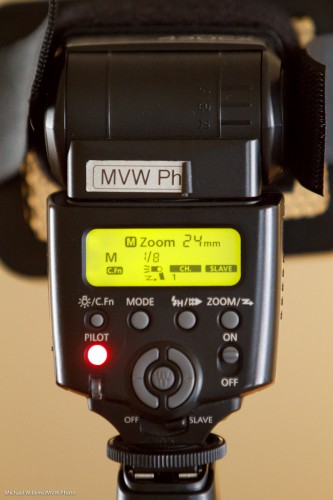
Now your cannon flash is still in slave mode, but it is now in manual power mode – TTL will not meter: the flash will just fire at whatever level you set it to (1/8th power, in this case). Note that the “M” to the left of the “1/8” now flashes, to remind you. One press and it goes back to TTL mode.

I bet there are some here who did not know this! Yes, you can use light-operated remote slaves that you set to manual, even in the Canon world.

PS: what’s that on the front of the flash? A Honl Photo speed strap plus a Honl 1/4″ grid.
 

Talking about weather…

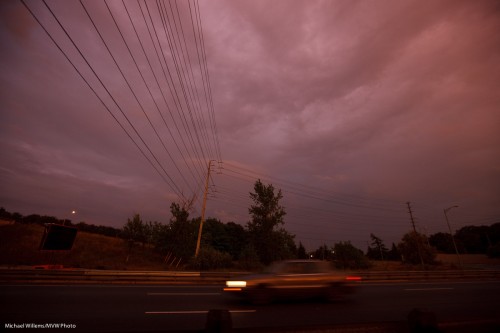
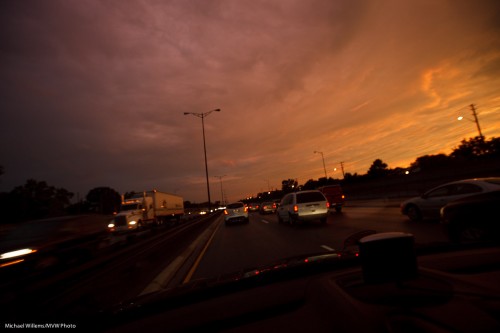
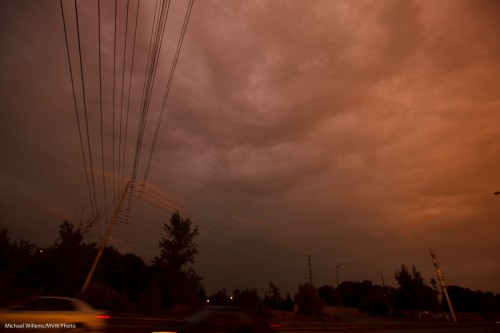
On 20 August 2009 I was driving westward, from Ajax back to Oakville, and around Vaughan I noticed the sky was getting increasingly unusual.

Churning skies…

Dark on top, light below. Dark, with light shining through. Green, then orange glow; very nasty. This was around 8pm.

It was no surprise to me that this was the night of the Vaughan tornadoes. I must have driven right by them.

Tips for this kind of weather:

  • Always carry your camera. I suppose for legal reasons, before some of you protest, I should say that you should not shoot from the car while driving. Regardless: carry your camera.
  • Use exposure compensation when needed to ensure the dark sky shows up as, well, a dark sky. Usually, a value around -1 stop will do this.
  • Set the white balance to an appropriate value.
  • Use a wide angle lens.

The wide angle lens makes it easy to show the screen in its perspective, but it also has practical benefits: (a) you get wider depth of field, and (b) you can shoot at slow shutter speeds without blurring your images.

If you always carry your camera, you will be able to document your life, and that of those around you.No camera = no images.


Internet on

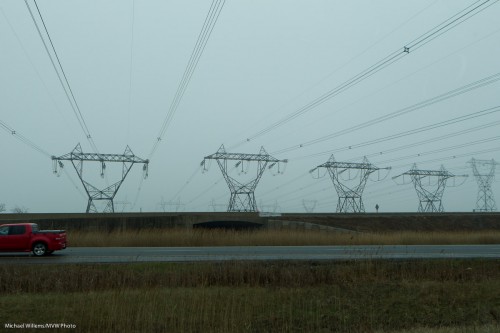
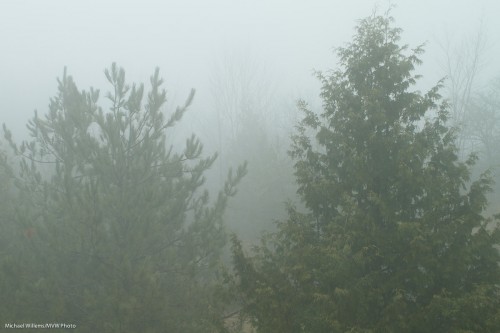
But the weather is still dreary here. All of this spring it has been around freezing, and it is grey like this:

Those images show me, though, that our environment can be especially beautiful in dreary weather. If like me you live in Ontario, you may want to go for a walk, and shoot some pictures.

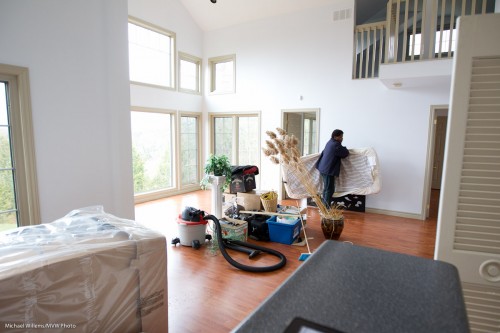
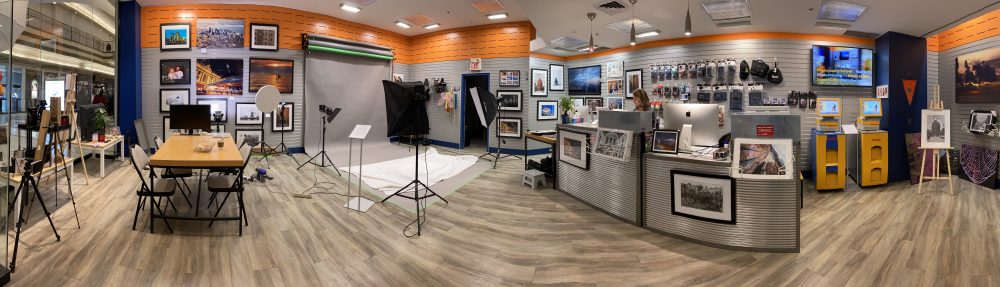
Anyway – in here I have nice weather. “In here” is in my new abode. Those of you who did workshops in Mono  will miss this location. Here, as it is being emptied:

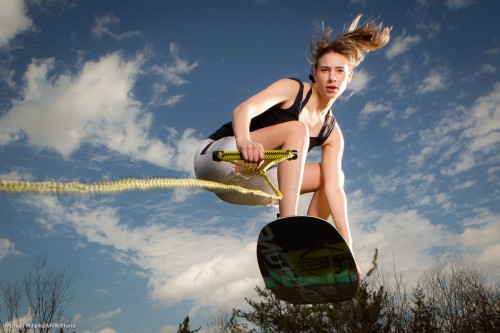
So, no more Mono workshops, known for shots like this:

However: good news. Because of my closer proximity, there will be more workshops than before. And while not in the same location, they will be in great locations also. So stay tuned to hear more. As soon as I have finished unpacking!


Move

I am moving today from Mono to Oakville, ON. That means for once perhaps no post. Not that I would not love to write, but it looks likely that Internet connectivity may take a day to set up.

In the mean time, why don’t you, if I may make a suggestion, take the lens cap off and go shoot some pictures. Right now. With a 50mm lens (or if you have a crop camera, a 35mm lens, or a zoom lens set to the “35mm” focal length zoom position. With particular emphasis o:

  1. Rule of thirds
  2. Blurred backgrounds
  3. Simplifying

I shall try to post later, but if not, you will know why.


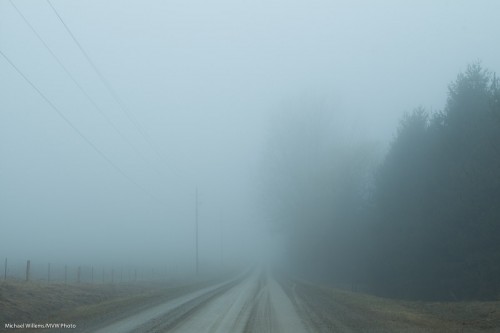
On my drive home, almost there last night, I was struck by how beautiful fog is.

25th Sideroad, Mono, in fog (Photo: Michael Willems)

25th Sideroad, Mono, in fog

For the technically minded: 38mm lens on a 1.3 crop camera, meaning “standard 50mm”, the “nifty fifty” look. 100 ISO, f/5.6, 1/50th second.

Fluorescent phenomenon

Ever tried to shoot in fluorescent light?

Tough light. The colour is all green.

So you know what to do: white balance. Set it to “fluorescent” – that will make the colour appear more neutral.

But sometimes it gets really weird. Especially when you shoot with a good lens, i.e. a fast lens, one with a low “f-number”, a lens with a wide aperture. You can get some pretty weird images.

With a slow “kit” lens you get something like this, perhaps:

And then you switch to a faster lens with a wider aperture. Now perhaps you get this:

And then perhaps this:

Huh? What’s up?

The increasingly  blurry background should give you a clue. Can you guess?

Click on “more” to read the answer after the line:

Continue reading

Monday: 5 Tips for beginners

Due to popular demand, below are a few beginners’ tips for today.

Michael Willems, March 2011

Michael Willems, March 2011

I occasionally throw in some of these, in case any of my readers may have missed one of these.

  • “Focus” means “where it is sharp”. Focusing means “setting the distance at which the picture is maximally sharp”. Focus does not mean exposure! “I focused on the tree, so why is it too dark” is meaningless (unless you are using your spot meter linked to your chosen focus spot, but that is an advanced topic).
  • The “mode” dial on the top of your camera sets the exposure mode, but not the flash mode. So “manual” means that aperture and shutter are set manually by you. Your flash has a manual setting too, but unless you engage that, the flash is still metered separately and set automatically!
  • In any case, there are many “manual” settings on your camera and they are entirely unrelated. Manual exposure. Manual focus. Manual flash power. Manual ISO setting. Manual focus spot selection. The list goes on – and these have nothing to do with one another. Hence “I am using manual” is not enough information!
  • Use one focus spot. Do not let the camera choose which focus spot: you choose it, and then aim that focus spot at your subject.
  • Use AF-S/One Shot (as Nikon/Canon call them) focus modes, unless you are shooting moving objects; then, consider AF-C/AI Servo.

Photography is not “about” this technical stuff. It merely needs to be done. So I will throw in one more, about composition:

Avoid putting your subject dead centre in your photos. Instead, use the “rule of thirds” more often than not.

Flash and ambient mixed

My friend (and Mercedes salesman) Steve Jones took a picture of me today, at the car dealership. Here is that picture:

I went through his camera setup for a flash picture with Steve, and I thought I would share that here.

  • What mode should we be in? Manual, for full control. The flash is still metered, of course, but background is manual.
  • What settings? In this case, in a big garage with much light, we will not go with the standard 400 ISO, 1/60th sec, f/4. Instead we will look at the light meter.
  • We want the background to be two stops, say, below the ambient light. So the meter should point to “-2”.
  • To get this, it needed 200 ISO, f/5.6, 1/200th second. With those settings the meter pointed to “-2”.
  • The flash had a Sto-Fen type diffuser on it for a bit of light softening, and it was pointed forward (to make the light emitting area larger).
  • White Balance was set to “Flash”.

And that’s it – that is how it is done: took a few seconds, means a nice shot.

The Colour Purple

I always try to use colour appropriately. What that means is up to me – and up to you. Photography is art, and there is no arguing over art. But there are some simple things to keep in mind.

First, consider using colour, period.

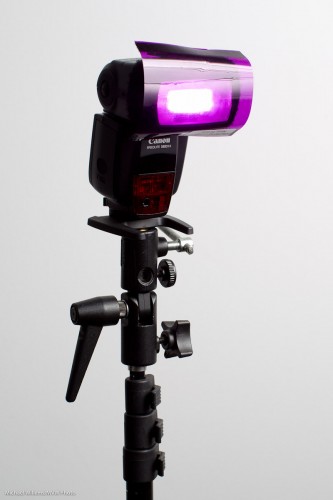
You do this with gels, when you are using flashes. For small flashes the gels are simple: you use the affordable, simple-to-use and extremely sturdy Honl Photo gels, like this one on my speedlight:

Simple. And I often use to use such colour in my backgrounds. To do that, the steps are as follows:

  1. First, make sure the background is dark enough. “Saturated colour” means “colour not mixed with white light”. Either move back from the wall, or use a dark wall or backdrop.
  2. Test this.
  3. Then add background light. Choose your colour well. I use complementary colours, usually.

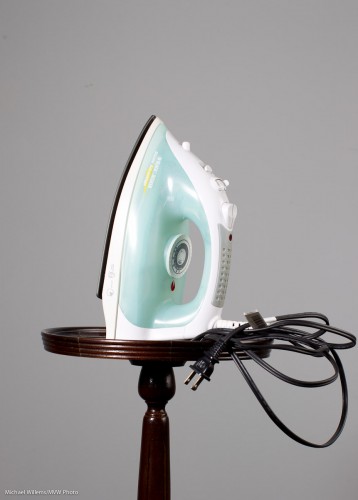
So here’s an iron with no background light and a dark enough background (Step 2):

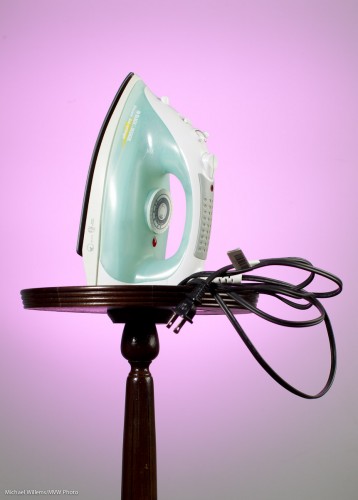
And here it is with a bit of complementary colour added (a gridded speedlight):

For that sea green, I used Rose Purple as a background colour.

Tomorrow, Saturday at 11AM in Toronto, David Honl, the inventor of those gels, joins me as Guest Star for my signature “Advanced Flash” course. You can possibly still book, I think here are a couple of spaces left: click here.