Umbrella or softbox?

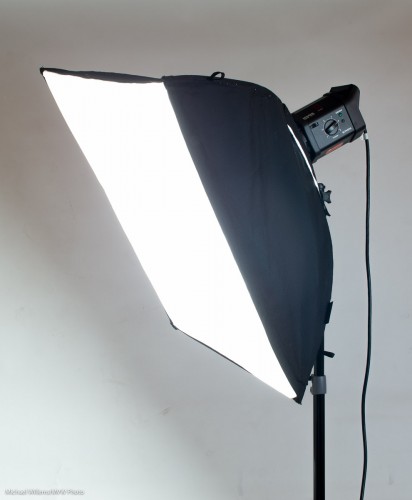
Umbrella or softbox? That’s the question. Whether t’is nobler in the mind to… never mind. But the question is valid: when you want to diffuse light, like in a portrait, which one do you use?
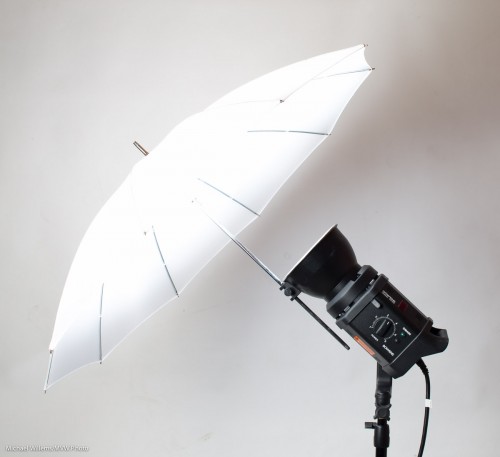
An umbrella:

  • Is light and small and affordable.
  • Can be used shoot-through (eg to get a nice round catchlight without “black blob”) or “into”.
  • Loses relatively little light.
  • Throws light everywhere.

A softbox:

  • Is not as small, light, or affordable. Does not fold into “nothing”.
  • Takes more time to set up.
  • Eats up a little more light than an umbrella.
  • Gives you wonderful light – but the catchlight is square.
  • Is more directional than the umbrella – it soes not light up the entire studio.
  • Is not necessarily square: can be long and thin, too (a “lightstrip”)

I prefer softboxes for their light quality and for their ability to selectively light; but I prefer umbrellas for their simplicity and portability.

So as so often: “it depends”. Get one of each!

And get to know them.

___

Special opportunity: I am teaching my “Canon/Nikon TTL Flash” in Hamilton, Ontario, tomorrow night, Friday 22 March, 7-10pm, in a wonderful studio (hamiltonstudio.ca). The class is small, and I have a special opportunity for you: if you attend, you will get a free copy of my eBook, “Photography Cookbook”. You will learn TTL flash on camera, off-camera, remote TTL using the built-in wireless control system, and much more. See http://www.cameratraining.ca/Flash-TTL.html and forego hanging around in bars tomorrow: sign up now, and make your Friday night into a special one that you will remember!


Focus – A Baker’s Dozen Tips

Following up from the last two posts, I shall share few more tips – a baker’s dozen, i.e. thirteen more tips – on obtaining sharp focus exactly where you want it.

Of course you know the basics, right?

  1. Select the appropriate aperture for the required depth of field (DOF).
  2. Select one focus point.
  3. Focus, with that point, on something contrasty.
  4. Holding the camera steady, now Focus-Recompose-Shoot (if using One Shot AF/AF-S).
  5. But if shooting moving subjects, AI Servo/AF-C can give better results. (Then, no recomposing!).

OK, sure. But is there more?

Well, yes. Little things, but important. Including the following:

  1. If you have time, it is better to move the focus point than to recompose. This gives you more accuracy – recomposing means shifting the focal plane a little.
  2. Set your joystick to be able to quickly move focus point (on the Canon 7D, for instance, by default you need to first press the focus point button, and then you can move it. Why that extra button?
  3. Low light is bad! The lower the light, the less accurate your autofocus will be.
  4. In my experience, low-level red (tungsten/incandescent) light is also not as good for autofocus as low-level white/blue light.
  5. If you have a flash and you have time, you can use your flash’s AF assist mode (the “red lines/grids”) to focus. Else, a flashlight can help, too.
  6. Not all focus points are equally accurate. Some, like the one in the centre, are sensitive to both horizontal and vertical lines; others are sensitive only to horizontal or vertical lines!
  7. The AF assist red lines from your flash will show you this – if you select a point that is sensitive to horizontal lines only, for instance, then the flash emits horizontal lines.
  8. Not all focus points are equally accurate with all lenses. On high end cameras, some focus points are horizontal or vertical only unless you use a lens that is f/2.8 or faster.
  9. If in doubt, use the centre focus point, since it detects both horizontal and vertical at all times.
  10. Focus points are in fact usually a little larger than the squares in your viewfinder.  This can easily confuse. If your camera has the option (like a Canon 7D or 1Dx), you can set a smaller focus area, meaning the focus spot is the size indicated.
  11. Lenses are sharpest when stopped down a little. In the shot above, I used my f/1.2 lens at f/2.0 – it’s sharper that way.
  12. But beyond a certain point, the wavelength of light becomes significant related to the small opening, so you get unsharp pictures. Most lenses will start to show this unsharpness beyond about f/11.
  13. You can also choose to allow the camera to use multiple focus spots to figure out where to focus. This can be helpful with moving subjects.

Even armed with this knowledge, you will find that often, especially when the subjects move or the light is low, it’s luck that gives you great images. My advice in those cases is simple: shoot a lot.


___

NOTE! Want to learn how to creatively use off-camera flash using “Master-Slave”/”Commander-Remote” TTL flash control for your Nikon or Canon system?  When to use modifiers? Flash secrets? Do not miss my evening course in Hamilton on Friday: http://cameratraining.ca/Flash-TTL.html. This and other upcoming workshops on http://cameratraining.ca/Schedule.html. Book now to guarantee your place.


Tools Matter

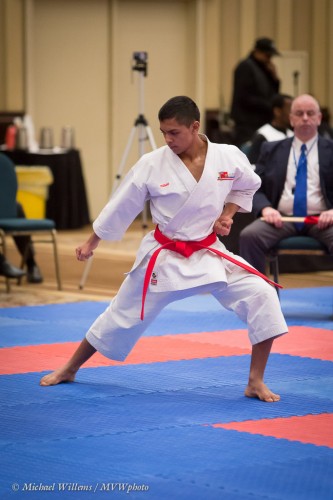
For the past two days, I photographed a lot of this:

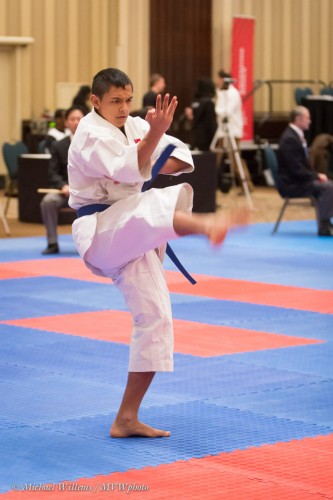
The national championships were held in Toronto in the Grand Ballroom at the Sheraton Hotel. And the photo may not show it, but grand ballrooms are dark, lit by rather dim tungsten light chandeliers.

How dark?

With my 1Dx and 70-200 f/2.8IS lens I had to shoot this morning at:

  • f/2.8
  • 10,000 ISO
  • 1/160th second

Yes, that is 10,000 ISO. Think of 1600, then add one stop (3200), then one more stop (6400), then two thirds of a stop (now you are at 10,000). Almost three stops more than I was comfortable with just a year ago. And I needed this to get to 1/160th second – I would have liked much faster, in fact.

Is there anything you could have done if you were using an “ordinary camera”? Many shooters came up to me to ask. Poor people with Rebels and 60Ds and D3100s and f/3.5-5.6 lenses. Think about it:

  1. If you have an f/5.6 lens you need two stops more ISO than I had at f/2.8 (the lens lets in less light).
  2. So if you want a fast enough shutter speed, like mine, you would need 40,000 ISO.
  3. But you can only use, perhaps, 1600 or -pushing it- 3200 ISO while maintaining good quality.

Is there a solution?

Well, yes. Use a 50mm prime lens on your camera, which gives you an 80mm equivalent lens, say at f/1.8. Now you are better than my zoom, one and one third stops better, so you can go to a lower ISO (around 4,000; or perhaps 3200 ISO at 1bout 1/125th second). One shooter, an intelligent young woman, got it, and pulled out her 50mm f/1.8. Saved!

And yes, you need those fast shutter speeds. Even at 1/160th second, if anything moves, it shows:

The moral of this story: equipment matters. I saw many people with simple cameras and kit lenses who expect to be able to do the same work I do. It doesn’t work like that, I am afraid. You buy modern cameras and fast lenses (low “f-numbers”) for a reason, and today illustrated that reason well.


Wednesday Possibilities

Today, some shots to get your imagination going – shots that show how much is possible with little effort, and quickly. Shots I took in and between classes in mere seconds, to demonstrate specific points.

Like this quick demonstration shot showing what a great modern camera like my 1Dx can do at – wait for it – 51,200 ISO:

Meaning that with a new camera, you can now photograph pretty much in the dark, or mix a little flash with very low ambient light, or bounce off very high ceilings.

Especially when using off-camera flash, that opens up all sorts of possibilities. Here’s a demo shot showing what a little extra light can do; look carefully and you will see that I am using remote TTL flash (where my camera’s flash is the “master”), and my student at Sheridan college has set his flash to be the “slave”:

Result: he is temporarily blinded… and lit up. You can do that too, with very little extra equipment. One flash, if you have a moden camera whose popup can “command” external flashes; else, two flashes, on on the camera and one remote. Imagine what you can do when you can add a little light everywhere you like!

Then, another student lit dramatically – from below! This kind of eerie effect is easy once you can take your flash off the camera as desribed above.

Or – just turn the camera upside down and bounce flash off the table, as I did!

Off-camera handheld flash gives me this image, even when the flash is aimed direct, of Mr Jun:

Not bad, and that is direct light aimed into his face – as long as it is not near the camera, the flash can be unmodified and direct!

And when you have several flashes, you can do things like this:

Now that is a competent portrait, taken in just a few seconds, using this setup with two off-camera flashes each fitted with a Honlphoto grid, and one with a blue-green gel; using two “biological light stands”:

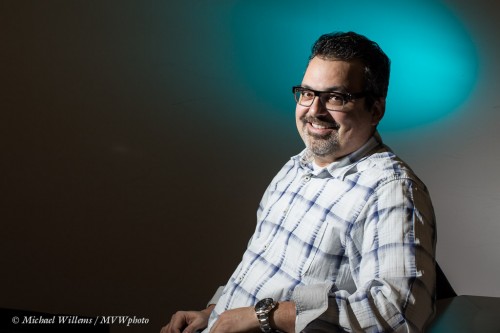
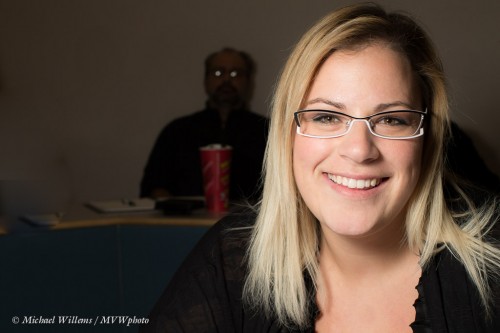
But finally – do you need all those flashes? No, here’s a portrait using one flash fitted with a Honlphoto 8″ softbox:

The apparent Martian in the background adds a little extra “huh?” to this photo, don’t you think? His glasses reflect the round softbox.

Anyway, these snaps demonstrate that you can achieve a lot in a very short time using simple means – you may already have every thing you need. Get creative, go outside the box, and above all, think “where is the light coming from”!


North American readers: it’s for you!

Message for you:

Now that the time has changed, go set all your cameras to the correct summer time – right now. All of them, and get it right to the second. Use our iphone as a super accurate time source.

When you shoot an event with two photogs, or with two cameras, and put the images together, you’ll be glad you did.

How do I start

When I shoot, I usually have my camera in manual exposure mode.

Easy, of course, just watch the meter, and there are only three ways to make a picture brighter (lower “f-number”, higher ISO, slower shutter), and vice versa – but I am often asked: “but where do you start“?

There are three answers to that.

One: experience, and the Sunny Sixteen rule. But that is not the most usefu answer, by itself.

Two: Put the camera into “P” or “A/Av” mode, and read the camera’s suggested settings; then enter those into “M” mode as a starting point.

But three: my algorithm is the following:

  1. Set ISO to what is needed. Outdoors bright 200, indoors 400-800, and “difficult light” 1600-3200.
  2. Set aperture to what I want/what is feasible. Depending on the lens and what I want as sharp depth of field area.
  3. Set shutter to the right speed for a good exposure reading.
  4. If that shutter speed is too slow, increase ISO, or if possible open the aperture. Then adjust.

You will find that if you do this a lot, it gets easier. And you will be a good photographer: being in charge is better than letting machines decide, however good those machines are.

Tomorrow, my signature flash course at Vistek in Toronto. Early night tonight!


Of Indoors Flash, And The Mode You Use

When you shoot with a flash indoors, what exposure mode should your camera be in?

Of course I would say “manual” – my camera is almost always in manual exposure mode. But why do I say that? Why manual – why not, say, aperture mode?

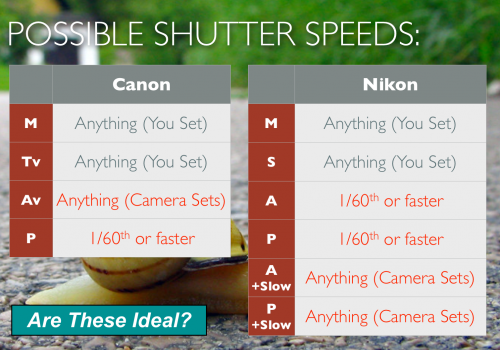
Let me explain. Here’s what the cameras allow the shutter speed to be in the various modes:

The Canon engineers decided that:

  • in Aperture mode (Av), the camera will expose as it sees fit. That could mean a shutter speed of, say, three seconds… not ideal!
  • in Program mode (P), the shutter shall not be slower than 1/60th second. Also not ideal: unless you like very high ISOs, you may well want to go to 1/30th or even 1/15th, when using a wide lens, to get enough ambient light in.

The Nikon engineers decided that:

  • In both A and P modes, the shutter shall not be slower than, usually, 1/60th second. Not ideal: unless you like very high ISOs, you may well want to go to 1/30th or even 1/15th, when using a wide lens, to get enough ambient light in.
  • In both A and P modes, when you enable the “Slow Flash” setting, the camera will allow slow shutter speeds to expose as it sees fit. That could mean a shutter speed of, say, three seconds… not ideal, either.

So neither of those modes are perfect for indoors flash shots. Hence, S/Tv, or better, M is the way to go!


Trixie

I shall now repeat a flash trick I have mentioned here before years ago. Time for a refresher.

You all know how important it is to avoid, at least when the flash is on your camera, direct flash light reaching your subject. Both in order to avoid “flat” light, and especially to avoid those nasty drop shadows, like this (don’t do this at home, kids):

But you have also heard me talk (and those who come to my upcoming flash courses will learn hands-on) that you should “look for the virtual umbrella”. For most lighting, this means 45 degrees above, and in front of, the subject.

So when you are close to that subject, you aim your flash behind you to get to that point. Good.

But what when you are far, as when using a telephoto lens? Then the “virtual umbrella” may be in front of you. And aiming your flash forward is a no-no, since the subject will be lit in part by direct light.

A-ha. Unless you block the direct part of that light!

Like this:

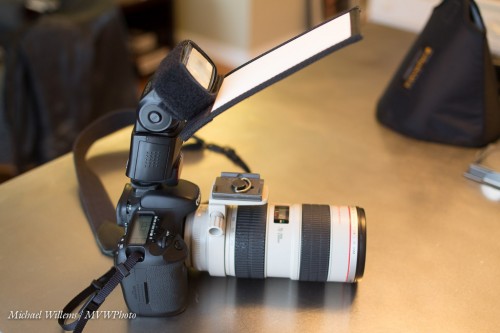
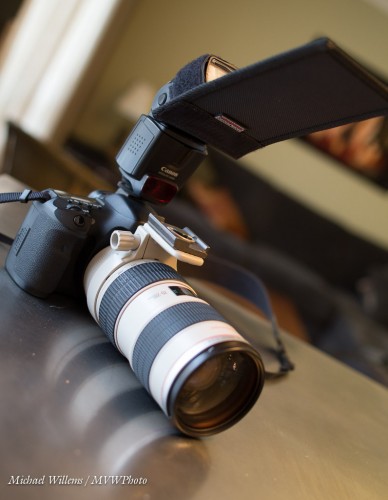
As you see, I use a Honl Photo bounce card/gobo to block the direct light. Simple, affordable, and very effective. I use either the white bounce side, or the black flag side, depending on the ceiling and position.

Simple, effective – done!

And one more thing. Direct flash is not bad per sé. Not at all. As long as it is not coming from where your lens is, it can be very effective, like in this “funny face” shot of a recent student (you know who you are):

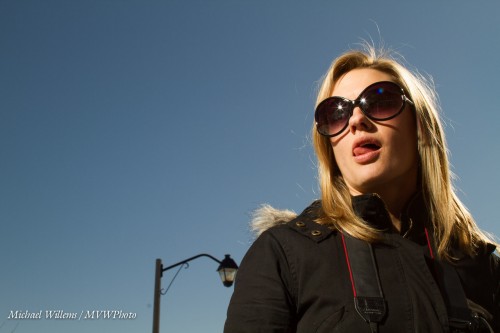
Lit by a direct, unmodified flash. And the hairlight, the shampooy goodness? Yeah. The sun. Just saying.

(And yes, that too is something I will teach those of you who sign up for one of my upcoming flash courses.)


Equipment doesn’t matter.

Except sometimes it does.

When should you buy a new camera? Not often, and not because the new camera has more functions or pixels.

One reason: because it has higher useable ISO. I have talked about this before. Here’s another example, from my Canon 1Dx, which has fewwer pixels than that 1Ds Mk3 I was using before. Fewer pixels plus more modern technology means higher useable ISO.

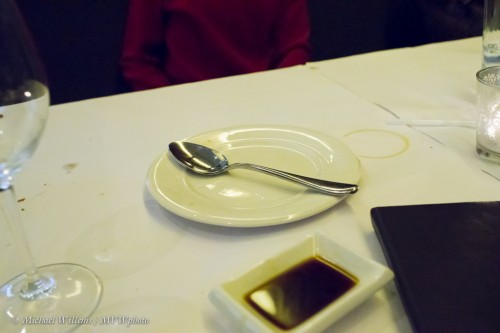
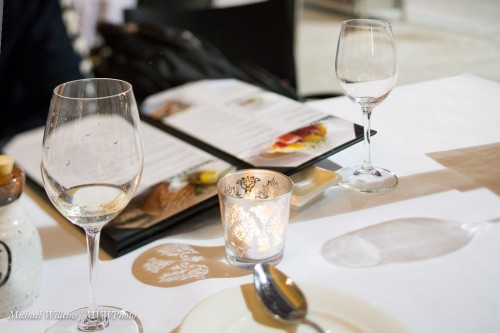
For example, unchanged from the camera, I just converted this from the RAW to a JPG – an image I shot at a whopping 12,800 ISO at f/2.8, 1/160th sec:

Yes, 12,800 ISO. No noise reduction in Lightroom – this, as said, is from the camera.

Even magnified to real size, 1000 pixels wide (click through to see at that size), it is really good – good enough for a large print.

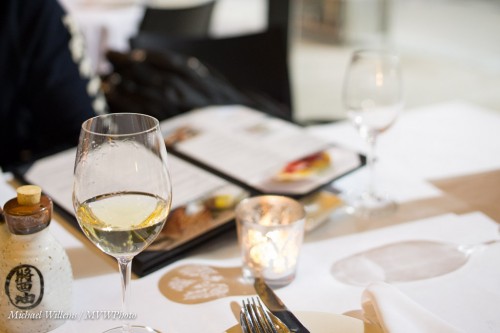
So with a modern camera you can shoot dinner in a dark restaurant at good quality with an f/2.8 lens, using available light. Is that cool, or is that cool? And that is why eventually you will trade in your 5D Mark I for a Mark III, or something like that.

On a side note:

Q: how did I get both glasses sharp at f/2.8? Shouldn’t f/2.8 from up close look like this, with only one of the glasses sharp?

A: Yes it should. But I used my 45mm tilt-shift lens, which allows me to shift the focal plane to where it is in line with both glasses.


Tilt. Shift.

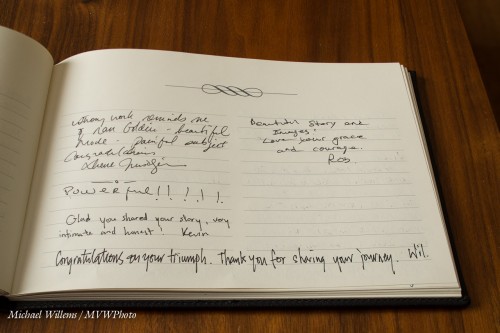
Why do I use my 45mm tilt-shift lens so often? Because I can. Because I like focusing manually. Because it is sharp. And because I can do shots like this even at a wide aperture:

I just shot some pages of one of my exhibit guestbooks. I did this for the upcoming Photosensitive “Picture change” Project, which I am very much honoured to be a part of.

To make pictures of a book like this from behind it, I would normally need to be at, perhaps, f/16. Which would mean no hand-holding, but a tripod and a long exposure. But by tilting the lens down, just as if I were using a view camera, I can shift the plane of focus so that the entire book is in focus even at a wide aperture like f/4. Simple and quick.

I used my tilt-shift yesterday as well, to do some nudes, as training material for the upcoming “art nudes” course. You can see them on my Tumblr feed. Not an obvious lens choice, perhaps (I would normally want a lens in the 35mm range, in a small room), but a good choice under the circumstances, where I am pointing up and down (which is where the shift comes in).

___

(By the way: there is still space on the course, just two spots left; and there are more courses planned too: see http://www.cameratraining.ca/Schedule.html)