Wide

What lens to put on your camera?

Sometimes it is difficult to decide. But sometimes it’s easy.

Social events are easy. When shooting such events, where there are people socializing, eating, drinking, I recommend a wide angle lens between at least 24 and 35mm “35mm equivalent” (greater range is ok of course).

Meaning that if you have a full frame camera, use a lens in that range. If, as is more likely, you have a crop camera like a Nikon D5000 or Canon Digital Rebel, you use a lens 50-60% smaller to give the same effect, i.e. a lens in the 16-24 range. Like a 17-40.

At yesterday night’s event with Wendel Clark, ex Leafs captain (below) I used a 16-35 wide angle zoom on my 1.3 crop camera (I used the new Canon 1D Mk IV).

I do this a lot, and so can you.

Remember to get close to people.

Another option is to use not a zoom, but a wide angle prime lens. On my full frame camera I use a 35mm f/1.4 lens quite often for these events.

The pictures that the three above are part of will be on Oakville.com in the next few days.

1D MkIV

As a shooter, and as a teacher,and as a tech blogger, I need the most recent equipment. So I have no obtained a Canon 1D MkIV to replace my 1D MkIII.

So far it seems fine. Not the same great focus system as the 7D, but th same solid feel as the 1D MKIII and the same software options, which Canon has left off the 7D (e.g. the option to name the files to your liking). And lowernoise than the 7D (of course, if only because it is a 1.3 crop factor sensor). Fast 10 fps shooting that lasts much longer than on the 1D MkIII. Sozen of full RAW shots before the buffer fill sup even with a slow memory card.

So far. so good. You can be sure I will post detailed information, rather than these very first impressions, in the next days.

Metering

A few words on light meters.

When shooting studio shots like the ones I talked about, you use a flash meter. When doing that to accurately judge the right exposure, keep this in mind:

  • Have a spare battery at hand
  • Move the dome out. Do not leave it screwed in.
  • Use the meter in Flash-metering mode!
  • Only flash one flash at a time. Turn off other flashes when you meter one.
  • Start with your key light; then one by one meter the other flashes. These will be darker generally.
  • Ensure your meter is set to the right ISO.

Then use the measured aperture as your starting point and check the histograms on your camera for fine adjustments. I believe that “exposing to the right” is generally a good idea.

Also, don’t forget to use a grey card to get a nice white balance reference target.

That portable studio

So when I pack by bags to do a location shoot, like today’s executive headshots shoot, you saw in a recent post that I bring rather a lot.

And what do I use? How does it look when it’s all set up?

That setup process, which takes about 45-60 minutes including carrying it all from the car in stages, results in this:

This setup consists of:

  1. A grey backdrop. I like grey because you can make it any colour, from black to white.
  2. The main (“key”) light: a light stand with Bowens 400 Ws monolight in a softbox. This is fired by a Pocketwizard (just visible, top left)
  3. The fill light: a light stand with a Bowens 400 Ws monolight into an umbrella. This is fired by the slave cell.
  4. The background light: a mini  light stand with a 430EX Speedlite, with a  Honl speed strap and a Honl 1/2 CTB gel. This light is fired by a Pocketwizard, using a Flashzebra cable.
  5. The hair light: another a light stand with a 430EX Speedlite, with a  Honl speed strap and Honl snoot. This light is fired by a Pocketwizard, using a Flashzebra cable.
  6. A stool.
  7. The camera set to 1/100th sec, f/9, 100 ISO, and equipped with a PocketWizard to fire the other flashes.

It doesn’t look like all that much, but when you write it out, and then add the power cables, connection cables, bags, and so on, it’s quite a lot.

Why photography costs money

Mainly because it breaks the photographer’s back.

Here is part of what I am bringing to a multiple corporate headshots session tomorrow:

This kit consists of:

  • One backdrop
  • Two rolls of backdrop paper, grey and white
  • One two-monolight set with three stands and two umbrellas
  • Two more monolights
  • Four lightstands with umbrellas for speedlites
  • Camera kit (lenses, a Canon 1Ds MkIII, etc)
  • Lighting kit with four speedlites, five Pocketwizards, modifiers, and much more.
  • Tripod

Not pictured:

  • a 60×80 softbox
  • a Canon 7D camera
  • a muslin backdrop
  • a stool for the subject to sit on.

I am now going to bed early, so that I can build strength!

The serious point, of course, is that when a photographer visits with a portable setup, he really carries with him a full studio and everything that includes.

Fun with gels

Tonight, I had some fun trying various new gels.

For those of you new to photography: a gel is a coloured material that you put in front of a flash to change the coour. You typically use these for background colours.

Usually I use a slight correction gel (1/2 CTO, 1/4 CTB, etc) to perhaps warm a background up a bit or to give a corporate shot that slight blue tint in the background. But tonight I thought I’d play with some great new colours.

My system for the test shots below was:

  • A key light to camera left, in a softbox on a Bowens 400 Ws monolight
  • A fill light to camera left, into an umbrella, using an Opus 250 Ws monolight
  • A Hair light, also into an Opus light, and snooted
  • A background light: a Canon 430 X flash with the various gels. I used the excellent Honl system: the speedstrap on the flash, plus gels conveniently Velcro’d on.

So for these gels I used some basic colours and the new Honl “Autumn” and “Hollywood” gel sets. Great colours. Here we go, and look how each gives you a very different shot:

[1] The new “Autumn” kit:

Egg Yolk Yellow:

Chocolate:

Rust:

Dark Salmon:

Medium Blue-Green:

[2] The new “Hollywood”-kit:

Follies Pink

Steel Green:

Rose Purple:

Smokey Pink:

Pale Lavender:

And for comparison, some basic primary colours: Red, Green, Blue and Yellow:

And finally, what it looked like with no background light, white background light, and “heavy frost” background light:

Note: When you play with gels, do not forget to set your white balance to “F;ash”, so your canera does not try to adjust the colour away.

Now to see these colours side by side, check them on one page: http://www.mvwphoto.com/gels/

Power Travel Tip

And I mean power. Battery power.

What happens if you are travelling to Africa and are not sure how much access you will have to reliable power? How will you charge your batteries?

My tip of the day: bring a small 12V DC to 115V AC power inverter. You can buy these at your local hardware store (Home depot, Canadian Tyre).

Because guess what. You will always have access to, or be driving around in, cars, and these cars have cigarette lighter outputs. You can bring a small inverter like this – small is key, and to charge camera batteries or a PC you need little power. So charge your spare battery while you are driving!

Problem solved.

Tip of the morning

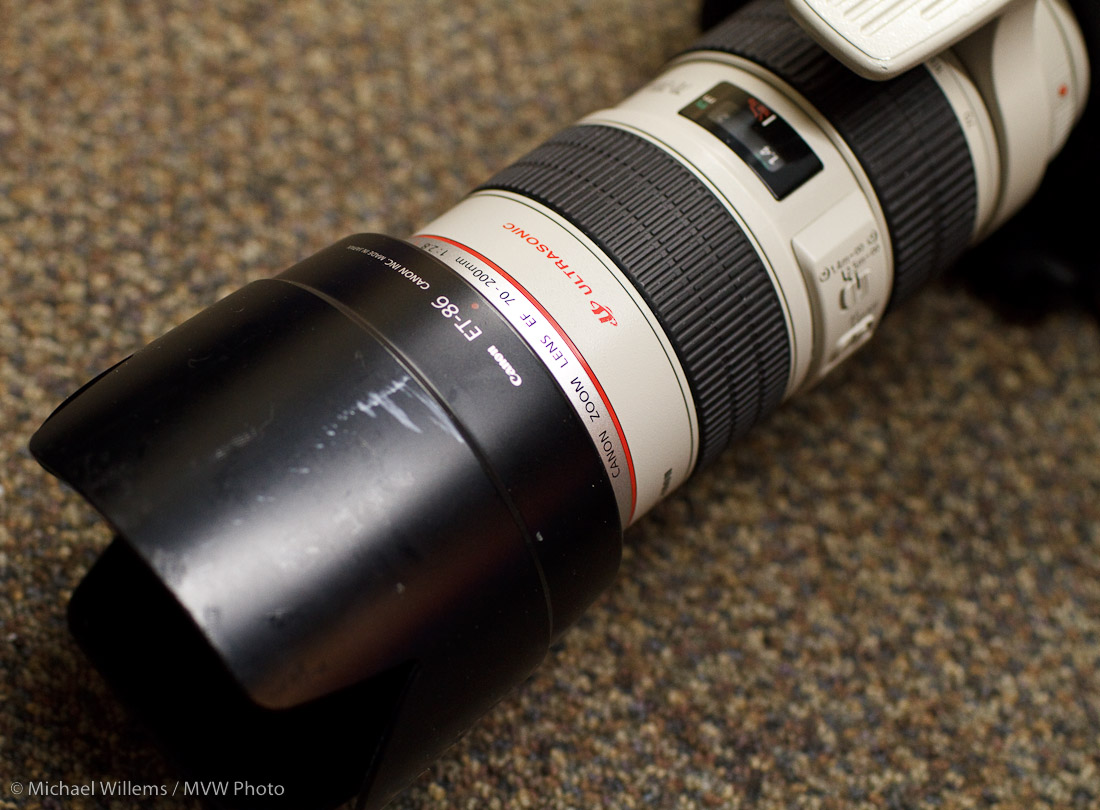
Look at my lens here:

Do you notice two things? Apart from the fact that this is my favourite long lens, the superb 70-200 f/2.8L IS, I mean.

  1. It has a lens hood. Always use the lens hood. Yes, even indoors. It affords protection for both damage and stray light causing “flare”.
  2. The dot is on top, even though Canon would rather I put the dot at the bottom. Why do you put the dot on top? Because it is then obvious if the hood is not on all the way (which would lead to vignetting in the corners).

There you go, another little tip to make you a better photographer – if ever so slightly.

One more "Studio" post

I thought I would add one more picture of the small studio, and how it works.

This consists of:

  • A grey background
  • A main (“key”) light: a Bowens 400 Ws monolight, fired into a Bowens 60×80 softbox.
  • This light is activated through a PocketWizard; all other lights have a photocell that follows this light.
  • A fill light, 250 Ws fired into an umbrella
  • A 100 Ws background light with a yellow gel
  • A 250 Ws hair light with a snoot
  • A stool for the victim to sit on

The camera is set to manual exposure and has a Pocketwizard on it which drives the flashes. Don’t forget to set your camera to manual low ISO, and to check that your exposure time is under the synch speed (e.g. 1/125th second). Then meter for the right light (meter key and fill lights individually).

And this very vanilla setup leads to:

Photographers will know: the biggest challenge is to focus on yourself. That is why we are always hassling people to model for us.

Opus Non Magnum

A word about that Opus studio flash that you saw in that previous picture the other day, at the top:

I have owned nine Opus lights, and seven of them have failed. They are sometimes dead in the box (the nine above do not include the one that was dead when I opened the box). If they do work, they die, or they malfunction later. Seven out of nine – I have never seen worse.

The importer, after I wrote a few times, told me:

It sounds like the equipment you’re using has been discontinued by Opus.
These unit were designed for the “Home User” looking to experiment with strobe lighting with out paying the premium for professional lights.

Meaning what, that failing is OK for home users?

He adds that the lights have a two-year warranty. But having seen so many of these Opus lights die, and having heard many photographers describe Opus catching fire, I cannot recommend them in any way.

For affordable monolights that also offer quality, I can recommend the Bowens lights.