A Business Note

[….we briefly interrupt our regular programming to bring you this message…]

SUMMER SPECIAL

I see and hear that many readers enjoy this blog. Then you will enjoy my e-books and personal training also, I am sure.

So… to thank you for being loyal readers and to encourage you to try my books and training, I have just created a limited time Summer Special: 25% off all orders over $250. The training or shoot must be booked and paid for by July 31st. The actual shoot or training may be taken any time in the future.

To benefit from this discount, head over to learning.photography and fill your cart with $250 or more of products; then on the last screen enter Discount Code ReaderLoyalty —and you are all set, the price will decrease when you recalculate. 25% can amount to a nice sum, making affordable prices even more affordable.

For example, take a course for two people (order the two-people price twice in the same cart) and you get the discount. A course for one plus the set of all five e-books would also get you there, as would a portrait shoot and the e-books—and so on.

And more importantly, books and courses will make you a better photographer. Quickly.

NEW COURSES!

When you look at learning.photography you will see new courses. Video on your DSLR and Landscape Photography among them. Go have a look. Also, many courses have been updated—they always are: as the industry changes, so do my courses.

TEACHING METHOD

The way I book courses is different from anyone else’s. Instead of me setting the schedule for my convenience, you do, at your convenience. And I make it affordable to get private, or near-private, tuition. Head on over to this article to check out the news post.


See you soon!

[….back to regular programming…]

Manual or TTL?

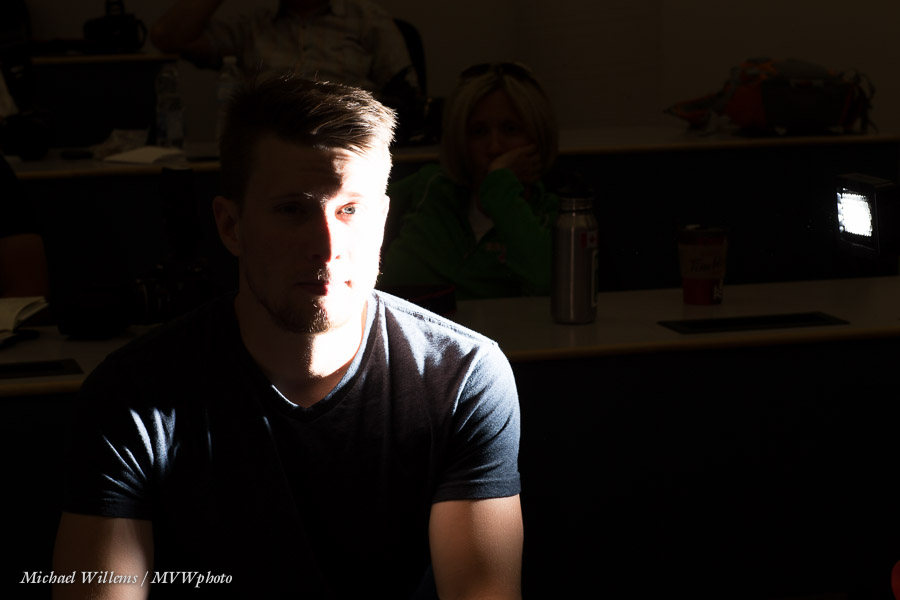
For chiaroscuro shots like this, of a Sheridan student Monday night, I prefer manual flash power settings to TTL (automatic flash metering).

(1/125 sec at f/10, ISO 200.)

Why? Because TTL may try to average this and will therefore overexpose the bright areas. If I do it manually, once it is set correctly, it is set correctly, period.

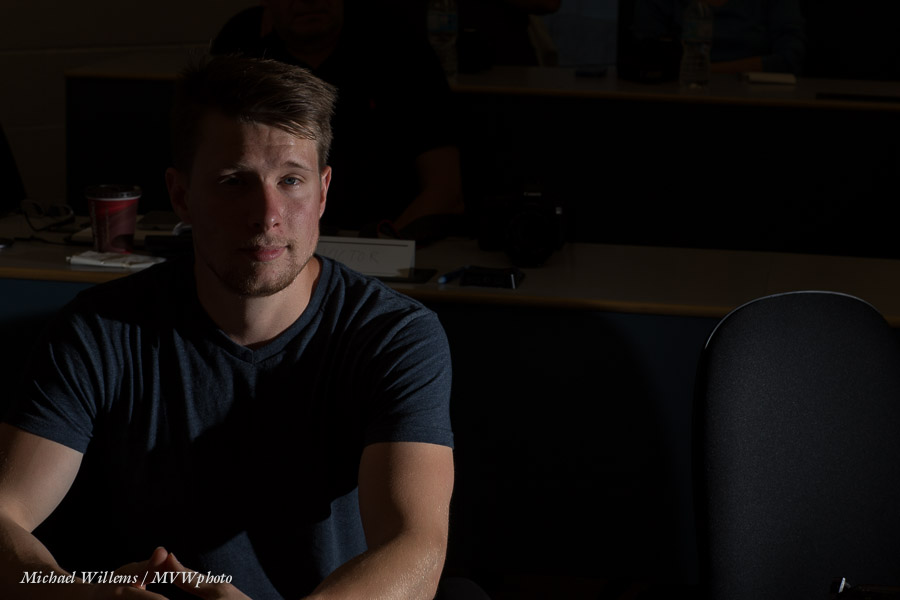
Unless, that is, I change the distance between light source and object that is being lit. Closer gives me this:

And farther gives me this:

That’s because of the Inverse Square Law. The brightness decreases with the square of the distance. Twice as far means 4x less light. 3x farther means 9x less light (since 3×3=9).

And

  • 1.4 times farther means 2x less light, i.e. one stop less, since 1.41 (the square root of two) times 1.41 is 2.
  • 0.7 times closer means 2x more light, i.e. one stop more, since 0.7 (1 divided by the square root of two) times 0.7 is 1/2.

So—and remember this: every time I want one stop more light, I move a flash 30% closer (to 0.7x the original distance); and every time I want a stop less light, I move the flash 40% farther (to 1.4x the original distance).

See? Math can be useful! Who’d have thunk.

Quiet times. But…

….but things will speed up again, no worries, fans. I have been preoccupied with things, busy shooting, busy teaching, working on the e-store at http://learning.photography, and dealing with all manner of issues. But things, as said, will get back.

Meanwhile, there’s a father’s day special! Go check it out: http://learning.photography

There are three Father’s Day options, open ONLY until Sunday: All five books for $49, a portrait for $100, and a one-on-one lesson for $149! Go check them out!


Whoop Whoop Pull Up

The title of this post? That is a warning, the kind of warning you get on the flight deck as you are about to fly into a mountainside.

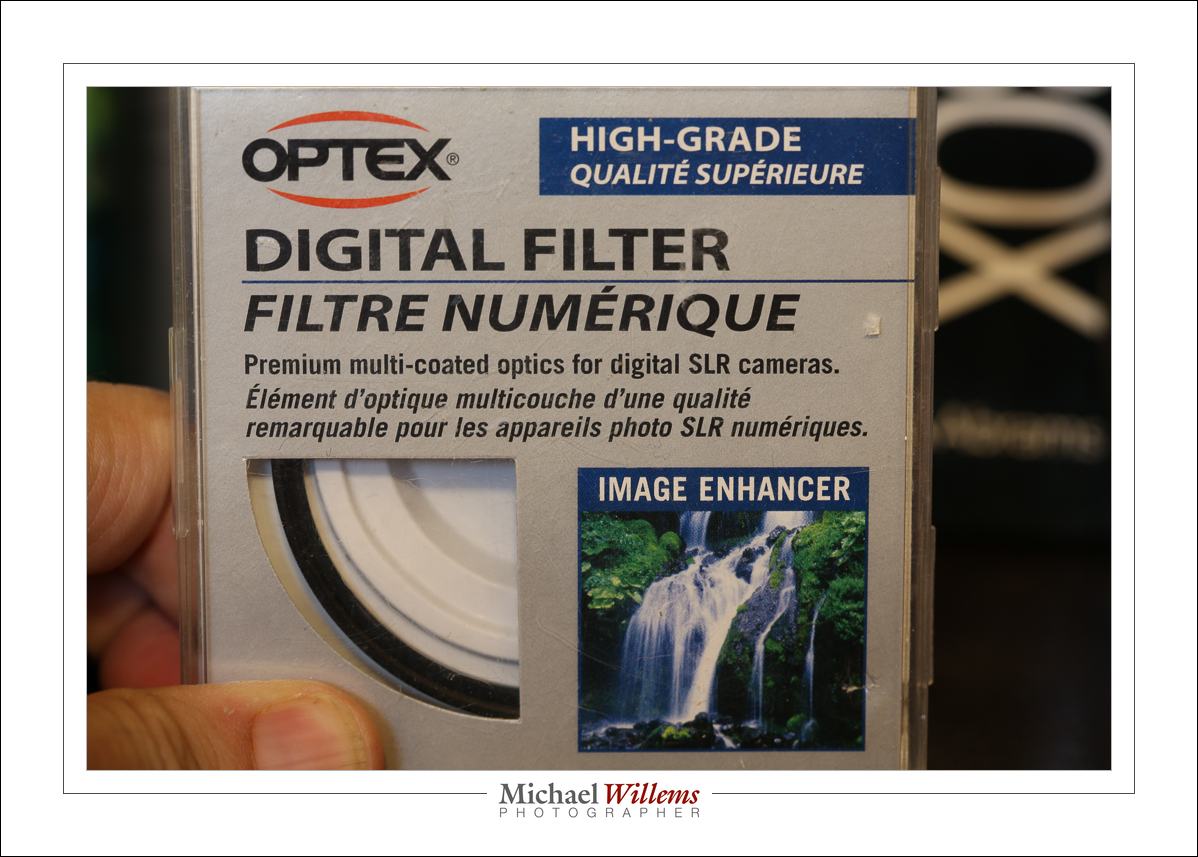
It is also the kind of warning I feel internally when I see something like this:

I mean… digital filter? Like photons care? Yes, I can imagine scenarios where a sensor needs a different filter from film, but not readily, and this ain’t one of them. This is more a marketing ploy to get Uncle Fred to hand over more money to replace his “analog filters” with digital equivalents, I think. So while having some lens filters for protection is a good idea in case it rains, do buy good filters, but don’t worry about having them always on every lens. I personally never use them.

Instead, spend your good money on a modern camera, 3 years old or younger, and on lenses.

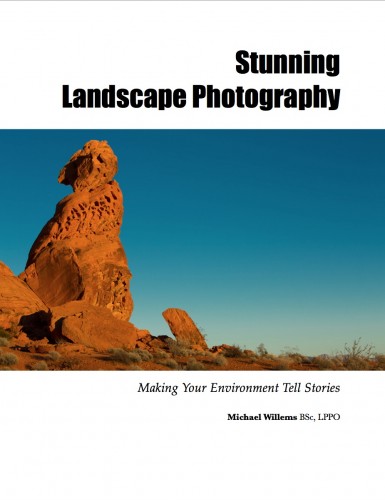
And on my newest ebook, and do use the discount code, see yesterday’s post.  Click on the image below to also see a few sample pages, plus the table of contents.


For Your Eyes Only!

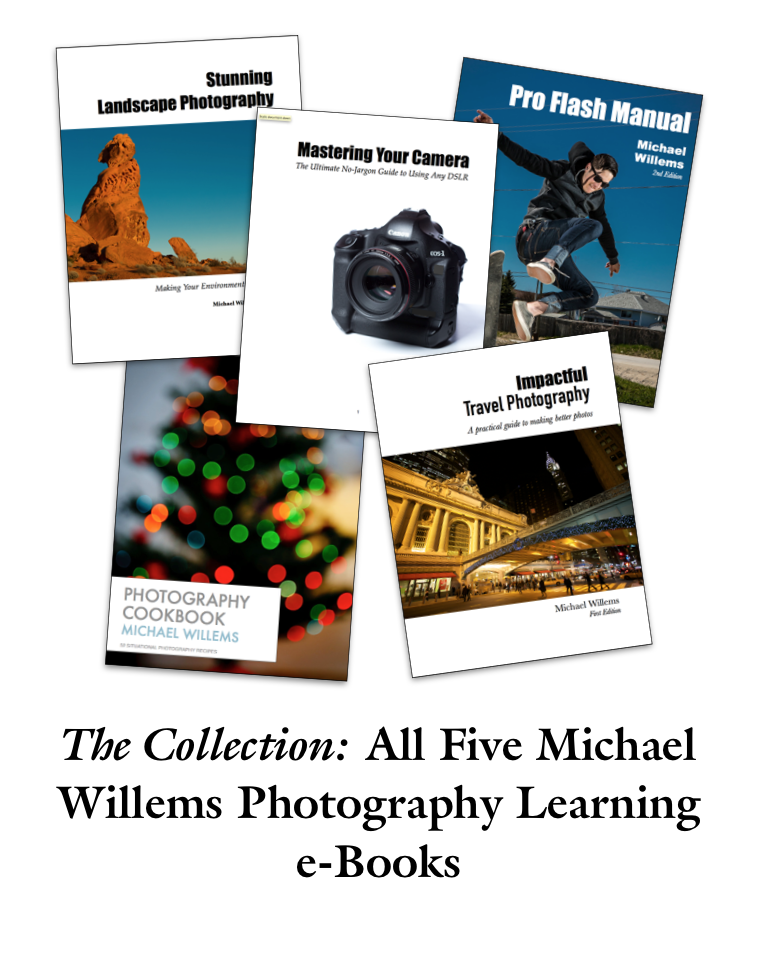
As you saw yesterday, the new book “Stunning Landscape Photography—making Your Environment Tell Stories”, the fifth in my series of e-books, is available immediately from the e-store at http://learning.photography.

And better news still. If you have always wanted to buy my e-books but have not gotten around to it, I have a deal for you, as a loyal reader.

Get an additional 10% off everything you buy, until July 1st, by using discount code “Speedlighter” upon checkout.

Enjoy!


Brand aware!

An acquaintance-via-the-web asked:

“I’m not a photographer. I’m a very busy mother of three. Having said that I’m looking for a “stupid- proof” dslr camera. We’d love the quality of the photos but want something simple to use. I was looking at nikon d series as well as the canon rebels.”

Well, as you might imagine, I have a few things to say in reply!

First: the camera does not really matter. You should be in manual mode for best result, and a camera is just a camera. The lenses matter: get a fast 50mm f/1.8 or f/1.4 lens. And both brands are superb. I can, and do, use both and I love them both.

But then: for the low-end cameras, go Canon. A Digital rebel has all functions including (for most) remote TTL flash master, flash compensation, flash exposure lock/flash value lock (FEL/FVL), and many others The Nikon leaves out many of these functions in the low-end models. And believe me, you will grow to need these. So definitely, between those two, the Canon.

Third: there is no fool-proof camera. The camera is a fool. In any picture, only YOU know what should be sharp. The camera does not. Only you know how bright or how dark you need the picture. Only you know what colours you like. There is no way for a camera to know these things. You need to learn things. Get the “mastering your camera” book from http://learning.photography and read this. Read this web site. Learn how to use the camera on manual (the free chapter will help, too). Asking for a stupid-proof camera is like saying “I want to do brain surgery but I just want it to be easy: I want stupid-proof scalpels”. It just does not work that way. We distinguish Uncle Fred snapshots from real pictures by the amount of knowledge the photographer has.

And the good news: not that much knowledge is needed. Learn how to:

  • Operate the camera in manual mode (manual IDSO, manual aperture, manualshutter)
  • Focus where you need, using just one focus point
  • Set the right white balance (colours)

Learn these simple things.. get a digital rebel with a 50mm f/1.8 portrait lens and do just a few hours training and your photos will be superb. You will be grateful later in life, when you have brilliant shots of your kids. Shot like this, which you can easily take with a Rebel and that 50mm lens:

Go for it, and enjoy photography. It can be easy, but you do need to learn a few basic things.


Engineers, and Thought For The Day.

If I were an engineer, I would use normal language.

Wait. I am an engineer. and I do use normal language.

But I am unique in that, it seems. Alas, the camera makers tend not to. Take this example. If I had a focus mode that does continuous focusing, I would call it “continuous focus”. D’oh. But if I am a Canon engineer, I call it “AI Servo”, because I assume that everyone knows that “AI” means “Artificial Intelligence”, and a servo-motor is an accurately controlled electrical motor with built-in negative feedback loop and positional awareness. Sigh. And we wonder why 90% of SLR users haven’t a clue how the SLR works or what it does?

So when your manual makes no sense, do not despair. It is not you. It is the manual.

What you can do is, of course, take one of my courses and read my e-books (see learning.photography, my new e-store; and yes, I would love feedback on that store please!). Or you can learn by reading this blog back to front. Or by figuring it all out yourself. Just remember: it’s not that complicated. It is often enough the jargon and the assumptions that “of course you know that” that makes this stuff complicated. Bear with it: you can learn pro skills!


EASTER SPECIAL

EASTER SPECIAL, ONE WEEK ONLY: my four e-books all for sale at a special reduced price. 25% off each book, or 50% off if you buy all four, This week only.

Four e-books to cover many aspects of photography. Photography is not difficult. Amateur or pro, you will benefit from:

  • Mastering Your Camera
  • Impactful Travel Photography
  • Advanced Flash
  • 52 Photographic “recipes”

See www.michaelwillems.ca/Book_Special.html and learn the secrets of professional photography—today. Act Now: This special is only valid for one week, after which prices will revert to their regular level.


Learning tip

Here’s a learning tip.

When you take a course or read a book (such as my e-books), you get all sorts of ideas. Great ideas that make you think “I must do that, next time I shoot”. Especially when travelling, the ideas can be very useful. Ideas like the use of negative space:

Or of using a close-by object (“close-far”) to introduce depth:

Great ideas. But you forget them, right?

So here’s the idea. Re-read your notes, or the book, and write down the 20 most important learnings. Make a list, whittle it down to about that number. Then write those 20 things down in shorthand, i.e. in simple form, on a piece of paper not much bigger than the size of a credit card. Have that laminated with plastic so it  lasts. Then carry it on you and before you shoot, look at the card for 20 seconds. Just 20 seconds. More is impractical: you’ll never do it. But 20 seconds is doable. That way, you refresh your mind when it matters. Namely, when you are about to shoot.

__

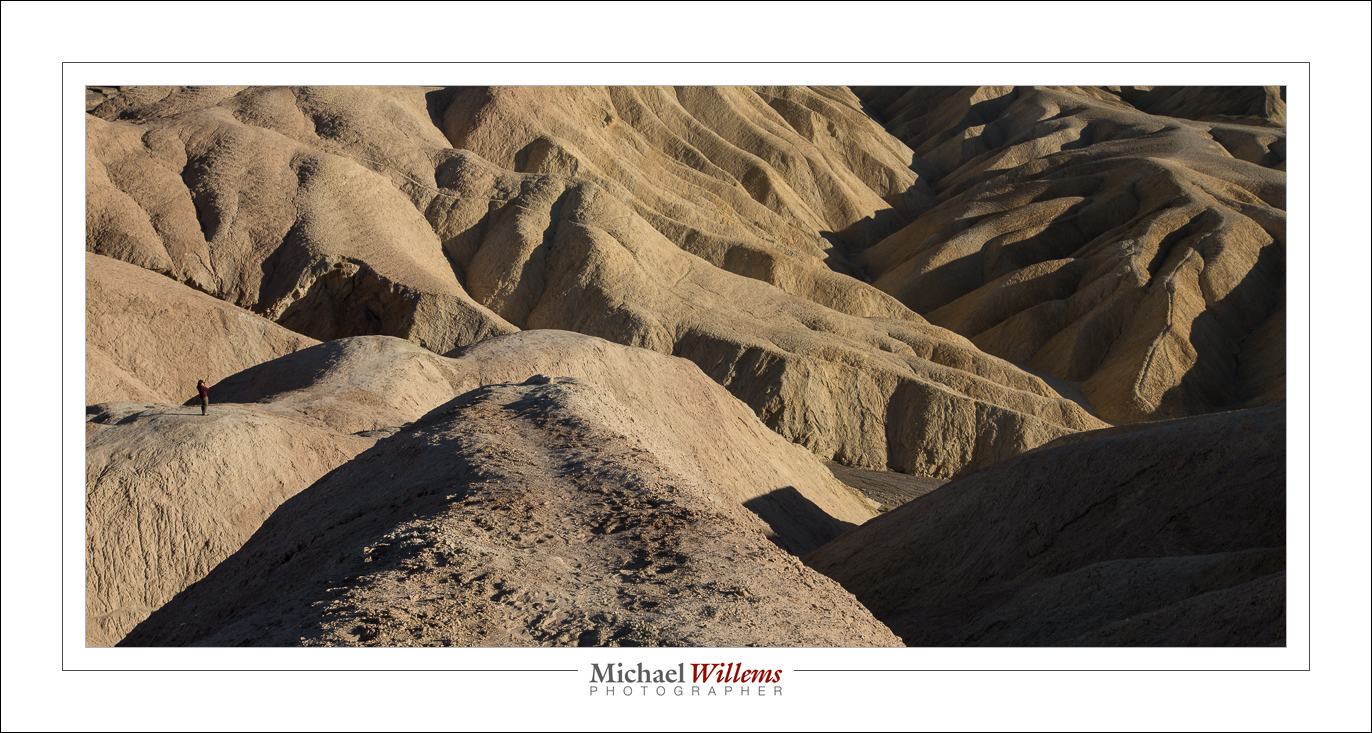
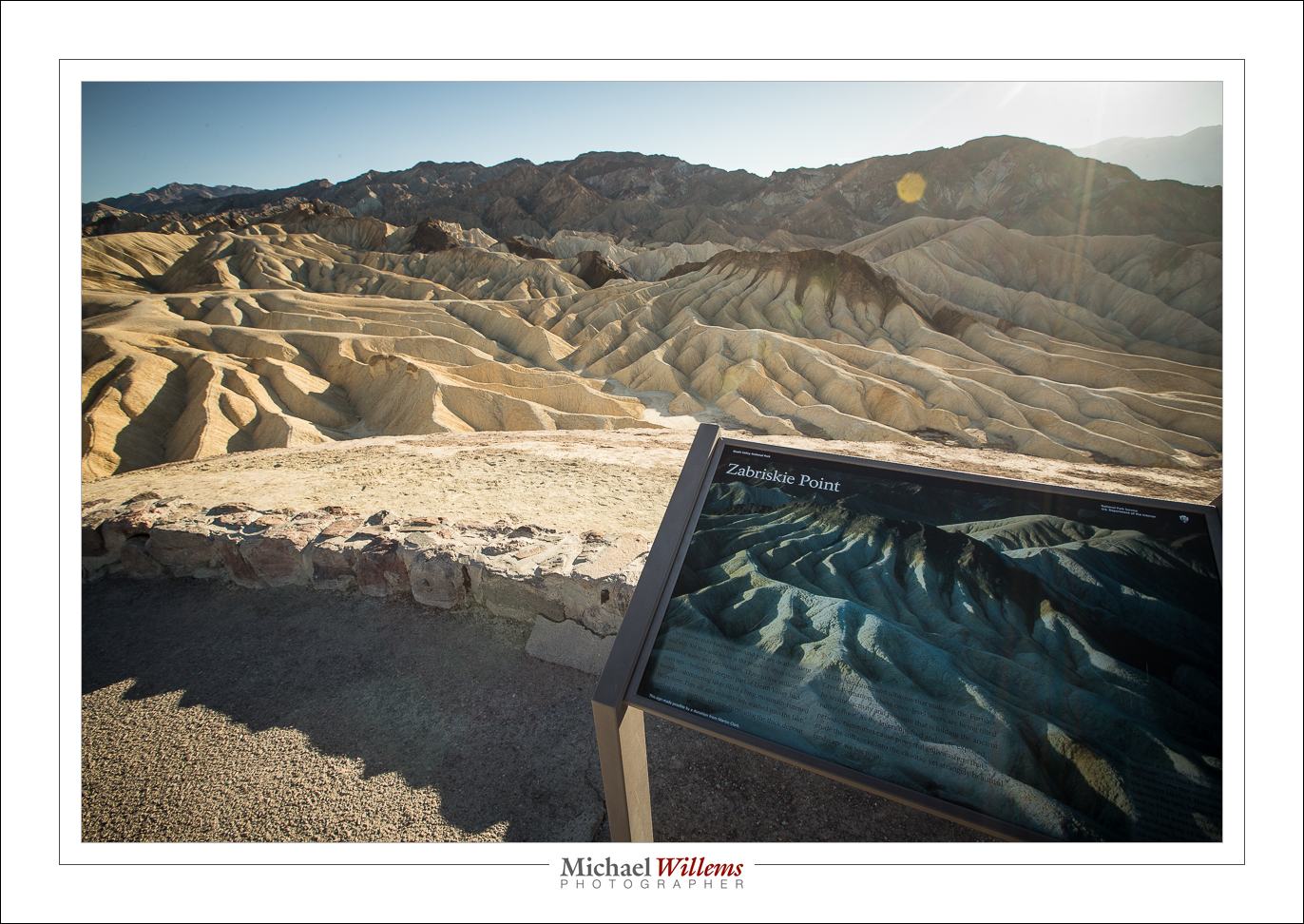
I made the first shot above in January at Zabriskie Point, Death Valley, California, using my Canon 1Dx camera and my 16-35mm lens set to 35mm. I was at 200 ISO, 1/400th second, f/11.

The second shot was the same except for the focal length (here, 16mm) and the shutter speed (here, 1/100th sec).