Funny math, and…

Remember the main aperture numbers? f1.4, f2.0, f2.8…

No, let’s do that again properly:

f/1.4,  f/2,  f/2.8,  f/4,  f/5.6,  f/8,  f/11,  f/16,  f/22,  f/32, f/45, and so on.

(Note: Corrected the f/35, my typo)

The last list is correct since an aperture number is a fraction. Strictly speaking, it is not “f 8”, but “f divided by 8”. Where, simply explained, f is the focal length of the lens and the result of the fraction is the diameter of the lens opening.

Why are these numbers important?

Because every next number is a stop darker (or when you move to the left in the list, a stop brighter) than the previous number.

A stop means halving or doubling the light. Hence the funny numbers; the ratio between these numbers is √2, or around 1.4, since to halve a circle’s area you reduce its radius by √2; halving the radius would instead you a quarter of the area (πr2).

So why are these numbers good to know? Well, imagine you are shooting at f/5.6 and 1/50th of a second. If instead I wanted to go to 1/100th second, what f-number would give me the same exposure?

The answer: 1/50th to 1/100th sec is one stop less light. So the aperture needs to provide one stop more light. Which means f/4, and you can set that instantly if you know the table of main values. Hence its importance!

Happy July 4th, US friends!


Light Meters Are Old Hat. Not.

Not! A light meter is an indispensable tool if you want to ace your exposures first time.

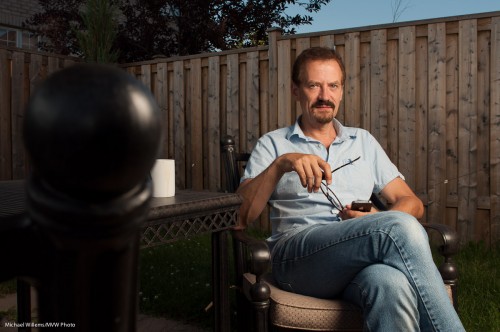
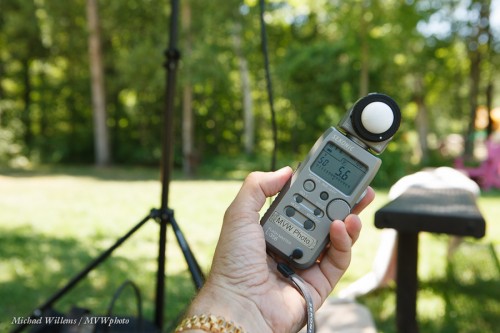
Take this scene (taken, incidentally, amidst a whole bunch of naked people):

That meter is well exposed. Perfectly, in fact. Values were 100 ISO, f/5.6 at 1/50th second.

How? By reading the values off the incident light meter (a meter you hold where the subject will be):

  1. Set the meter to ambient (not flash) metering
  2. Move the ball out
  3. Select the camera’s ISO and the aperture you want
  4. Hold the meter where the subject will be.
  5. Click and read the value for shutter.
  6. Set those values on your camera
  7. Click.

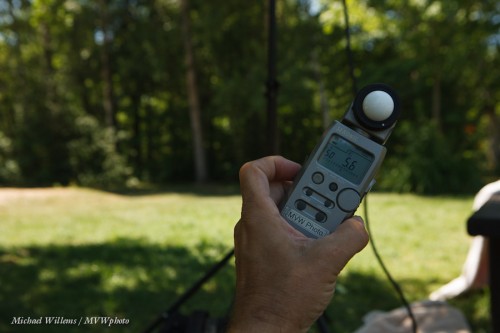
With the camera’s built-in light meter, however, the exposure came out like this, since the light background was also read by the meter:

That’s nice for the background, but if the meter is the subject, this exposure is all wrong – 2 stops too dark (the camera thought 1/200th was the correct shutter speed).  You would now have to adjust the exposure manually, or instead aim your camera, set to spot metering, at a gray card held there. Which is less convenient.

And that is why light meters are far from old hat. Pros use them all the time, even as ambient light meters as here.


Why oh why?

Happy Canada Day!

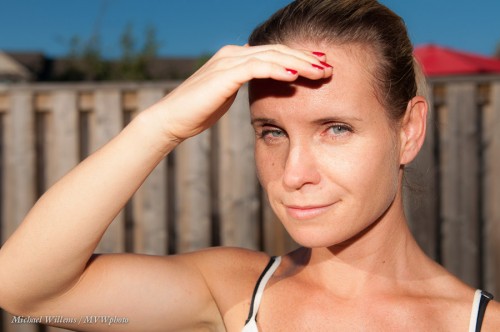
So why do I do this, people ask – this daily blog? Give away all my knowledge? Like how to take dramatic portraits like this (thanks, Mel) on a sunny day?

(Hint: 200 ISO/ 1/200th second, f/11, and a speedlight in an umbrella. See if you can work out why those particular settings? )

I do this teaching blog for a number of reasons.

First, because I am passionate about photography. We should all document our lives with artistic photos – the only time travel we ever get to do.

Second, because if I don’t, someone else will, and I’d rather you learned from me since I believe I know what I am talking about. I am a full-time photographer and photography coach and teacher, so I live and breathe this.

Third, because many of you come to me for private training sessions. A few two- or three-hour sessions and you will know so much more than before – all this theory here wil click into place and whatever aspect of photography you need help with, we can teach you quickly. From portfolio reviews ove rthe internet to live workshops here in Oakville, Ontario or actoiss the Toronto area and nerby, I’m your guy. You won’t believe the improvements to your photography!

Fourth, because some of you will come see me at venues such as my Vistek Mississauga seminars, and at the five-day August Niagara School workshop at Brock University (there’s still some space).

Fifth, because if you like my photos, you may engage me for your portraits, wedding, event, party, industrial, nudes, or whatever-else-you-want-documented-photography. I;m good, and while not the cheapest, I am sure you will be delighted with the iamges.

And finally – last but not least: becuase I love teaching. We are here only once and we may as well share.

Hope you enjoy. This blog is free and always will be. Updates are daily – with a few exceptions when I am travelling and so on.

And if you do feel like contributing: make a contribution at my site and I will send you a personal preview draft of my Photography Recipe e-Book (in convenient PDF format) as a sign of my gratitude!


What’s this Hi-Speed flash thing again?

A reminder for all you speedlighters.

Say you want a shot like this, taken a few days ago,with your Nikon D90 or whatever SLR you have equipped with an external flash (like an SB900):

Yes, direct on-camera flash, when used outside and hence mixed with available light, can give you this – not bad eh? And the picture isn’t bad either. 🙂

But look at the background. It is blurry.

That means a large aperture was used (f/5.0 in this case).

But that means the shutter speed must have been very fast – even at low ISO, you need a fast shutter on a sunny day if you want the aperture to be large. I used 1/2500th second.

But hang on. When using flash, you cannot exceed the flash sync speed! Which is 1/200th second on this camera.

So how did I do this? I enabled “fast flash”. (“Auto FP flash” is what Nikon calls it; Canon calls it “High Speed flash”). On a Nikon, go into the flash part of the pencil menu and find flash sync speed, and set to Auto FP. On a Canon flash, indicate the little “H with a lightning symbol”.

Now the flash, whenever you exceed the sync speed, pulses rapidly instead of firing all at once, meaning that you can shoot at fast shutter speeds, where the shutter never fully opens all at once.

The drawback is that most power is lost, so you need to be very close. Aim the flash forward and watch the indicated flash range: as soon as you exceed the sync speed, that range drops rapidly. Stay within that range and you get great outdoors flash pictures!

___

NOTE: Come join me for a five day workshop at August’s Niagara School of Imaging – it is filling up but there is still space. Act now and spend five days with me on all this stuff, and emerge a flash pro.


EV

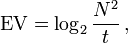
You will have perhaps noticed that in the EXIF Wizard post the other day, theere was a value called “EV”, or exposure value. That is the absolute “exposure value” that corresponds to a certain “light value”. The exposure value is basically a camera setting for exposure, where:

(N = aperture number, t= exposure time).

0EV corresponds to “1 second at f/1.0”. A typical exposure value for a full daylight scene at mid-day in full sunlight at 100 ISO is 15.

And this is useful, why?

First, because it allows you to realize that there is such a thing as absolute exposure values. Second, more practically, because using this, if you use a tool like Exif Wizard, you can see what the light value was when you took a certain picture.  And that is always useful for a photographer. And third, because light is predictable (the sun is always equally bright, for instance – rememer the “Sunny Sixteen Rule”?), so you can use the theory behind this to calculate camera settings.

This article on Wikipedia is good reading, if you feel like a little light academic liftwork.


Solo Exhibits

As you may have gathered, in the next few months I am putting on another two solo photography exhibits. One starts this weekend: an exhibit with a twist. A series of Fine Art Nudes, displayed in a naturist resort 40 minutes north of Toronto (just past Newmarket). See www.michaelsmuse.com for more details. The twist, of course, is that the audience will also have to be nude. (Try it: not weird, not threatening – and a whole new level of interaction with the subject matter – this is a unique experience – don’t miss it).

The second exhibit will be in the Kodiak Gallery in Toronto’s historic Distillery District, during all of August. Stand by for details soon.

So as for the first of these: why shoot Art Nudes?
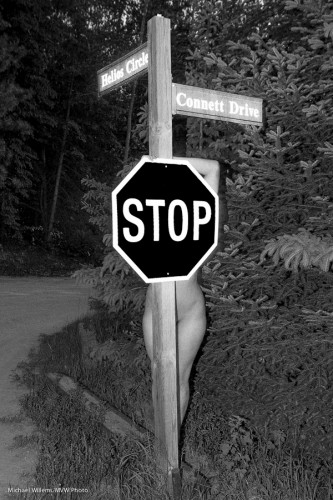
I wrote posts about that on my Tumblr.com feed, here and here (warning: you may encounter nudes). But let me summarise, including a repeat of some of what I said on Tumblr.

I shoot many things. Weddings. Parties. Events. Business portraits. Product. Industrial. News. Whatever you have, I’ll shoot it. But like most photographers, I also consider that there is a large art element in photography. And nudes bring that out more than most other types of photography. They are far from simple to do well: you have to know technique, composition, light, and especially, what people think.

  • “You just get a naked girl in front of your camera and click”, some people say.
  • Or “You sleep with your models”
  • Or, “It’s Porn”.

Let’s start with the latter: nope. It is not porn. Porn is pictorial depiction of the sex act. Nothing against the sex act or its depiction, but it is very limited in its expression of mood, story, emotion. These are pretty clear. I do not object to porn, but it is not that interesting: it is limited not because of what it does show, but of what it does not show. No story. No mystery. No beauty. No guessing. No freedom. Just sex: porn shows one subject only.

Sleep with models? Nope. If that is all you want there are much easier ways, I am sure, than by lugging around expensive and heavy camera and lighting gear. I think in general, it’s good to separate the personal and professional worlds.

Finally, the first part. No, it is not easy. When you picture someone nude, you picture their essence. You picture an emotion, an expression, a feeling, not encumbered by clothing, which restricts, ties to a certain time, sets a mood for you. You can picture many things, not just one. And best of all, a good nude is evocative. It raises questions. It tells a story, and best of all, it makes the viewer wonder what that story is; put it all together. That, in my mind, is the essence of an art nude. That is why it is art. Art Nudes are difficult but very rewarding.

When you want to achieve, you should challenge yourself. If you want to learn photography – and that is why you are here, I presume – you should definitely try nudes. They do not have to be 20-year old supermodels – on the contrary.

Oh… to see an illustration of how most Canadians get it, and are therefore relaxed about these things, go here (warning, nudity). From yesterday’s shoot.

Want to learn more? Give me a call or drop me a line, or better still, come to Never Not Naked: Natural Nudes, 22 June-8 August just north of Newmarket, Ontario. I promise that if you have the courage to turn up, if it is the first weekend I shall be there and I shall take the time to give you sufficient tips to get you started.
When a shoot is done…

…it is not done. In some ways, it is just beginning.

Apart from the obvious finishing, which includes things like:

  • Choosing images to use
  • Cropping
  • Rotating
  • White balance correction
  • B/W conversions
  • Lens corrections
  • Exposure adjustments (especially if you “shoot to the right”)
  • Skin adjustments if needed

… there is a very important aspect to finishing: “look with fresh eyes”.

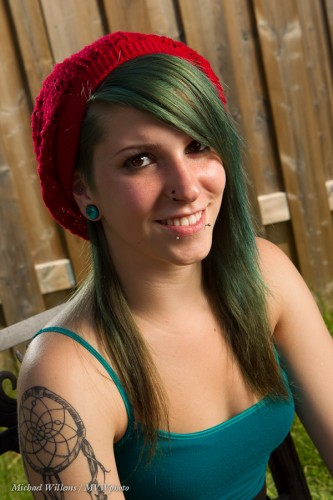
I shot portraits of new model and photography student Khoral today. She is young, pretty, and very photogenic. She has an amazing quality: she always smiles. A quality which will see her achieve big things in life. Here’s a sample:

And my point is: that is a sample. Out of the several hundred images I did a preliminary pick of around 100 to present to her, with around 30 top picks: a higher than normal number for a first shoot. When photographer and subject know each other, the shoots get ever better.

But I am stopping there for tonight. Because when I look again tomorrow or the next day, I am more detached and see the art as art, not as “what we were saying and doing at the time”. As a result, I will find several images I overlooked today. Even months after a shoot, a new look yields new winners.

My advice for today: always put your photos away after you shoot, and look again a few days later with a fresh pair if eyes. You will often be amazed at how you did.

I shall leave you with a couple more snaps. But in the next days, when I look properly, I shall be able to choose my winners.


The Art of the Dramatic Portrait, Continued

At the risk of being repetitive, let me deepen your understanding of dramatic portraits a little.

A dramatic portrait, in my world, is one where:

  1. I emphasize the subject.
  2. I darken the background.
  3. I make the subject the “bright pixels”.
  4. I carefully shape the light.
  5. I carefully direct the light.

You have heard me say this many times, but as said, let me deepen your understanding.

To show you want I mean, look at a few samples from a recent shoot the other day. These are outtakes, but they serve well to see what I mean (for actual shots, come see the Never Not Naked: Natural Nudes exhibit – an exhibit with a twist, June 22-July 8).

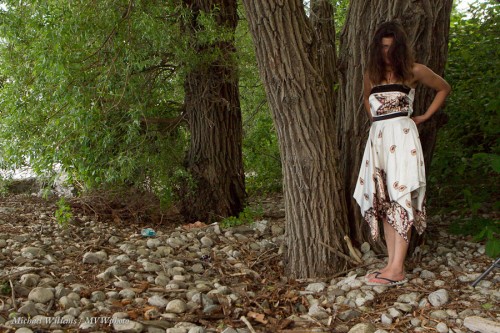
Let us start with a typical snapshot. 100 ISO, f/5.6, and this would be around 1/30th second. This is what available light and “Auto” or “Program mode” would give you:

Fine, but there are several things that can be improved.

  • The subject’s face is lit uneventfully and insufficiently.
  • The subject is “dark pixels”, not sharp “bright pixels”.
  • The subject competes for attention with pretty much everything else.
  • The tree bark’s texture does not really come out very well.

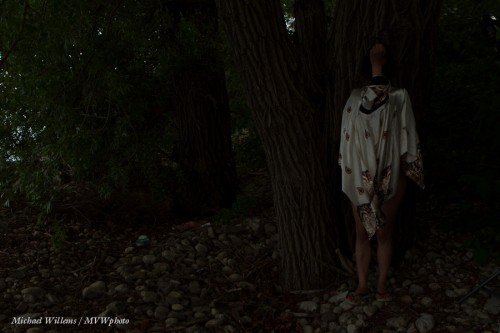
So now let’s do it properly. When I say properly, I mean “Michael Dramatic”. And “Michael Dramatic” for me means three stops below ambient. So I move the shutter to 1/250th second. Three stops darker than a “normal” exposure, in other words. (1/30 to 1/60 is one stop; 1/60 to 1/125 another; 1/125 to 1/250 the third stop).

Three stops is my dramatic portrait. Often, of course, you use less than three stops darkening. Like when you want less drama. Or when your flash is not powerful enough to provide three stops above ambient light.

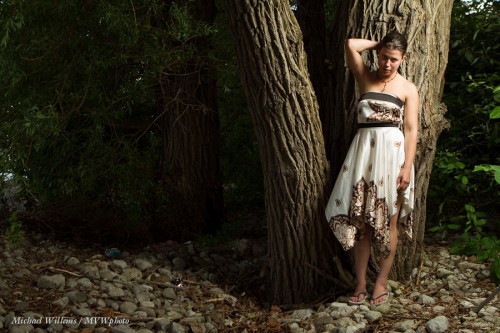
Anyway, three stops below gives us this:

That’s dark. Um yeah, that is what I had in mind.

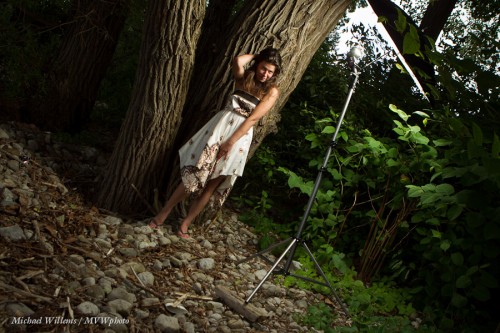
Because now, finally, we add a flash. And we get what we came here for:

That was done with a single off-camera 430EX speedlight close by, fired into an umbrella. Like this:

You see there are several aspects to this, right?

  • The darkening of the non-flash lit part of the image (the “background”).
  • Properly lighting the subject.
  • Softening the light for the human.
  • But also the shaping and directing of the light. When I see a tree, I think “texture”, and side lighting brings out that texture.
  • Good composition.
  • The Inverse Square Law: light drops off away from teh flash.

Yes, all this needs to come together for a good shot. Go try a photo like this, and tell me how you did!

___

Note: You really can learn this, and in not many hours. My June Special is stil on: $75 per hour plus tax for private coaching, for June only (normal price is $95 per hour).


The Beer-Quay?

At the risk of sounding defensive, let me emphasize to all my students:

Your photography is valuable – do not give it away.

Photography is at least as valuable as, say, dental hygiene, or plumbing, or sewers, or garbage collection. Yet people will pay for the latter, and pay well, and often not for the former.

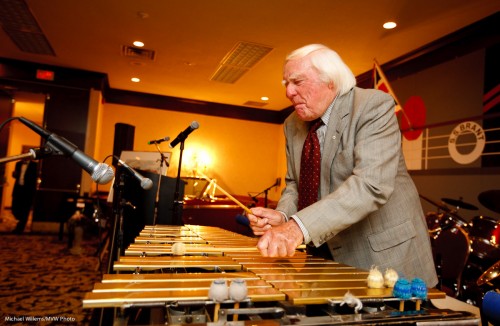
Case in point. An art festival contacted me a few days ago: they wanted to use my photo of Jazz great Peter Appleyard, which they described as a “stunning photo”:

Peter Appleyard. Photo © Michael Willems, All Rights Reserved

Note that this is a significant art festival, which:

  • Charges up to $50 for admission per guest, for each event. Plus HST.
  • Is sponsored by the Ontario Arts Council, the Ontario Arts Foundation, the Canada Council for the Arts, and  the Canadian Heritage ministry.
  • Is sponsored by The Cooperators and various other commercial organizations.
  • Undoubtedly pays for its venues, food, drink, permits,
  • Undoubtedly pays its performers.
  • Undoubtedly pays its taxes, office costs, hydro, water, sewerage.
  • Most certainly pays its printer for the brochure I was going to be used in.

And yet for the photo there was no remaining budget.

I would have let it go for a very small fee (my way of subsidizing the arts), but “”free” is a no-go. You see, I too am expected to pay the bills.

Why is this happening? I see a few reasons.

  • “Uncle Fred has a Digital Rebel”. This makes the perceived value of photography zero, even though there’s no way Uncle Fred can produce a photo like the above.
  • New photographers fall into the trap of “doing it for credit”. Don’t do this, new photographers, if you ever want to do it for a living! Instead, calculate the hours you really spend on a shoot (including talking about it, getting there, shooting, waiting, and post-editing), and multiply that by the wage you want to make (hint: you are worth at least what a dental hygienist or a plumber are worth!).

It is what it is – the Dutch have an expression that translates as “you can’t fight the beer quay” – i.e. if people want beer delivered, it WILL happen. Calligraphy went away, and if quality photography is no longer wanted by society, so be it. We’ll all just shoot weddings. Although – even those: I have recently been asked to shoot several weddings for “a few hundred dollars each”. Which is at least 20 times below my normal fee.

There will of course always be quality photography, Ads in magazines, art shows (like mine coming up: Never Not Naked – Natural Nudes) and more will always need competent artists. But it will be a market where 1% of photographers get paid, and the rest do it “for credit”.

So – a parting thought: be part of the 1% and come to me to learn how to really do it!


Flash Ethics

I bumped into another pro yesterday at The Distillery. She was about to teach a workshop and thought I had come to attend. Which I had not.

Turns out this photographer does photojournalistic weddings and family shoots, and never uses flash, and, astonishingly to me, for the following reason: because she has “ethical problems shooting flash”. I think was unable to convince her to even take a look at speedlighter: flash was a no-go area for her.

Ethical? Artistic I can understand, but in my experience, pros who do not use flash have several reasons:

  1. They do not really know how to, especially TTL flash with all its limitations and complexities. This is the vast majority of non-flash users.
  2. They have genuine (and in my view, misguided) ethical problems.
  3. They have reason (1) but say it’s (2).

Category 2 is a minority, and in my opinion, a misguided one!

As a newspaper shooter, I could never alter a picture: cropping, white balance and exposure is all, and any other alteration would ensure I would never work in press photography again. You need to trust the photos you see in the paper. So I get ethics! But adding light has been allowed for many, many years. What are you supposed to do when there’s not enough light?

I shoot, and teach shooting, with flash. Either:

  1. On its own (in a studio); or in a mixed environment, namely:
  2. Mixed with bright outside light, when you need to kill that light
  3. Or with dim indoors light where you have to boost that light.

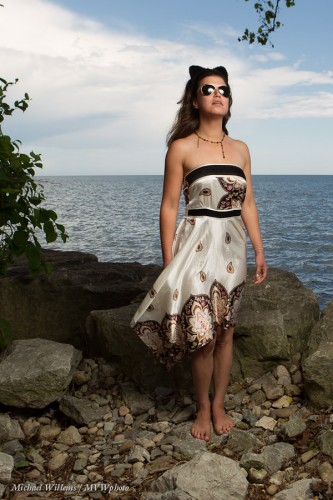
The main point is not not the adding light – the main point is the creative options that this opens. By saying “I only shoot with flash” you are denying yourself a great number of opportunities. Like this, taken a few hours ago at Lake Ontario in Oakville:

I used an off-camera flash. Am I ethically sinning by adding light and making this a nice picture? No way. As for events: bounce behind you and use the flash as additional light. You are not committing ethical breaches by doing this!

So go ahead, learn flash, and use it for both technical (adding light) and artistic purposes. Have fun!