Shot of the day

Here’s my Picture of the Day, taken last night:
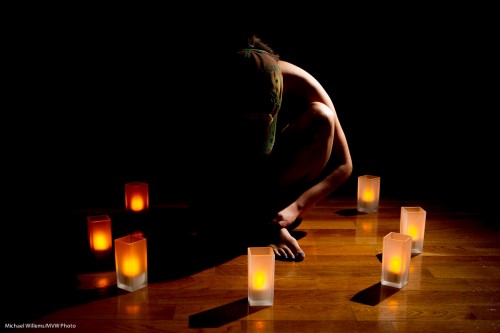
For a picture like this, what are the challenges?

First and foremost: to get the exposure right for the candles, while still keeping the room dark. The usual “flash only” setting of 100 ISO, 1/125th sec, f/5.6 will not work: the candles would be dark. Too wide open, and the entire room would be bright. You have the find the right “in between” setting: in my case, 1/30th sec at f/5.6, 400 ISO. Room lights were dimmed slightly, to avoid dark areas from becoming light.

Second, to avoid flash hitting the entire room. I fitted the single flash, an off-camera 580EX, with a Honlphoto 1/4″ grid. This lit up the side of the model, and the centre of the floor, only. (You can work out where the flash is by seeing where the shadows converge.)

Third, to aim the flash correctly. This is of course a matter of taste: I like side lighting to emphasize round shapes (the arm, leg, and toes in this picture).

Finally, to get the flash to the right level of brightness. I used TTL with flash compensation, though normally I would have used manual flash power setting for a creative flash shot like this.

Try a shot like this, if you are up to the challenge!

High Key: Keeping it Simple

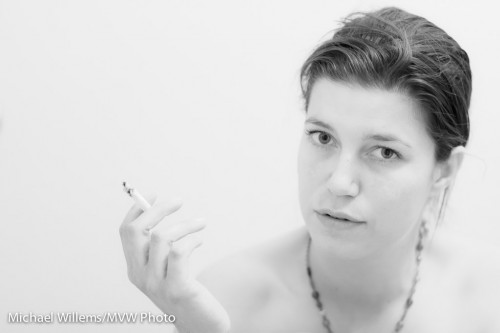
A quick pic of the day today. A “high key” image.

That is, a photo where the entire image is bright. Like this one:

To do this:

  • Use a person dressed in white, or a pale-skinned person, against a white background.
  • Expose properly – meaning brightly. Use manual, or use exposure compensation + (plus 1-2 stops).
  • Or, when using a flash, use flash exposure compensation +1 to +2 stops.

Note also that I used the “rule of thirds”. One attention point – the eyes – is top right; one (the cigarette) is bottom left.


Filling the frame

When you shoot, consider “filling the frame”.

This is one of the easiest ways of simplifying. In the picture here, for instance, I used this:

I used these devices:

  • Filling the frame. Yes, you can cut off bits.
  • Selective focus. This helps “tell the story” and generate interest.
  • The Rule of Thirds. Off-centre composition creates a much more pleasant composition.

A little goes a long way, when these simple compositional rules are concerned.


More “simple light”.

Here’s student Brittney, in a Seneca College workshop I did the other night:

Again: simple light: one off camera flash.

  • From yesterday’s post you will remember that I first thought about the background, then about the flash. In this case I set my camera (in manual exposure mode of course) to give me a very dark background. I wanted no ambient light.
  • And yes, you can use direct flash. I had a honl photo grid on a 430EX flash, driven by the camera’s 580EX.
  • The 580EX was disabled from contributing to the actual shot: all it did was fire commands.

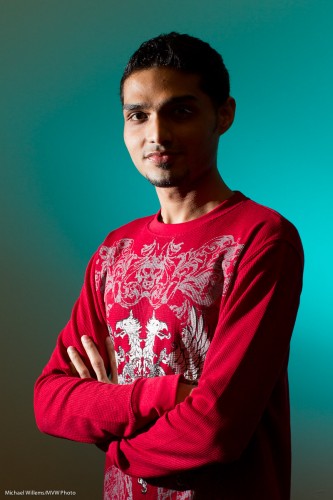
Another student – and here I added a background light too:

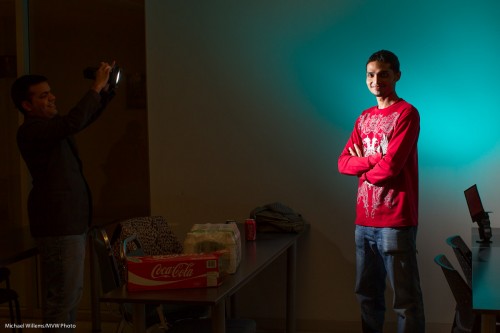
How did I do that?

TIP: always do a “pull-back shot”, where you see your setup.

As you see, here I asked a student to hold the gridded main flash; then I used a second flash with a gel and, to prevent the color from hitting the subject or shining into my camera, a flag (a gobo – “go between objects” – the Honl bounce cards are also gobos/flags.


Available Light

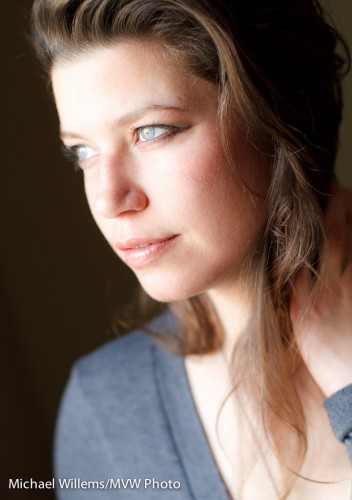
Here’s an available light portrait of the other day:

In a portrait like this, keep the following in mind:

  • Use a prime lens at wide aperture (like f/2.0) to get that dreamy look and to get the ability to shoot in this available light. A fact 50mm is great for that (I used my 50mm f/1.2 lens on a 7D for this shot).
  • Even so, use high enough ISO to ensure a fast shutter speed (say, 1/twice the lens focal length, so 1/100th sec on a 50mm lens). I used 400 ISO here, to get 1/160t sec at f/2.0.
  • Put the person next to a window with indirect daylight – not direct sunlight.
  • Ensure they are low enough for the face to be hit by the “cone of light” that comes from that window;
  • Turn the face toward the light for even lighting if that is what you want.
  • Use a reflector if necessary to open the unlit part of the face.

And that is how you do that. Could not be simpler. Try some!


Flash Note

When bouncing a flash, you may need more flash power than you have available. To ensure you have enough, do the follwoing:

  1. Use an ISO of at least 400. You may need higher ,especially if ceilings are high or non-reflective.
  2. Use an aperture of, say, f/5.6 or wider.
  3. Test your bounce environment by turning the flash to MANUAL mode at full power (1/1, or 100%). Fire. If the picture is overexposed, you have enough power; go back to TTL and start your shoot. If not, then raise ISO and open aperture, or move to a better environment.

Simple steps that can avoid a lot of pain – and TTL flash can do a good job, like here in Anastasia’s picture a few days ago:


Lighting

Here’s why you use proper lighting – with flash used for many outdoor shot too.

Say I shoot talented new model Anastasia outdoors using available light:

That is well exposed – but poorly lit. Even on an overcast day, there are shadows; no catch lights: not a great shot.

So now I do it again, with a big flash (a Bowens 400 Ws) with a softbox. I set the flash manually, using a light meter, as follows:

  1. First I meter, using the ambient light meter, for ambient light. I read, say, 1/100th second at f/8 at 100 ISO.
  2. I want the background to be darker than what I will light (remember Willem’s Dictum: “Bright Pixels Are Sharp Pixels”), so I actually set exposure to 1/250th second (still at f/8 at 100 ISO).
  3. I now switch the meter to flash meter mode. I set it to 100 ISO and 1/250th, and fire a test flash while holding the meter in the exact place the model will be. I adjust the flash level until the meter reads f/8.

That gives me this:

I think you will probably agree that this is a much better shot. And the procedure is simple. On an overcast day you can use speedlights too, if you prefer.


Dogma

Be careful to question dogma – in photography like everywhere else.

Two items of such dogma:

  1. You must light evenly in portraits
  2. You cannot shine a flash directly at someone – you must use modifiers like softboxes and umbrellas every time.

So this is not OK?

Sure it is. No rule, even the best ones, always holds. Sometimes art can be made by breaking rules you thought were sacrosanct!


Quick portrait

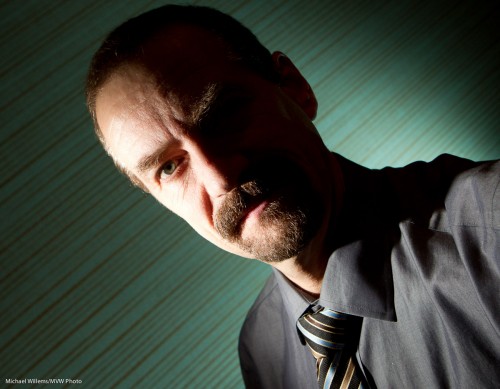
Prior to a class the other day, I decided to do a very quick self portrait or two. Let me share, and explain how.

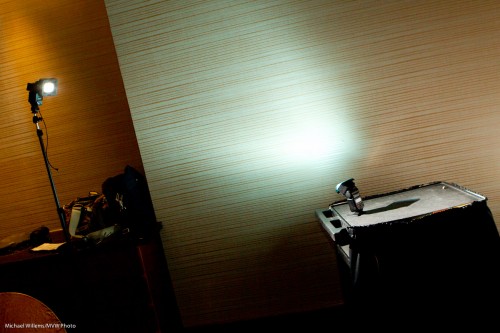
How? This is how:

  1. A 1D camera with a 580EX flash on it – with that flash used as a master, and disabled otherwise, so it only drives additional flashes.
  2. The camera set to manual, 1/125th sec, f/5.6, 400 ISO.
  3. An additional flash A on our left: a 430EX on a light stand, with a HonlPhoto grid to avoid the light spilling onto the wall.
  4. An additional flash B on our left: a 430EX on its little foot, equipped with a HonlPhoto gel.
  5. A 1:1 ratio of A:B flashes.
  6. The camera set to choose its own focus point for once, since I am holding it myself!
  7. The camera in my outstretched arm, tilted for diagonal line effect.

Not bad eh?

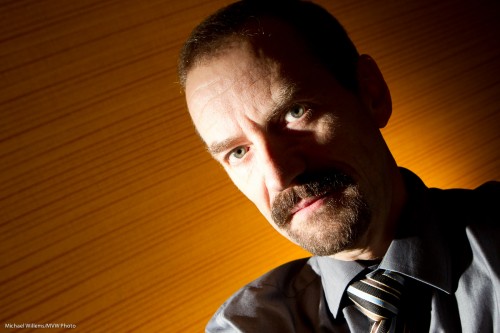
Finally, one more with a different gel on the background flash: egg yolk yellow, my favourite colour.

Total time taken: Maybe two, three minutes.


Going black for the day

In continued protest at Facebook and its prudishness, its heavy-handedness, its terms of service, its rude suspension of my account from its monopoly service for a perfectly OK image (see yesterday’s post), and its “no questions, no appeal” process, I am going black for the day.  As far as I recall, this is the first day since I started this blog that I have had no post.

The Economist warned in an article last week that things like this would happen, and that Facebook had better be careful (I paraphrase) – regulators will increasingly look at them, and users will increasingly dislike them. Even in a monopoly situations, having your market dislike you is not a great idea.

So here’s today’s image of the day:

See you all tomorrow (and for my Facebook friends, in a few days time).