This morning’s post will be delayed some hours because my Internet connection is malfunctioning.
Blog delayed
Reply
This morning’s post will be delayed some hours because my Internet connection is malfunctioning.
A bit of revision, since I was asked this three times in the last few days. “Why are F-stops important?” Yes – repeat answer, but important enough to repeat, I think. So here goes.
F-stops (the clicks on the aperture adjustment ring on old cameras, hence “stops”) are important. You know: f/5.6, f/8, f/11, that sort of thing. Or on a good lens, maybe f/2.8, or for a prime (non-adjustable) lens, even lower. The lower a lens can go, the better.
Why?
This means two things:
Blurry backgrounds and low-light pictures are good things. So look at the front or top of your lens. If the lens says “1:3.5-5.6″ it is a kit lens that can open to f/3.5 at wide angle and f/5.6 when zoomed in. A pro zoom lens will just say 1:2.8”.
And the new 50mm prime lens I am buying, used, tomorrow says 1:1.2, meaning f/1.2 – meaning it is faster (more light gets in) than the 1.4 lens I now have.
Alas, more light means more glass, and hence more dollars. But you will see why this is worth it.
In general, get the fastest lens you can get, if you can afford it.
A reader asks this, and I thought I would make this today’s post:
I read your wonderful blog everyday, and I learned many thing about flash photography.
I am 53 y. old and I ‘d like to get a 1D camera once in my life. I am debating if I need to change my camera, a canon 50D, with the new 1D Mk IV.
I am not a pro; I own many crop lenses ( 17-55mm f2.8 is – 15-85mm is – 10-22mm 60mm macro).
My other camera is a full frame 5D old with 17-40mm, 70-200mm f4 is, 24-105mm f4 is, plus 2 canon flash 430 and 580 II. I am selling some stuff and I have now 2200€= than I could sell all my crop material and finally buy my dream with some more new lens.
What I am asking, in your opinion ..WORTH IT ? or is better to sell the old 5D and buy a less expensive new 5D mk II…?
Thank you!
Regards from Italy – Adalberto
Adalberto: great question.
Always great to hear from Italy: I lived in Rome for about a year in the 1980s, e mi manca l’Italia – tanto. La cucina Italiana; Roma; le donne; il vino; le macchine; mi mancano queste cose.
Anyway, back to cameras. This is a question we all wrestle with: Do we buy a better camera, or spend our money on lenses and so on? Which camera? I have a 1Ds Mark III, a 1D Mk IV, and a 7D, and I used to own a 5D, so I can probably say some sensible things about this choice.
First, there is the choice “crop or not crop”? A crop camera is a camera with a smaller sensor. Crop is cheaper, and can use cheaper lenses; but “full frame” (like a 5D or 1Ds) or “almost full frame” (like a 1D, which has a 1.3 crop) is better than the usual 1.6 (or for Nikon, 1.5) crop:
So yes, full frame or near full frame is better.
Then there is the choice of body type: an amateur body (50D), a lower-end pro body (5D), or a pro body (1Dx)? A pro body does not take better pictures. But it is more waterproof; it has more settings; it can write to two memory cards at once; it will last 300,000 shutter releases instead of 150,000 shutter releases: all great things.
In your case, I would ask:
As for question one: yes, if I were you, I would go all full (or almost full) frame, and sell your crop lenses, if I had that budget. Sell the crop lenses, would be my advice, and sell the 50D while it has value.
As for question two:
In general,
Lenses are more important than the camera
…so perhaps a 5D and some f/2.8 lenses, and maybe a prime or two, would be a good way to go?
On the other hand.. I know the excitement that a really great body gives. If you really want a 1-body, get one. A 1D Mark IV.
Ask yourself:
If you answer “yes” to even a few of those, get a 1D and a 50mm f/1.4 lens. If not, you can get a 5D Mark II and some more lenses. That is my advice.
But you cannot go wrong: all the equipment and cameras you are looking for are great. So whatever you do, you will do well. And DO get a 50mm f/1.4 lens, or even the 50mm f/1.8!
Have fun with your camera sometimes! So do the following:
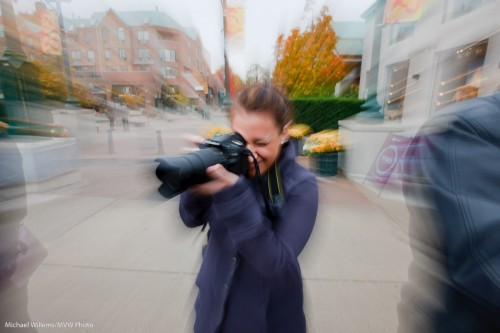
World Centres On me
And you do this as follows:
This takes a bit of practice, but it is fun.
Today, a few more pictures for you for the recent walkarounds.
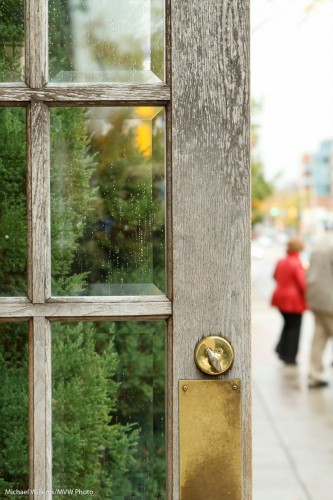
Door and leaving
You know how I always talk about story telling? One way to do it, one I have mentioned many times before, is to have a blurry subject in the background and to hence make the viewer work out what is happening. Having to work it out adds to a photo’s interest. In this picture, “Door” and “Leaving” are of course connected. And you see the rule of thirds being applied, I prusume?
I am called The Speedlighter. Speedlights are often handy, like in this picture.
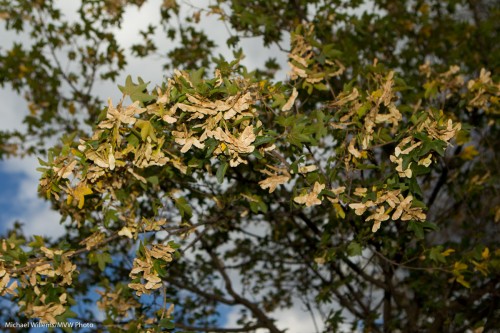
Fall leaves lit with flash
I underexposed the background by two stops or more. And to get the background blurry, I took this at f/4. This needed 1/4000th second if I recall correctly. That is beyond the flash sync speed, so I had to use High-Speed flash (FP Flash). Nice result, no? Looks surreal, and that is what you get by combining depth of field control with light control.
Last one. Use unusual effects.
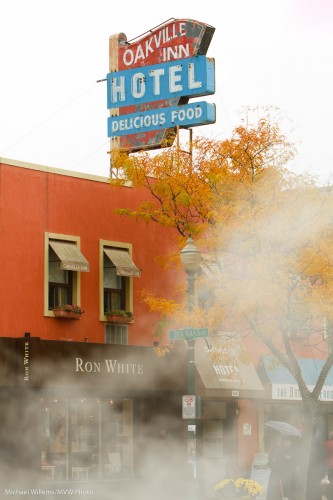
Oakville Hotel, October 2010
Like smoke from a barbecue to get an unusual picture of a familiar sight.
As always, photos look best when viewed full size.
Now: time for you to take the lens cap off, if you even use one, and go shoot!
Today, another tip for urban photography.
Shoot signs. Anything that has writing on it. Because it can provide context. It can tell stories. It can provide interest. It can provide amusing juxtapositions.
Two snaps from a short walk through Montréal a couple of days ago:
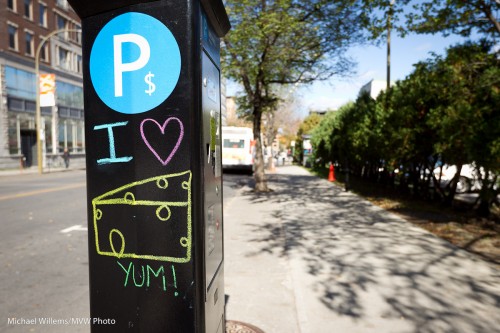
ilovecheese
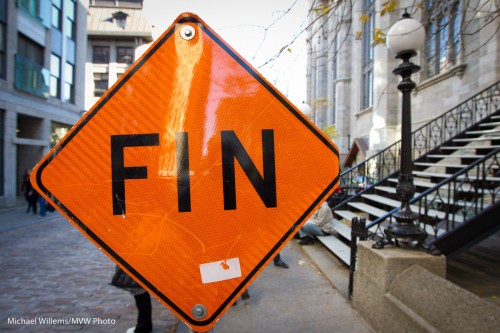
Fin
Don’t you love how that last one helps end the story, as the last one in a series?
When you photograph someone with glasses, especially in a studio, watch out for a couple of things.

By observing these simple precautions, you can get good photos of someone wearing glasses. Not complicated: as so often it is in the “paying attention”.
As you know, I, both at Henrys and by myself, and with colleague Joseph Marranca, teach beginners and advanced users all manner of photography topics.
And then… sometimes I see a course that complements my courses very nicely. One of those is the upcoming Henry’s Ivan Otis Pro Shoot event on 23 September. Ivan, a well-known and incredibly talented commercial photographer, spends a day with up to 20 people teaching them the mechanics of a full commercial campaign, including working with a full creative team. I happen to know that as I write this, there are a few spots left. Check it out!
Notes to Readers:
There is always pressure between “techie” questions and “art” questions. Many artistic photographer scoff at the idea of talking about technology.
But I don’t. I think that yes, sure, photography is art: but if you do not have the tools, and the knowledge of how to use them, i.e. if you do not know the craft, you will never get to the art you want to get to. And a blurry or underexposed picture is not going to be liked by anyone. So the tools and the technology are very, very important.
In that contact, let me answer a reader question I received today. Nicolas asks:
I am a photo enthusiast and take photos for my own pleasure when I travel, when I have some time to walk around or when I go to some events sports or others. So no pro, not necessity of any results to make a living, just for fun.
I have a 70-200 f4 IS telephoto lens from canon, a 18-55 not IS and I used to have a 400d from canon.
But I broke the back screen of my camera when traveling because I just had it in a normal bag… I thought about having it repaired, but it costs too much compared to the price of a new camera.
I also thought for quite some time to get a bit better camera to improve AF, ISO and the way the camera handles since the 400d was a bit small.
But now my choices are very difficult. What camera should I go for and which lens to go with it ? I mostly take street photography or some inside photos with not that good light, and a few portraits. I really like fast lenses to create nice out of focus backgrounds. What would you recommend for my use ? I would like to stay with L lenses for future proofing and built quality.
- 7d with 16-35 2.8 ? with 24-70 ? with 17-40 ?
- 5d mk 2 with ?
- 1d mk 4 ?
Anything else ?
My budget is not big at the moment, so if you would recommend the most expensive cameras that would mean wait more to save more, so no photos in the meanwhile…
Great questions.
First, of course it is not about the camera – much more about the lenses. When the picture is being taken, on two things are being used: the sensor, and the lens. The camera is just a box.
But there are several good reasons to replace your camera.
It seems to me you hit at least several of these features. So you need a new camera.
OK, then, which one.
So if I were you, a 50D (which is cheaper now that the 60D has been announced) or 7D sounds great. The 7D is more modern (I have one), but also more expensive. I would only go to a 5D if the full-frame ability (even blurrier backgrounds, even lower noise, wider lenses) is important.
The 50D/60D and the 7D are both 1.6 crop cameras, so a 50mm lens works like an 80mm camera.
I agree with your choice of “L” (luxury) and “EF” (unlike EF-S, these fit on any Canon SLR) lenses, so that means things like:
The great news is that the lenses keep their value (unlike the camera).
Personally, I would start with a wide range like the 17-40, and add a 50mm immediately for low light and portraits. Then I would add 10-20 or 24mm prime as soon as able.