It appears that Lightroom is 50% off until March 5: buy now, is my recommendation. $149 is a steal – worth every penny and then some (do not tell Adobe I said that).
Go to Adobe here or here, or just search the site.
Everyone by now has seen this two-week old Craigslist ad from Seattle?
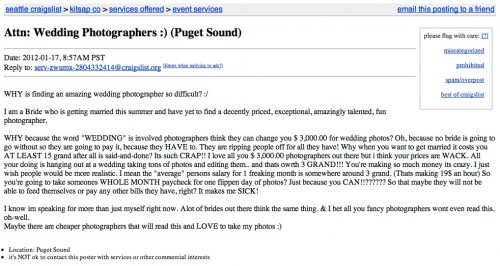
The text reads, in part:
WHY is finding an amazing wedding photographer so difficult? :/
I am a Bride who is getting married this summer and have yet to find a decently priced, exceptional, amazingly talented, fun photographer.
WHY because the word “WEDDING” is involved photographers think they can change you $ 3,000.00 for wedding photos? Oh, because no bride is going to go without so they are going to pay it, because they HAVE to. They are ripping people off for all they have! Why when you want to get married it costs you AT LEAST 15 grand after all is said-and-done? Its such CRAP!! I love all you $ 3,000.00 photographers out there but i think your prices are WACK. All your doing is hanging out at a wedding taking tons of photos and editing them.. and thats owrth 3 GRAND!!! You’re making so much money its crazy. I just wish people would be more realistic. I mean the “average” persons salary for 1 freaking month is somewhere around 3 grand. (Thats making 19$ an hour) So you’re going to take someones WHOLE MONTH paycheck for one flippen day of photos? Just because you CAN!!?????? So that maybe they will not be able to feed themselves or pay any other bills they have, right? It makes me SICK!
That would be funny if it wasn’t sad. Of course photographers cost money – photography costs money! Setting the right price is part of my “Running a small photography business” course at Sheridan College.
It is simple: in a free market, you need a price that:
A two hour family shoot, once you have all the packing and unpacking and setting up and preparing and editing afterward factored in, can take at least ten person-hours. The equipment used can cost at least $15,000 – up to multiples of that. That is why it costs money to have photos taken.
The bride above is free to go with Uncle Fred, but before she does, she may want to think of this as life long memories that must be captured, and captured reliably, and captured well. In any case, when she does the math, she will see that a plumber is much more costly than a photographer.
If you are a budding pro: do not underprice yourself – or you will go broke. Plot your expenses – all of them, including travel time, taxes, car costs, and new cameras every three years – and offset those against the expected shoots per year. Now you know what you need to make to break even – and ideally you make a profit, of course.
To all photographers: do not be negative, and do not tell people they have to pay you because you need the money. Clients are interested in CLIENT VALUE, not in Photographer Need!
Looking at it more positively, and from the client’s perspective, a few more thoughts on this here: www.michaelwillems.ca/benefits.html
I recently told you about an honourable company, that shall go unnamed, that settled an unlicensed use of my image to satisfaction.
There’s another such company – but this one did not do the honourable thing. They did not even bother to reply, even though I attempted to contact them several times since 18 July 2011. They had a large image of my 7D with 16-35mm lens on their web site. This company is http://www.dirtcheapcameras.com.au/
So since they have not deemed fit to respond, to pay, or anything else, I warn Australian readers to stay clear of them – they willingly and knowingly stole an image, and then did not respond when the owner repeatedly contacted them. That kind of ethics does not make for good business.
As predicted, Kodak has just applied for bankruptcy protection.
A sad almost-ending for a company that made the photography field into what it is. But a predictable one. Kodak failed to keep up with the digital world. Just like Polaroid (but unlike Fuji): when Film ended – Kodak ended.
Kodak, you see, was afraid of cannibalizing its film sales. Digital will do that – and did do that. But here’s the problem: if you do not cannibalize your own sales, someone else will. You need to be market-trend centric, not “me-centric”.
The same is true in my field. I teach as well as shoot. Some colleagues criticize me for “training the competition”. Yes – but at least I train them well, and most importantly, if I do not train them, somebody else will. If there is a demand, there will be a supply.
Which is why I train at Sheridan College, at the School of Imaging, at CameraTraining.ca, at The Granite Club, at this daily blog, and at various other venues. These are great times to learn photography, and I will do my utmost to train as many people as possible.
Tip or photographers: embrace the concept of trends. Trends are unstoppable. So in terms of trends (not individual products – look at Apple), you should look where the market is going and go there. For us that means supplying images on a DVD, for instance. Using the cloud and the web to share work. Providing cheaper, or fewer, prints. All these are unstoppable trends, so embrace them.
I am not saying “all change is good”, but I am saying “once a change is unstoppable, recognize it and embrace it – see how you can make it into a benefit”. Fuji dealt with the Tsunami of Digital – while Kodak singularly failed to.
I am currently writing and teaching a course at Sheridan College on “Small Business Photography”. This is a 12-week course on running a small photography business.
And today I thought I would touch here upon one of its subjects: the name you choose for your business.
Your name needs to be:
Your name is a large part of your brand identity. So I would avoid business names that are:
That last point is worth expanding. What is your market? The Sears market? Then by all means call yourself something that sounds like the Sears studios, like “General Photo Studios”.
But I think that as a photographer you are probably in the photographer business, not in the photography business. So, advertise yourself. While my company is officially called “MVW Photo”, I usually use “Michael Willems Photographer”. Simple, available (see www.michaelwillems.ca) and clear.
Whatever you do – do decide on a name, and on the other hand don’t obsess too much.
Sometimes life is not what you want it to be, and sometimes it is. The latter just happened to me – I was informed that a large photographic equipment retailer was using one of my images without permission. They had even altered/combined it, and had been using it for seven months on their web site, to support selling equipment.
This has happened before to me, with an Australian company – losers who did not even respond to my repeated emails. That action continues.
But this latest example is a reputable, and I assumed moral, principled North American company – I shall sign a non-disclosure so I shall not mention their name here – so I sent a note with all the evidence and a proposal for settlement.
The company’s counsel called me back quickly, and it turns out that the company was indeed as I had assumed moral and principled. We settled on an amount agreeable to us both and I await the papers to sign.
The moral is combined:
I am going to be teaching a Photography in Business course at Sheridan College in Oakville starting this coming week. No doubt this kind of example will come up in the course.
I have a tip, a bit of self-promotion, and a suggestion for you. (You wil allow me a little promotion for once, I hope – if only because it can benefit you).
The tip: In addition to the schooling you take at commercial venues (like the School of Imaging or Sheridan College, both of which I teach at), consider doing some private or small-group coaching.
As it happens, December and January are great months for it, for four separate reasons:
Small-group or provate coaching are especially great as a complement for class teaching:
So for the reasons above, to motivate you, I have a special on for December and January: a further 10% off the normal hourly price. As always you only pay me if delighted.
See more on this link and contact me (click on “contact” above) to learn more and to reserve your time right now – the months do fill up!
Whether you are a pro (i.e. you do photography for a living) or an amateur (you do it for the love of it), there are always chores; things to be done. And how quickly you do them determines how quickly you get back to what you want to really be doing.
So here, in case it helps you, are a dozen of my main productivity tools:
Your mileage will vary, but this gives you some idea of what I use to make my life more efficient. As far as my “a mile a minute” personality will allow, of course!
Prompted by a visit to a restaurant web site just now, a few tips for those of you who run web sites, or would like to. Perhaps to create a photo business, or to grow an existing one? Here’s Michael’s Top Four Tips.
TIP ONE: No Adobe Flash. For four reasons:
TIP TWO: No music. Sound distracts. And the song you choose will annoy half your viewers. And slow the site on its initial load. Yes, you can turn sound off, but why make your client jump through hoops? Unless you are Air Canada, you cannot get away with that.
TIP THREE: No tumbleweed-blogs. If your site gives the viewer the impression it is being updated regularly, update it regularly. A blog that is updated every now and then is deadly. Set an expectation – then exceed it. I promise to blog daily – for now- and I achieve or exceed that. If forced by time constraints I go to a lower frequency that would be fine – in that case I would say “at least twice weekly” and then ensure I do three or four times weekly. Under-promise, over-deliver.
TIP FOUR: Keep it simple. Simplicity rules! Simple font choices. White space. Simple design. Complexity is bad. Your client is not there for you – it is the other way around, and simplicity keeps the client on your site.
All photographers, as I pointed out recently, should know about copyright. As reader Warren said recently in a comment on this blog:
“When a photographer shoots pictures for themselves, they own the copyright and they are the Author.[ ] If the photographer then uploads these pictures to someone else’s web site, the photographer may fall victim to the terms of use of that site and they may lose some rights. Read the terms of use!”
Very true. And potentially scary. Read what Facebook says:
“For content that is covered by intellectual property rights, like photos and videos (“IP content”), you specifically give us the following permission, subject to your privacy and application settings: you grant us a non-exclusive, transferable, sub-licensable, royalty-free, worldwide license to use any IP content that you post on or in connection with Facebook (“IP License”). This IP License ends when you delete your IP content or your account unless your content has been shared with others, and they have not deleted it.”
Ouch. Transferable? Sub-licensable? And to boot, Royalty-free? And “…on or in connection with Facebook” (my emphasis)? Geez. This post better not have a picture in it, or Facebook can use it or even resell it.
Thank God Facebook itself only allows (so far) uploads up to 720 pixels wide. Otherwise they could take my work and use it in an international ad campaign for Coca-Cola, say, for free. And this of course is why I embed my name, small but visible, in each picture I upload in Facebook.
Other sites can be as Draconian – or more so. Apple? No idea, since I have never actually read the 41-page “agreement” that you have to read and “agree to” before you can do anything (like upgrade iTunes). I am sure no-one has (lawyers excepted: they like that kind of thing).
BBC news, and other news outlets, use “user content” nowadays. That is content they do not pay for. Users are happy to work for free, and that means reporters no longer get paid, Fine, you may say – except the level and trustworthiness of the work goes way down.
So be careful with copyright. Make sure you have an explicit written agreement when shooting for someone: an agreement that gives you copyright (or that pays you very well, if you a “shooter for money” and do not end up with copyright). Photography is fun, but the equipment is not free. The time spent learning is not free, and time cannot be reclaimed. Your photos are valuable – copyright protects that value.
Working for free never works for a valuable skill that is hard to learn and expensive to use, and unless you are careful, without good agreements that is exactly what you will end up doing. My advice today: be careful where you upload photos.