The SUV of lenses

I like to shoot with many lenses. Wide (16-35 on full frame), long (70-200 on crop), and fast primes.

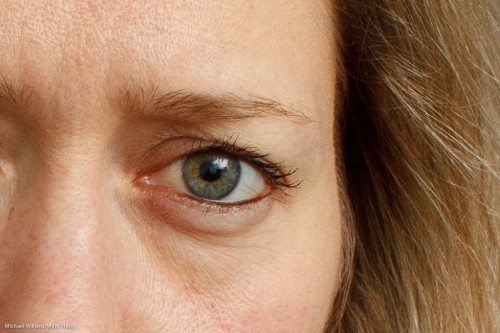
But the one “general purpose” lens I keep going back to is the 24-70 f/2.8L. First of all, this lens is sharp:
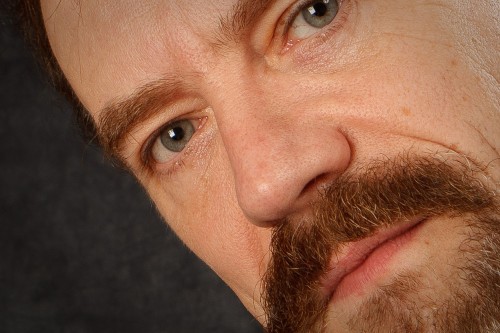
Michael Willems - self portrait, detail

Self portrait, detail (view at full size)

You like crazy sharp? This lens is crazy sharp.

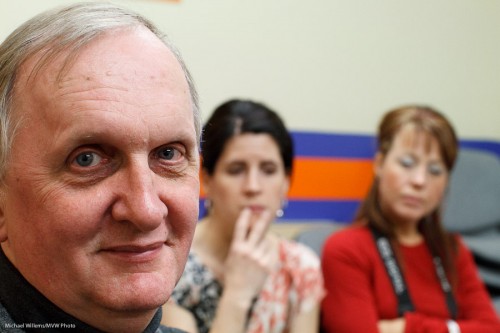
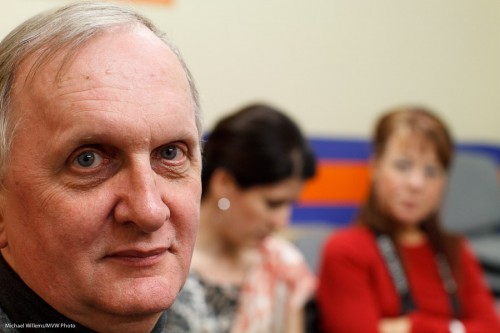
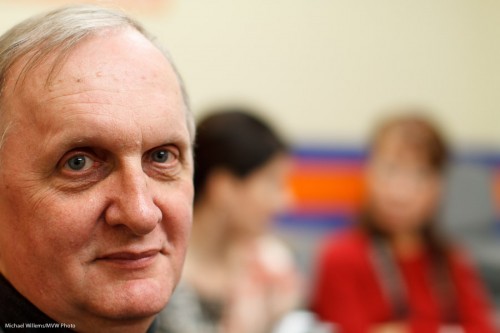
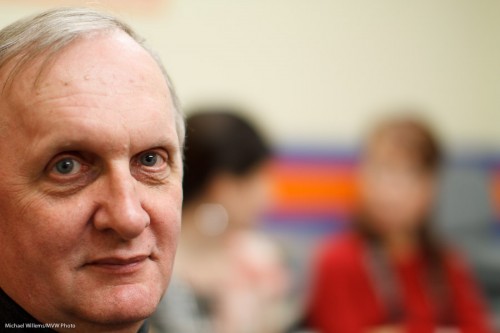
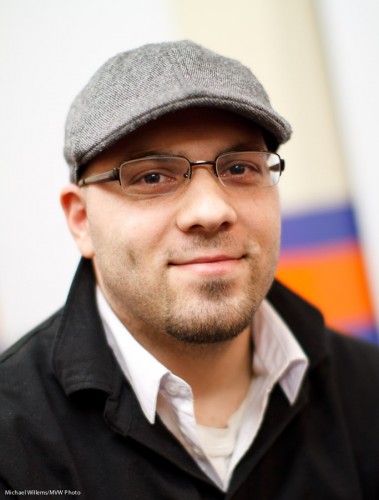
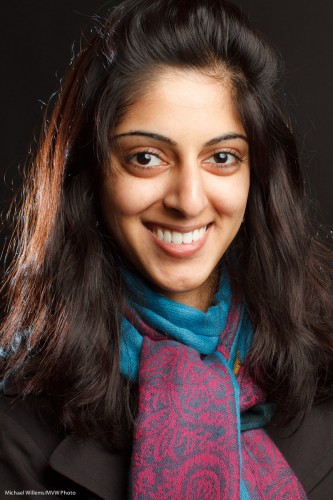
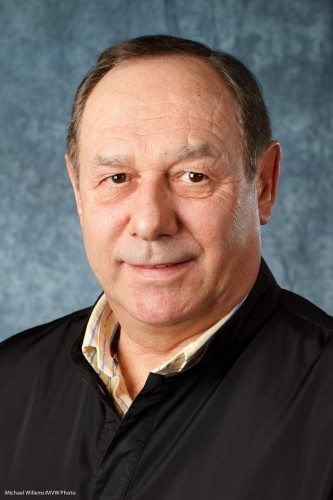
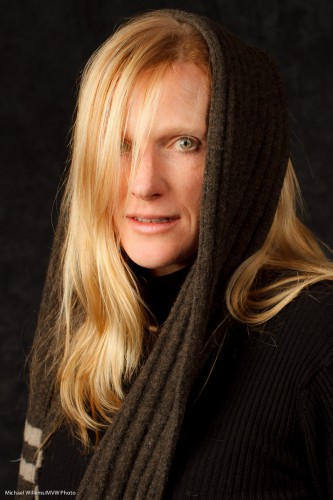
The main thing about this lens, however, is that it can be used for almost any shoot. For instance, for music school portraits like today’s:
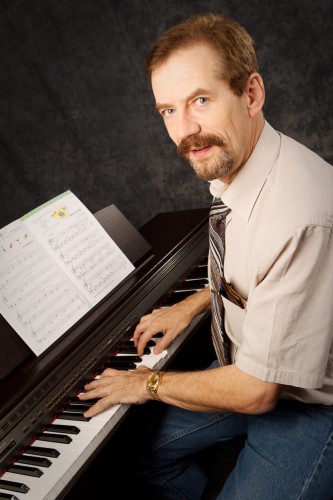
Michael Willems - demo portrait

Michael Willems - demo portrait

But also for headshots, environmental portraits, events, travel, low-ish light shots, and much more. Its fast speed (i.e. the low f-number, a constant 2.8 throughout its zoom range) allows you to blur backgrounds well, and allows its use in low light. This is why photojournalists keep that lens in the bag and on the camera.

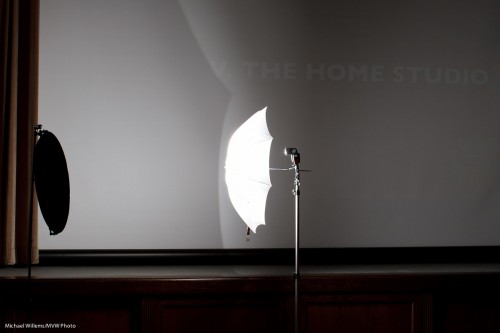
Today’s shoot was a music school and tomorrow’s is the same – all day. If you wonder how the shots above were lit: three Bowens studio lights; an umbrella, a softbox and a snoot. Here’s the softbox:
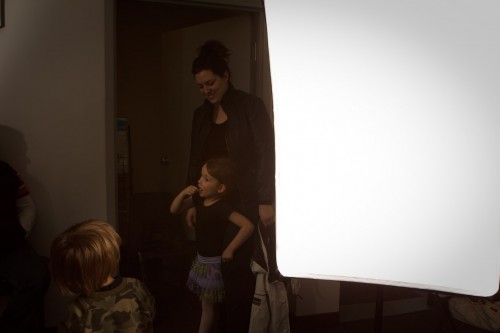
Softbox during music school shoot

Softbox during music school shoot

A softbox gives you a large area and hence soft light. For studio I use a large softbox; for on-the go shoots I use the Honl Traveller 8 softbox on a speedlight. (As you know, Dave Honl will be helping me teach a course in Toronto on March 19; he is in London today, where yesterday he taught a course to Matteo, a young friend and student who has taken a number of my courses. Small world!)
Focus!

The other day I said “focus using one focus point”. A reader asked why. So let me explain why I said that.

On a modern SLR camera you have many focus points: 9, 11, 22, or even 40. The camera has various modes, which may include:

  1. The camera chooses from all available points.
  2. The camera chooses from a smaller area of available points.
  3. You choose a point, but the camera will look immediately next to that point if it cannot find focus.
  4. You choose a focus point, period.
  5. You choose a very small focus point.

Method 1 is the “snapshot” mode. Methods 2, 3 and 5 may only be available on high end or very modern cameras (2 and 5 are only available on my 7D, for example). I like 3, but it too is for high-end cameras only. So usually the choice is “1 or 4?”

In method 1, the camera chooses one or more focus point; in other words, it decides where to focus.

What does it base its choice on?

A lot of people think “on the subject”. No, it does not have a brain, It does not know what the subject is. The camera basically bases its choice on “I’ll focus on whatever is closest”.

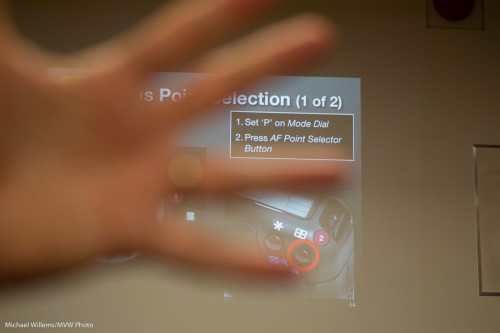
And that, as in the image below, is not always what you want. In this image I wanted the wall to be sharp – so I aimed the single focus spot between my fingers.

Which is why you choose method 4: YOU choose a focus point, and aim that at the subject where it should be sharpest.

There are a few things to remember:

  • You need to allow enough distance.
  • The subject needs to be well lit.
  • The subject needs to be contrasty (focusing on a blank white wall is impossible).
  • You can recompose after focusing, as long as you keep your finger half way on the shutter.
  • On high end cameras, exposure is also biased to the focus point, making it even more important to focus accurately.

Photographers who let the camera decide where to focus are playing roulette – Russian roulette. after all, in a portrait, do I want the closest object (the nose) to be sharp, or the eyes?

So take charge and usually, use one focus point. Focus, wait, recompose if needed, and shoot. Presto – sharp where you want it to be.

Another tip

One more beginners’ tip today for my readers. (The term “my readers”, it occurs to me, makes me sound a little like col. Qaddafi. whose Green Book I read when I worked in Libya for around a year, a few decades ago).

Anyway. I often see that my images are really, really sharp where others’ are often not quite as sharp. So how do you make your images sharp? I have written about this before, see here, among others. Operation, light, settings, and good (prime, or quality) lenses all come into this.

A student, photographed by Michael Willems.

Student Volunteer, photo Michael Willems. Canon 7D, f/5.6, 400 ISO, 1/125th sec.

When you show that image large (original size), you see it’s sharp.

A student, photographed by Michael Willems. Detail.

Student Volunteer, photo Michael Willems. (Detail).

But today a quick tip about errors I see people make frequently.

Whenever I see people whose images, in spite of good lenses and the right settings, are not as sharp as mine, and when I then watch their technique, I often see these mistakes:

  1. People jam down on the shutter. I hear a beep, and a millisecond later, the click. This means the shooter is not giving himself or herself enough time to verify that focus was achieved on the right object. Instead, you should aim, press half way down, wait for the beep, then wait, and only once you have ensured the focus point activated properly where you wanted it, push down.
  2. The shooter leaves the beep off. This means no confirmation of focus unless you look away from the subject… bad.
  3. The shooter beeps and waits correctly – but then moves forward or backward before pushing down. Even a slight backward or forward movement shifts focus!

Watch yourself carefully when you shoot. If you discover that you are making any of the above mistakes, this will affect your sharp focus.

And that would be a shame. My people deserve sharp focus!

Ideal Aperture

The ideal aperture is like really large, yes, a small F-number?

Depends.

Well then, at least in a portrait it is, yes?

It can be. But you need to think about this carefully.

Look at this image of some students who kindly volunteered the other day:

f/5.6:

f/3.5:

f/1.8:

f/1.2:

Which one do you prefer?

I think you may agree with me that a blurrier background is better. But so is a sharp face. Often, the extremely shallow depth of field (e.g. the DOF you get at f/1.2) is too shallow for comfort. Personally, I would say that for this kind of close-up hand-held available light portrait, f/2.8 to f/4 is great.

Lenses

Take a headshot portrait (one where the head fills the page) using a 20mm lens.

Go on, do it. You know you can. And I mean a real 20mm lens, so if you have a 1.6 crop camera like a Digital Rebel you would use a 13mm lens; on a Nikon you would use a 14mm lens. Or that setting on your wide angle zoom lens.

You would get this – and thank you to the student who kindly volunteered to be pictured with, um, an enlarged nose:

Because that is what happens when you use a wide lens, because you have to be so close.

You see, it is not the lens that has the bad magic. It is your position right in front of his face.

Now use an 80mm lens (that would be a 50mm lens for crop factor camera users). That forces you to step back a couple of metres. Now you get this:

That’s a lot better, eh?

So the moral: portraits are best taken from a few metres away. Either that means you use a longer lens (80-135mm), or you avoid headshots where the subject is large so you have to get close.

And therefore yes, you can use a wide lens – just with a small subject, in the middle. So an environmental portrait with a wide angle lens is fine, if your subject is small and not near the picture’s edges. Otherwise, a long lens. On a crop camera, 50mm and longer!

Zoom Power

A friend asked me the other day:

Mike – I don’t understand how to compare the zoom power of my Nikon P100 26x zoom to the Canon 28-300mm zoom with my Canon 5d MkII.

Good question. But I think it is the wrong question. Or at least, the way the question is asked shows me that it might be based on the wrong premise.

The term “zoom power” seems to indicate that the ability to chance focal length settings through a wide range is a good thing. Like, a 10-500mm lens would be a good thing. Some even call this “ultra zoom technology” – you know, as in: just add the word “technology” to a term and it somehow gains in value. But only to the ignorant: when someone says “technology” like that, I just hear “marketing”.

Here’s why I think a wide zoom range (i.e. a wide ability to change from one focal length to another) is not necessarily a great thing.

First, it is a compromise. The wider the adjustment range, the more this lens will be a compromise at all lengths. A wide zoom range lens will neither be a great wide, nor a great standard, nor a great telephoto lens. Its aperture will be small, and it will vary. It will show pincushion and barrel distortion at both ends. It will not be sharp. The more a lens is like a prime lens, on the other hand, the clearer, faster, and sharper it will be.

The other reason is that of discipline. With a lens that can go from very wide to very long. you will never have a reason to be consistent in your images. Your pictures will not take on any particular look and feel: rather, each image will be different. Neither fish nor fowl, you might say.

The reason we have these super zoom compacts is for convenience, of course. But a lot of the time, this is wishful thinking kind of convenience. I hear it often: “yes, but I don’t want to own multiple lenses to get from 10mm to 500mm”. Sure, like I don’t want to die or pay taxes. Both are, alas, inevitable.

So only you can decide whether you want a wide range zoom camera or lens. To me, the wider the zoom range, the more everything will be a compromise, and the worse my pictures will be. But you may have different thoughts if size and convenience are more important to you than quality.

My lenses are a 16-35 (“2.2x zoom”), the 100mm, 50mm and 35mm primes (“0x zoom”), a 70-200 (“2.9x zoom”), and a 24-70 (“2.9x zoom”), and they are among the best on the planet. In fact my entire range of lenses from 16 to 200mm is equivalent to one 12.5x zoom, in those terms. This shows you how little those terms really mean.

But since you ask: a 28-300 mm zoom would be a “10.7x zoom” in marketing-speak. So the compact 26x zoom has a much wider range. 2.43 times wider, in fact!

Simple Means.

Today, I taught a flash workshop that concentrated on the use of just small flashes. (Of course as you know I am doing an in-depth version of that workshop on March 19, with special Guest Star David Honl, yes? See www.cameratraining.ca/Flash-Honl.html – not to be missed!)

Anyway, simple portrait lighting with speedlites. You normally use wireless TTL for that – multiple flashes that the camera talks to using its wireless TTL technology. All major brands support this.

So here we have a simple shot of one of tonight’s students, using:

  1. a 580EX flash on our right…
  2. …shot through an umbrella, and
  3. a 430EX flash on our left…
  4. …using a Honl 1/4″ grid and a blue gel.

All this fired from a 580EX on a Canon Camera (if you have a Canon 7D or a 60D, or a Nikon, you can use your popup flash for this).

If you set the two flashes to different “groups”, i.e. A and B, you can set the ratio to what you like (e.g. A:B set to 4:1 means A is 4 times, or two stops, brighter than B). On Nikon, the system is the same although the way you set it is different (stops with respect to zero).

One important thing to remember: a key difference between strobes (you meter by measuring incident light, and it’s always good whatever the subject) and speedlites (TTL meters reflected light). So when using TTL instead of a studio, your subject makes a difference.

A subject with dark hair, a dark top, and against a dark background, will be overexposed so you need to use Flash Compensation of minus 1 to minus 2 stops. In the shot above, I used minus 1.3 stops.

Go try this if you haven’t. It’s fun. As a minimum, you need a camera with an on-camera flash (or use the pop-up on a 7D or 60D or a Nikon); one additional flash; a light stand; an umbrella; a bracket to mount them together; and a reflector (see yesterday’s post).

Can you tell my spouse?

A student recently asked me to explain to his or her spouse (anonymity will be preserved) why it is worth investing in lenses.

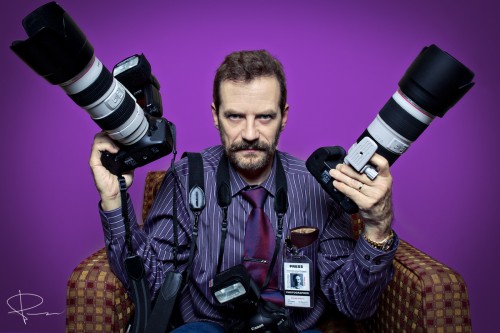
Michael in The Plaid Chair (Photo: Peter McKinnon)

Michael in The Plaid Chair

And indeed I am happy to do this. Not because I have any stake in selling lenses (I teach, at various venues including Henry’s School of Imaging, but I have no stake in selling anything anywhere). But because:

  1. I strongly believe the lens is the most important part of photographic equipment between you and a great picture.
  2. A lens keeps its value much better than a camera does.

Let me explain.

  • The lens determines how sharp your picture is. Good lenses are simply sharper, and with today’s sensors this difference is noticeable.
  • The lens determines how fast your shutter speed is. And hence, how blurry the image. A faster lens (“fast” means “how wide is the aperture”, i.e. “how low is the minimum F-number this lens can go to”) means more light can get in – which means faster shutter speeds are possible at the same ISO.
  • The lens determines how blurry you can make the background. An f/2.8 lens gives you, if you want it, a much blurrier background than a consumer-grade f/3.5-5.6 lens. A “prime” (fixed) f/1.4 lens, even more so.
  • Good lenses focus faster, are quieter, have better “bokeh” (look better where they are out of focus), are water- and dust-sealed, and so on.

Those are very important factors whose importance it is almost impossible to overstate. Photojournalists like me use f/2.8 zoom lenses and f/1.4 primes. for a reason. For several reasons.

And finally- a lens keeps its value. A camera – not so much (next year it is worth half; a afew years later it has $0 value). A good lens keeps its value for decades.This is because 20 years from now it will still do what it does today (let through photons), and because the intrinsic value of the optical glass is a larger part of the value of the lens.

This is why lenses are worth buying. They make much more difference to images than the camera does, and they are a much safer investment.

About that home studio

One more about the simple TTL home studio. I can give you some pointers to do your own.

Here’s how.

You need:

  1. A modern SLR camera.
  2. A lens – anything over 50mm will do. A 50mm f/1.8 might be a great choice: sharp and affordable (and if you need it, fast).
  3. If you have a Nikon, or a Canon 60D or 7D, just one flash (a 430EX/580EX for Canon or an SB600/SB900 for Nikon).
  4. If you have a different Canon camera, an additional 580EX to command the other flash.
  5. An umbrella (shoot through).
  6. A stand for the flash, with a mount for flash plus umbrella.
  7. A reflector (silver or gold or white, or a multi-purpose one).
  8. A stand for that reflector.

As an option, another flash with a small stand to light up backgrounds, but this is not a must have. You can just move the umbrella and subject closer to the wall if you want the wall to be lighter.

Now that you have the equipment:

  1. Set your flash to “slave” (Canon) or “remote” (Nikon) mode. Use the manual to find out how. On a modern Canon with a modern flash you can use the camera to set the flash.
  2. Set up your on-camera flash to be the “master” (“Commander”, on Nikon).
  3. Ensure that the on-camera flash is not going to fire (it will only  send commands to the remote flash, but it will not actually fire – else you get a shadow).
  4. Move the umbrella close to your subject. For a “standard” portrait, the best position is 45 degrees up, off to the side 45 degrees.
  5. Move the reflector close on the opposite side.
  6. Set your camera to manual exposure mode, f/8, 1/125th second, 100 ISO (or 200 on a Nikon).
  7. Take a test shot.
  8. Check the histogram. If you are shooting a dark subject against a dark wall, you may need negative (perhaps -1 stop) Flash Exposure Compensation; if you are shooting a light subject against a white wall, you may need positive (perhaps +1 stop) Flash Exposure Compensation.
  9. Make sure there is a catch light in the subject’s eyes. Ensure that any glasses do not reflect (move subject or umbrella if they do).

It is as simple as that. You will have studio quality shots, for very little investment. Shots like this (which I made with the exact setup above):

With a modern camera and flash and a little knowledge, it really can be that easy.

Granigif

That cryptic title means “Animated GIF at the Granite Club”. Which is where I was teaching portrait photography last night.

I cannot image a more fun way to spend an evening: some of the most committed, fun, outspoken, and friendly people I have had the pleasure of teaching.

So let’s start with how I set up. Click below to see it as an animated GIF. The time elapsed here was over an hour:

Studio Photography Lesson Setup, by Michael Willems

Studio Photography Lesson Setup, by Michael Willems

Last night was a lightning-fast lesson in portrait photography basics, from lights to pocketwizards to positioning techniques.

The interesting thing, I think, is that while for full control, the more “stuff” you have the better, you can often keep it remarkably simple.

A shot with “the standard four lights” might be this:

Portrait at The Granite (Photo Michael Willems)

Portrait at The Granite

That uses a key light (softbox), a fill light (umbrella), a hair light (Honl snoot), and a background light (Honl Grid).

But you can also keep it simpler. For a lady with light hair, I would not light up the background. We would also not really need the hair light. So now indeed it is simpler:

Robbin at The Granite (Photo: Michael Willems)

Robbin at The Granite

Beautiful, no?

But the real surprise is the simple setup on the left: you can just see it. A TTL flash through an umbrella. A reflector to provide fill light. And a background light to add a bit of brightness to the available background. Now all we are using, then, is two flashes and some affordable stands and a reflector.

That gives us:

Matt at The Granite (Photo: Michael Willems)

Matt at The Granite

You see: you can often keep a studio setup simple. Why use a light when a reflector will do just as well?

Studio photography is incredibly rewarding. If you think so too, I strongly recommend you take a course or private coaching and learn how to do it.