Dreaming.

Professional Canon shooters used to have a thing called “CPS” – Canon Professional Services.

For years, I was a member. All you had to do was to be a real photographer, have your portfolio etc OK’d and buy (And prove that you bought) lots of Canon gear, like pro lenses and bodies. In return you would get loaners and slightly faster service, and a separate lineup at the Canon service desk: consumers to the right, pros to the left.

Why you need spares

Why you need spares

Then in 2010 someone had a bright idea.

“Hey – these pro shooters only spend maybe $40,000 on Canon equipment. And they upgrade all the time. None of that is enough – surely we can squeeze more money out of them? They need us, so let’s make them pay for real service! Instead of us supporting them let’s have them support us! Let’s charge $100 a year in some countries (or in Canada, $250)”

I think CPS is free in some countries, and I think Canada is the most expensive country (Canon, please correct me if others have to pay even more). Also, service levels differ: in Canada they are pretty vague: Canada “Platinum” has a “Service turnaround target” (i.e no commitment) of 4 days, and a 30% discount of an unspecified service cost.

Needless to say, I did not renew. At first, before I saw the conditions, I tried – but when they “could not” (i.e. refused to) accept Amex, I gave up. Just as well.

I keep getting emails with a link to a European please renew page – but no way. If anything breaks I’ll wait, use a spare (you all have spares, right?), or use my excellent Henrys extended warranty.

So Canon makes great cameras, but if you were expecting goodwill here – no way. After paying tens of thousands of dollars over the years, being sent a bill for what should be provided in the first place is simply insufficient and disappointing.

Question Time

Time for a reader question, I thought. So… reader Lisa asks:

I searched through your blog before I thought about sending this email. I have been reading a lot of online information about the Canon 5DMii having focusing issues, unlike the old Canon 5D.  I found nothing on your blog about focusing issues. I do a lot of pet photography for non-profit organizations and I cannot afford focusing issues, but I want to move up to a full-frame semi-pro camera (that’s affordable to me). If this is the case, what is your opinion if you’re willing to offer it up, on purchasing a used 5D to get reliable focusing as opposed to a new crop like the Canon 7D? I have been using…ah hem…my little XSi (been collecting professional lenses and saving up for a new body). Should I just invest in the 7D and wait until a new 5D comes out?  I really want the full-frame, but I need focus reliability.

Excellent question, and one with a few different answers.

First: the rumours. I generally take these with a pinch of salt. Canon cameras do have the occasional focus issue, believe me – but the Mark II having such issues is more of a “meme” than reality, I think (Meme? look it up. Google is your friend.). Often, people who complain do not understand how to use the equipment. In general, I would not be put off unless you are sure that for your types of photography, a camera will not do.

Now, some notes in response to your questions.

  • There is a big difference in focus systems, and the 5D MkII has the old system, while the 7D has the best focus system I have yet seen on a DSLR. Fast, flexible, great options. Much more modern than the 5D’s (either 5D).
  • That 7D focus system is especially good when you are shooting sports. It is fast. For animals – if they move, a newer focus system is great. Not the most important thing, but great.
  • You shoot in controlled conditions, so noise (one advantage of full frame) is less important to you I expect.
  • You shoot in controlled conditions, and at f/5.6, so focus will be good too.
  • The original 5D is a bit of a dust magnet. I would say a newer camera would be beneficial. Also – the focus system of the MkI and the MkII is essentially the same.
  • Yes – I agree, full frame is great. But for you, I would say it makes less of a difference. Low noise, not a great issue.

So if the choice is 5D (MkI) or 7D, I would vote 7D. On the other hand, if you really want full frame, then 5D Mk II would be my choice.

The moral, for everyone here who faces similar choices: there is often no “best” choice. In this particular case, all the options are good in different ways, so you will be delighted whatever you choose.

Macro, anyone?

A definition for you, today.

“Macro” (or as Nikon calls it, “Micro”) means “showing ordinary things large”.

But true Macro, following the official definition, means the ability to obtain a 1:1 ratio between the object’s size and the size of the image on the sensor. So a 1cm long bug casts an image 1cm long onto your sensor.

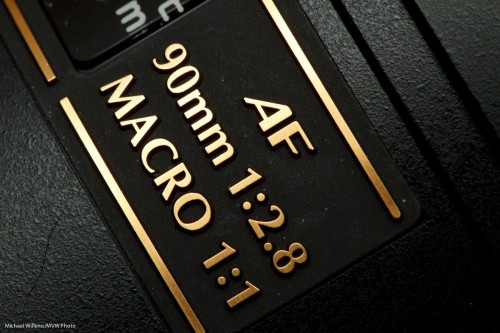
A lens can be a normal lens (not macro, usually 1:5 or worse, meaning a tiny bug image on the sensor), or a “macro featured lens” (perhaps 1:4, so that would make the bug 1/4 cm long on the sensor), or a true macro lens, like this one:

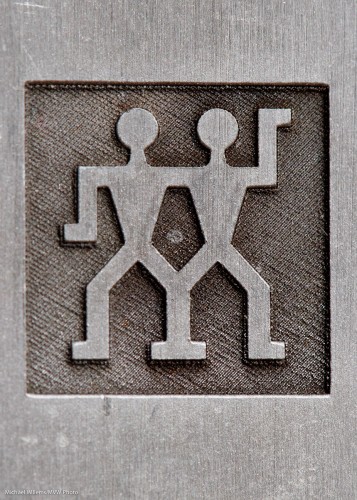
See the “1:1” marking? This, as you have seen, can give you cool images of day-to-day objects in a new light. Like this, the top of a knife:

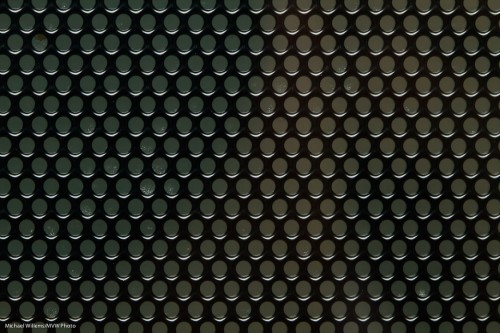
Or this:

Yup. That’s the front of a microwave.

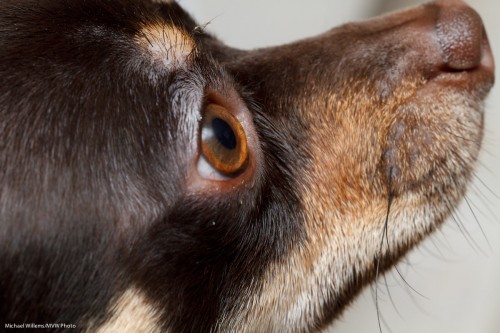
Or finally this:

Cute eh?

If you have a macro lens, try to shoot a few normal objects close-up, in your kitchen.

Engineers

I have always been a good teacher because I am, at heart, very simple. I think intelligence means “making complex things simple” – not the other way around. Ask any consultant. The consultant who uses obfuscatory language (complicated words) is the wrong consultant. The one who explains complex things in simple words is the one you use.

And as an engineer, I think sometimes other engineers make things seem too complex.

So, an example. Somewhere deep in its menu, my Canon 1D MkIV camera has (among many other settings) four possible settings for how it achieves focus when you are shooting a burst of shots. Here’s how Canon explains it is an explanatory document (and remember this is meant to clarify!):

The Engineers’ Version…:

C.Fn III-3: (AI Servo 1st/2nd image priority) has had the optional [3: Release/Tracking priority] setting added. Shutter-release priority (rather than focus priority) is given to the first shot. During continuous shooting (from the second shot onward), stable focus-tracking of the subject is given priority. This new setting, which was the only option for AI Servo AF release/tracking priority with the original EOS-1D, EOS-1D Mark II and EOS-1D Mark II N, was conspicuously absent on the EOS-1D Mark III. Now, EOS-1D Mark IV users will have the best of both worlds together with the new improvements to AF hardware and software.

Now the detail:

(Michael’s note: Four options in the C.Fn III focus customization setup menu are explained here. Each one defines “First frame during continuous shooting/All subsequent frames in burst”.)

  • 0 AF priority/Tracking priority: Shutter is released once subject is in focus. There may be a delay when image is blurred./Focus is prioritized. Continuous shooting speed may slow down depending on amount of blur , contrast and brightness.
  • 1  AF priority/Drive speed priority: Shutter is released once subject is in focus. There may be a delay when image is blurred/Continuous shooting speed is prioritized. Continuous shooting may slow down. (depending on amount of blur , contrast and brightness) but is faster than for tracking priority.
  • 2 Release/Drive speed priority: Shutter is released even if subject is out of focus/Continuous shooting speed is prioritized. Subject tracking may not be active depending on amount of blur , contrast and brightness.
  • 3 Release/ Tracking priority: Shutter is released even if subject is out of focus/Focus is prioritized. Release timing may be delayed depending on amount of blur, contrast and brightness.

All clear? I did not think so: I have spent time deciphering this. So now let’s look at…

Michael’s Version:

The camera focus system has the following options for “burst shooting”:

  • It can either start shooting only when good focus is achieved, or it can start shooting as soon as possible, even if focus may not be perfect yet.
  • And that decision can be different for the first shot versus for all subsequent shots.

There are therefore four different setup possibilities:

  1. First shot: shoot only when focused. Subsequent shots: shoot only when focused.
  2. First shot: shoot only when focused. Subsequent shots: shoot as quickly as possible, even if focus may not yet be perfect.
  3. First shot: shoot as quickly as possible, even if focus may not yet be perfect. Subsequent shots: shoot as quickly as possible, even if focus may not yet be perfect.
  4. First shot: shoot as quickly as possible, even if focus may not yet be perfect. Subsequent shots: shoot only when focused.

Another, simpler way to explain this would be:

  1. First shot: shoot accurately. Subsequent shots: shoot accurately.
  2. First shot: shoot accurately. Subsequent shots: shoot quickly.
  3. First shot: shoot quickly. Subsequent shots: shoot quickly.
  4. First shot: shoot quickly. Subsequent shots: shoot accurately.

When do you use these modes? If “getting the shot” is more important, in developing news events, for instance, then you should probably shoot quickly. If quality is more important, and if events repeat, as in some sports, then you should shoot accurately.

The default is to always shoot accurately. We recommend that you leave it like that, unless you are shooting events where you simply must get the shot, even if it may not be quite as well focused.

——–

And you realize, that is just one of the many options and settings on the 1D MkIV camera. I would love to produce a plain English “how to”-guide, including a “recipe book” of all the recommended starting settings for various situations and sports (Canon, if you are interested, do let me know).
Gridlock

Why do you use a grid on a flash?

A grid softens the light somewhat, an effect I really like. But the main use for a grid is to avoid the light going everywhere.

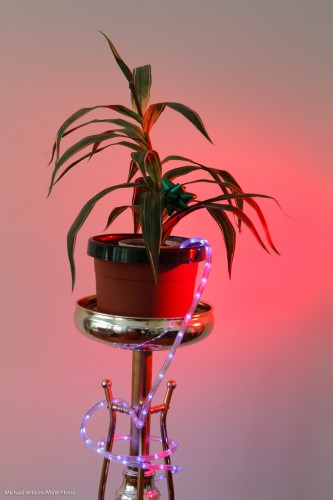
Look at this image: lit from the side with a bare speedlight (a Canon 430EX, which is equivalent to a Nikon SB600) with a red gel.

As you see, light hits the wall.

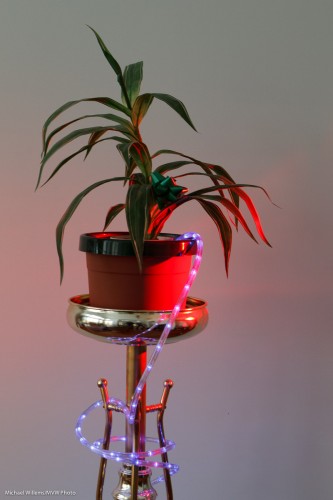
Now look what happens when I put a 1/4″ Honl Photo grid on the flash, with a gel on top of the grid.

Ah. No more light spill onto the wall.

That’s all. As simple as that.

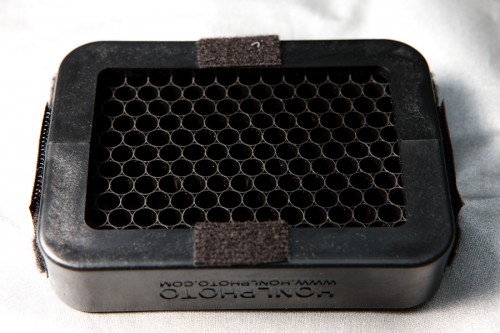
And here’s what a Honl grid looks like:

Checklist: Aye Aye

Back when I spent a lot of time flying airplanes, I would never have dreamt of leaving without going step by step through a detailed checklist. Much as you know, without the checklist you’ll forget that fuel tank selector once – and once is all it takes.

Photography is less critical – but not much. So I propose that you use a checklist much of the time.

This checklist depends on what you are shooting. I usually start from standard settings for snaps:

Focus:

  1. Lens (and camera if it has a setting) on AUTO
  2. Select one focus point
  3. Mode: One-Shot/AF-S

Exposure:

  1. Mode: Aperture, set to f/5.6
  2. ISO: 200 outdoors, 400 indoors and 800 in difficult light
  3. Exposure Compensation: Off (Zero)
  4. Flash compensation: Off (Zero)
  5. Meter: Evaluative/Matrix (“Smart”)

Other:

  1. White balance: Auto
  2. Shutter release: Single

Then I vary from there.

For indoors flash pictures, for instance, it would be as above, except:

  1. Mode: Manual
  2. ISO: 400
  3. Aperture: f/5.6
  4. Shutter: 1/30th second
  5. Flash: On, pointed 45 degrees behind me

You can make your own, and I encourage you to. One of my flight instructors once told me: every item on the checklist is there because that feature has killed several people. And for photography, every item is there because it has ruined someone’s wedding pictures.

Open wide

Wide angle lenses tend to be under-appreciated by amateur photographers. “Surely to get a good photo you need to have a long lens: the longer the better!”

No, not so. A wide angle lens (say, a 10-20mm lens on a crop camera, or a 16-35mm lens on a full-frame camera) allows for interesting pictures.

Wide lenses are great for creative reasons:

  • You get depth, three-dimensionality – we call that “close-far” technique.
  • You get leading lines, strong diagonals.
  • You can make great “environmental” portraits, with a person surrounded; enveloped, as it were, by their environment.

And for technical reasons:

  • It is easy to focus “everywhere:”: depth of field is extensive.
  • It is easy to use slow shutter speeds without motion blur (rough guideline: a 15mm lens can be used at 1/15th second, while a 200mm lens needs 1/200th second).

If I were to have to choose one lens (admittedly this would have to be with a gun to my head: life is not that simple) – but if I had to choose one lens, then I would choose the wide angle zoom as my lens of choice.

The Hood

Nope, not the neighbourhood, but the lens hood.

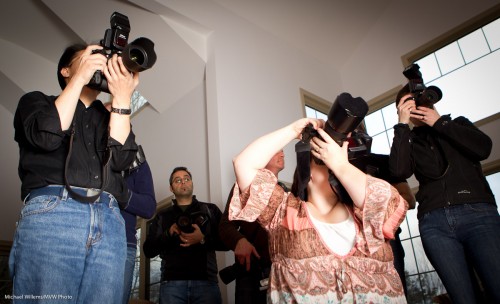
Look at this picture of a group of students here in Mono, Ontario at a recent workshop:

See what I see? Apart from the fact they are all quite rightly aiming their flashes behind them onto walls, I am struck by the fact that they all have their lens hoods on.

  • A lens hood means you get more contrast, since no stray light gets in from the side.
  • If you use a filter, this is especially noticeable.
  • Less flare too (the worst case of contrast loss).
  • And finally: a lower chance of damage when you knock your lens into things (as you will).

So my mini-lesson for today: always use the lens hood that comes with your lens. It has to be that one – the shape is designed to avoid vignetting, i.e. dark corners.

Oh. Yes, it can increase the circle of shade that you get from the lens when using your popup flash. But you do not use that popup flash anyway, do you? Please tell the speedlighter that you don’t!

Power!

Power. To the Speedlighters.

When you are using  a flash outdoors, power is the greatest need, and potentially the greatest problem. If your flash is to be comparable to outside light, or even brighter than it (“nuking the sun”), you need lots.

So I have two tips for those of you using speedlights (small flashes) outdoors.

  1. Do you have enough power? To find out, Set your flash to MANUAL mode (on the back of the flash). Now set it to full power (100%, or 1/1). Now Fire! If you get overexposed parts, you have enough power, so any dark pictures are due to your settings or metering. Carry on and find the problem. If not, you simply do not have enough power, so forget it or move the flash closer.
  2. Need more power? Then zoom in your flash manually. Eg when using 50mm lens, zoom the flash to 105mm. Again, using buttons on the back of the flash (you may need to, dare I say it, read the manual!). This zooming in gives you a centralized, concentrated beam of power. The outsides will be darker but wherever you aim your flash wil be lighter.

Those two tips have saved me many times. I bet they will do the same for you.

Event Fave Lenses

Another word today about lenses, many of which I have mentioned before: here are my  four favourite for lenses for shooting events.

  1. 35mm f/1.4 prime – for low-light “people, camera aware” events. Its large aperture makes it ideal for clubs.
  2. 16-35 f/2.8 zoom – for events with groups of people, or events in small rooms. Its wide angle makes it idea for cramped rooms and dramatic leading lines.
  3. 24-70 f/2.8 zoom – for general purpose events, where you do not know what you will encounter. Its wide range makes it ideal as an all-round lens for events,
  4. 70-200 f/2.8 zoom – for candid shots. Its long focal length makes it great to catch those unexpected portraits-from-a-distance, camera-unaware.

So those are the four lenses I use most. I also use 50mm prime lenses, 100mm macro lenses, and others, but for most events I can grab one or two of the above and be well equipped.

Do you need all four? No. But yo uight want to start saving for the one or two that are most useful for the type of events you shoot.