Hood good

Always use a lens hood (the optional removable flange that sticks out on the front of your lens). Indoors, outdoors; day, night: always.

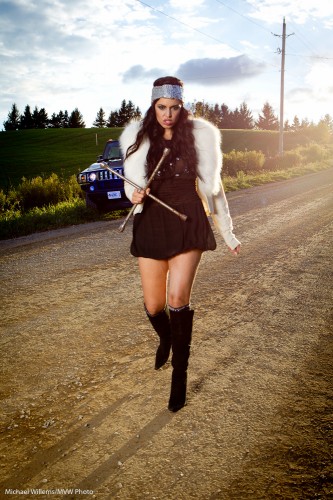
The obvious reason is to decrease the kind of flare you see here, on the right:

Tara the Tire-Iron Terror

But the hood also provides:

  • More subtle contrast enhancement
  • Damage prevention
  • Prevention of dirty lenses

That’s why you always use one, and it is why expensive lenses come with one.

Make sure you use the right hood for your lens. And if a lens has a hood, use it. It can cast a circular shadow when you are using your pop-up flash, but you should not be using that flash anyway.

I wish you all a very happy New Year tomorrow, full of joy – including the joy brought by increasing photography skills. And note that tomorrow’s post may be late: I intend to sleep in!

Prime primer

Why do I shoot events with a prime lens?

My favourite lens is the 35mm f/1.4 lens on my full-frame camera.

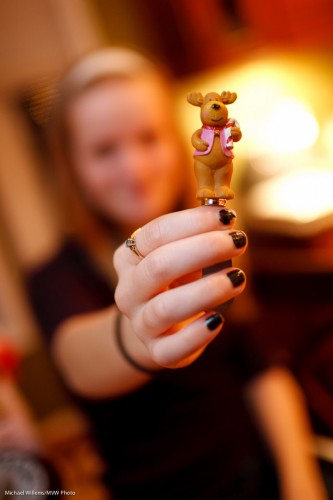
Party figurine at f/1.4

I like primes because they:

  1. Are often smaller and lighter than zoom lenses.
  2. Are generally sharper as well.
  3. Are faster (meaning they have a lower f-number/bigger aperture) so that (a)  I can shoot in darker surroundings.
  4. Are faster (meaning they have a lower f-number/bigger aperture) so that (b) I can blur backgrounds more dramatically.
  5. Force me to use one view angle, meaning that (a) both my pictures and settings are more consistent.
  6. Force me to use one view angle, meaning that (b) I need to tilt and move more rather than zoom to achieve the right composition.

I love the 35 because it is also the perfect length for “grip and grin” party pictures.

For beginners, there is an additional huge benefit: by not zooming but using the same focal length, you get much more quickly to a deeper understanding of the relationship between aperture, focal length and depth of field.

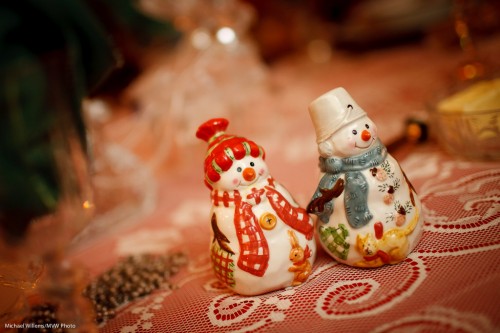
Happy Xmas figurines

There is a lot of benefit there. So I shot two events in the last two nights, and you can be sure my 1Ds camera was my main camera, and it was fitted with the 35mm prime lens.

(As I have pointed our here before, if you have a crop camera, like a D90, Rebel, or 60D, you will want a 24mm lens instead, since 24 x 1.5 = 36).

Event lenses

What lens to use at an event? I hear this question all the time, and it is a good question.Especially with “events” happening all over, during the next week or so.

In my upcoming “Events Photography” workshop I’ll talk about this topic at length. But today, let me give you a starting pointer or two. Some of this is a repeat from prior posts, but put together in one post it probably has value.

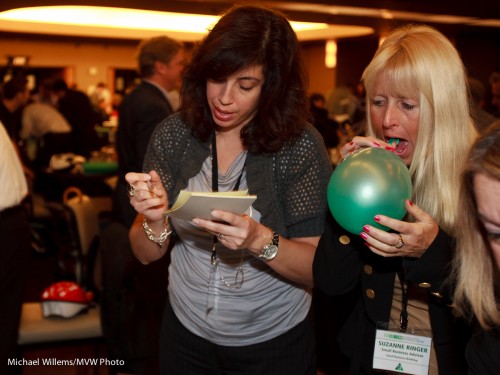
Teambuilding at a recent event

I use the following lenses rather often: and this is on a full-frame camera, so on a crop-factor SLR you need to divide each of these numbers by roughly 1.5:

  • 24-70 f/2.8: General purpose, when I expect a “normal” party or event: i.e. no cramped spaces, no ultra-low light.
  • 16-35 f/2.8: When I expect group shots or cramped spaces. I also use this to get extra perspective, or to get shots with lots of leading lines, possibly angled shots like the one above.
  • 35mm prime f/1.4: When I expect low light, or when I expect mainly “grip and grin” pictures.
  • 70-200 f/2.8: when I expect to be asked for impromptu “fly on the wall” shots and portraits.

So on a crop camera (a low- or medium-priced SLR like a D90 or a Digital Rebel) I would use the 16-35 or 17-40 lens as my general walk-around event lens and I would use a 24mm prime for low-light shooting.

Wide apertures are good

Fast lenses (low “F-numbers”, or “wide apertures” are good for two reasons: they let in more light, and they allow me to blur the background more.

The decisive moment

Yes it may

The most important lesson is: It does not greatly matter. While a wide lens is probably easiest, you can take pictures with any lens. “Fast” is more important than the exact width.

A quick flash tip

One of the things you may wish to do this festive season is use off-camera TTL flash.

I.e. holding the camera in your right hand and the flash elsewhere – for instance in your left hand (or your other fight hand if you have two – well spotted, Mike).

In any case: away from the camera – this is key to good pictures.

All brands of camera allow this, and if you have a Nikon, or a Canon 7D or 60D, you do not even need additional hardware: just your flash and your camera, with its popup.

The popup (or on other camera, the on-camera flash) now sends commands to the other flash. So you can light a subject – like the student in Thursday’s Flash class – from one side, in this case with a flash in an umbrella on our right side, with a reflector on our left:

Off-camera flash using TTL

Much better than straight flash!

You can even use several flashes, divided into groups. In the next shot, we have an additional flash on our left, rather than a reflector. That flash has a red gel (one of the Honl Photo gels) on it, to see clearly which light is doing what work:

Off-camera flashes, using TTL

But what you must remember is this:

Disable the on-camera flash.

That is, the pop-up or 580EX/SB900 on your camera still sends its commands to the other flashes, but when the actual photo is beingtaken, it does not flash.

If you forget to disable it, it will fire. And then you get this unfortunate effect:

On-and Off-camera flashes, using TTL

Deer in the headlights. Harshness. Shadows. Brrr: baaad.

So your tip: use off-camera flash, and disable the main flash from firing actual flashes. The camera menu (or the flash on your camera) has functions for this.

If you want to learn this and many other techniques before the holiday, take the advanced flash course in Mono (see http://www.cameratraining.ca) next week. Else, take a course with me or at Henry’s early in the year. It is worth learning flash!
What camera should I buy?

I hear this question a lot.

And of course there is no real answer. Like asking “what car should I buy”. Up to you!

But there are part answers that may help you make your own decision. Last time, I talked about “Canon or Nikon versus Olympus, Sony, Pentax, etc”. This time let me talk about “Canon or Nikon”.

Both are great. They are the industry leaders. Most photographers and photojournalsits have eitehr Canon or Nikon (by far). But the most important question is “how recent is your camera”, not “what brand is it”.

Some people say the two brands have different DNA. That is an overstatement – you can use and like either and they do the very same job. That said:

  • I feel that in the low end (Nikon D3000, D5000, etc versus Canon Digital Rebel XS, T1i, T2i, etc) Canon beats Nikon. The inability to auto-focus using a 50mm lens on these Nikon cameras is, in my opinion, a showstopper. A lot of options are unavailable. The Canon cameras feel much “cleaner” here, and more professional.
  • In the mid-range, Nikon D90/D300 vs Canon 50D/60D, it’s a wash, especially if you compare modern with modern.
  • In the upper mid range, Canon wins my vote with the excellent 7D and 5D II.
  • In the high end (1D, 1Ds, 3D, etc) it’s a wash again.
  • Hold the cameras and see what feels and sounds better. This is like doing a car test drive. Essential part of your choice.
  • With video, Canon beats Nikon in all but the most recent cameras. But these are not video cameras, really.
  • If you like customizing, Nikon beats Canon. Canon seems to not like to give photographers customization options, especially in lower end cameras: these are used to drive people to the more expensive cameras.
  • On the other hand, Nikon’s menus are terrible: the user interface with the vertical tabs and scroll bars is hard for beginners to understand. Canon is much cleaner here.
  • Canon still has a better lens range than Nikon.
  • Controls on Nikon turn “the wrong way” – e.g. the exposure adjustment scale goes from plus to zero to minus, exactly the opposite to all other Cartesian coordinate systems we have been taught to use all our lives. And to unscrew a lens you turn clockwise. And so on. I find this extremely irritating, but you may love it.
  • Nikon’s TTL flash system is excellent. On the other hand, NIon’s high-end flashes overheat. So again, a wash.

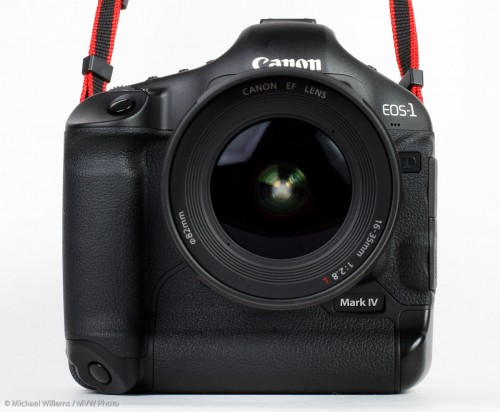
I am a Canon shooter, with a 1D4, a 1Ds3, and a 7D. Buit I also shoot Nikon. A good photographer can handle any camera.

My recommendation:

  1. Make a list of what you will use the camera for
  2. Make a list of MUST HAVES and LIKE TO HAVES in your camera
  3. Take those lists to a good camera store, like Henry’s, where the staff know photography.
  4. Research the recommendations on dpreview.com and via Google.

And above all, buy now, before the festive season.

And above even that: come get some training. Call or email me, sign up at Henrys or at cameratraining.ca, or do whatever you can to learn. It is simple, but if you do not take a course you will never live up to your potential.

Classic Portraits

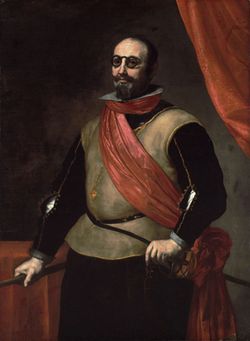
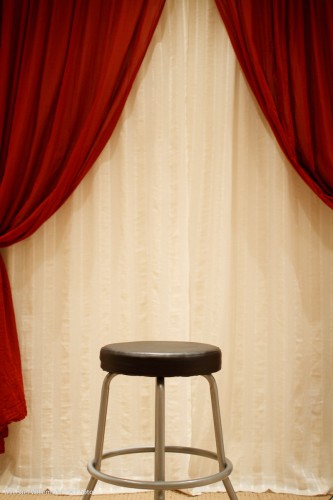
Here’s one tip for classic portraits: you can use classic backgrounds.

In the 17th century, that meant an elegant drape behind the subject, to provide:

  1. Nice texture;
  2. Elegance;
  3. A sign of wealth and comfort;
  4. A nice curve.

Somewhat like this:

1630 - portrait

You do wonder how people walked around in those Halloween costumes. But anyway, back to backdrops. Why not do that today?

My student Melony built this in her home studio.

Home Studio Backdrop System

Against a wall, two curtain rods: the back one with white curtain hanging from it, and the front one with red curtain. Both operable independently so you can open or close either or both. Easy, and it is not in the way of normal use of the room.

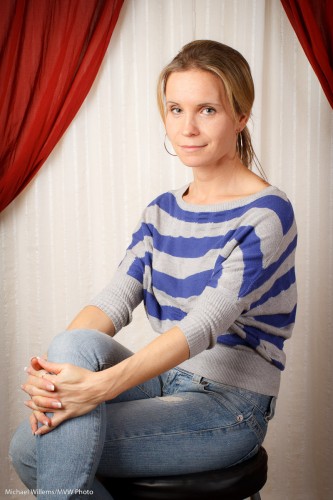
And with proper, light and white balance, this results in portraits like this:

Student Melony in home studio

That kind of setting is very suitable for family portraits. Even in 2010. Many times, I much prefer this to a standard white or black backdrop, or to a muslin.

I might even say especially in 2010. Tip: go to an art museum if you want to see great portraits.

How did we light that portrait?

  1. A softbox to camera left
  2. A fill light behind me to camera right

Questions?

  • Why a softbox? Because it does not spill light everywhere, like an umbrella. Umbrella = safe; softbox = more controllable, and hence more for art.
  • Why the fill light? Because without it, even in a small studio, the non-lit side of your subject can get a bit dark.
  • And if the light is too bright even at the lowest setting? Move it back.
  • Could we have used a reflector instead of a fill light? Absolutely.
  • But will you sometimes want a roll of paper for a neutral, simple background? Of course. Having a drape does not mean you have to use it every time.
  • What kind of lens were you using? A prime (fixed) 35mm lens on a crop camera (the Canon 7D). That means effectively a 50mm lens, which is perfect for half body portraits like this.

So, a classic portrait does not have to be complicated: a few simple tools and you have great options.

Simpler then.

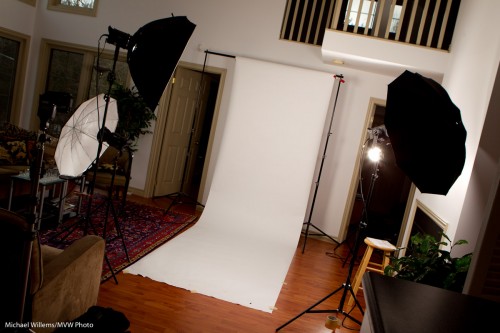
You may recall yesterday I asked whether you could do professional lighting with simpler means than this:

Mono Studio (Photo Michael Willems)

And indeed, you can.

The secret is to think about

  1. The background. If not simple, then make an environmental portrait and use the environment.
  2. The number of lights. In the studio above, my lights are doing it all. So I need many lights. So how about using ambient light as one source?

Here’s ambient light in an environmental subject (environment is relevant here – you’d have to know the story):

Ambient light

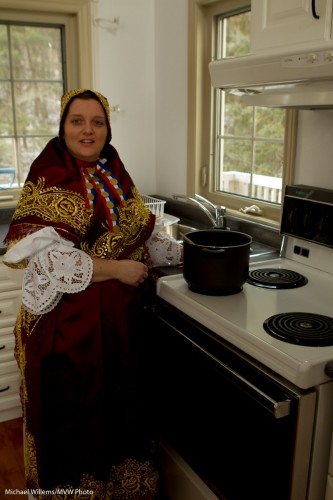
That’s good for ambient, but how about the subject? So, add one flash in a softbox. This gives you a finished shot. Just one light!

Kitchen Surprise (Ambient and softbox)

The recipe here is simple.

  1. Meter for outside light.
  2. Check what aperture that gives you – set sped to between 1/100th and 1/200th second on manual and aim for, say, f/8
  3. Now use your light meter to adjust the flash to that aperture (use your light meter).

Another light lit with the same technique (and again using just one softbox):

Dress in room

So while all the equipment is nice, by combining ambient and flash, you can do a lot with just one light. Keep that in mind over the holiday period.

If this all sounds complicated, at first glance it is, but once you know how to do it, it is simple. This is the kind of technique I teach at my advanced flash workshops, and at the advanced lighting courses Joseph Marranca and I teach together. The new schedule will be posted soon!

(Home) Studio

Sometimes I use big lights, not speedlights. Here’s my studio for a shoot Friday:

Mono Studio (Photo Michael Willems)

That is a tad complex:

  • Three and a bit lights. I use Bowens lights – love them.
  • A way to fire them (cable or pocket wizards – I use the latter).
  • Modifiers (softbox for the main light, and umbrella, perhaps also a snoot)
  • A backdrop stand.
  • Paper roll. White, grey or black, depending.
  • Tape to hold the roll down.
  • Clamps to stop the roll from rolling down.
  • A light meter.
  • A tripod.
  • A camera with a lens of the right range (50-150mm)

It takes up to an hour to set that up, and a good half hour to take it down (ask why photography costs money).

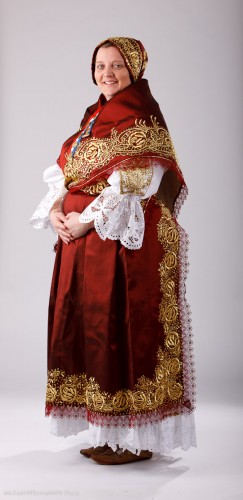
And all this results in pictures like this:

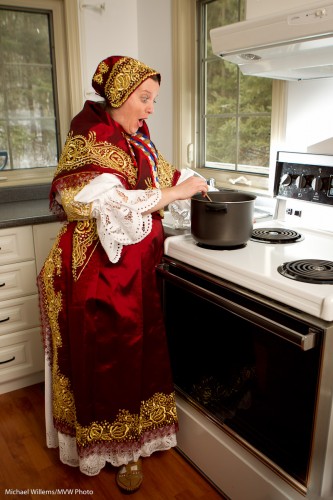
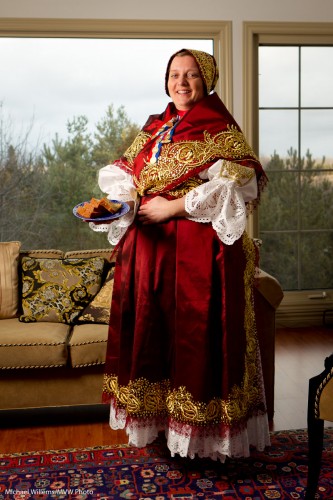
Traditional Dress

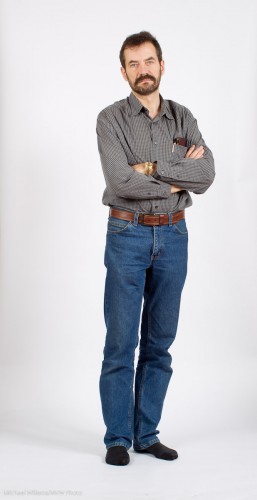
For a studio like this you need, above all, lots of space. Especially when using powerful studio lights and long lenses like my favourite 70-200. Vertical space (ceiling height) as well as lots and lots of horizontal space. In this case, also space to move the subject away from the backdrop, in order to make it darker. Otherwise, if the subject is close to a white backdrop, the backdrop turns very white:

Michael Willems, self portrait

Michael Willems, self portrait

I like that look a lot, but the dress in the shot above had white, so we needed to create separation between it and the backdrop. Meaning we needed a darker backdrop.

So an important question: can you do anything with less?

Sure you can. Tomorrow I’ll show you some examples from the same shoot.

Bring a spare!

If you are shooting an important event (and ALL paid shoots are important), take some basic precautions, and bring spares.

Here is my advice:

Camera:

  1. Format memory cards before you shoot.
  2. Bring spare memory cards.
  3. Ensure that your camera batteries are 100% charged the night before. Check this!
  4. Bring spare camera batteries. At least one spare per camera.
  5. Bring a charger too, just in case.
  6. Bring a spare camera. This can be a starter camera or an old camera – just something you can grab when bad things happen.
  7. Bring a spare lens (what if your one lens’s aperture blades gets stuck? You need an alternate!).

Flash:

  1. Bring a flash – but also a spare flash of the same type. Canon TTL shooters, unless they use a 7D or a 60D, must use an IR transmitter or a 580EX flash on the camera: when that fails, your entire system is down since you can no longer remote-fire the other flashes. My 580EX II failed recently… good thing we had lots of spares.
  2. Bring charged (ideally, conditioned, i.e. discharged-then-charged) NiMH flash batteries.
  3. Bring lots of spares of those. No, I mean lots.
  4. Also, always keep a few (8?) Alkaline batteries in your bag as emergency backup. These do not cycle as fast as NiMH batteries, but they will keep their charge for many years.

Other:

  1. If you use big lights, bring more than you need. You know that your light’s flash tube will die during a shoot, not when the light is in a bag!
  2. Bring a spare photographer, if you can. If you cannot, then at least bring headache and tummy-ache pills just in case.
  3. Bring a charger for your cell phone.
  4. Here’s one most photographers forget: Bring spares for each type of cable you use. USB if you are tethered. Remote flash cable if you use that. Flash X-type. And so on. Whatever you use – bring a spare. Cables break, or go bad, all the time.

During the shoot:

  1. Change flash batteries before each segment of a shoot, even if not empty.
  2. Change your camera’s memory cards every now and then in case a card malfunctions. On some high-end cameras, like my 1-series Canon bodies, you can write to two cards at once.

These simple precautions will not only save your hide sometimes – they will. But more importantly, every shoot you do will involveless stomach acid and headache. Although of course you carry pills for those.

Final bit of advice: make a personalized checklist for shoots. This too gives you peace of mind.

Is brand important?

A student asks me this via email:

Hi Michael, hope you are well. I wanted to send this email as I enjoyed the class you taught and enjoy reading your blogs!

As an amateur photographer the very first camera I started out with was a 35mm Minolta. Hence the reason I purchased my digital Sony, as my lenses were compatible.  I’ve have been building my equipment around “Sony” but have come to so many roadblocks.

I’m not sure if you remember me but I had to borrow your camera in class because I did not have a Nikon or Canon which was compatible to your remote flash. I would love to attend your workshops but I have no knowledge of Nikon or Canon. There has also been some part time job opportunities that I could not apply for because they preferred Nikon or Canon.

So therefore my question is…should I trade in all the Sony equipment and begin with Nikon or Canon? If so, which brand and model would you recommend?

Currently I have the Sony A700 model with 3 lenses (16-105, 50, 70-200macro).

Any recommendations would be greatly appreciated!  (Can’t wait to attend one of workshops, need more help with lighting theory).

Great question, and one that occurs regularly.

And a tough question, too. And it is one to which the answer, as so often in life, is “it depends”.

Let’s go through the various aspects to this choice.

  1. Technology. The A700 is a great camera. In general, though, there is little difference in quality between brands. Sure, Canon and Nikon, as market leaders, have larger R&D budgets, but in the end, all cameras end up with the same features. Differences are minimal. Do not discount Sony, they want to be number two soon, and who knows. If Canon has benefits (very extensive lens selection) and Nikon has advantages (low ISO), Sony also has advantages (available Zeiss lenses). Where Canon has drawbacks, so does Nikon and so does Sony (ask me if I like the Sony proprietary flash socket, or if I like Sony’s menu navigation). All cameras have aperture, shutter and ISO settings, so in the end, technology is not the decisive factor – either way. More important than “what brand is this camera” is “how modern is this camera”. They all get better every year.
  2. Backward Compatibility. Clearly a big one: if you have many thousands of dollars in one equipment maker’s hardware (say, Minolta lenses, which work on Sony cameras, since Sony bought Minolta) that is a factor to be taken into account.
  3. Market. Now we come to a biggie. The market leaders, Canon and Nikon, have a huge advantage over others, since the pro photography pretty much is Nikon and Canon. You have seen it yourself: if you cannot operate Nikon or Canon, many people do not want to know you. This is unjustified – but “it is what it is”.
  4. Peripherals. From available third-party lenses to Pocketwizards, all peripherals are available for Canon and Nikon. So that too can be, for pro shooters, a benefit of switching.
  5. Knowledge, Support, Expertise. An offshoot of the previous point. Books. Courses. Technical support. “Hey guys, my flash just died: anyone have one I can use?”. “Guys, who knows how I turn on this custom feature on my camera?” – Availability of used gear on Craigslist. Reviews on the magazines and online (like my blog). All these are easy if you use Nikon or Canon.

So what would I advise you?

If you are considering a switch for technical reasons, I would say “wait”. I have shot with Olympus, Panasonic, Asahi Pentax: Nikon, Canon, and I teach all others: all cameras are great. The camera is not the important thing, the lens is – and the photographer.

But since you want to be a pro shooter who has already run into roadblocks, I would seriously consider the switch.

To what? Canon or Nikon is a personal choice. What feels better?

Then you choose the level: for you I would say

  • Starter level (Rebel, or 3000/5000) – avoid. These cameras need more pro features
  • Mid-level: 60D or D90, say: great options.
  • Basic pro: 5D, 7D, D300s, etc: great options.
  • Pro: 1D, 1Ds or D3 etc: overkill, I would say, at this point, and in general, overkill for most users (but that said: I use a 1D as well as a 1Ds).

My advice: Check out dpreview.com. When you have a particular camera in mind, ask me about that one. Ask your friends and ask other photographers.

I hope that helps.