Home Studio Needs

A reader’s spouse just asked me:

My spouse had a few photography lessons with you and I am considering getting him some equipment to begin setting up a basic photography studio in our home.  Since it’s a Christmas gift, I didn’t want to ask him or her directly what he or she would need and was hoping you could give me some advice regarding the brands and equipment he or she  would need.

Sure, I would be delighted to help. Here’s what I think you need for a home studio.

Always:

  1. A camera, of course.
  2. A suitable lens (maybe a 24-70, or a prime 50mm lens. For available light it needs to be a fast lens, like an f/1.8; for studio, the speed does not matter. For a big studio, get a 70-200 – but at home you are unlikely to have enough space).
  3. Some kind of background. For simple portraits, this can be a white wall. Or an air mattress blown up as a nice patterned background. Or anything else improvised.

Then, if you want a proper background:

  1. A stand kit – these are very affordable at Henry’s: they consist of two stands and  three crossbars. all in one case. Mine is a Cameron kit and I recall I paid somewhere between $100 and $200 for it.
  2. A roll of paper to roll down from the stand kit (I like grey, since you can make it any colour you like). Wider is better but you need space, plus the ability to transport it home, so you may want to choose narrow.
  3. Alternately, you can use a curtain (or two), hung down from a curtain-rod you attach to the wall just below the ceiling.

For available light portraits:

  1. That 50mm prime lens I mentioned. Or a 24 or 35mm prime lens. Now the lens needs to be fast (have a low F-number, like 2.8 or lower).
  2. A reflector (it can be one of those that folds up when not in use).
  3. A stand for the reflector, so you do not have to hold it.
  4. A window that faces away from the sun (e.g. a north-facing window).

For studio portraits:

  1. A backdrop, again, as above.
  2. A main light. Like a Bowens light (avoid Opus, but pretty much all others are great. For a home studio 200 Ws may be enough, though normally I would try to go with 400 Ws just in case.).
  3. These lights come with stands, usually. If not, you need to add a stand.
  4. A reflector, as above.
  5. A way to connect a flash cable to your camera. The light should come with a cable, and if the camera has a PC-type flash connector output, you are set. If not, a small converter from hotshot to flash connector is all you need to add.

That is the minimum. But to do it well, you may want some of the following added:

  1. Preferably, a second light.  Fortunately, many lights come in kits of two, like the excellent Bowens Gemini kits.
  2. A light meter (this needs to be a flash-meter).
  3. Two Pocketwizards to fire a flash (any other flashes can be slave-cell followers).
  4. One or two additional lights. These can even be speedlights, as long as you can fire them. Four lioghts is ideal, but not necessary of course.
  5. Modifiers – like grids, snoots and gels. If you use speedlites (small flashes) you can keep this simple: use the  Honl Photo range of small flash modifiers. That’s what I do.
  6. A tripod.

Here are two previous posts that may be helpful:

Does this help at all? I bet many of you, with Christmas just a month away, will be thinking similar thoughts.
Opportunity for Ontarians

My speedlite (580XE II) malfunctioned Saturday. Shame but – oh well.Nothing lives forever.

Amazingly, I saw today, as I was buying a replacement, that the price was dropped for a special sale at Henrys from around $550 to around $350.For a few days only!

Those of you who need a Canon professional flash, go get a 580 EX II flash tomorrow. The sales ends tomorrow, so it’s your last day.

My flash could not have broken at a better time!

Michael

7D or 60D?

My friend and student Ed asked (and this is the abbreviated version, his question was more nuanced): “should I buy a Canon 60D or a 7D to replace my Digital Rebel”?

Because this type of question comes up often – one camera versus another one, and use the difference for lenses – like “a D90 plus a lens versus a D300 without one” – I thought I would share my answer here. It may give you some ideas as to the factors that affect a difficult choice like this.

These are both great cameras. They both have the same sensor and the same video.

The 7D does not have the cool articulating mirror, true, but it has other advantages that made me buy one:

  • The 7D has a titanium body (60D is plastic)
  • Weatherproofing.
  • A much better, entirely new focusing system.
  • Better controls (e.g. a switch for video/live view selection; more controls accessible via a switch rather than a menu).
  • More customization options
  • Better viewfinder (100%)
  • More settings in video (e.g. the option to use Av mode)
  • Faster: Two processors rather than the 60D’s one means that you get 8 frames per second when shooting sport. That’s FAST!

Clearly, there is no good or bad – both good. But

  • If you want a sturdier, weatherproofed camera with the latest focus system (more points is good: you will only use one, but you have more to choose from for that one, in a bigger area), and if you shoot sports, then the 7D for sure.
  • But since lenses are more important than cameras for the image quality, if quality is important and the other factors are less so, then go for a cheaper camera and better lenses.

As said: either is good.  But I hope this brief discussion shows there is no clear winner in these things, since the factors that go into your decision are multifaceted and complicated.

When would I use a 24-70?

A colleague asked me recently: when would you/do you use a 24-70mm lens?

Here’s when: always.

That is to say: the 24-70 range is the most versatile range. Any type of portrait can be made in that lens range. Other lenses are great too, but none offer the versatility of a 24-70 on a full frame camera.

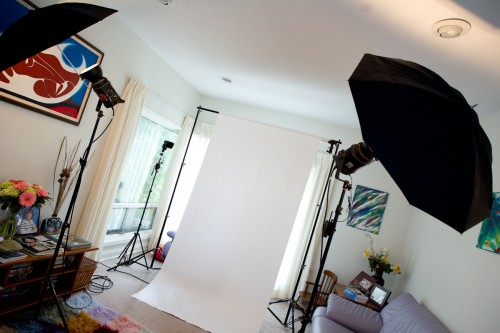
Here’s a recent simple portrait setup in a small room. This was intended for family pictures (the occasion was a Bat Mitzvah celebration):

Portrait setup

You can see:

  1. A backdrop with a narrow white background paper roll
  2. Two 400 Ws Bowens studio lights with umbrellas
  3. A speedlight with a Honl speed strap and a Honl Photo 1/4″ Grid fitted to it
  4. All lights are fired via Pocketwizards

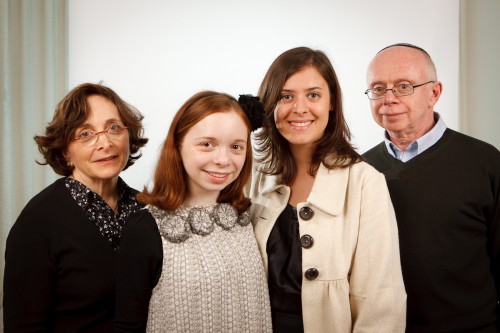
I used a Canon 1Ds Mark 3 camera with the 24-70 f/2.8 lens set to f/8.

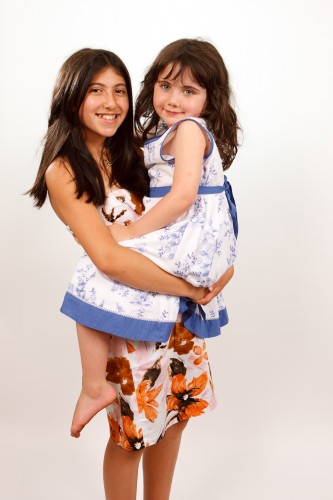
This gives me 50mm portraits:

Sisters (50mm)

Sisters (50mm)

And another one – where I ran out of space:

50mm group shot

50mm group shot

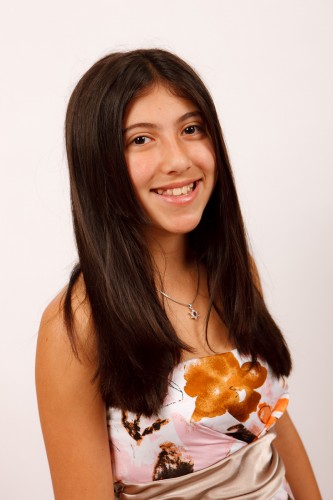
This lens also gives me the ability to take 65mm portraits like this:

Portrait at 65mm

Portrait at 65mm

65mm group shot

65mm group shot

Can you see these are closer up?

Photographers often say “you need 85mm or longer”. As a blanket statement this is nonsense. Plus, for much longer lenses I would have needed a larger room.

Now a few notes.

  1. In all my numbers, I am taking about “real” lens length. If a lens is marked “50mm” or “24-70mm” this means “this lens is a 50mm lens or a 24-70 mm lens on a full frame camera”, i.e. on a camera whose sensor is the same size as a negative.
  2. On a crop camera, a lens “behaves longer” proportional to the crop. So on a small Nikon camera (1.5 cop), a 50mm lens behaves like a 75mm lens, and a 24-70 like a 36-105. On Canon, the crop factor is 1.6. Still in the range!
  3. You can use a 50mm fixed lens (or a 35mm fixed lens on a crop camera) to get this same 50mm effect. Affordable, small, and great quality.

I hope note 3 in particular inspires you to go get a prime lens or two.

For me, I also have a Canon 1D, with a 1.3 crop, and guess what? The 50mm is like a 65mm on that camera.

So I can put the 50 on the 1Ds to get 50, or on the 1D to get 65. Who needs zooms? Yes, the 24-70 is my lens of choice for these portraits, but sometimes it is nice to not zoom, and to work with one length instead.

Compromise lenses

I am often asked “Can I not just bring one 18-300 lens instead of bringing all these multiple lenses?”

Well, of course you can. There is some benefit from carrying just one lens. Convenience is important.

So why do we often forgo that convenience and use multiple lenses instead? What is the drawback to a “one does it all” type lens?

There are several.

  1. Aperture. Your standard kit lens says “1:3.5-5.6” on the front. Or even “1:4.0-6.3”. That means when zoomed out to a wide angle, the lens can open its aperture to f/3.5 or f/4; and when zoomed all the way in, it can only go down to f/5.6 or f/6.3.
  2. Sharpness. General purpose lenses tend to be less sharp than specialized lenses.
  3. Distortion. General purpose lenses distort more at then far ends, and show more vignetting. They are neither a great wide angle lens nor a great telephoto lens.
  4. The lens hood has to be the right shape for the widest angle, so at a zoomed-in setting, it will be less effective.
  5. Size. They are big and heavy when they do not necessarily need to be – you always carry around your longest lens.
  6. Build quality. These lenses tend to be less sturdy than “professional” lenses.

So the convenience comes at a cost. and the secret is to see when you need the benefits above, and when you do not. When you are on a vacation outdoors, a general lens may well do. But to take product photos, sports photos, night shots, or pictures for a magazine, I would go with a better lens.

Remember:the picture is not made by the camera, but by the lens (and by you!).

Softly softly.

For last night’s picture, what did I use?

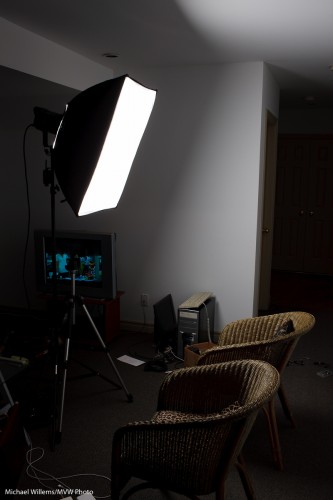
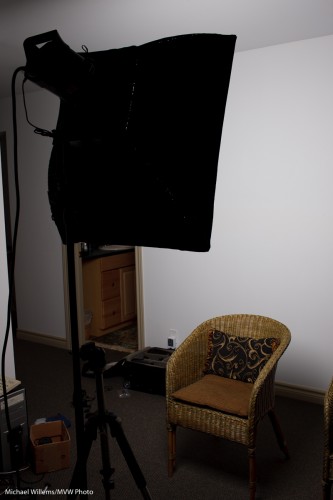
Here’s the answer. It was a simple softbox. This one:

Bowens Softbox

That gives a beautiful and soft-yet-directional light – which is why softboxes are the gold standard for portraits.

Bowens Softbox

Can you see in the shot above how the light drops off beautifully and softly?

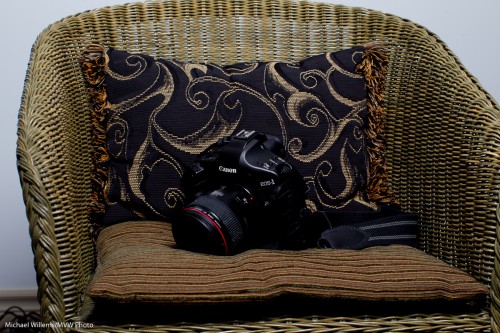
Camera lit with softbox

In a small room, the softbox alone is enough. For a beauty portrait, of course, I might add any of the following:

  • A reflector, underneath the model’s chin, to bounce light back.
  • A hair light (using a snoot).
  • A a background light, perhaps with a gel to change the wall’s colour.

But those are optional: quite often a standard beauty light softbox is all you need. So there you go.

A softbox is better than an umbrella because

  1. It is much more controllable.
  2. It does not throw (spill) light all over the room where you do not necessarily want it.
  3. Being double diffused, a softbox produces a softer light than an umbrella.
  4. It produces a more even light, and avoids hotspots more.

True: it is less convenient because it is bigger and heavier, does not fold into a tiny area, takes longer to set up, and costs more. But considering the advantages above, a softbox may still be the way to go.

Try using a single light with a softbox, and see how you get on!

Portrait tip

As I said before, you can use just about any lens for portraiture.

But there are certain guidelines to obey. Like: when using a wide lens, put the subject small in the centre. Then optionally crop.

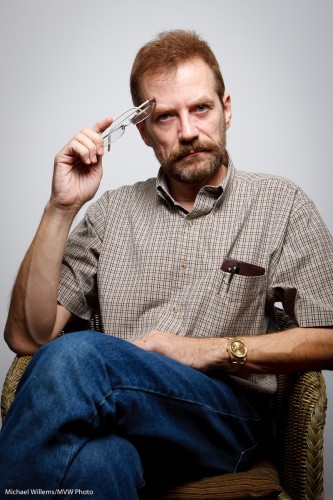
To illustrate. This is a 50mm portrait of me just now:

Michael Willems by Michael Willems (50mm)

Michael Willems by Michael Willems (50mm)

That is just about OK. Any wider and it would be too wide, and for a portrait like that, ideally I would like to zoom in more, to maybe 70mm, and then to stand back.

But perhaps you cannot do that because there is no space. Or you want the environment in the image.

Fine, you can use a wide angle lens. But be careful. If you put your subject too close, the nose will be too large and the face distorted. And if you put your subject near the edge of the image, it will be distorted also.

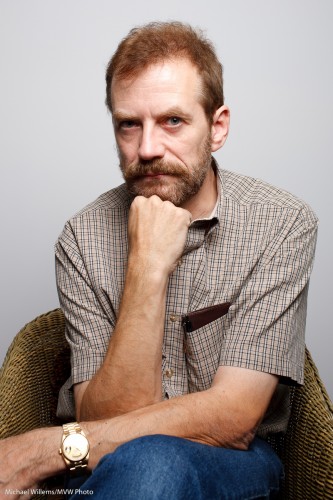
Look at this 35mm portrait:

Michael Willems by Michael Willems (35mm)

Michael Willems by Michael Willems (35mm)

Not good. But what if we put the subject smallish in the centre?

Michael Willems by Michael Willems (35mm, subject in centre)

Michael Willems by Michael Willems 35mm, subject in centre)

That is fine, And optionally, then we crop:

Michael Willems by Michael Willems (35mm, cropped)

Michael Willems by Michael Willems (35mm, cropped)

By cropping, we have now essentially made the 35mm lens into a longer lens. But even without cropping, it is the fact that the subject is in the centre and not very big that makes the composition fine.

I can think:

Michael Willems by Michael Willems (35mm, cropped)

Michael Willems by Michael Willems (35mm, cropped)

I hope this brief example helps dispel the thought that you “must” have an 80-135mm lens for portraits!

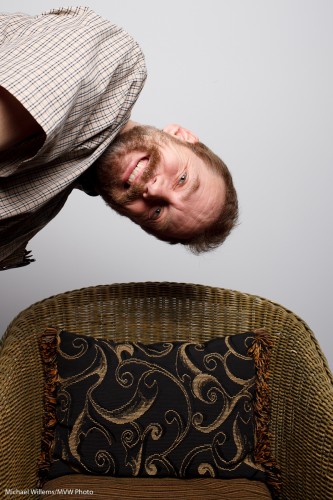
And to finish, a silly image.

Michael Willems by Michael Willems (35mm, silly)

Michael Willems by Michael Willems (35mm, silly)

Yes, I can be silly.

Finally, a question for you to try your hand at, at home. Can you figure out how I lit these images?

Vignetting

My new f/1.2 lens reminds me to point out that vignetting is a good thing.

Let me explain.

Vignetting means “making the outsides of a picture dark”.

A lens, especially a fast lens, used wide open (at the lowest f-number) does this rather a lot. Like in this example. Here is the 50mm lens at f/1.2:

Vignetting at f/1.2

Vignetting at f/1.2

And here at f/2, “stopped down” just over a stop:

Less vignetting at f/2

Less vignetting at f/2

As you see, the wide open image gives you a lot more vignetting: the corners are dark. This is mentioned as a drawback for lenses that do this.

But hold on! Often, vignetting is a desirable thing. Especially in portraits.  Like many photographers, I often add vignetting using the “effects” tool on Lightroom. A little vignetting is hard to detect but makes the picture noticeably better. Vignetting, in this way, makes the subject in the centre looks like he is lit by a spotlight:

Make my day

Make my day (Michael Willems)

I could do this in Photoshop, true – but I like to say “I did it all in the camera”.

And that is why I believe that for a portrait lens, a little vignetting when the lens is wide open is not a bad thing. And I ignore it when lens reviews moan about vignetting wide open.

Faster… faster!

As regular readers will have read yesterday, I just bought a 50mm f/1.2 L lens.

As some here have mentioned, this lens is not known for being the very sharpest at wide open apertures. It is also not known for being one of the cheapest: you can buy an f/1.8 lens for $120, so why spend $1,800 on a f/1.2 lens? Especially a prime lens-  meaning not a convenient “10-500mm” zoom lens?

Because:

  • It is yet another bit faster (meaning, lets in more light) than the f/1.4. A third of a stop more. And as you saw in my post of two days ago, that is important: every little bit helps.
  • And it allows me to blur the background even more.
  • And it gives me beautiful bokeh when used wide open.

Here’s an f/1.2 snap:

Food held out

Food held out

…and another one, showing nice blurry background:

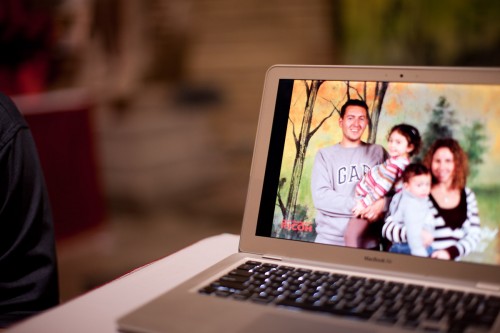
Laptop at The Royal

Laptop at The Royal

Of course even at smaller apertures, like f/2.8, you can get a nice blurred background:

Hold out your glass...

Hold out your glass...

But wide open you get this wonderful soft bokeh (the nature of the blur):

Glass with bokeh

Glass with bokeh

And that is why I am happy to invest in this type of lens.

Plus unlike a camera, a lens keeps its value. A lens’s value depends on the intrinsic value of the optical glass, so it is great.

So when people ask me “should I spend money on a lens or on a new camera”, well – you know they are both great and useful and fun. So either decision is good. But lenses are more important to your photos, and they keep their value, so do not ever feel bad about purchasing a great lens.

Dust to dust

So why do sensors collect dust, and how do you detect it, and what do you do about it?

A sensor is just an electronic negative. But it collects dust for two reasons: one, it never changes (unlike a real negative, which changes for ever shot); and two, it is electrical and can therefore get electrostatically charged, meaning it attracts fine dust particles.

This dust can show up in images where you use a small aperture (like f/16) and have an even surface (like the sky). It looks like this:

So how do you know if you have dust on your sensor?

You do. Everyone does. Do not worry about it unduly – unless it shows up in images! But if you really want to know, here’s how:

  1. Set your camera to aperture mode (A/Av).
  2. Select a low ISO.
  3. Select an aperture of f/16 or f/22 or even f/32.
  4. Set the lens to wide
  5. Focus manually to the closest distance
  6. Point at, and fill the entire frame with, a clear surface like a white wall
  7. Shoot – and move your camera about while shooting.

You will now, when you zoom right in, see the dust.

If is it annoying, then go about removing it in the following ways:

  1. Use the camera’s anti-dust feature repeatedly.
  2. If that does not work, ensure you have a 100% full battery and use a blower (set the camera to manual cleaning, or bulb mode, open up, and carefully use a rubber bulb blower.
  3. If that fails, the safest way is to have it done by your camera maker.
  4. Alternately, use the Visible Dust rotating brush first.
  5. And finally, when even that fails, use wet pads.

The wet pad process is annoying and scary. You will clean some dust but deposit new dust. (Test after each attempt). You will see smears. You have to carefully repeat this process a number of times until you are finally dust free.

Finally: prevention etc: always minimise lens changes and when you do change lenses, carry the changes out with the camera pointed down. Store your camera with a lens attached, always.