Reader question

Today, another reader question that I think may interest others. Reader (and student in one of my workshops) Chuck asks:

I wanted to ask you a second question since my class – this time about Canon lenses:

I’m looking for a wide angle Canon EF lens, and I’m seeing two choices:  17-40MM L F. 4.0 lens and for literally twice the price, a 16-35MM F2.8 lenses.

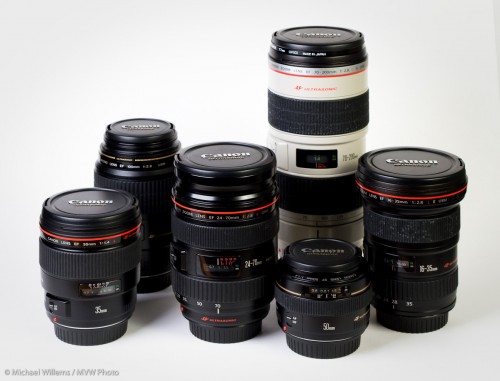
Having heard you educate about ISO abilities & Lightroom capabilities and seeing your picture of lenses ( http://mvwphoto.files.wordpress.com/2009/10/lenses.jpg) I’m wondering why you choose the more expensive 16-35MM F 2.8. over the 17-40MM F 4.0  I read a lot of praise for the F2.8 lens and mixed praise for the F4.0 lens…. but just wanted your perspective please on these two L series lens before I make the purchase.

Thx!

Great question, Chuck.

First of all: either lens would be superb. They are both high quality “L” lenses. On a full frame camera like my 1Ds this is a very wide angle lens; on a crop camera like my 7D this is a wide-to-standard lens. All great.

So why do I go with the 16-35 f/2.8 instead of the 17-40 f/4?

Two reasons.

  1. A wide lens is easy to keep in focus all over the place, i.e.in focus from the tip of your nose to infinity. The wider, the easier this gets. But what if I do not want that? What if instead I want selective sharpness, with a really, really blurry background? Then on a wide angle lens I need very low f-numbers to achieve that. F/2.8 is better than f/4 (which is better than f/5,6, and so on). ISO will not help here.
  2. Light. A wider lens lets in more light. One more stop may not seem much, but in the low light environments I often shoot in, that extra stop can be the difference between a lost shot and a good shot. ISO can of course help, but in that case the more expensive lens can be the difference between me having to shoot at 3200 ISO and being able to do it at 1600.

That’s why I chose the 16-35. The 17-40 would also be a super l;ens, and if you do not need the extra depth-of-field control and you do not shoot very dark environments all the time, the 17-40 will be great as well. I used to own one and loved it.

Why is the 2.8 twice the price? It has literally twice the glass in it, that’s why (a larger aperture means more of that expensive optical glass). So it’s not just marketing!

Advice: go into your camera store and hold both, feel them, try them out. Then, you will know. And since either choice will be superb, you will be happy!

Michael
Reader question

A reader asks the following question:

The issue of aspect ratio: most D-SLR cameras don’t shoot in the traditional 4×6 ratio (or at least I don’t think they do). That’s why whenever I send my photos to be printed off (in 4×6) they always come back a little cropped around the edges.

Good question. Infuriating,  isn’t it?

And yes, you are almost right: other than 4×6, other photo sizes tend to be different: 5×7, 8×10, 13×19 and so on. So why 4×6 is cropped I do not know: most DSLR sensors are 3×2, which is 4×6. So it must be the printing process.

But your question stands: most aspect rations are very different, as are most frames. And the reason is simply history.

And the solution: crop them yourself to the correct aspect ratio, in Lightroom. That way the lab does not have to guess (bad) and you get full control.

Either that, or print at the original aspect ratio on larger paper (i.e. with edges), and then cut those off.

I was having a coffee…

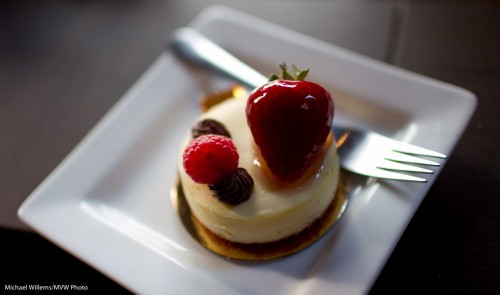
…when I decided a cheesecake would be good. So I bought a piece.  And shot it.

Cheesecake (Photo: Michael Willems)

Cheesecake

35 mm lens, f/1.4, 1/60th second at 100 ISO. You see what those nice fast lenses can do? I cropped a tiny bit of light from the top – no other adjustments.

The moral of this post:

  • Be ready to shoot your food.
  • Fast prime lenses are good: available light works.
  • You do not always need flash.
  • Low ISO is good.
  • Wide open is good: selective focus is great.
  • A wide angle lens can be used to shoot a macro food shot!

Exhaustion prevents me from working more tonight – but more soon.

Meter the light

You know how in 1970 photographers always used to use light meters?

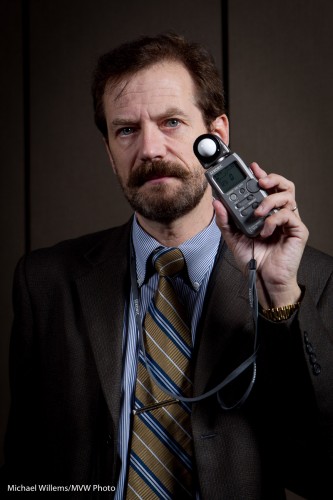
Like this one, in a pic from the recent photo show:

Michael Willems holding a light meter

Michael Willems holding a light meter

Yes that is right: I am using a light meter. In 2010. And like most working photographers, I use one often.

Why?

Here’s why.

1. Type of meter. The light meter built into your camera is a reflective meter. It meters light that is reflected off the subject.  So if the subject is dark you might get a long exposure time (little light is reflected off it, so your camera sees little light), while if the subject is bright, you might get a short exposure time (a lot of light is reflected, so your camera sees a lot of light).

This means that the subject affects the metering. This is wrong. Think of a bride or a groom in a room. The bride would cause a fast shutter speed (see above), causing the room to be too dark, while conversely the groom would cause the room too bright. Clearly the subject’s brightness is absolute and should not cause the exposure to vary.

An incident light meter, and that is what hand held light meters are, measures the light falling onto the scene. The subject’s brightness has no effect at all. Problem solved!

2. Flash. The only way to meter a flash of light is by using  flash meter. You can use the histogram and a lot of trial and error, but that is just that: trial and error. A light meter gives you the right result.

So in a studio setting, or when using manual flash, you use a light meter. Now you turn it to “flash meter”. And again, guaranteed results.

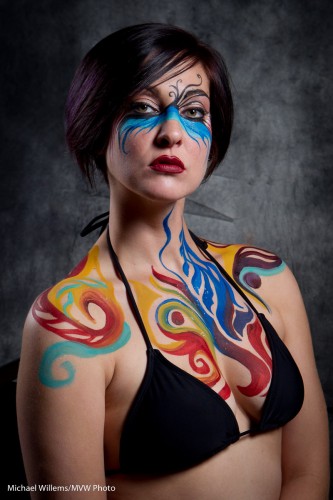
And that is why we use them still. Like in this shot from this weekend’s show:

Bodypaint Model

Bodypaint Model

Card Speed

A question I get often is “what memory card speed do I need”. The ratings are confusing and the offering even more so. So this is a good question. A reason to explain card speeds.

I have explained before why and when you need fast cards (in short, when you shoot high-def video, when you shoot sports, and when for simple convenience you want to be able to review the pictures on the back of your camera as quickly as the camera will allow).

But what do the ratings mean?

  1. CF Card ratings. The original CD-ROM had a transfer rate (“how fast can data be moved off the device?”) of 150 kByte/second. That is what we call “1X”. So 10x = 1.5 MByte/second, and “40x” means “6 MByte/second”. This is how CF cards are rated.
  2. CD card ratings. These are usually rated as a “Class”. This expresses the minimum transfer speed in MByte/sec, so class 6 means 6 MByte/second.
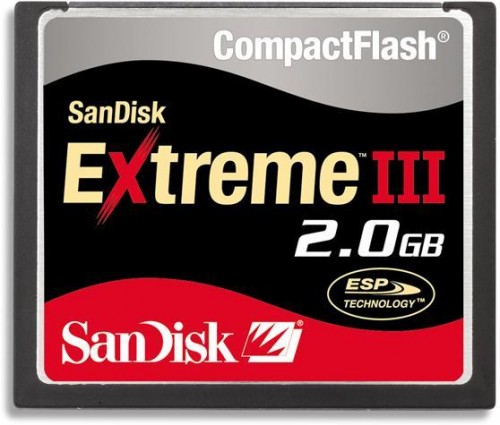
  3. Manufacturer ratings. Oh, well, these are mainly (but not all) marketing. “Extreme this or that”. You need to Google these and translate them back to real numbers.

Be aware of a few things.

  • Just like Megapixels, a simple number does not tell the whole story. Is the data rate continuous or “burst”? Does the card do more error-checking and correcting while it is doing the transfer?
  • And be weary of large sizes: if you lose a 16 GB memory card due top failure or theft, you lose hundreds or even thousands of pictures all at once.

Michael’s tips: Buy a few good brand-name memory cards (Sandisk and Lexar are the class leaders). Own at least one fast card. For hi-def video, you need a class of at least 6 (6 Mbyte/sec).

Why do lenses cost so much?

I often hear this question: why do lenses cost so much? And why are fast lenses even more expensive?

There are several very good reasons for this.

  • Lenses contain very expensive, high-quality optical glass. The more glass, the more cost. The faster a lens, the more glass (that is what “fast” means: a larger opening): ergo, the higher that cost.
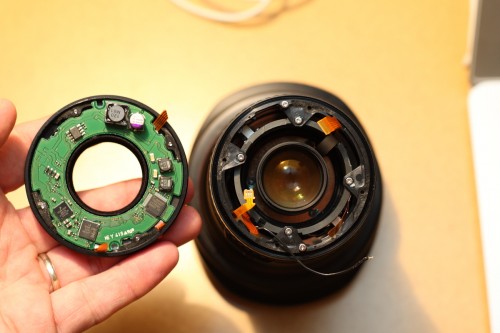
  • Today’s lenses contain sophisticated electronics. See my 16-35 f/2.8 lens below, a while ago after I, um, dropped it. Twice.
  • Economies of scale: of course a more popular lens has lower cost, because it sells more (look at the popular 50mm f/1.8 lenses).

Here’s that lens of mine:

Lens "wide open" - for real

Lens "wide open" - for real

The good news: as I have said here many times, lenses are an investment. They are more important to your picture than the camera, and they retain their value, often for decades.

TIP: go to the online Canon Museum and go to the Virtual Lens Plant to see a very interesting series of videos about lens manufacture.

But.. but… it’s complicated!

Well, sometimes things need work.

I often have students who ask “do I really need two lenses?”, “do I really need a reflector”, “do I really need a tripod”? “Must I really use manual”, … and so on.

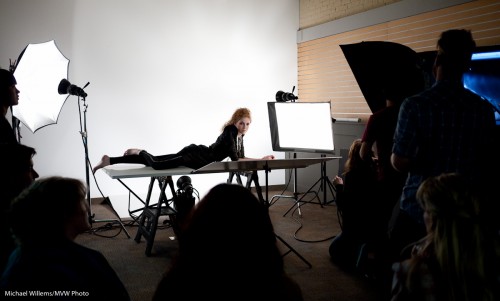
The other day I attended a very entertaining shoot with Ivan Otis, and this shoot was a typical example of “how it’s done”.

Even a simple fashion shoot like this involves cameras, light stands, reflectors, computers, umbrellas, light meters, batteries, cables, softboxes, pocketwizards, props, two assistants, a make-up artist (“MUA”), a hairdresser, lunch, and of course a model and a photographer.

A Fashion Shoot

A Fashion Shoot

A more involved fashion shoot would also have fashion advisors, a creative director, and more.

So the answer to “do I really need all this” is “it depends, but you cannot always do everything with one handheld camera, a 50mm lens, and a pop-up flash”.

The complexity in a shoot like the one above is not done just to make things complicated! As I always say, the Sports Illustrated swimsuit-issue model cavorting happily on the beach looks good only because there is a guy with a big reflector cavorting along right behind her.

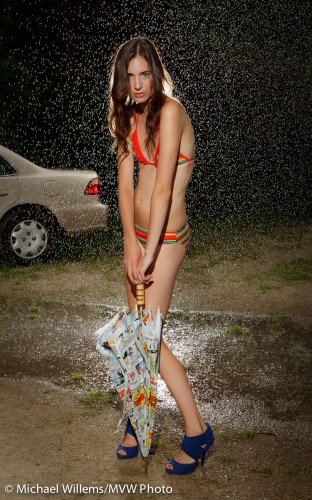
That said: you do not need to over-complicate things. Simple means can often achieve great results. Like this, taken at a recent Mono workshop Joseph Marranca and I taught:

Evanna Mills in the rain

Evanna Mills in the rain

That used just three bare speedlights and a handheld camera.

(On that note: our next “advanced lighting” all-day workshops in Mono, Ontario, will be held on 3 October and 20 November, and as of the time of writing, there is still space).

Portrait lenses

“What do you use for a portrait lens”, is a common question.

Michael's lenses

Michael's lenses

OK. So my favourites include:

  • 50mm f/1.4 for half-body shots (1Ds) and headshots (1D). Especially for avaialable open light portraits.
  • 70-200 f/2.8 for flattering headshots, in big studios.  A favourite… man, that lens is sharp.
  • 24-70 f/2.8 for fashion, etc: great for generic portrait shots.
  • 100 f/2.8 Macro for headshots: did you know, macro lenses are also great portraits lenses?
  • 16-35 f/2.8 for party shots. Wide allows me to inlcude dramatic views of room, food, etc.
  • 35mm f/1.4 for “dark party” shots, and environmental portraits.

Huh? All your lenses, Michael?

Yes. And I hope that helps show that there is not one answer to this question.

The “50-100mm” standard answer is an oversimplification. There is not “one portrait”, and nor is there “one portrait lens”.

Shout it out

Or rather, perhaps you should not.

I do not much like to use branded camera straps – like the Canon camera straps on my Canon cameras.

First of all, much as I love all my Canon equipment, without being paid for it I am not sure I should be an advertisement. Also, my fashion sense likes to think I do not have to match everything with Canon red. Black is easier.

More importantly, when I travel I like to avoid anything that draws attention to my gear. Every little bit of theft avoidance helps: tape over the name, a brandless lens cap (if you even use them), and these non-branded straps.

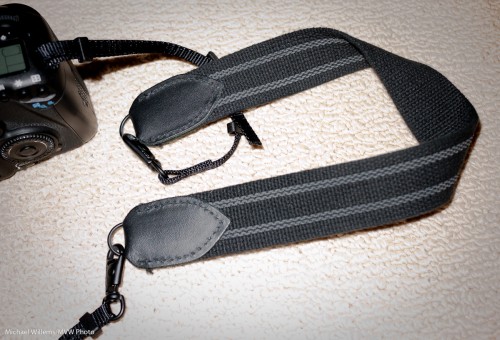
So I use these Domke straps on all my cameras:

Domke Camera Strap

Domke Camera Strap

These aftermarket straps have several other big benefits:

  • The rubber strip through the material ensures a good grip on my shoulder.
  • The strap is removable: two fasteners can be opened, and then the strap is gone. This is very handy when I want to switch to my Black Rapid strap, and need to remove the usual strap.

That is why I give my pick this:

Michael’s Quick Judgment: a big thumbs up.

Size matters (2)

As I said earlier, in sensors, bigger sizes are better.  Let me expand on that a little.

A bigger sensor means five essential things:

  1. Lower “noise” (and hence, greater ability to shoot in low light).
  2. Greater ability to use selective focus (“blur the background”).
  3. Better use of the maximum resolving power of the lenses’ glass.
  4. On an SLR, a bigger, brighter viewfinder.
  5. Greater ability to use small apertures (high F-numbers”), which otherwise lead to distortion due to the bandwidth of light – so this is physics, and will not be overcome. This is why lenses have a “sharpness sweet spot” – say, at around f/8 on a full-frame camera with a typical lens.

And less fundamentally, but very importantly in practical terms, for those of you choosing between full-frame and crop sensor SLRs, a larger sensor also means that the same wide angle lenses are wider on the full-frame camera.

So what sensor sizes are there?

  • A typical point-and-shoot: 6 x 4 mm
  • Four Thirds (as used in Four Thirds and Micro Four Thirds cameras): 18 x 13.5 mm
  • APS-C, the sensor used on a typical crop SLR, like a Canon 60D or a Nikon D90: around 22 x 15 mm
  • APS-H, a Canon format, as in my 1D Mark IV:  28.7 x 19.1 mm
  • And “full frame”, as in a negative: 36 x 24mm

And every step smaller means less ability to close down the aperture and stay sharp, less ability to blur the background, and more noise.

The benefits of small sensors are the small size, weight and cost; the ability to use small and hence cheap lenses; the fact that they make lenses appear longer (which is good if you are a sports shooter, but bad if you are a wide-angle shooter); and the ability to get close, so point-and-shoots are usually very good macro cameras.