Flash power

A few notes on speedlites today.

How does a flash set its power level? Not by making itself brighter or darker, but by shining for longer or shorter. Using light in pictures is like using a spray can: the longer you spray, the more you get.

So how long is a flash? That depends. It is 1/1000th second on full power. 1/2000th second on half power, 1/4000th on quarter power, and so on. So if you want very short flashes, fire at low power.

How do I fire at low power? Just get closer to your subject or use higher ISO settings. Then set low power (if you use TTL, the camera will do that automatically for you).

But what if I use high-speed flash? Then rather than firing one flash, it fires many very short flashes, at a rate of around 40 kHz. This simulates continuous light, which you need when using fast shutter speeds (over, say, 1/200th sec), where the shutter does not open all the way at any time.

Product release: Those of you who shoot Nikon can go get SB-600s while they last, and then upgrade to the SB-700, a major improvement, if slightly less powerful than the SB-600. And hopefully it will not overheat too easily, like the SB-900 does.

Why bother?

A friend just pointed me to the new Canon PowerShot SX30 IS, a newly announced super zoom.

“Why bother with something like a micro four thirds camera?”, he asked. All he needs is the super zoom capability. “It has a 14.1 megapixel sensor; why do I care whether it is micro four thirds or not?”

Well… you know I’ll weigh in on that.

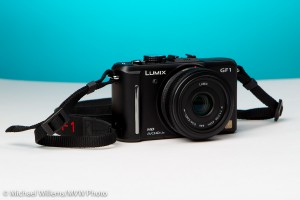
When not using an SLR, I like Micro Four Thirds cameras like my Panasonic Lumix GF-1:

Panasonic GF1, photo Michael Willems

Panasonic GF1, photo Michael Willems

And for some very specific reasons.

  1. A larger sensor means lower noise. The higher the pixel density (pixels per square mm), the lower the signal-to-noise ratio, and hence, the higher the noise in any given picture. That is why Canon very sensibly went down in Megapixels between the G10 and the G11 (by the way, the G12 was just announced).
  2. Hence, less ability on small sensor cameras like the Powershot to go to higher ISO settings. I can take good pictures on my full-frame camera at 3200 ISO. Forget even 800 ISO on a typical small frame camera. And that’s physics, so there’s not much to be done about this.
  3. Inability on small sensor cameras to go to selective depth of field. The aperture as a ratio of the sensor size determines “how blurry I can make the background”. Large sensor = ability to really blur the background. On my micro four thirds Panasonic, which has a sensor almost as large as many SLRs have now, I can create really blurry backgrounds at f/1.7. On a small point and shoot: forget that, even at the lowest “F-number”, your background is still crisp and sharp.

So that is why zoom ability and small size are not everything.

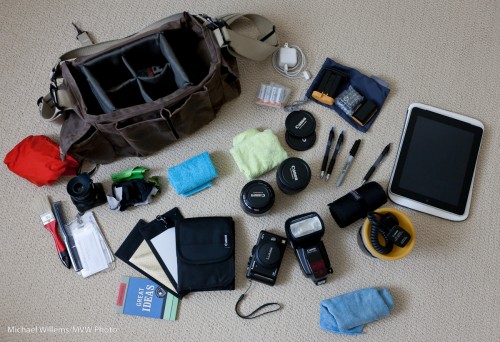
What is in my bag?

I am often asked “what is in that Domke bag of yours”?

Here. Too much, many would say…:

Photo Bag by Michael Willems

Photo Bag by Michael Willems

The bag is a Domke bag, and it contains:

  • Two lenses (Which ones? That varies per shoot).
  • A speedlight (Canon 580-EX II).
  • My off-camera flash cable.
  • My point-and-shoot camera (a Panasonic Lumix GF-1 Micro Four Thirds camera).
  • The indispensable Hoodman Hood Loupe (Get one. Now.)
  • Memory cards… always carry spares.
  • Fong Lightsphere – for safe shooting when I need safety rather than creativity.
  • Honl Photo reflectors/gobos.
  • A Honl gel set in a Honl roll.
  • My iPad .. plus, just in case, its charger.
  • Spare batteries for every camera and for flash. Never travel without spare batteries.
  • Lens caps for the lenses that are on the camera. I do not use them on the cameras I am using.
  • Cloths, plastic bags, headache and stomach acid pills.
  • Note pad, pens, comb, small brush, business cards.

And an important note: no camera. That is (or more accurately, those are!) over my shoulder.

Wide, and wider

Wide angle lenses are good, you have heard me say this many times.

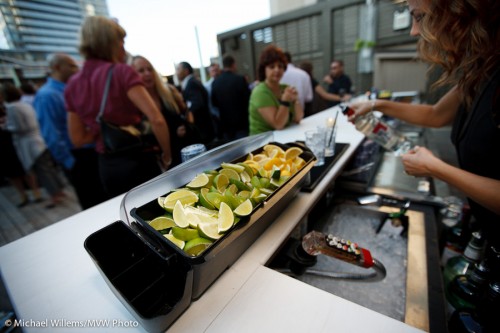
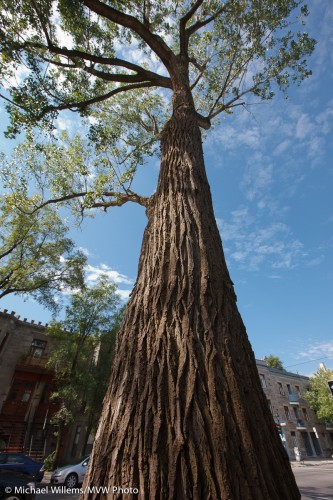
Not just for travel. Also, for instance, for “event background shots”, like this recent picture taken at a corporate event:

Bar Lemons

Bar Lemons

Or for this:

Montreal Plateau Tree

Montreal Plateau Tree

Wide angles because:

  • You get more in (d’oh).
  • They are easy to focus – if you wish, you can get it all in focus (but see the note below).
  • It is easy to avoid camera shake (a safe-ish shutter speed is “1 divided by the lens length”, after all, so shorter lenses are easier).
  • You introduce depth (“close-far” technique).
  • You can exaggerate perspective, if you wish.

So how wide is “wide”?

I would say 16-35 mm on a “full frame” camera – that means 10-20 mm for those of you who use a crop camera, like a Digital Rebel, 50D, D3000, or D90.

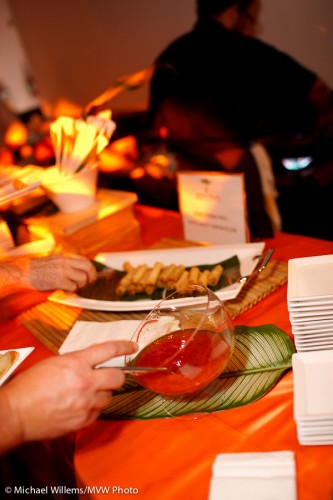
Now I promised you a footnote. Wide lenses make it easy to focus on “everything”. So what if I want selective focus, like in the bar or in the following shot? Selective focus is oh so important in photography, as it helps you tell a story:

Buffet

Buffet

Well, then I need to have a wide open aperture. Wider than on a longer lens.

And that is why I use a 16-35mm f/2.8 lens, and if I could find a faster one I would get it, too. The faster (i.e. the lower the “F”-number), the better. So when some say “a wide lens does not need to be fast”, they are wrong.

Dodo Lenses?

A student from the other day asks:

My son & I really enjoyed the course with you last night.  I do find myself a bit puzzled though about one particular matter when it comes to future investment.  I’m thinking about updating my 10D and then purchase another lens, yet you’re not the first person to praise their “Micro Four Thirds” camera – especially given the quality and additional lens options.  I’m wondering if this is going to be like the cherry-wood entertainment center I purchased years ago when wide screen tv’s were just on the way… but this entertainment center was not built for it.  Today, it’s still a beautiful piece of furniture, but it’s admittedly been sidelined since it’s unable to accommodate modern TV shapes.

What do you think? If this is the way of the future… perhaps my EF lenses may go the way of the dinosaur?

Good question: and yes, I d love the Panasonic Lumix I recently bought, and yes, it can produce work as good as the SLRs. So are we dumping those and going to Micro Four Thirds?

No – not at the expense of SLRs. SLR cameras will always be here. Why? Why lug about a heavy camera when a small camera can be as good? For reasons like these:

  • The availability of a much wider range of lenses.
  • The ability to shoot more quickly (ten frames a second on my 1D, 8 on the 7D).
  • Waterproofing
  • Focusing systems that do not rely on the sensor
  • The ability to use a viewfinder that shows “the real thing”
  • More buttons – yes, that is a good thing. Few menus needed. To change exposure, ISO, metering mode, white balance, and a host of other things, on my SLR I can press one button. On smaller cameras I often need to enter menu systems, which can be convoluted.
  • Micro Four Thirds is so special because it uses a biiig sensor: but it’s still not quite as big as a crop SLR’s sensor (and not nearly as big as a full size sensor). And sensor size matters greatly: lower noise, and more restricted depth-of-field possibilities.

Those reasons show why SLRs will be at the forefont of camera development for many more years.

Now, one thing you may want to do is use EF rather than EF-S lenses. More cameras are being released as full-sized snesors, and an EF lens can fit on any Canon camera, while an EF-S lens can only fit o the crop sensor camera.

EF lenses, then, provide great future proofing. You can go ahead and buy and not fear that five or ten years down the road, your lens will be worthless and (worse), useless..

Learning light

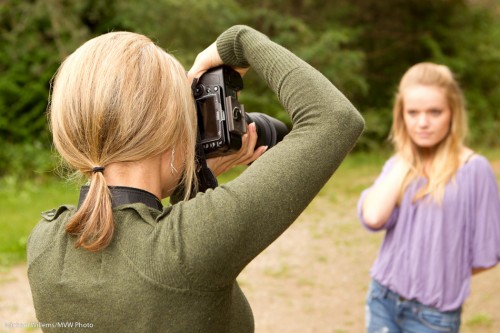
In an intensive half-day custom course, I taught my student Melony some glamour photography techniques a few days ago. From flash techniques to colour to modifiers to using a light meter to posing.

She brought her daughter as her subject, and both did excellent work.

Student shooting model

Student shooting model

(By the way, did I ever tell you to make the viewer work in interpreting an image? Yes I did. And the blurred out daughter in the background is an excellent way to do that. Don’t tell the whole story, let the viewer figure it out.)

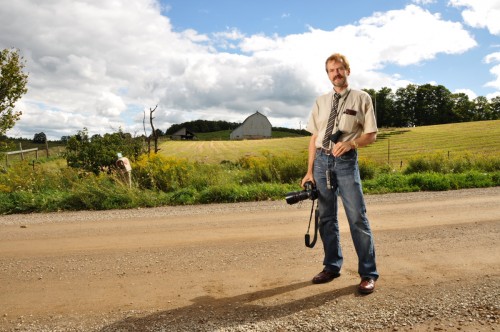
But anyway. Student Melony also kindly photographed me:

Michael Willems, by Melony McB.

Michael Willems, by Melony McB.

That is a great portrait.

And I can say that because it is the photographer who makes the portrait, in this case, more than the subject.

So how did we do this? Why does it work?

This works because:

    1. The light is good. First, Melony exposed the background properly (i.e. she did not overexpose it: exposing less is good, so that the subject, not the background, becomes the “bright pixels”). Willems’s Dictum: “Bright Pixels are Sharp Pixels”. Also known as “blurriness hides in the shadows”.
    2. Then, I am lit by the sun from the right (aided by a speedlight, but as the sun came out just at the right moment, this was no longer necessary). That gives us the nice shadow.
    3. But then, in a twist, and that twist is what does it, I am lit by a strobe with a softbox on the (camera) left – that gives the “ultra-realistic” look. Light from the back -and yet I am bright in the front.
    4. This image also show good use of appropriate props – I am holding the camera, which for a photographer is part of the story.

      Pocketwizards and a battery-powered Bowens light, as well as a speedlight, were used here.

      And kudos to those of you who spotted the other essentials, around my neck: a Hood Loupe by Hoodman, and a flash meter.

      Light makes a photo. Creative light makes it better. And it is simple. Once you know it.

      This is the sort of stuff I teach at my workshops, and Joseph Marranca and I are doing several more in October: check the schedule on www.cameratraining.ca !

      And yes, I wear a tie almost every day.

      Back trouble

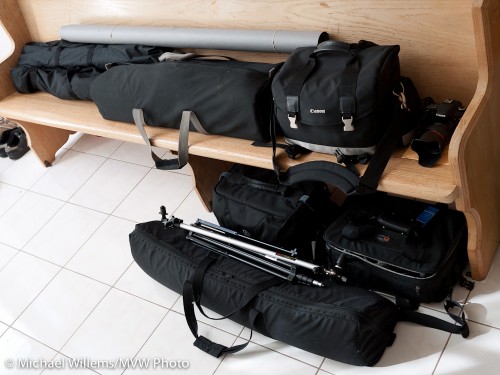
      Back trouble is what I think of when I see what I carry to one shoot. And this is not even all of it:

      Michael's Gear - part of it

      Michael's Gear - part of it

      That contains:

      • Light stands
      • Lighting stuff: speedlites, pocketwizards, etc
      • Big backdrop stand
      • Small backdrop stand
      • Additional Camera gear
      • Backdrops
      • Tripod
      • Strobes

      In addition, I carry:

      • Two more cameras
      • Camera bag

      So when people wonder why a shoot costs hundreds of dollars, this is why. A photographer is prepared for everything (No power? Then use speedlights. You also want formals? Then I set up the backdrop. One camera breaks? Then I grab another. Long lens no good? Then I use a shorter one. Batteries dead? Then I grab replacements.)

      The only problem is my back. Price to pay!

      UPDATE:

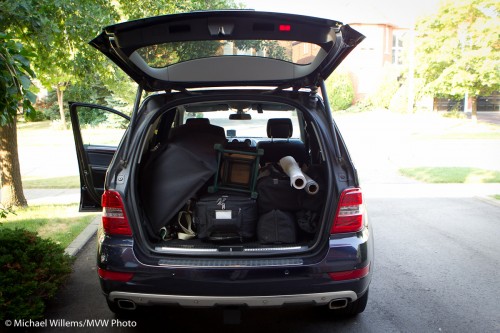
      Today, at 10:30, I shoot in an office building in Toronto, on the 35th, 37th and 38th floor. And so far, I have been unable to find an assistant for the shoot, so if you’re interested, give me a call before 10am!

      And here is my car. You can probably see why I need that assistant!

      Car full of photo gear, ready for a shoot

      Car full of photo gear, ready for a shoot

      Gizmo of the day

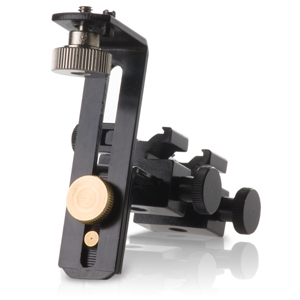
      The gizmo of the day is this Photoflex bracket:

      Photoflex dual flash bracket

      Photoflex dual flash bracket

      Intended mainly to put two small flashes in a softbox. For which it works well. Adjustable just like it should be.

      But I have another use for it.

      You see, I am a speedlighter. I use small flashes. And pocketwizards, when I am not using TTL. So I am always looking for ways to mount those flashes and Pocketwizards, and no-one has yet come up with any good ways to do it.

      So that’s where this bracket comes in. I use it to put one flash and one Pocketwizard onto a light stand. I mount it on a ball head, which I put on the light stand.

      In order to do so, I had to use a metal saw to remove the little tag that sticks out: you can see it on the very top, sticking out next to the screw. I am not sure why they put that there: much better without.

      But that done, I now have a bracket that allows me to securely, safely and sturdily mount two flashes, or a flash and a pocketwizard, for use on a light stand.

      Michael’s Quick Judgment: recommended, provided you have a saw.

      Data mining

      Photography is not about gear. It is about art, expressions, emotion, colour. About the end product, not about what you use to get there.

      Right. But it does start with gear. I thought, therefore, that you might be interested in what lenses I used for what shoots. I get asked this rather a lot. So I did some data mining of my shoots of the last few years.
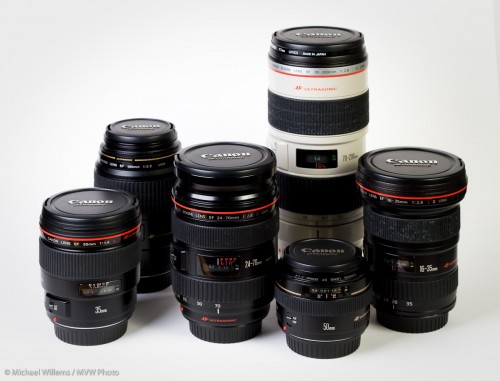
      Michael Willems's Lenses

      Michael's Lenses

      EVENTS:

      First I picked some recent event shoots: “grip and grins”. The lenses I uses were, out of a total of thousands of images:

      Canon 1D Mark IV (1.3 crop factor):

      1. 42% – 24-70 f/2.8 (equiv. 30-90) (by shoots, this is number 2)
      2. 39% – 70-200 f/2.8 (equiv. 90-260) (by shoots, this is number 1)
      3. 17% – 16-35 f/2.8 (equiv. 20-45)
      4. 1% – 35mm f/1.4 (equiv. 45)
      5. 1% –  50mm f/1.4 (equiv. 65)

      Canon 1Ds Mark III (full frame)

      1. 51% – 16-35 f/2.8
      2. 33% – 24-70 f/2.8
      3. 12% – 35mm f/1.4
      4. 2% – 70-200 f/2.8
      5. 1% –  50mm f/1.4

      That is interesting. On the 1Ds, I use the 35mm f/1.4 lens in too few shoots (a lovely lens!).

      GENERAL:

      Now the total, all types of shoots, out of a total of tens of thousands of images::

      Canon 1D Mark IV (1.3 crop factor):

      1. 49% – 24-70 f/2.8 (equiv. 30-90)
      2. 25% – 16-35 f/2.8 (equiv. 20-45)
      3. 19% – 70-200 f/2.8 (equiv. 90-260)
      4. 3% – 35mm f/1.4 (equiv. 45)
      5. 2% –  50mm f/1.4 (equiv. 65)
      6. 2% – 100mm macro

      Canon 1Ds Mark III (full frame)

      1. 33% – 24-70 f/2.8
      2. 27% – 16-35 f/2.8
      3. 19% – 70-200 f/2.8
      4. 13% – 35mm f/1.4
      5. 5% –  50mm f/1.4
      6. 3% – 100mm macro

      One surprise here is how often I use a specialty lens like the macro. The real surprising thing is how often I use the 24-70, on both cameras.

      Here is another breakdown: What focal length do I use in event shoots. More data mining from Lightroom gives me this (out of aroud 2,000 shots in a number of event shoots):
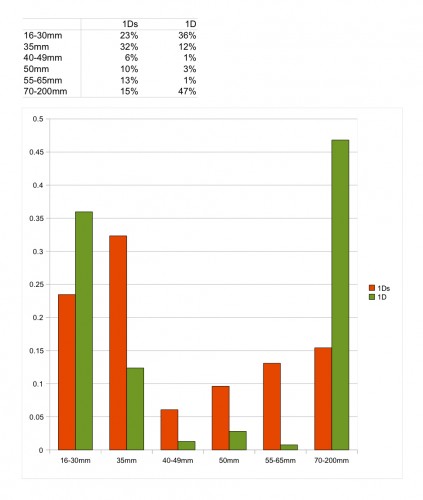
      Michael's event shoot focal lengths

      Michael's event focal lengths

      As you see, peaks at 35mm for the full frame and at 70-200mm for the 1.3 crop camera.

      So for an event, here are a few suggested combos.

      Large room: A good safe “vanilla” combo, for larger rooms:

      • 1Ds with 24-70
      • 1D with 70-200

      Smaller Room: Another safe combo, good for wider shots, e.g. in smaller rooms:

      • 1Ds with 16-35
      • 1D with 24-70

      Creative: A slightly riskier combo, great for both wide effects and long shots (and covering a super-wide range, but maybe a bit riskier because the range between “real” 35-90 is missing):

      • 1Ds with 16-35
      • 1D with 70-200

      Dark: Finally, a combo for darker rooms:

      • 1Ds with 35 f/1.4 prime
      • 1D with 70-200 – or with 50mm f/1.4!

      Of course you can also just pick what you have. I mentioned a friend and student who recently showed me a wedding he had shot entirely with a 35mm (equivalent) lens. You do not need to obsess too much.

      That said, it is fun to use the tools in the best possible way. And I strongly recommend that you also make checklists.

      What camera?

      Or more importantly, why do I use these big, heavy, costly 1-series cameras? Like my 1D Mark IV?

      Even in tonight’s course, a student asked me that (yes, you know who you are). Good question.

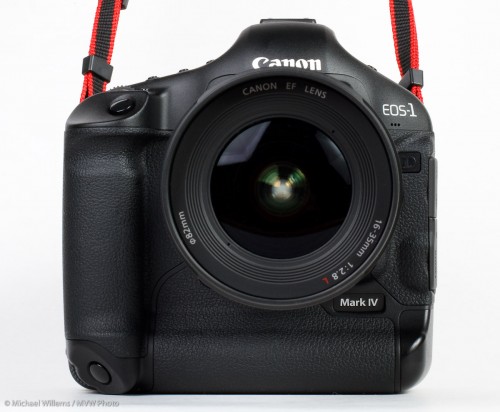
      Canon 1D Mark IV camera

      Michael's Canon 1D Mark IV camera

      So do they give me better pictures?

      Of course not. Unlike the lens, the camera makes little or no difference to the image. Sensors are pretty much sensors, now, and when the image is being taken, the sensor and the lens are really the only two thing sin play. The camera is ust a box.

      Nevertheless, I invest in these heavy things. I’ll give you some clues as to why.

      • I can write to two memory cards at once. This is important when the event is important, like a wedding: memory cards can, and occasionally do, fail.
      • They can get wet – on last Sunday’s Creative Urban Photography shoot, my 1D bodies were dripping with water, literally.
      • They are fast (the 1D Mark IV, a sports camera, takes 10 shots a second!)
      • They are more customizable. The less you spend, the more functions are removed by Canon and Nikon et al.
      • They last. The 1-series bodies can take 300,000 shots before the shutter needs replacing. A consumer camera can take a fraction of that.
      • Support. I can sign up to Canon CPS and pay extra money to get support: but only if I have “professional” cameras.

      That’s why I spend money, and if you do not need these benefits, that’s why you do not have to. Spend your money on lenses and flashes, in that case!