Lefties Unite

Did you know that just like you are left- or right-handed, you are all left-eared or right-eared, and left-eyed or (more usually) right-eyed? The ear thing is easy: what ear do you hold your phone to? For me, left – for most people, right.

And the eyes? How do you know?

Find a small object some metres away. Then cover it with your thumb held up. Now hold that thumb, and alternately close left and right eye. You will see ONE eye has the thumb in front of it. For most people, this is the right eye. For me, the left.

Why is this important? because it also affect the way you hold your camera. I use my left eye on the viewfinder. You probably use your right eye. And if you use your right eye, make sure your left eye is closed. I do not have to do that, since my “other” eye is behind the camera. I prefer it that way!


Brampton – come and learn!

There are currently some people signed up for the Sheridan College “Basic Digital Photography” course starting 22 April in the Brampton Campus of Sheridan College. But there is a lot of space.

And.. I am teaching it, so it will NOT be “basic”! 12 weeks of Monday nights, three hours a night, and I teach – and it is my own course. Truly amazing value. Come sign up, or tell your friends to.. it’ll be fun!

Students may register in person, by mail or online via the Sheridan home page www.sheridancollege.ca….click on Continuing Education, Browse by Area of Interest (a page of boxes), click on course link for e-store information. The e-store displays the course name, course code, course description, semester offerings, cost and number of seats available…if the student chooses to register online, they would then proceed to the shopping cart and pay by VISA or Mastercard.

Come join me for an amazing experience!


Photo Change, and Video Starter Tips

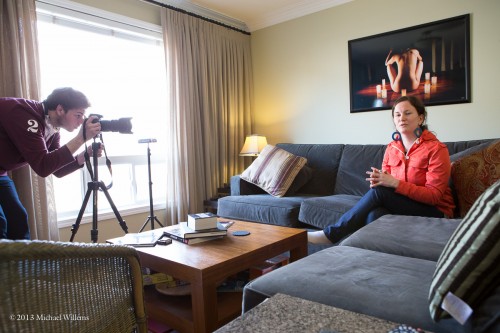
Here’s Brynn and her colleague from Photosensitive, preparing to video-interview me today for the Picture Change Project I will be part of (keep July 15 open, all!):

And this prompts me to talk a little about video today.

Vido on a DSLR is great. Better than with pro hi def video cameras of just a few years ago. As long as you take a few simple things in mind. Here’s my 10 starter tips for video on a DSLR:

  1. Do not focus during shooting. Focus, then leave it alone. Or if you must, then do manual focus, and practice the technique.
  2. Wide lenses make it easier.
  3. Avoid fast shutter speeds: they lead to unnaturally “shocking”, stuttery-looking video.
  4. Unless you are shooting an interview you should shoot short clips, usually. Say, 8-10 seconds.
  5. Shoot 2 seconds before, and 2 seconds after, each clip for fade in/out purposes.
  6. Get close-up, too, not just all-body shots.
  7. Avoid unnecessary zooming in and out or panning.
  8. Shoot “B-roll” frames too – the environment, the “establishing shot”, etc.
  9. Stabilize the camera. See the tripod here?
  10. Use photographic composition rules you already know.
  11. Use separate audio equipment. See it in this shot?

There. Start with that.. and leave lots of time for editing… at least three quarters of your shoot should end up on the metaphorical cutting room floor.


Dan’s The Man!

Congratulations to my client and friend, drummer and Jazz band leader Dan Bodanis, who at this weekend’s Photo Network Expo in Toronto won in the raffle, and not just anything: he won the free admission to this year’s Niagara School of Imaging, held at Brock University in August  – that’s around $800 in value! I am teaching there again this year, so I look forward to seeing you there, Dan, and it could not have gone to a nicer person. You’ll love the experience.

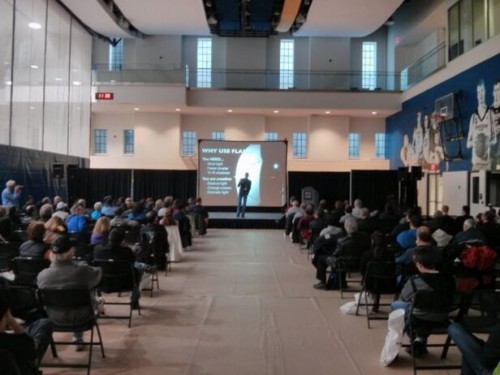
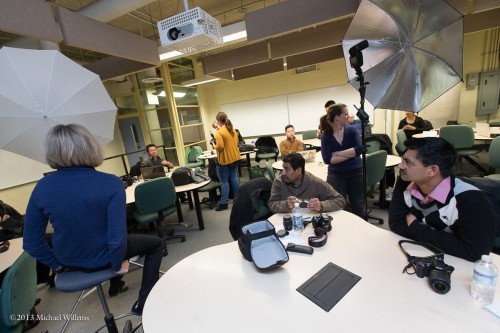
Here’s me, teaching at the EXPO in Maple Leaf Gardens on Saturday:

Are you, too, coming to NSI? People come from all over the continent: worth it, totally. Great teachers, great subjects. and a week with other enthusiasts (amateurs, emerging pros, and pros) living, breathing, eating and dreaming photography.

You can perhaps start by coming to my Studio Lighting course on Wednesday night in Hamilton? There’s still space: book now if you want to learn studio lighting.

I am once again mentioning learning, because learning photography is actually rather simple. If things are well explained, you will have many epiphanies. I love opening eyes, and more and more, I see how great it is when people “get it”. Like EXPO attendee Thomas B, who just now sent me this very kind email:

“Your presentation at the Photo Network EXPO was absolutely amazing.  Not only are you an excellent orator, clear and concise, but your instruction was seamless and logical.  I’ve done a lot of photography but almost exclusively with existing light.

I’ve recently acquired two Canon speedlites and have been somewhat dumbfounded as to how I would make them work for my purposes.  With your expert direction, I was able to experiment the following day and had considerable success.  It has motivated me to learn more.  I look forward to taking one of your courses.

[…]

You have completely demystified the flash for me.  Your lecture was like an epiphany.  The camera as a “light shifter”, what the shutters actually do at the different speeds and the fact that the flash is always 1/1000 of a second, regardless of what you thought it would be.  Impressive.”

I am posting this for no other reason than to stress my assertion that you indeed need to learn in a formal learning setting, with a good teacher, not just by reading articles or watching videos on the Internet. Come to NSI, do my courses on the way to then, do some coaching: you will be amazed at how quickly you learn.

So, the learning part. Here are ten learning tips:

  1. One thing at a time! Never mix subjects while learning. If you are talking about focus, for instance, then do not mix exposure or colour or motion blur into it. Solve focus first, then move on to the next item
  2. Break everything down into logical and consecutive sub-units. Only when you understand the first point, move on to the second point. You build a solution out of building blocks, as it were. This is where a great teacher comes in, and his or her good understanding of logic.
  3. Writing things out is good – but not at the expense of listening! Use a camera to snap the screen, perhaps.
  4. Follow your instructor’s logic. There’s a reason behind it. (See step 2).
  5. Class learning is about understanding, not about committing immediately to memory. You understand the logic of a subject in class; then you practice; and during this, your understanding deepens and you actually commit to memory.
  6. Never confuse “a function and how it works” with “the buttons you press to use it”. The latter is completely unimportant. That’s what manuals are for. It’s the purpose of a function that matters.
  7. After a course, immediately put a reminder into your iPhone calendar to review your notes one month, and then six months, after that course. Everything that has slipped between the cracks will click into place at that point.
  8. Follow the instructor’s advice. There’s a reason for everything he or she says.
  9. Learn the techie things: it will become apparent later why they are important. I assure you that, at least in my courses and workshops, everything you are taught has a good reason for you to know it, or it wouldn’t be in the course.
  10. Be as hands-on as you can. We learn by “muscle memory”, not by “being told things”.

Go on: become a pro shooter. You can do it.

Now back to my cats, who have just discovered that my custom-made furniture is very good for sharpening their nails, and is fun to climb onto vertically, by using just those nails.


Welcome!

A warm welcome to my new readers – those of you who saw me speak at the Photo Expo.

Use this DAILY site as a resource for all your photo learning. I aim at everyone, from beginners to pros. Use the SEARCH field to look for articles that talk about whatever interests you, and ask questions whenever you like.

And come see me teach – at NSI in August, but also whenever you like for private coaching or on one of my scheduled courses. See you there!

Michael


Fun day at the show

Today I talked at the Photo Network Expo show in Toronto (at the old Maple Leaf Gardens): “Conquering Flash”, a one hour crash flash course. Tomorrow, I am on again with the same subject at 3:30pm, so if you did not make it today, come tomorrow!

It was also a great opportunity for me to network and to play with gear, since gear is important. As you know I am considering adding, or switching to, a Nikon D4.

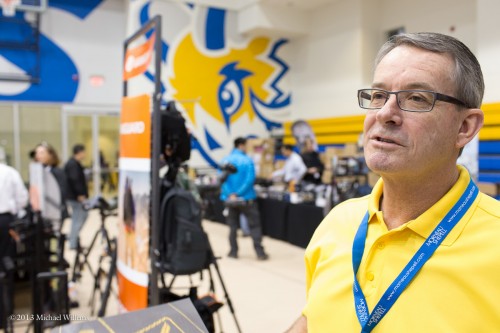
Service and support can be important too, and Nikon’s pro program is free for pros. The Nikon folks have been extremely helpful in my exploration of them and their equipment. Here’s Nikon’s Jim Eyre, who was instrumental in arranging to lend me the two D4 bodies and lenses and flash:
While the D4, like every camera, has a few drawbacks (the menu system is old; I cannot turn vertical shots a quarter turn so they fill the LCD display when reviewing “only on the camera”, etc), they are minor, and this camera is a true delight to work with. The “click” is just wonderful; it’s light; it holds very well – and ergonomics are important. It is very tunable, like all Nikon bodies; one feature I particularly like is that I can rename my own custom modes. I never use these modes on the Canon bodies, since I cannot rename them and hence, I forget what they are for.
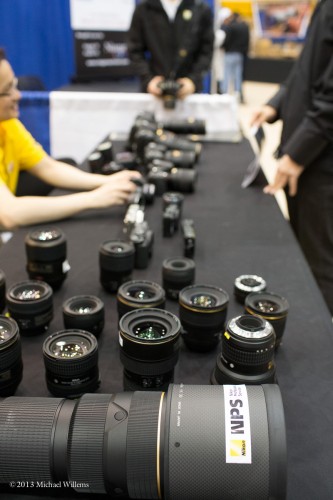
The Nikon lenses have come a long way too: they are now, well, sweet. Progress is good, isn;t it?

Here’s Chris Ogonek, left, who like me used to teach at Henry’s School of Imaging, evidently in awe of his lenses, one of which, the super-sweet 14-24mm f/2.8, is being tried here by my tolivetolove.com colleague Kristof:
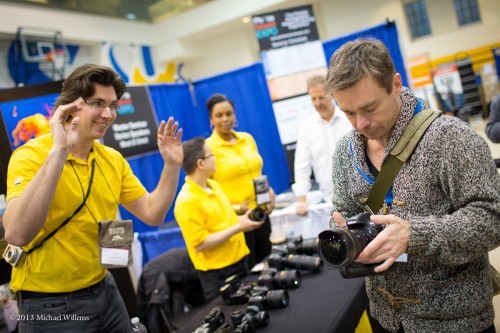
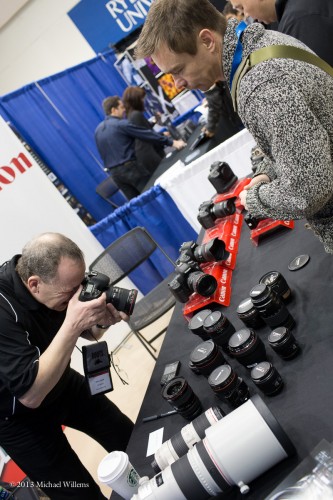
Canon, of course, has cool gear too. Here’s the 300mm f/2.8 IS in action:

And a few more:

That’s 6400 ISO, f/2.8, with the 300mm f/2.8L IS II USM, and it’s like a studio shot – the lady’s hair, which I was aiming at, is great, with every strand sharp. (View at full size!)

The Fuji X100 is now the X100s: many improvements, but manual focus using superimposed squares (like a Leica) in particular is excellent. Damn, my X100 is outdated now. I liked the X100s as much as the superb Leicas, which were also on display.

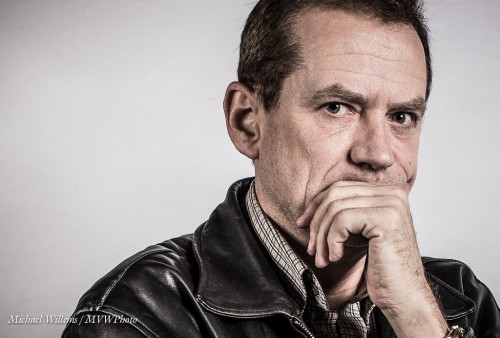
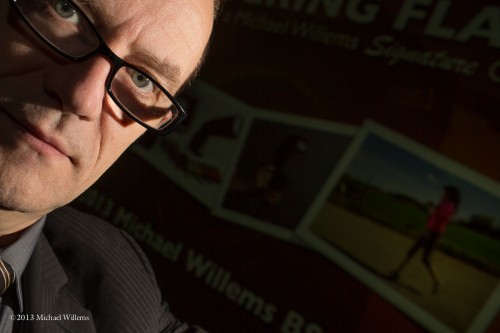
My talk is about flash, of course. Including off-camera flash, like in this hand-held shot of myself I did in about ten seconds on stage:
More fun tomorrow: and for me, more networking and a report on what’s great.

For you, the same, and lots of speakers, including Storey Wilkins and David Williams; it is very much worth coming, even on a Sunday when perhaps you would rather sleep. Get up, come see the expo, an expo downtown for once, and learn from the great collection of NSI (Niagara School of Imaging) speakers!

 

Writing on wall.

The writing has been on the wall for many years. Now, Sears and Walmart USA portrait studios have shut down, unable to make ends meet. No more family or portrait photos.

Mmm.

As the article says:

Store photo studios, which did big business in the 1970s through the 1990s, have been closing in recent years due to the move to digital and smartphone photography, where anyone can create, crop, and edit a family photo online. In addition, the demand for paper photo albums has all but disappeared.

What do I think when I read this?

On the one hand, I think there are reasons these guys did not do well. Reasons such as:

  • They failed to keep up with society (people often want electronic files, not prints, for example, and the old-fashioned “sears backdrop” is, well.. old-fashioned).
  • They did not employ proper photographers, just minimum-wagers who can push a button and follow a script.
  • Thus, their quality was “okay” – not great.
  • They promised $8 for a shoot, but wanted in-store staff to upsell to $100 each time. That is a stretch: if you try to attract “$8-customers”, these people are not interested in “$100 sales”.
  • Their business model did not work: you simply cannot sell photos for $8! Underpricing is a grave error.

On the other hand, the writing really is on the wall. Everyone is a photographer now. Perception versus reality! Now that everyone with a camera thinks they are a photographer even without training, the market for family shots has declined.

“Yes but in Canada, they are still open!”. No – the writing is on the wall here, too. We simply get it later than Americans, who are often ahead in many ways.

And since a large print is $2 at Costco, paying $80 seems odd to a market that cannot distinguish “making a print” from “making a photo and printing it”. I think we have to face it: photography for money is a declining market except in niches (like “people who want top quality and are willing to pay”).

Is it all bad news? Yes, overwhelmingly (seeing skills disappear is a shame), but taking all this into account, it seems to me that for photographers who want to make enough money to eat there are still a few avenues left open:

Find niche markets: there are always niche markets that are willing to pay, since in those markets, photography is not perceived as a commodity.

Go upmarket: even in saturated, commoditized markets like portraits, there are always those who can see quality. We have a lot to offer. Good composition, perfect lighting, great artistic insight, experience, good “post”-skills, redundancy, reliability, customer service. The fact that there is a McDonalds does not mean there is not space for $200 a meal luxury restaurants also.

Teach: If everyone thinks he is a photographer, let’s make them all into real photographers! This is a good market, if you are a great teacher. Beware, though – everyone thinks they can teach, and few actually can. But if you are one of those few, you will do well. I am delighted to teach, here on this blog and also at Sheridan College, at Vistek, at Niagara School of Imaging, and at CameraTraining.ca – and by way of private coaching. Come see me tomorrow and Sunday in Toronto: http://photonetworkexpo.com/ – book online and use promo code Michael2013 to get 50% off a weekend pass. See you then!

So no, it’s not all bad news. The world, and the photography market, is changing. As it always will continue to do. Adapt, and change the business you are in. I am in the business of getting people bueatiful images – whether from me or from themselves after I teach them how.

Michael


Photo Life

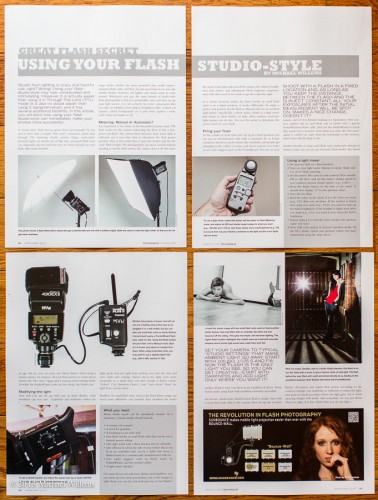
The new April/May issue of Photo Life Magazine is in stores this week!  And in it, the next article in my light series: “Using Your Flash Studio-Style”.

Get your copies now – excellent magazine, and I am not saying that because of my article: this magazine talks about photography, not just about gear.

Get your copy now! And see me AND the magazine staff this weekend at the show in Toronto: http://photonetworkexpo.com/.


Lenses distort?

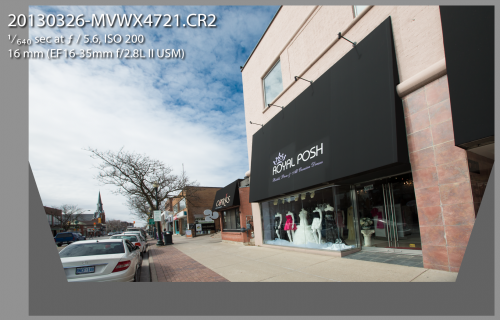
A wide lens, if you aim it upward, will give you converging verticals at the top:

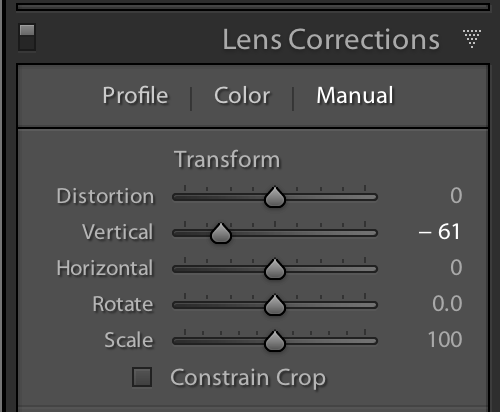
If you do not want this, go into Lightroom’s “Lens Corrections”:

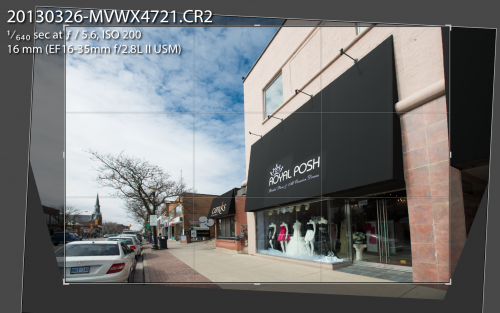
This gives you a corrected view, from which you then crop the excess:

Leaving you with:

The venue above is the venue where tolivetolove.com (my venture with Kristof Borkowski) is joining Jane Dayus-Hinch’s “Wedding Café”, which opens next month.

___

See me next weekend in Toronto:

Explore, network and discover an inspiring array of new photographic products, services and techniques. You will experience the latest photography and video gear and creative solutions at our Photo Network EXPO. Admission not only includes the trade show but also access to hours of free professional imaging presentations each day. To register or for more information visit www.photonetworkexpo.com/.

  • Saturday April 6th, 2013 9am to 6:30pm
  • Sunday April 7th, 2013 9am to 5:00pm

Location: Ryerson University’s Mattamy Athletic Centre (Formerly Maple Leaf Gardens), 50  Carlton St. Toronto, ON


The Outer Limits of Flash

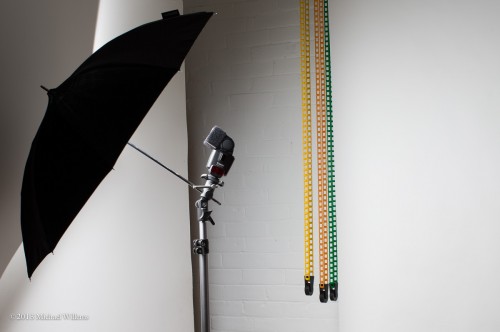
When using flash, as you know, I very often use just one off-camera speedlight in an umbrella, like this:

But as you have read here before, there will often be limits to what you can do in practice. These limits and how we handle them are “what separates the men from the boys”. Usually, they are not coincidence: flash makers have made their flashes to be just the right power, for instance, to meet normal earth sunlight conditions. To help you, here are a few limits and solutions:

SHUTTER SPEED: You will run into limits w.r.t. shutter speed: when using flash, normally 1/200th to 1/250th sec will be the fastest shutter speed you can use. Solutions: be aware of this limit, and use low ISO/small aperture to control light.

POWER: Most of all, you will run into power limits. At 1/200th, in bright sunlight you will have to go to f/16-f/24 for a proper exposure, and this means the flash will have to be very powerful to equal or overpower the ambient light (we call this “nuking the sun”). Solutions: use no modifier but fire direct (a direct flash has much more power than a modified one!); or move the flash closer to the subject; or use multiple flashes.

LINE OF SIGHT: Outdoors, your off-camera flash must be able to see the “morse code” light pulses emitted from your on-camera flash. Make sure that the little round light sensor on the side of your flash (Nikon) or the red area on the front of your flash (Canon) can see your camera!

HEAT: Nikon flashes like the SB-800, SB-900, SB-910 and so on, and to a lesser extent Canon flashes, will overheat (and depending on model either break, or shut down, or slow down) when you use the flash repeatedly at full power or anything close to it. Solutions: fire the speedlights at lower power.

CONDITIONS: If the ceiling you are trying to bounce your flash off is 50 feet high, you will have to go to a very high ISO setting. Solutions: do use that high ISO, or use very fast prime lenses, or ask people to move to a better location.

FOCUS: In the dark, focusing your camera is very difficult. Solutions: use a flashlight, or a laser pointer; or focus manually.

TTL INCONSISTENCY: In fact, TTL systems like E-TTL or CLS work very consistently. Solutions, therefore: learn exactly how the TTL technology works; learn exposure and metering; adjust by using Flash Exposure Compensation; avoid reflections; use Flash Lock (FEL/FVL).

There are many more challenges, and the good news is that for each such challenge there is a set of solutions. Learn the tech, and then you will be able to concentrate on what really matters: composition, light, moment!

Enjoy Passover / Easter / the start of spring; and let me leave you with the Thursday News Roundup:

  • LEARN… Join me to learn studio shooting on April 10, and join me in many other courses: see www.cameratraining.ca/Schedule.html
  • WEDDINGS… Watch for news on The Wedding Café: Celebrity planner Jane Dayus-Hinch’s new initiative, which colleague Kristof and I are part of!
  • DESTINATIONS… I am off April 14-21 to shoot a wedding in Jamaica.
  • And finally GEAR: Nikon Canada is lending me a D4 and a few lenses and a flash for two weeks. I shall report on them in detail here.. excited!

If you have any time, then use this long weekend to learn and practice some new photography skills. I vote for “Flash”. Here’finally, a sample snap taken with one flash in an umbrella: