Wireless flash tip

In keeping with the “flash” tips, in anticipation of Saturday’s Advanced Flash course in Toronto, with Guest Star David Honl, for those of you who are trying wireless flash for the first time: here’s a beginner’s problem to avoid.

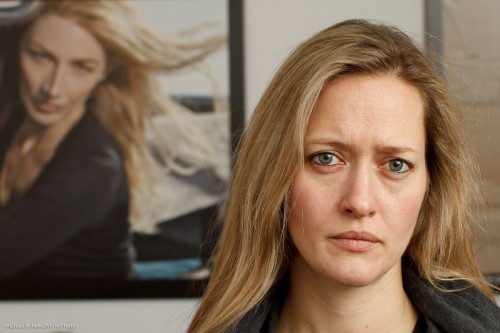
A picture of one of my favourite items (not) lit with an off-camera flash on my left using a Honl Photo Traveller 8 softbox; and a reflector on my left:
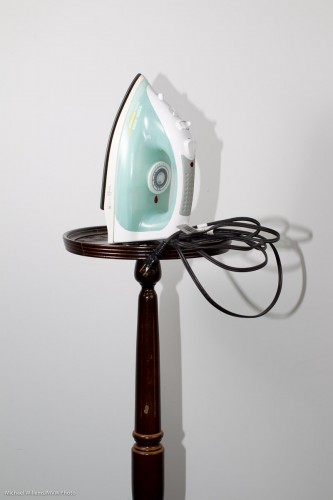
Can you see the problem? If you have eyes, you can: that horrible shadow.

You see, even though I used the off-camera flash with the Honl softbox, I failed (for the purposes of this demo, of course!) to disable the on-camera flash.

The on-camera flash (which can be the popup, on a Nikon or on a Canon 60D or 7D, or else an on-camera 580 EX or SB-900) is there to direct the off-camera flashes with “Morse code” pulses that happen before the shutter opens. So you need to make sure that when the actual flash happens, that on-camera flash is silent.

And you do that by setting the on-board flash to off. “–” on a Nikon, in the CLS menu, and just “disable” on a Canon. On the Canon, look, there are no rays coming from the flash head:
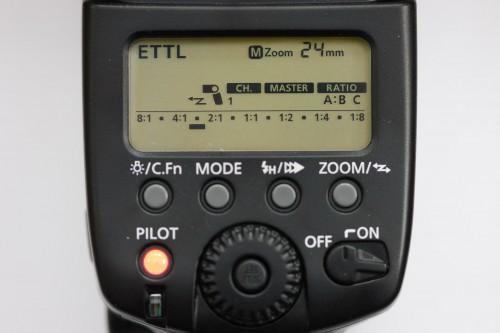
So then it still looks to you like it is working, but in fact it only fires its “Morse code” instructions, bu nothing else.

Now we have:
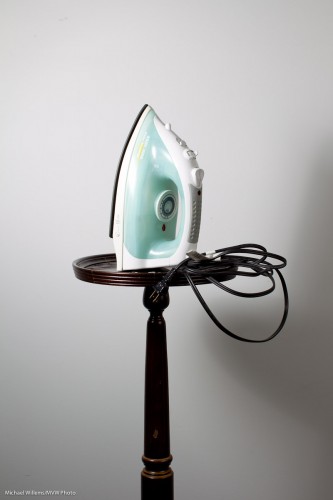
That’s better!

—–

One more recommendation, if I may (you will forgive me): there are spots open for the all-day “The Art of Photographing Nudes, 2 April 2011, Mono, Ontario. We use the same lighting techniques you are learning from me here, and more. Same model as last time, same two pros teaching! Click here to book.
Groups: making them work.

I shot a music school this past weekend. Wonderful work, great people: fun.

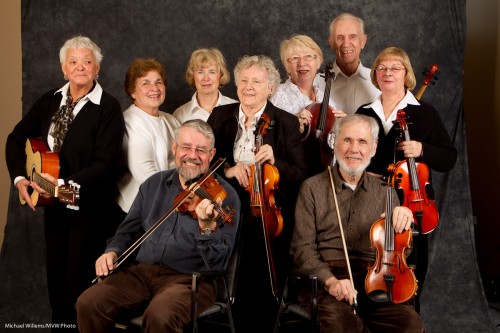
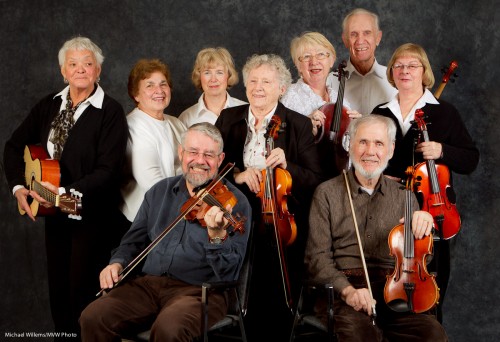
One shot I particularly relished setting up is a portrait group of nine musicians. This is a challenge because:

  • You need to get nine people lined up in a space that is always too narrow.
  • You want to avoid making them look leaden by lining them up straight.
  • You have to light them all well.
  • You need to light evenly, too, so umbrellas and so on need to be moved back. The room is never wide enough either, of course.

First tip: always be confident when doing this. Take your time, but never hesitate. The captain is in command, just like in the USS Enterprise.

I start by deciding who sits, who stands, and who leans. Not “the older people sit”. More like “the taller people sit”. Then the older people can lean against chairs. The rest depend on height and other properties.Sometimes you just have to do what you can.

Then I look to see how people stand. What is their body language. I turn everyone. I make small groups. Back to back or facing one another.

The biggest challenge is to get everyone in front of the backdrop, which as said is always too narrow. And when people are having fun, they will not necessarily obey your orders accurately – which is fine: they are there to have fun, not to obey.

Then you shoot. Lots. Make sure everyone’s face is clearly visible in every image. Tell your subjects that when you ask for adjustments, you want “baby steps”.

In the end I decided this shot had merit and was suitable for finishing:

A group of fiddlers (Photo: Michael Willems)

A group of fiddlers (Photo: Michael Willems)

The finishing now consisted of:

  • Adjusting white balance, exposure, and other basics.
  • Cropping and rotating.
  • Lightening a few darker areas using Lightroom’s selective brush tool.
  • Darkening bits that need darkening. Possibly even a little vignetting.
  • Now popping briefly into Photoshop CS5 and using the “content aware fill” tool to fill in the backdrop.
  • Then, one last look and  final adjustments.

And I am done. Here is the image almost finished:

A group of fiddlers (Photo: Michael Willems)

A group of fiddlers (Photo: Michael Willems)

See it larger by clicking. Not a boring shot – a little more like Rembrandt’s Night Watch.

Yes, OK, that is a stretch – but you get my meaning.

And that, as they say, is a wrap!

Tip: If you are near Toronto and want to learn technical flash techniques using small flashes and modifiers, there are still a few spots left on the March 19 one-time special featuring special Guest Star David Honl. If you are interested, act quickly, since they are filling up rapidly.

Bodies.

A couple of learning opportunities for you today.

First, on April 2, Joseph Marranca and I are leading another “The Art of Photographing Nudes” all-day workshop in Mono, Ontario.

This is an intensive all-day workshop which starts with technical training, then goes on to subjects such as composition, model interaction, light, studio equipment, and much more. Then we shoot. Most of this workshop is shooting, not listening.

Space is limited, so sign up soon if you are interested in this. Small group, great location, two pro shooters/teachers, and the same great model as last time; you will see her when you click on the link with information and signup, which is here (there is nudity, so if you do not like nudity, do not click): http://www.cameratraining.ca/Nudes.html

Second: There is also still a little space left on March 19 in Toronto, where I present the all-updated “Advanced Flash” with special Guest Star David Honl. A four-hour course with lunch break, so 4.5 hours, and also with a lot of real shooting. Downtown Toronto, plenty of (paid, but cheap at the weekend) parking right in front, my new updated small flash workshop where you will learn stuff you did not even know you did not know, and the Dave Honl all the way from LA. Not to be missed. I’d sign up for it, if I wasn’t already teaching it.

Cockroaches…

…and noise. They have something in common.

Namely, that they both hide in the dark. (As do politicians: Almost three thousand years ago, Greek comic writer Aristophanes wrote “under every stone there lurks a politician”).

Noise hides in the dark – or more accurately, it comes out in the dark – because of what we call the “signal to noise ratio”. Engineers know what this means-  it rules their lives. In practical terms, basically it means “if the signal, the thing that carries the information, like a radio signal, or like the light in a photo, is strong compared to the noise in that system, then you won’t hear much noise. If the signal is comparable to the noise, however, then you’ll see or hear a lot of that noise”.

The noise (electronic noise, in a sensor image) is pretty constant, and at a low level. So when the picture is bright, the low level noise is not noticeable because it is so much weaker than the bright bits. But in a dark image, it is very noticeable. This is one reason flash pictures are so good: nice bright light makes the noise hard to see.

This brings me to today’s reader question. Reader Deborah (who I know understands ratios and math) writes:

Saturday’s workshop was a real step forward for me… I won’t bore you with the long list of things that clicked into place for me. Suffice it to say that it was a really happy moment early Sunday morning when I took 10 shots of my cat in my kitchen and got about 8 decent if not good images. And he wasn’t blinking in one of them.  …now if you’d only run a model training workshop for pets, all of my cat images would be great 😉

One question is bugging me if you have time to explain it:  Flash is often used in combination with high ISO. I usually avoid high ISO because of the noise, but I’m wondering if horrible amounts of noise come not so much from increasing the sensitivity of the sensor but just in general because I only use extreme ISO in very low light conditions where noise/signal ratio is already impossibly bad. So does it make sense that if flash adds a significant amount of light, the poor quality of high ISO won’t be nearly so bad as it might be without flash? In other words, does flash allow us to push the ISO up without sacrificing quality (as much)?

Indeed it does.

First – flash is used in combination with higher ISO -not necessarily high. 400 ISO is not high, and that is a good starting point. Remember, the starting point for indoors flash would be:

  • 400 ISO
  • f/4.0
  • 1/30th second

And in studio flash, it is as low as you can go – 100 ISO, say. So I would not say necessarily very high, But yes, flash does tend to be bright and that means a high signal to noise ratio where you aim the flash. It is also brief, and that means no motion blur. If you like your pictures to be great quality, use flash.

Indeed, turning up ISO in low light causes exactly what you would expect: even more visibility of the already present noise. That is why in night photography, for instance, turning up the ISO is not necessarily the thing to do.

So yes Deborah, your conclusion is correct.

Oh, and that cat? Catnip. One of the great secrets of cat photography.

Shooting events

A corporate shoot the other evening, with an assistant/second shooter. A music school shoot all weekend. Many more shoots coming up: lots to do, and lots of fun.

I like shooting indoors events, because with training, it is simple to get consistent results. And as you know, my favourite party lens is the 35mm f/1.4 prime (fixed) lens. It consistently gets you images like this, from the other night:

Event shot, photo Michael Willems

Event shot, photo Michael Willems (35mm prime lens)

I like this style of shooting and it is worth talking for a moment about how this is done.

  • The lens is a 35mm on a full frame camera. On a crop camera, you would use a 24mm lens. Prime lenses are nice and consistent and sharp.
  • The flash is a single 580EX II speedlight, on camera but bounced 45 degrees behind me, slightly to my right to get light onto the subject’s face.
  • The camera mode is manual. It is set to 400 ISO, 1/30th second, f/4. This gives me an ambient exposure of about -2 stops (the meter says “-2” when I look at an average part of the room).
  • The white balance is set to “flash”. That ensures that the subject is natural, but the background, which is lit by tungsten light, is warm.
  • The flash is on TTL.
  • I ensure the subject is close – but not too close. And not right next to the edge.
  • I compose using the rule of thirds – I avoid totally centered subjects here.
  • I look for a background that tells the story (i.e. a corporate cocktail party; people meeting and talking).

Here’s one more:

Event shot, photo Michael Willems

Event shot, photo Michael Willems

That person blurred in the background helps tell the story.

And one more, to inspire you all:

Event shot, photo Michael Willems

Food - always shoot this.

Do not hesitate: you can tilt. You can shoot the food. As an event photographer you probably should not be eating it, but shooting it is OK.

(These, and many other tips and tricks, are part of my special “Michael Willems’s Events Photography” course – soon as a special at Henry’s School of Imaging, as well as here as a one day special: April 3 in Mono, Ontario. Let me know if you are interested. )

Another tip

One more beginners’ tip today for my readers. (The term “my readers”, it occurs to me, makes me sound a little like col. Qaddafi. whose Green Book I read when I worked in Libya for around a year, a few decades ago).

Anyway. I often see that my images are really, really sharp where others’ are often not quite as sharp. So how do you make your images sharp? I have written about this before, see here, among others. Operation, light, settings, and good (prime, or quality) lenses all come into this.

A student, photographed by Michael Willems.

Student Volunteer, photo Michael Willems. Canon 7D, f/5.6, 400 ISO, 1/125th sec.

When you show that image large (original size), you see it’s sharp.

A student, photographed by Michael Willems. Detail.

Student Volunteer, photo Michael Willems. (Detail).

But today a quick tip about errors I see people make frequently.

Whenever I see people whose images, in spite of good lenses and the right settings, are not as sharp as mine, and when I then watch their technique, I often see these mistakes:

  1. People jam down on the shutter. I hear a beep, and a millisecond later, the click. This means the shooter is not giving himself or herself enough time to verify that focus was achieved on the right object. Instead, you should aim, press half way down, wait for the beep, then wait, and only once you have ensured the focus point activated properly where you wanted it, push down.
  2. The shooter leaves the beep off. This means no confirmation of focus unless you look away from the subject… bad.
  3. The shooter beeps and waits correctly – but then moves forward or backward before pushing down. Even a slight backward or forward movement shifts focus!

Watch yourself carefully when you shoot. If you discover that you are making any of the above mistakes, this will affect your sharp focus.

And that would be a shame. My people deserve sharp focus!

The Social Network

Sunday I spoke at a large Social Media show in Toronto – one of the world’s biggest, at Ryerson University.

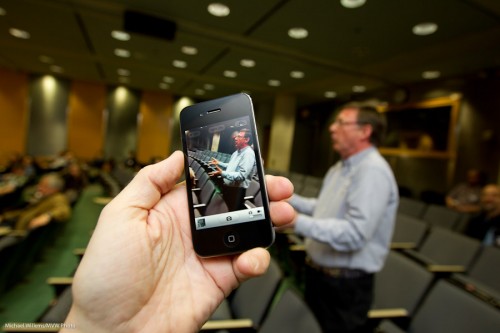
Peter West talking in a social media forum (Photo: Michael Willems)

Peter West talking in a social media forum

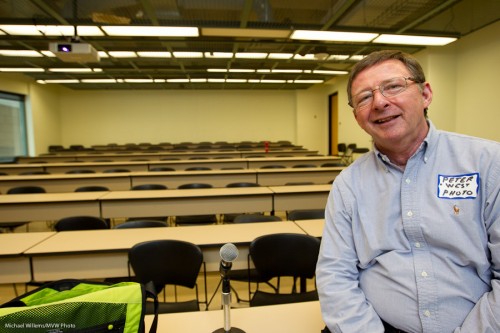
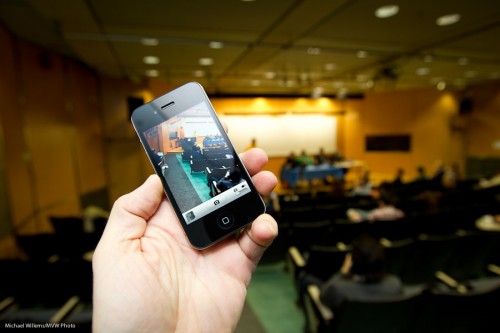
With my friend Peter West, pictured above in an image that stresses the importance of iPhotography, I talked to an audience about photography for social media. Small World: Ren Bostelaar and Mark Shannon, two of my Henry’s friends, were also on several of the forums, as well as in my audience.

Peter West at Ryerson, before a Social Media workshop (photo: Michael Willems)

Peter West at Ryerson, before a Social Media workshop

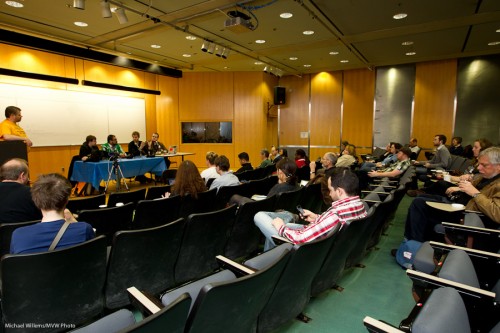
The interest (and, um, yes, the room filled before we started) shows that social media are interesting to, and understood by, not just young people but also people as old as 25.

Social networking Forum (photo: Michael Willems)

Social networking Experts at work

Okay, I kid. Peter and I are at least 30.

My talk was not just a 45-minute photography lesson. I had two additional main themes:

  • You can do a lot on an iPhone. You can compose well, focus where you want, and even expose on a chosen point.
  • Social media (like this blog post) are just better with photography.

When some people say photography is dead, I do not believe it at all. When others say “everyone can now do it”, I do agree – but only if they learn at least some of the same skills I, and every other professional photographer, had to learn.

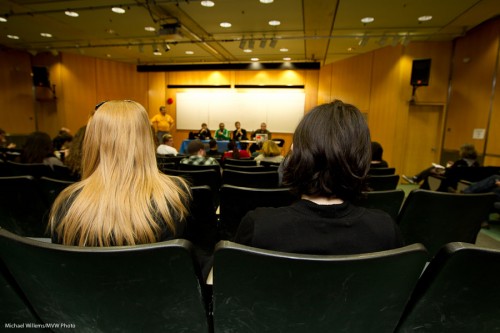
Social Media Forum (photo: Michael Willems)

Social Media Forum

For the images above, I used a fairly standard recipe:

  • Camera on Manual mode
  • Flash in TTL mode, aimed behind me, 45 degrees up
  • 400 ISO
  • 1/80th second at f/3.5

Those settings gave me an exposure reading just over a stop below zero on the meter – meaning the background is just over a stop below ambient, and the flash lights up the rest, namely mainly what’s in front of me.

Social Networking Panel (Photo: Michael Willems)

Social Networking Panel

And I think you may agree those pictures tell the story better than just words would.

Beginner’s Tip

A tip for beginners today, about a subject that can confuse.

I constantly hear people confuse focus with exposure. I hear things like “I focused on the face”, when they mean “I exposed for the face”, and vice versa. Or “I used one focus point to get the right exposure”.

Clarity of language leads to clarity of thinking and hence, to better understanding. So here for beginners are a few definitions – you will find these helpful if you are just getting into photography.

Focus:

  • “Focus” means “what is sharp”, particularly “what distance is the sharpest”, and also “what range of distances is acceptably sharp” (we call the latter the “depth of field”). Your camera cannot make everything, from 5cm in front of your lens to the infinite distance, sharp. That is why we talk about it.
  • You focus by aiming focus spots, or preferably one chosen focus spot, at your subject and then pressing half way down before clicking. Your camera now sets its focus distance to the object you point at.

This does have anything to do with, or affect, exposure. They are entirely separate.

Exposure:

  • “Exposure” means, in practical terms, “how dark or how bright is my picture”.
  • Exposure is also measured when you press half way down – but it still has nothing to do with focus.
  • You can base your picture’s exposure on an average of the entire scene (we call this “average metering”) or intelligently (“evaluative metering”, or “3D Color Matrix metering”), or in one small area only (“spot metering”).

The fact that the camera measures and decides on focus and exposre at the same time is what leads to the confusion. But realise that they are different, and independent.

“How sharp a picture is” has nothing to do with “how dark or light a picture is”. One is set by the lens moving its elements, the other is set by adjusting ISO, aperture or shutter speed.

If these things are not clear, ask me!

Preparing

I am preparing for several courses, including the special version of my signature “Advanced Flash” workshop. which you may recall I teach in Henry’s School of Imaging location in Toronto on March 19 with Special Guest Star David Honl (Yes, the David Honl).

Dave is doing this in Canada for one day only – sign up now!).

I am also preparing more runs of my new signature course “Event Photography”, which I ran Sunday and will run at Henry’s School of Imaging as a featured course repeatedly, starting soon-  stay tuned.

And this brings me to “preparing”. One of the subjects I teach in all my courses is how to prepare. Preparation is half the work. Preparation takes time but it guarantees great results. Doing it on the fly is less successful and more stressful.

So today’s tip: create checklists per situation. Three of them:

  1. An event preparation checklist. This has names, addresses, parking details, shots you must get, etc.
  2. A gear checklist. This contains all the equipment you need for that event.
  3. A day-of-shoot checklist. This needs to contain names of people to shoot; moments to expect; shots you must not forget; camera settings for situations you expect; behavioural stuff; tech things to remember: everything you need to remember on the day. You carry this in duplicate – like everything else important.

Do you have those yet? If not, here’s your homework: go do it, make three checklists for a typical event you shoot. Questions welcome (and wait for my article on this in the June issue of Canada Photo Life magazine).

One Day Special: Advanced Flash

Good news. The One-Day Only Special “Michael Willems’s Advanced Flash”, with special Guest Star David Honl (yes, the David Honl, the inventor and creator of that great range of small flash modifiers!), is now open for booking.

  • When? March 19. From 11AM until 2:30PM
  • Where? Downtown Toronto, Henry’s School of Imaging flagship location at Church and Queen Streets.
  • What? Check the syllabus at www.cameratraining.ca/Flash-Honl.html
  • How Much? $175

Registration is limited, so go to the Henry’s School of Imaging site today to reserve your space – click here:

www.schoolofimaging.ca/Courses/64044-Advanced-Flash.aspx

Registration is open now and space is limited, so I recommend you book soon if you are interested. In this four-hour workshop in downtown Toronto, you’ll learn a lot about advanced use of flash, and Dave will show you some signature shots made with simple, small flashes that you can also afford.

Not to be missed if you would like to be exert at using small flashes to create professional shots, even when the light is tough.