Simplify!

After yesterday’s long post, a few short ones. You will, I hope, bear with me and forgive. And – simple is good, since I am sure you are all preparing for New Year’s Eve.

Simple is good – and in that vein, this one is to emphasize once more the importance of simplifying your pictures.

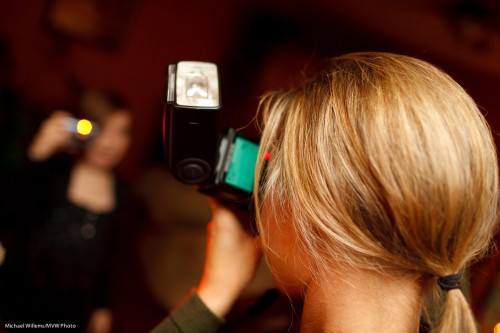
Shooter shooting shooter

You do this to make your pictures look better – much better – and you do it by:

  • Zooming in.
  • Repositioning yourself: up-down, left-right, and around.
  • Tilting!
  • Blurring the background.
  • Cropping.
  • ..even moving things or your subject.

This is the most important lesson for many amateurs, because it is the most sinned against and the easiest to fix.

Go check what you did on your last 100 images: could you have simplified?

TTL: 10 Problems, 20 Strategies

I shot an event yesterday that prompts me to give you some TTL management strategies. This is a long post – one that you may want to bookmark or even print and carry in your bag.

TTL Management Strategies? Huh?

Yup. TTL (Through The Lens) flash metering is great, but it can have its challenges. Unpredictability, or perhaps better variability, being the main one.

So why use TTL at all? Well, for all its issues, it is the way to do it since you are shooting in different light for every shot, and you have no time for metering. Metering and setting things manually (or keeping distances identical) in an “event”-environment, especially when bouncing flash, is usually impossible. So TTL (automatic flash metering by the camera and flash, using a quick pre-flash) it is.

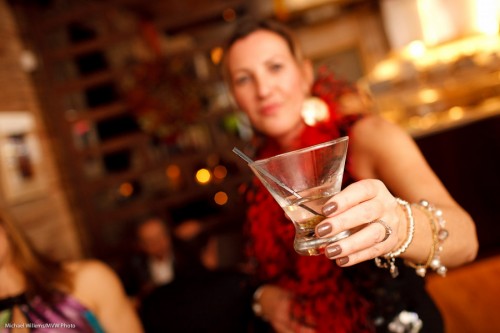
Cheers! (a Michael Willems signature shot)

Yesterday’s event was in a restaurant that had been closed to the public for the night. Challenges for me were:

  1. Light. It was dark. Very dark, meaning achieving focus was tough and settings needed to be wide open and slow.
  2. Consistency. The venue was unevenly lit: parts were light, parts even more dark. Meaning that achieving “one setting” is difficult.
  3. Space. Space was limited: hardly enough space in a small venue to walk around, let alone to compose shots.
  4. Bounceability. Walls were all sorts of colour, mainly dark brown, making bouncing a challenge.
  5. Colour. This also created coloured shots. Orange wall = orange shot.
  6. Predictability. Long lens? Very wide? Fast lens? Every shot seems to need another lens – which is impractical.
  7. Reflections. There is a good change reflections of glass or jewellery will upset your shots, causing them to become underexposed.
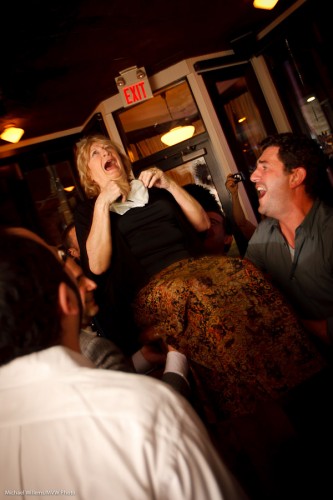
  8. Motion. People kept moving (uh yes, especially when the chair dances started).
  9. Technology. Batteries run out. Flashes stop working. Cards get corrupted. Nightmare scenarios we all know.
  10. Time. People were not there for me – it was of course the other way around. So my ability to ask people to pose and to move was limited. They are there for a party, not for the photographer.

So then you shoot and you notice that shots are too dark. or too bright. Or faces are too bright while backgrounds are too dark. But this is all in a day’s work for The Speedlighter… that is what I do for a living!

Mazel Tov!

I am sure everyone who has ever shot events is familiar with these issues. To solve them and come up with solutions, I have developed a number of strategies. So let me share some of them with you here.

(Click to continue and read the solutions…)

Continue reading

Ways to think about ISO

ISO, sensitivity, gives you the ability to shoot at high shutter speeds, but at the expense of quality. It is therefore important to choose judiciously. Hence this post.

There are several ways to think about ISO, and I thought I would run them by you again in these dark days of December (and I added “Studio”, as per reader Ray’s suggestion):

1. By absolute starting points:

  • Outdoor: 200
  • Indoor: 400 (but in a studio, 100)
  • Difficult light: 800

And you go up if and as needed, and down if able.

B. Simple, by situational starting points:

  • Normally, outdoors: Auto
  • When using a tripod: 100
  • When in bright conditions: 100
  • When in a studio: Indoors: 400
  • Sports, night clubs, museums: 800-1600

C. By consequences:

  • Motion blur: Increase the ISO.
  • Shooting art, or for a magazine, or in a studio, or for large prints: decrease the ISO.
  • Getting very fast shutter speeds, faster than you need: decrease the ISO.

By understanding those three lists, you will be able to choose the right ISO at the right time. And that is an essential if simple part of making a good picture.

Christmas gifts – there is still time…

… to buy your significant other a custom training course.

A three-hour individual one-on-one course with me is not only affordable and fun: it is also useful, because you will see your photographic skills visibly improve, and get sooo much more out of your camera. So if you are stuck wondering what to buy last minute: a certificate for a course, usable any time, may be just the ticket. If so, plenty of time to act – contact me today.

Or if you are like me, you do this Christmas eve at 4pm. That is when I shall be doing my shopping.

And may all your…

….festive seasons be white!

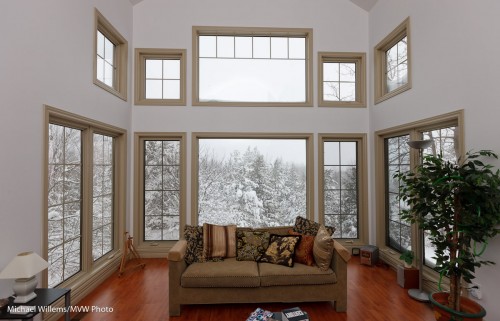
A quick reminder therefore of some basic flash technique.  Look at this shot of my living room the other day:

Snow outside

To shoot that you take the following steps:

  1. Expose for the background (use your camera’s spot meter and point at a tree, or use smart metering with +1 to +2 stops exposure compensation).
  2. Add a flash you your camera. Turn the flash head above and behind you.
  3. In a white room such as this, also use flash compensation, say +1 stops for a start.

And there you go, a well exposed picture. Have fun!

A very Canadian endeavour

Since it is winter, I thought it might be a good idea to give you a quick recipe for a winter sport a lot of you (and not only the Canadians!) play, or shoot when your kids play.

That is, of course, hockey. (“Ice hockey”, for my European readers).
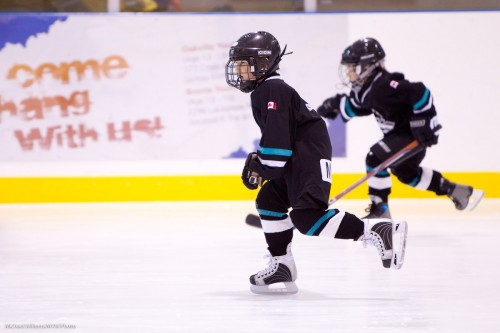
A hockey arena is quite bright.

Perhaps. But in your images, you need it to be really white, which means longer exposures. While to stop motion, you need shutter speeds to be fast. Which pulls you the other way.

So the solution, if you can afford it, is a fast lens (like an f/2.8 70-200 lens, which  lot of pros use). For that lens, a typical starting “settings-recipe” might be:

  • Camera on manual mode (“M”).
  • 1600 ISO.
  • Aperture f/2.8.
  • Shutter 1/400th second.
  • Continuous shutter drive.
  • AF-C/AI Servo focus.
  • White balance on “Fluorescent” .
  • Lens IS/VR off, or mode 2 (or ON if you keep the lens steady).
  • Shoot through the glass at right angles, if you can.

For a standard f/3.5-5.6 “kit” lens, the settings are:

  • Camera on manual mode (“M”).
  • 1600 ISO.
  • Aperture f/5.6.
  • Shutter 1/100th second.
  • Continuous shutter drive.
  • AF-C/AI Servo focus.
  • White balance on “Fluorescent”.
  • Lens IS/VR off, or mode 2 (or ON if you keep the lens steady).
  • Shoot through the glass at right angles, if you can.

In the latter case, you will have to work harder to get enough sharp images.

In both cases, of course, these are starting points. You may well find that your particular arena is darker, or even lighter. Look at the histogram to ascertain which it is – the ice should show as a large peak on the very right side of the histogram, just shy of the right edge.

And have fun!

POSTSCRIPT: an anonymous user said, and I paraphrase: “White balance should be according to the temperature of the light which varies from arena to arena. Custom white balance off of the ice or better yet the referee’s jersey. Also; 1/100? They better skate super slow… Even 1/400 is a bit on the slow side. Crank up your ASA: Your mark-IV can go higher than 1600. Finally; try and get the puck in the picture.”

Read carefully, please: those are starting points, anonymous user. Of course you can accurately white balance off the ice, as I have pointed out here repeatedly in the past, and of course when you shoot, you shoot action, puck, wipeouts, emotion, and so on. But fluorescent WB is usually very close, and for parents, a picture of their child is better than a picture of someone else’s kid who has  the puck.

And finally, yes, my 1D can go to very high ISO – but I do not need to: I have an f/2.8 lens. Parents with an f/5.6 consumer lens, however, will often have a consumer camera, hence will be stuck at 1600 maximum. This therefore will mean something not unlike 1/100th of a second. Not ideal, and it will take many shots to get a few good ones. Compare the two situations: I am making a didactic point, which was perhaps lost on you.

But then – we pay nothing for those extra shots, and if it is all you have, it is what you will have to use. And fortunately, small hockey kids do not skate fast!

Learn light before the holidays!

You can learn now… before the holiday season. Make GREAT portraits and party shots using flash. The festival of lights seems an appropriate time to tell you about light!

So here’s how you can see me in action in December:

  1. There are a few more chances to see me at Henrys this week. After that, a break until the new year.
  2. Big news: Joseph Marranca and I have added an extra “Advanced Lighting” course in Mono, Ontario, on December 19. Indoors as well as outdoors “Winter Wonderland” shooting using small flashes, large strobes, and a combination of all of those. Learn the theory and “do it!” – and go home with great portfolio shots, in a Winter Wonderland setting in Mono, Ontario.

If you want to partake in Mono, be quick: we will limit this all-day course to a maximum of just 8 participants, since with snow we’ll need more individual attention.

If you understand your camera and know what aperture is but have always wanted to learn professional lighting, now is your chance. Read about it, and book, by clicking right here.

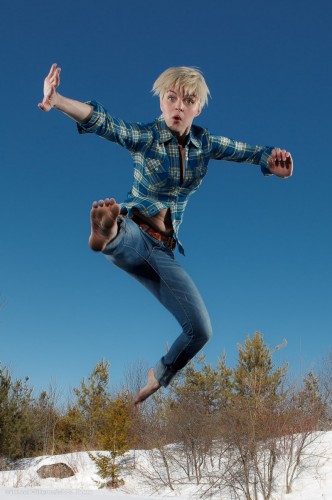
Model Lindsay in Mono Snow

…and dust off your camera, gloves, and boots. And use your camera to make some amazing shots during the holidays.

Cheers.

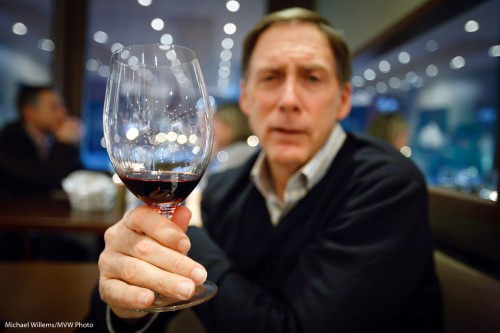
The other day, before a course I taught, here’s a friend and student holding out his glass of Merlot – no, it was not a Merlot, it was an Italian red:

Bruce holding glass

Isn’t that a nice shot?

So here are a few notes, numbered for your convenience, to help you take the same.

    1. As I point out time and time again, a shot that “makes the viewer put it together” is often great.
    2. A blurry person is often also appreciated by… the person, if they are shy. When people (ladies and teenagers, often!) say a panicked “no pictures”, try this.
    3. I used a 16-35 mm lens set to 30mm on a full frame camera, set to f/2.8.  On a crop camera, you could use a 24mm prime lens, for example. On my 1Ds I could also have used the 35mm prime. This would have been my favourite lens for this shot.
    4. The wide angle gives you those wonderful converging lines.
    5. The wide open aperture of f/2.8 enabled me to shoot at 1/15th of a second using available light – at 3200 ISO.
    6. The blur also gives me a simple image with no distractions.
    7. It is very important that the lens is wide open. Look at the out-of-focus lights. They are circles. If the lens had been partly stopped down (to f/3.2, or f/4, say) you would have seen octagons or hexagons instead of circles.
    8. And yes, you can shoot at 3200 ISO with a good camera. Point-and-shoots will not do this, even with Lightroom noise reduction.
    9. That speed of 1/15th second is still a bit slow. You could easily get motion blur. So I took 3 or 4 pictures, of which this one was razor sharp.
    10. I focused carefully, using one focus point, on the glass.
    11. I had the subject move his glass forward, and I moved as close as the camera would let me focus. This makes the background go blurrier.
    12. Finally, I had to get the white balance right in post. This is very important with available light shots, which can otherwise take on an orange/yellow cast.

      A little work – some thought goes into even a simple snap. But do it, think, and you get nice shots where you would not have expected them. And that is what sets you apart from Uncle Fred.

      Yesterday’s workshop

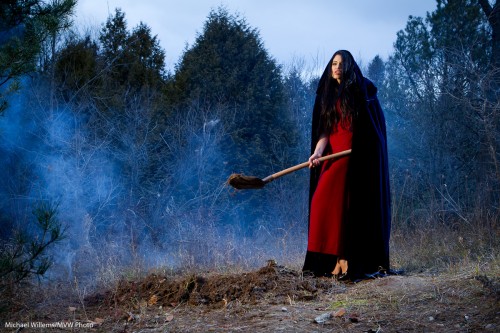
      Yesterday’s Mono workshop, hosted by Joseph Marranca and myself for a full crowd of students, was a great success: four portfolio shots and great learning, and above all, great fun for all.  Here’s one image:

      "Tara Buries her Lover"

      Props, model, make-up, creative idea, and light all come together. Learn how to do this sort of stuff: join us for more upcoming workshops.

      Now, I am off to teach a workshop at Henry’s in Thornhill.

      To delete or not to delete, that’s the question

      And I say “not”. Especially when you are learning to photograph.

      Never mind what other leading photographers say: I am not a fan of deleting images in your camera. And I do not think you should be, either. And here’s why not.

      1. You are using up your camera’s battery.
      2. You are using time that can be used better in other ways.
      3. You are looking elsewhere than at your subject, so it stops you from taking pictures.
      4. You will delete the wrong picture – or rather, the right one, by mistake. It is not a matter of “if”: it is a matter of “when”.
      5. The bad image may not be as bad as all that – or it may be the best image you are going to get.
      6. Most importantly: if you are learning, you need those bad images. You need to hold them by the good ones and look at the EXIF data, and determine why you went wrong. How you can do better What modes work, and which ones do not. By deleting the bad,you are depriving yourself of a great learning opportunities. Delete them when you have done the learning – on your computer.

      That is why I am not a fa of deleting images “in camera”.