Workshops

I have done two workshops in the last two days, and am preparing for the Vegas one with David Honl in a couple of weeks time (read on, below). Workshops are fun for all concerned and add tremendously to your ability to create great shots. Read all the books you like, but doing in an interactive learning environment is how to really learn.

Saturday was “Creative Lighting”, with Joseph Marranca. We taught a group of students some advanced flash techniques using small flashes:

Students at the workshop in Mono, Ont (Photo by Michael Willems)

Students at the workshop in Mono, Ont

This is a great course and we will be doing it again soon. Everyone goes home with knowledge and experience – and with portfolio shots.

Then on Sunday, I led a group of students through Oakville for the School of Imaging, for “Creative Urban Photography”.

Phone box in Oakville, Ont (Photo by Michael Willems)

Phone box in Oakville, Ont

Now I take a moment to regroup and to prepare for many more.

One exciting pair of workshops coming up in Las Vegas, NV on July 12 and 13.

I am teaching “Advanced Flash” – for amateurs and pros who really want to learn how small flashes work. When to use TTL, and when manual? What are the four technical items you need to know? What are the catches to TTL? How to overcome them? When to use what modifier? Why and when to use gels?

To make it even better, it’s not just theory and technical stuff. I am once again joined in these workshops by David Honl. Yes, the David Honl of the excellent line of modifiers, and the David Honl who shot Saddam Hussein’s trial (with a camera). Yes, that one. Dave will take students through making some great creative shots using small flashes and modifiers, and all participants get to go home with these portfolio shots.

Read up on this workshop here – there’s space, but do book soon to be sure.

Photography is better and easier than ever, once you learn the small flash technique that enable you to do really creative lighting with real ease. Come to Vegas and find out how.

Dave Honl shooting Michael Willems (with a camera)

Dave Honl shooting Michael Willems in Phoenix, March 2010

Now what?

I shot a corporate event the other day, and it taxed me. I shall explain how, and how you can get good (meaning sharp, well lit and well exposed ) shots in bad light.

When I walked in to the venue, I saw the problems:

  1. Extremely bright on one side (direct sun); very dark on the other side (too dark to see the camera)
  2. Virtually no bounce (high black ceilings and walls)

Like this:

Venue with difficult light, by Michael Willems

Venue with difficult light

Except with 300 lawyers and corporate clients.

So I set to work. And here’s what I did.

Mitigate the problem:

  • Shoot by the window using natural light and high-ish to very high ISO if anyone looks at the window
  • Shoot outdoors, when people move outdoors.
  • Find one or two spots where the light does kinda work and concentrate on those.
  • Move people to a wall where you can bounce a bit.

Handle the problem:

  • Use super high ISO if you must.
  • Use fast lenses.
  • Shoot RAW.
  • Use TTL – and know it.
  • Watch your meters carefully.
  • Avoid moving too much – even when you move half an inch it can put people in totally different light. See the previous point!
  • Be ready quickly. I carried three cameras with three lenses. Ouch. a 1Ds MkIII with a 35mm f/1.4, a 1D MkIV with a 16-35mm f/2.8 lens, and a 7D with a 70-200 f/2.8 lens.
  • I used bounce cards (Honl Photo reflectors, and outdoors,a 1/2 CTO Honl Photo gel) and a Fong thing (I even used a Fong Lightsphere with a Honl bounce card Velcro’d behind it – worked am charm).
  • Work out your best settings for each area and if the area is consistent as an area, set those in manual mode.
  • Shoot a lot.
  • Also shoot things that do not move, like food and furniture.
  • Do more then usual post-production. Yes, some prints will be under-or over-exposed all or part, but if you know your craft and get “close enough” in camera, then you will be able to finish them on the computer.

This way I got prints like:

Indoors, in a good(-ish) area:

Good area in a bad-light location, shot by Michael Willems

Good area in a bad-light location, f/2.0, 800 ISO, 1/50th sec

Outdoors, with a half CTO gel:

A couple shot at an event, by Michael Willems using a half CTO gel

A couple shot at an event, by Michael Willems

Indoors, long and with a 7D at 3200 ISO using available light:

Naural light shot using 7D at 3200 ISO, and a long lens, by Michael Willems

Naural light shot using 7D at 3200 ISO

Food:

Food at an event, shot by Michael Willems

Food at an event

At this event I used all the tricks I know, and it was hard work. But I got good pictures, of course.

If you want to learn some of the lighting tricks of the trade, and hone your skills in the flash area, join Joseph Marranca and me in Mono, Ontario tomorrow, Saturday 26 June. There are only two places left!

Outdoors with flash: what mode?

Let’s assume you follow my advice and use your flash, as fill flash, outdoors. Say for pictures like this.

A baseball team

A baseball team

In that case the question will be, what mode do you use on your camera? You want aperture in a certain range to ensure sufficient, but not too much, depth of field, and you want the shutter in a range that ensure sufficient stability but that is limited at the upper end by the flash sync speed (normally around 1/200th second).

  • Program mode: this will work, but you get no control over either aperture or shutter speed. Not the preferred mode unless you are in a hurry.
  • Manual mode: you meter for the background and set your camera accordingly. Flash lights up the foreground. This is practical when you know aperture and shutter speed and their effects well, and when the light does not vary too much.
  • Aperture mode: good for determining the depth of field. But there is a drawback. Outdoors, if you open the aperture, your shutter speed could easily exceed your flash sync speed. Result, an overexposed picture. Or if you stop down the aperture, the shutter speed could get so slow you get blurry images.
  • Shutter speed mode: if it is bright, you can set your shutter speed to just below your sync speed, say 1/200th second. The camera will now choose whatever aperture suits this. The risks are fairly low – worst case, you get a wider or narrower aperture than you wanted. If it is dark and your ISO is low, you can get an underexposed image.
  • “Aperture and shutter priority”: on some cameras you can select “Manual exposure, plus auto ISO”, which effectively means “aperture and shutter priority”. If you set your aperture and shutter wisely, the ISO will be in an acceptable range. The danger is that you need lower than available ISO (overexposed picture results) or that you need high ISO (noise, or “grain”, results).

As you can see here, there are certain strategies, but there is not one perfect one that is easy to use at all times. That is why photography has a technical aspect you need to learn.

A different approach: Rather than worry about modes too much, look at what they do. You need to look through your viewfinder and be aware of shutter speed, aperture, and ISO. Look out for:

  • Shutter too slow: blur
  • Shutter too fast: flash sync speed will be exceeded, and overexposure results
  • Aperture fully open: overexposure will occur, and depth of field will be narrow
  • Aperture too closed: too much will be sharp
  • ISO at its lowest: overexposure may result
  • ISO too high: noise (“grain”) will result.

Then adjust whatever you like to get all three variables into the right range.

For the shot above, I used shutter speed priority with my shutter speed set to 1/200th second. I chose an ISO of 200 to get into an acceptable aperture range (I was aiming for f/5.6).

Site of the day

I see that this site is today’s Site of the Day at http://www.1001noisycameras.com/ – that’s great! Welcome, 1001 Noisy Camera fans.

As you will see, on this blog I teach daily – a teaching post every single day. Enjoy, and search back through the past year – many useful tips here from a working photographer and teacher to everyone who is interested!

Few posts of mine come without a snap or two, so here are a couple from yesterday’s shoot – the Hon. Minister Harinder Takhar MPP, a truly charming man:

The Honourable Minister Harinder Takhar, MPP, photographed in June 2010 by Michael Willems

The Honourable Minister Harinder Takhar, MPP

I used three lenses: one long (70-200 on the 1D Mark IV) and two wide (24-70 and later 16-35 on the 1Ds Mark III).

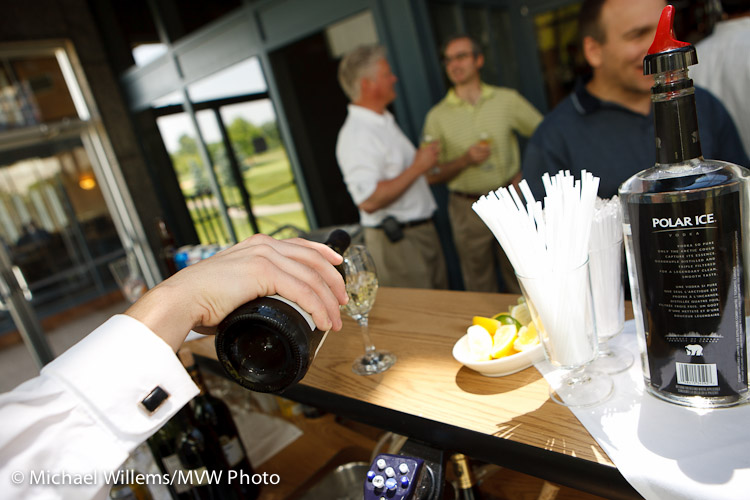
Wine being poured at a reception, photograph by Michael Willems

Wine being poured, photograph by Michael Willems

Manual and with a flash for fill.

Reception Buffet, photograph by Michael Willems

Reception Buffet

Cheers,

Michael

Positioning

When you shoot people, do not tell them how to pose, or that you are posing them. Tell them you are positioning them, or ask them to position themselves in a certain way.

You get more natural poses that way!

Bat Mitzvah Girl's Big Sister and Mom, by Michael Willems

Bat Mitzvah Girl's big Sister and Mom

A family, close shot by MIchael Willems

A family

And if the pose is more traditional, you can rotate, and even show the background, to add some life:

Bat Mitzvah Girl and friends, by Michael Willems

Bat Mitzvah Girl and friends

Please release me…

..not the song, but it is model releases I am referring to. When do you need a model release?

First of all, I am not a lawyer, so I cannot give legal advice. Go to a lawyer if you need that.

I can, however, tell you best photo practices as I understand them. And these are as follows.

First, let’s talk about taking photos. In much of the world, including North America (but not Quebec, where permission must be forthcoming), you can take any photo you like, within reason, if you are on public property. Yes there are exceptions (so put away those thoughts of a long lens aimed into the neighbour’s bathroom as she steps naked out of the shower) but generally, you can shoot what you like. Shoot, not necessarily use.

Of course whether you want to shoot is another subject: you may choose to be nice, and not do it if anyone objects, or you may want to not do it for fear of being arrested, sometimes, like when the officer looks straight at you as he is beating up a subject.

Now about using your images. That is where releases may come in. A release is a form where the model tells you that “for valuable consideration received” (i.e. you paid, or gave something else in return) you are allowed to use the photo; you have the rights to it as set out in the release.

When do you not need that, first of all? When the photo is news, or art. You can shoot for art and you can shoot news, whether the holder of the rights (the person, or the owner of the car or building or trade mark) likes it or not. Yes that is right, there are building releases too.

But when do you need one? When you are going to use an image commercially. SO if you intend to use the street person oin an ad for your local chairty, get a release. If you want to use yothe girl in the street for a fashion ad, get a release. If you want to put the image on a product box, get a release.

A release can be hard to get (try in Africa), but it can also work for you. “Sign this release and I can send you a copy of your picture” is a good strategy.

So I always carry a little mini release. The full release is a page long, but the mini release just says a short version, see below, and I can fit three on a letter-sized page. That way I have something to ask people to quickly sign. I advise you do the same, carry some.

—————————————————————————————–

RELEASE

For valuable consideration received of ______________, I hereby grant to ____________________ (“Photographer”) and his/her legal representatives and assigns, the irrevocable and unrestricted right to use and publish photographs of me, or in which I may be included, for editorial, trade, advertising and any other purpose and in any manner and medium; to alter the same without restriction; and to copyright the same. I hereby release Photographer and his/her legal representatives and assigns from all claims and liability relating to said photographs.

Name (Print)__________________________________ Date _________________________
Signature ____________________________________ Phone _________________________
Address ____________________________________________________________________
If Minor, Name/Signature of Parent/Guardian __________________________________________

What not to learn on your camera

Or, wheat and chaff.

Your point-and-shoot camera has two types of functions:

  1. Essential photographic ones. These are the same on all cameras.
  2. Fluff that is camera specific and is designed to market, or to “make it simple” but actually makes it complicated.

Your point and shoot especially has many “value added” functions. “Super OIS”. “Multi AI Focus”. “Oriental Food Mode”. “Child Mode”.

Those are like the radio programming functions in your car. Nice, perhaps, or maybe not – but not part of driving. And they can (and do) confuse.

So you should learn:

  1. How to do basic settings (like size) and functions (like reviewing and formatting).
  2. How to focus accurately.
  3. How to use exposure compensation.
  4. How to force the flash ON, and how to force it OFF.
  5. How to use ISO.
  6. How to use White Balance.

Those are photography. If you learn those six things, you will be a photographer. Whether or not you know the three Super OIS settings or the seven Image Enhance Options is pretty irrelevant, or at least should be an option later – but only after you know the essentials above.

Rule of thumb: If a function is unique to your camera, it’s probably not necessary and may even get in the way. It is certainly going divert your attention from the essentials, unless you already know those.

Sofly softly now.

A softbox is a great device. Soft, wraparound, wonderful light that flatters your subject and yet imparts directionality. Like this recent picture of model Tara:

Model Tara, shot by Michael Willems using a softbox.

Model Tara, shot using a softbox.

That was using a large softbox on a studio strobe, powered by a lead acid battery.

But there are also small softboxes, and as a travelling photographer I love those. I am talking about the Honl Photo Traveler 8 softbox:

Honl Traveler 8 softbox shot by Michael Willems

Honl Traveler 8 softbox

That mounts onto the flash, which is fitted with a speedstrap:

Honl speed strap, shot by Michael Willems

Honl speed strap

Leading, Velcro style, to this:

Honl Traveler 8 softbox, shot by Michael Willems

Honl Traveler 8 softbox

Which gives you nice soft light, and gives you another big benefit: a round catch light. Like in this self portrait:

Michael Willems in a self portrait made using a Honl Traveler 8 softbox

Michael Willems in a self portrait

Nice, no? Not me, the light. Well OK, me too.

Tip: use the wide adapter on your flash (no, that is not a softener: it is merely a wide angle adapter), so that the light bounces off the inside.

And take the flash off camera with a flash cord:

Off-camera flash using Honl Photo Traveler 8 softbox

Off-camera flash using Traveler 8 softbox

That works well for macro pics, too, like this recent snap:

Flower, shot by Michael Willems with Honl Photo Traveler 8 softbox

Flower, shot with Honl Photo Traveler 8 softbox

Nice, soft shadows again.

One more example: this time the main light on the subject was a bare flash, and the fill light was a Honl Photo Traveller 8 softbox:

Model Tara lit by small flashes by Michael Willems

Model Tara lit by small flashes

My advice: get yourself a softbox or two.

Learning Opportunities:

  • I am doing another two workshops in July, with David Honl – yes, the very man who designed these excellent flash modifiers. On 12 and 13 July in Las Vegas, Nevada in Studio Petographique.  See http://www.cameratraining.ca/Vegas.html for details.
  • And for Canadians here: there are spaces left on the full-day Creative Lighting workshop Joseph Marranca and I are doing in Mono, Ontario: details here.

And believe me, it is worth taking this type of course: we’ll teach you in hours what you would otherwise spend weeks learning.

Of workshops, and how to use them

I just taught a photo club in Oakville a thing or two. Great fun: I love the enthusiasm. This is a great time to be a photographer.

And a teacher. Next month, I am teaching in Las Vegas with special guest star David Honl: http://www.cameratraining.ca/Vegas.html – a great time will be had by all, but I do shake my head at doing this in July in Vegas, partly outdoors. Glad I (like Dave) enjoy the heat.

But even closer to July, a workshop in Mono, Ont,just an hour north of Oakville, that is a fantastic opportunity for anyone who wants to practice and learn creative flash skills: all day on June 26.  See here: http://www.cameratraining.ca/Mono-Day-2.html

As said, great days to be a photographer. A simple camera, rudimentary knowledge, and training by the pros: you can be a pro in no time.

And above all: practice. Never ask “what would happen if I pressed this button?”. Press that button!

Why use artificial light?

In yesterday’s post, I talked about making “hyper-real” images by using light coming from unexpected directions.

Today, another reason to use artificial light in photos: because the available light is too contrasty.

Here’s a picture of a model last Sunday in available light in the forest. Horrible contrast: pretty girl and great model, but not a picture I would use:

A model in natural light, photographed by Michael Willems

A model in natural light, in the forest

No, that just will not do.

Instead, let’s use a strobe in a softbox, and a gridded light as hairlight. Now we get:

A model in outdoors studio light, photographed by Michael Willems

A model in outdoors studio light

You can easily see how much nicer that is. The soft strobe light overpowers the sun, and removes the harshness and the contrasty nature of the available light. It also allows me to decrease the exposure of the background.

So next time you see a photographer lugging light stands and batteries and cables and such, you know why.