See the light!

Tip of the day:

To see the colour of the light you are shooting in, to really see it, take a first test-shot in every shoot with the white balance set to daylight (the sun symbol). That will show you the real colour of the light. Then you can take it from there.

You can judge by yourself, by looking at the back of  your camera, or you can look at the colour histogram, if your camera supports that.

Zoom zoom zoom.

A beginner’s question this time:

What does zoom have to do with wide angle? I thought they were two opposite things!

Not necessarily. A “zoom” lens is simply an adjustable lens. As opposed to a prime lens.

What you are perhaps confusing with a “zoom” lens, dear student, is a telephoto lens.

Let me explain.

There are two main types of lenses:

  1. Zoom – this means adjustable focal length.
  2. Prime – this means not adjustable: you have to zoom in by stepping forward.

And, an entirely unrelated classification, there are various lengths of lenses:

  • Wide angle – roughly, less than 24mm on a crop camera
  • Standard – roughly, 30-40 mm on a crop camera
  • Telephoto – roughly, longer than 50 on a crop camera

So a 10-20mm zoom lens is a wide angle zoom lens. A 24-105 zoom lens is a wide-to-telephoto zoom. A 24mm prime is a wide angle prime lens. And so on!

Off-camera flash kept simple

Sometimes it can be simple: off-camera flash can be really easy. Like in this student’s recent portrait:

Off-camera flash portrait

Off-camera flash portrait

You can also see how nice the splash of colour is in the background, right?

A matter of choosing manual mode with just the right combination of aperture and shutter speed and ISO to get enough light into the background. And Flash White Balance makes the tungsten light look nice and orange.

My message today: although flash can be done in a very sophisticated manner, it is not always necessary to make it complicated. Often, very simple is all you need. “Off camera” is often enough to just make it work. And an off-camera flash cable, while not cheap, is the simplest way to achieve this.

Why would you use flash outdoors?

So why would you use flash outdoors during the day?

Sometimes it is obvious: to fill in shadows on backlit subjects. Or to soften hard shadows. But sometimes you do it for more artistic reasons.

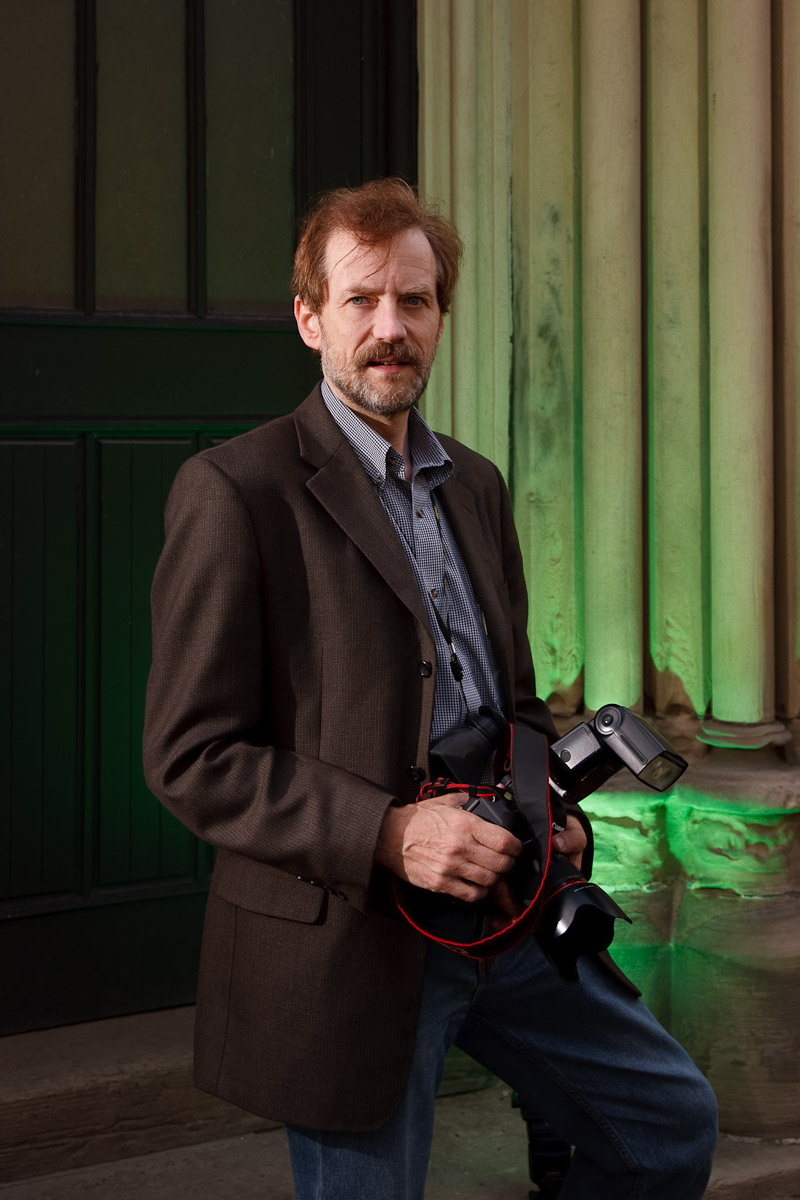
Let me illustrate this with a shot taken during the Get Out and Shoot run we did in Toronto early this week – the workshop I wrote recently.

Imagine you are shooting someone – me, say – on a bright day, but in a spot where I am in the shade against the shady side of a grey building. Before you know it you get a dull picture: grey and low-contrast on all counts: blaah.

So that’s when you bring out the flashes. Say, two remote “slave” flashes, fired by a “master” flash on the camera. One slave to the camera’s left, shining into a Honl reflector, and aimed at the subject’s face, to add bright light to the subject. The second flash is equipped with a Honl Speedstrap and on it, a green gel, and this flash is aimed at the grey wall behind the subject to make it less grey.

Now you get this:

Outdoors Flash

Outdoors Flash Used During the Day

You will agree, I hope, that this is a lot better than it would have been without the help of flash. Even, no, especially, on this bright day.

Want to learn about all this stuff: read here of course, but also: join me for training.

(Thanks to colleague photographer Rob Corrado for the picture)
Big News about Little Flashes

For those of you in the Toronto Area who want to learn more about flash, there’s some great opportunities coming up in the next days:

  1. For advanced, pro, emerging pro users, I teach an Advanced Flash” evening workshop in Toronto’s historic Distillery District on May 4, and there is still space! You will learn about the subtle differences between CLS/iTTL and e-TTL, you will learn about balancing light creatively, and much more. See here: http://www.cameratraining.ca/Schedule.html
  2. On 30 May (new date) Joseph Marranca and I are teaching a full day advanced light workshop in my country home in Mono, Ontario, just an hour north of Toronto. A great opportunity to make some great creative shots! See and book here: http://www.cameratraining.ca/Mono-Day.html
  3. For amateurs who want to get advanced in their flash use and practice what they learned, I wrote the all-new “Get Out and Shoot” workshop for Henry’s School of Imaging, and I and other experts will be teaching this Get Out and Shoot from May on across the GTA: check Henry’s School of Imaging to book!

Take advantage of these unique opportunities and kick-start your use of flash and light this month. Sign up today and enjoy sharing your passion with the pros and with other enthusiasts.

A reader asks: Manual? Why?

A reader asks:

“Question: I understand why you would use most of the modes ( av, tv, etc.) but what are the main applications where one would/should use the manual mode? Thks”

Great question.Why use manual? Here’s why you want to use manual (“M”) exposure mode (the dial on top of your camera).

  • Predictability. If you set the camera to manual exposure mode, your settings are, well, set. Turning your camera a little to the right or left will not now change your exposure. Imaging you are shooting in a room with predictable light, but your subjects walk in wearing white suits, then black suits, then white suits again.
  • Hard to measure subjects. How are you going to measure fireworks? It cannot be done in any automatic mode since when the metering is done, it’s all over.

That means you will want to use manual exposure mode in the following circumstamces:

Some photographers say “always, and use a meter”, but for me, the above captures it nicely.

PS: be careful: there are many types of manual. See here: http://blog.michaelwillems.ca/2010/03/11/manual/

Tip time: studio setup

A few quick setup tips – for portable studios like mine, here today for a corporate shoot:

Portable Photo Studio Setup Tips

Portable Photo Studio Setup

In no particular order:

  • Roll the paper the way I am showing here. Like a toilet roll: roll from the top. That way you get more available height.
  • The backdrop stand goes in a bag. Ensure that when you put it back in the bag, the large holes show. That way you can see which sidebar is the middle one – you may not need it (like me here).
  • Ensure cables are out of the way. Wrap them around light stands to avoid them hanging out too far where people can trip over them.
  • Always bring a power bar.
  • Use tape or something large on the floor to tell models where to stand and how to orient themselves.
  • Tell subjects “baby steps only when I ask for adjustments”. Else they always turn too far.
  • Start with the body. Then the head. Then the eyes.
  • Arrange to have a test subject available. Else your first client is the test, and that looks unpfofessional.
  • Use a tripod. Adjust height as needed.
  • Camera to 100 ISO and auto ISO off.
  • Camera on manual, 1/125th second, f/8, and use a meter to adjust the lights to that.
  • Test shot one: no flash. It has to be dark!
  • Test shot two: flash, but no subject (focus manually). It has to be white!

That is, I trust, helpful. Efficiency is all, or a two-hour shoot can turn into four hours with setup and takedown.

A studio like this one, the one I built this morning, took me half an hour to build and 15 minutes to take down.

About wide angles:

I often get asked “what wide angle lens should I get?”. Of course that is a difficult question to answer: there is no “should” about it. But in general, unless of course you are shooting an African lion safari, wide angle lenses are the most flexible.

Here’s my son Jason driving the car the other day:

Why do I use a wide angle lens for this?

  • Wide angle lenses allow the introduction of perspective, as I explained in a post a couple of days ago.
  • You can use them close to a subject and still get enough in.
  • You can get the environment to “wrap around” the subject, as in the picture above.
  • It is easy to focus them, with very wide depth of field even at large apertures.
  • It is easy to stop them from shaking (the longer the lens, the more susceptible to blur).

So is it “the wider the better”? Yes, pretty much, but watch out for a few things:

  • In close-up portraits, wide is not the best, unless you want large noses.
  • Lenses can distort perspective in the corners, so avoid people in the corner unless you want conehead-shaped distortion in them.
  • They can be imperfect in the far corners.
  • They can distort angles even when you would rather that they did not.
  • Your flash may not cast light as wide as your lens.

So not a panacea for all cases. But in general, wide is great and at least one of your lenses ought to be very wide – in the range of 10-20mm on a crop camera, and 16-35 on a full-frame camera.

Tip: Become a bag-person.

Quick Tip of the day: carry some small things at all times. Namely:

  • Plastic bags – to put things into, absorb shocks in your camera bags, stop things from moving around, and heck, even to throw up into if you’re sick.
  • Microfiber Cloths – to regularly clean your lenses and the back of your camera’s LCD, and also to absorb shocks in your bag.
  • A cheap 1″ paint brush – dust that does not get onto your camera will not get into your camera.
  • A “bulb”-type air blower – ditto.
  • Shower caps from hotel rooms – to wrap around your camera when it rains – poke a hole at both ends and you’re better protected than without.

These cost almost nothing, weigh almost nothing, and are worth more than than their weight in gold for a photographer. Solutions can be low-tech.

And another few sports tips

Since I just got back from shooting a junior Lacrosse game, here’s another few quick tips.

And they do not apply just to Lacrosse!

  • As said yesterday: look for action and emotion.
  • If you are shooting through Plexiglas, shoot straight through it and get close to it. You may need to bend down to minimize reflections from behind you.
  • Bring a soft cloth to clean that Plexiglas.
  • Avoid shooting from the penalty box in pro games of hockey and lacrosse. In junior games you may be able to get away with it without getting hit by projectiles. Safety first, though…
  • Bring bottled water and a snack.
  • Indoors, shoot manual. Tonight I shot at 1600 ISO, f/2.8, 1/320th second. Pretty typical values for an arena.
  • And as also said yesterday: shoot a lot. It took me 400+ shots to get enough good ones: I aim to submit 6-10 images.

Here’s one I like: