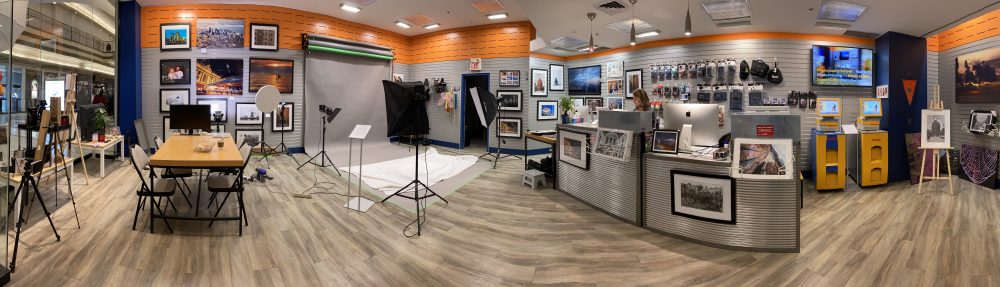
Black's

Canadians may find it interesting that Telus just bought Black’s Photo. Look for increased Telus saturation in the malls.  Just like Bell Canada recently bought Canada’s ex-Radio Shack stores.

I don’t find this very surprising: there is indeed some convergence in these small devices and Black’s just sells commodities to a low-end market, and no doubt Telus needed more mall saturation. In any case I am not sure how Black’s survived: their busines used to be photo developing and printing. Who does that anymore? And how many overpriced Chinese-made picture frames can you sell?

That said: this will defocus Black’s from photography. As it is, the only place to go in most of Ontario is Henry’s (where I teach).  Henry’s (and, in a few places, Vistek) are the only places to go for specialized photography retailing, where you need expertise and selection, and this will make this even more true.

As for printing, which is what Black’s really do? We should do this ourselves. I print 13″ x 19″ prints on my Canon Pixma Pro 9500 printer, and once you are used to how it works and once you have set up the printer drivers, you are better off doing it yourself. A learning curve, but a useful one.

Print your pictures, do not leave them sitting in hard drives!

Nifty Fifty

One lens that should be in everyone’s kit bag, however cheap your camera or however little you want to spend on equipment, is the 50mm lens. A lens they used to call the “nifty fifty”. I have mentioned this lens before.

Many manufacturers have a cheap 50mm lens – Canon and Nikon both have a 50mm f/1.8 version that costs less than $200. This Canon one costs only about $130:

50mm

So it can’t be any good, then?

Wrong. It is very good. On film cameras this used to be called a “standard lens”. Now, on crop factor cameras,  this lens has come into a new life as a portrait lens – on a Canon Rebel, for instance, with a 1.6 crop factor, this is like an 80mm lens. Great for “headshots” portraits.

And the nifty fifty is a fast lens – “fast” being somewhat of a misnomer that just means “has a low f/number”, so it allows lot of light in, and allows for selective depth of field (only part of your picture is sharp).

Which in turn allows you to take pictures like this, using only available window light:

Ivka, 50mm, f/2.0, 200 ISO

Notice that at f/2.0 you get very selective focus. This is not bad – it can be used for effect.

Make sure, however, that if you do this you focus carefully, using one focus point, on the closest eye. Looking at the picture above in detail:

Eyes

If you like that look, and have a window, go get yourself a 50mm lens today.

Fill the frame

If you have been in any of my composition or travel photography classes, you will have heard me recommend that you simplify – this is essential.

And one way of doing this, I then go on, is to fill the frame. Get close. Concentrate on the essence and ignore the rest.

Like in this shot:

Candy Jelly

“Fill the frame” often meets resistance.

  • “But I’ll cut off bits!”
  • “But I’ll miss essential stuff”.
  • “But you can’t cut through someone’s head! Not allowed!”
  • “But then I won’t show the whole story”.
  • “But I was always taught I must never cut people off at the feet!”.

All very well. But think about it: if I had not filled the frame above, I would had had mess on all sides, black tables, hands, trays: clutter. The shot would have been much less effective. And sometimes you tell the story better by getting close-up.

I have a tip for you. Next time you hear my voice talking to you as you are about to shoot – or could it be your conscience? – just shoot twice. Once close in, like in the shot above; and once wider, with lots of stuff on all sides.

Then at home, see which one you actually prefer.

Crop factors explained

Cameras used to have a negative-sized negative (duh). That is what we call “standard size”. (It is 24×36 mm, if you are interested).

But many digital cameras, especially cheaper models, have a slightly smaller sensor than that. We call this a “crop factor” sensor. These can be 1.5 times smaller than a negative (some Nikon models), or 1.6 times smaller (some Canon models), and so on.

So let’s work though this to see how it works.

First, using, say, a 24 mm wide angle lens, take a photo on a “full frame camera” (a film camera, or an expensive DSLR like a Canon 5D) and you get picture 1:

MVWS7676

Now put the very same lens on “crop factor camera” and take the very same picture from the very same vantage point. Same lens. Smaller sensor. So because of this smaller sensor, only the central part of the lens is actually used, and you now get picture two:

MVWS7676-2

The lens is the same, but the sensor is smaller, so a smaller part of the lens is actually used.

Finally, if I now print or display that “crop” picture at the same size as picture one (after all, it probably has the same number of pixels), I get picture three:

MVWS7676-2

And that looks just like a picture I would take with a 36 mm lens on a full-frame camera! See how the objects are larger?

That is why we say that a crop camera “appears to make your lenses longer”. So a 50mm lens on a full-frame camera, when used on a Canon Digital Rebel (crop factor 1.6) works like an 80mm lens on a full-frame camera. It has, as we say, “an effective length of 50×1.6 = 80mm”. There are other subtleties, but basically, that’s all.

This is excellent news if you like long lenses (your 200mm lens is now, free of charge, a 300mm lens). It is perhaps not quite such great news if you like very wide angle lenses: your 35mm lens works more like a 50mm lens (35mm x 1.6) would work on a full-frame camera. So to get what we used to get on a 16mm lens, you would need a 10mm lens.

Black and white…

..is underrated, I think; especially for portraits. Or else why don’t we do it more?

A good black and white photo can full of character; moody, even. Especially in portraits, where the absence of colour means the absence of distraction, and the ability to concentrate on the essence of the person.

MVWS8517-2

35mm f/1.4, 1/30th sec, available light

For a good B&W picture, you need to realize that the background and the subject need to contrast, and that where we see clear colour contrast, in a B&W picture we may see none.

B&W works especially well where colour distracts. It can work where the subject either has blacks and whites, or is high-key or low-key. A good B&W picture can be a study in shades of grey.

MVW_0021

35mm on 1.3 crop camera, f/8, 1/200th sec, strobe in umbrella.

When I shoot black and white, I do the following.

  • I shoot in RAW. This is essential.
  • I always set the camera to “Black and white” also. Even though this has no effect on the RAW images, it gives me a preview of roughly what the image will look like.
  • I ensure I do not overexpose the whites, but I do “expose to the right”. I.e. until the histogram almost hits the right edge.
  • Then I finish the image in Lightroom. In the DEVELOP module, I use the GRAYSCALE adjustment in the HSL/COLOR/GRAYSCALE tool. This gives me the easy ability to change different colours’ brightness.

This last step in particular has made B&W a practical endeavour once again for a busy guy like me. You know what they say: “no rest for the wicked”. And if I were, oh, 35 years younger I would add a “LOL” at the end of that.

Finally: B&W does not have to be moody – or rather, the mood does not have to be serious. Here’s my friend Keith, and his happiness and intelligence, big parts of his personality, really shine though here:

MVWS2431-Edit

50mm f/1.4, 1/1000th sec, available light

Go ahead, give it a go. Have fun shooting B&W. And because you are shooting RAW, you can always go back to colour at the touch of a button.

Showtime!

Put this in your calendar: 16-17-18 October, come to the Henry’s Imaging Show, at The International Centre in Mississauga. Details here:

www.henrys.com/show/

This show features just about every major manufacturer and importer, and as you see when you click on “Presentations” and scroll down, features free seminars with the likes of Michael Gilbert, Gary Fong (himself) and indeed also features yours sincerely:

Travel and Photojournalism
Join Michael Willems, an award winning, experienced traveler and photojournalist as he shares his ideas on traveling and photojournalism and how to get “the shot.””

I really enjoy presenting at these shows. The only drawback for me is that when I am teaching constantly, I never have enough time to walk around. Believe me, this show is worth the time and having several days is no luxury. A must-see, so do bring out those iPhones and add these dates.

Our new book… soon

Yes it’s true. Our new book is being written right now. Go to www.cameratraining.ca to put your name on our private, exlusive list for notification of our publishing date.

More information is on its way. This is the must-have book if you’re an emerging professional or advanced amateur and you’re struggling with getting the same quality images as you see the “big-name photographers” getting when they shoot weddings, events, portraits or travel photography.

I'll be your private da… eh, teacher.

Camera

A quick divergence – once only! – from my usual teaching blog. Instead of teaching, let me talk about another option for learning.
In my daily work as a photographer and teacher of photography, I meet many people who would  like to learn more about photography. Digital photography has unlocked a world of new possibilities: digital means new technologies, great affordability, and quick learning because of the instant feedback inherent in the technology.

I refer these people to Henrys’ School of Photography and its excellent courses, which I teach. But if they need training that is different from eth available material offered by Henrys, or if they need at-home training instead of classroom training, my colleague Peter West and myself are happy to oblige. This kind of training is very affordable and effective.
In this kind of “taught by the pros” courses, you will learn exactly what you need to know, when you need to know it. You will learn about your camera, your specific types of favourite photography, and your personal points for improvement. Then you get to practice them.
Whether you know a lot already or have never held a camera before, this type of training in the comfort of your own home can be useful. Even if you think you know all the basics: are you fully aware of how to:

  • Use your focus system? One point vs many? Auto, one-shot or continuous?
  • Choose the right lens for the right job?
  • Shoot in “Manual” mode?
  • Use exposure compensation?
  • Shoot and handle RAW images?
  • Use the Rule of Thirds?
  • Use your camera’s multi-flash system?
  • Use a flash when it is bright outside? And why?
  • Shoot at night?

Because this type of training is individual, we will be able to meet your exact requirements.
Where do we offer this? Anywhere at all. Usually in the Greater Toronto area, but everywhere else is possible too.  And as a traveller who has worked in 33 countries, when I say everywhere, I mean pretty much everywhere.
Check out the site here [link].  And start your next phase of photography.

A softbox to the rescue

LumiQuest_Softbox3

I have been playing with my new flash tools. I shoot things with three Canon 430EX Speedlites, driven by a 580EX speedlite on the camera. I use Honl Photo speedstraps, grids, snoots, and gels, and a Lumiquest softbox of the type pictured above.

But sometimes it is easier. The portrait on the right was of my friend and colleague Peter West an hour ago, on the Lakeshore Road in Oakville.

MVWS6680

I shot Peter with the 1Ds MkIII with 50mm f/1.4 lens, set to “P” mode for a change.

On the camera, the 580EX flash that was not actually contributing light (master flash disabled). In my left hand, fired by the 580 EX’s infrared remote control, a 430EX flash fitted with a Honl speedstrap, a Honl 1/4 CTO gel to warm the light, and the Lumiquest softbox (available from Henry’s; description here).

I used two stops negative exposure compensation (-2 stops). That makes the background sky nice and blue and it makes the unlit face of Peter’s face two stops darker than the lit part. That’s what you want.

It is easy and it is effective. By using these simple techniques, even your snapshots can be well-lit and dramatic.