Four Flash Shots

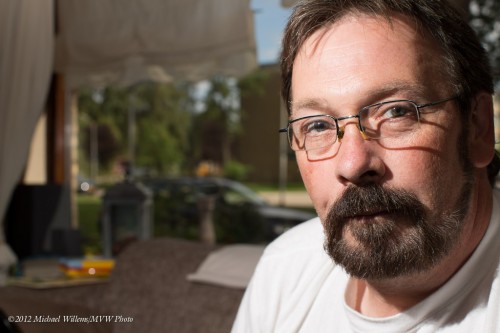
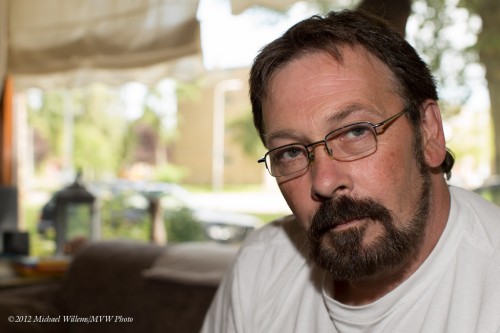
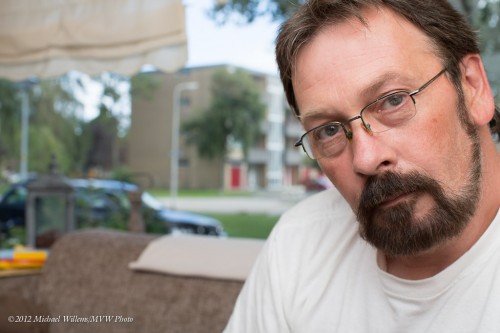
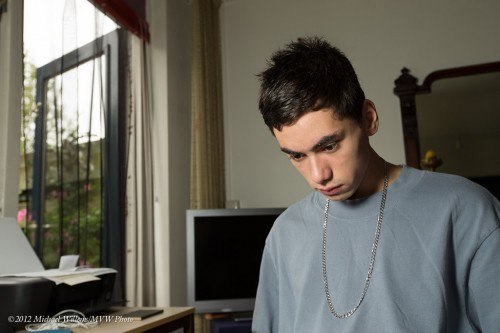
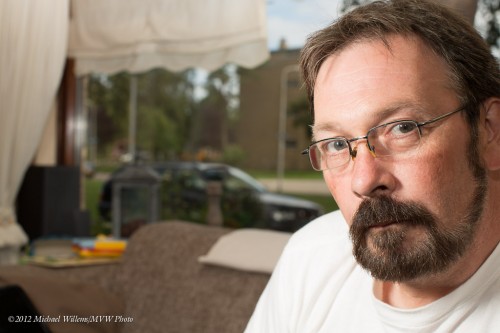
My friend and colleague Riker from Riker VP, shot a number of ways using flash:

[1] My favourite first: Using an off-camera flash with the Honl softbox:

[2] Using an off-camera flash direct – not as good, harsher, with shadows:

[3] Using an on camera speedlight directly aimed forward from the camera:

And [4] – using bounced flash off a ceiling a little way behind me:

Numbers 1 and 4 are by far the best – the choice is yours. As long as you see that 3, and to a slightly lesser extent 2, are poor. Flash is all about

  1. how soft it is and
  2. what the direction of the source is.

As long as you always think consciously about those two, you’re good.

This is part of what I am teaching in Rotterdam today… momentarily!


Flash!

Here’s a flash with a small 8″ Honl softbox:

Sometimes, bouncing is not the solution. For a snap like this, you would:

  1. Decide on the desired brightness for the background
  2. Set your aperture, shutter and ISO accordingly
  3. Turn on your off-camera TTL flash
  4. Hold it “where the umbrella would be”
  5. Click.

The key here is to use an off-camera flash – even in a simple snap of your child, this would lead to a better simple snap.

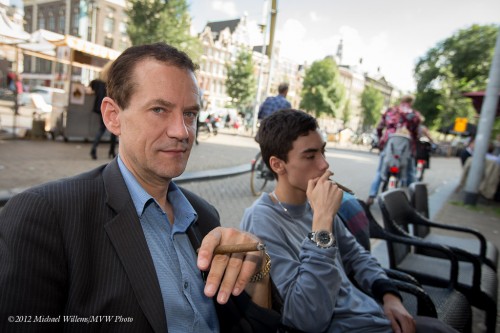
Here’s one with direct unmodified on-camera flash, of me and the same son smoking a cigar in Amsterdam (better than the alternative):

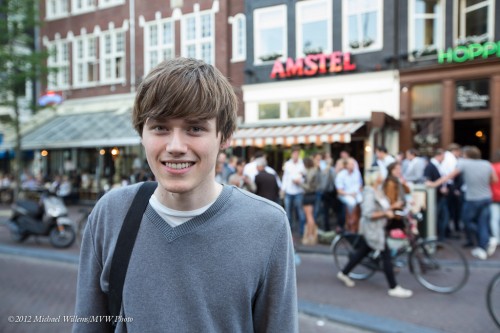
And sometimes you just use open shade only, as in this image of my other son in front of Café Hoppe in Amsterdam:

The important thing is to always think of light – “what do I need”.


Fun with lights

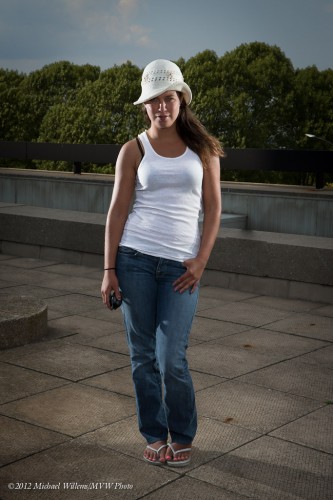
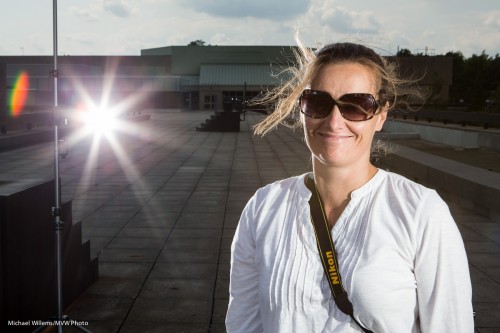
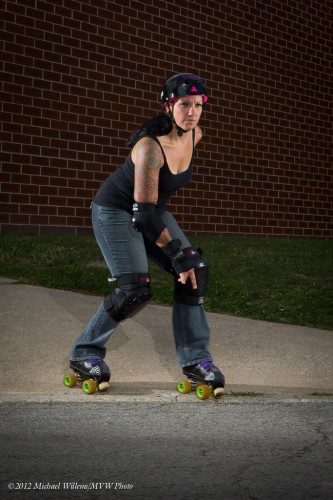
As regular readers here know, you can use speedlights for cool edgy shots that look photoshopped. Like these, taken today at my 5-day course at the Niagara School of Imaging at Brock University:

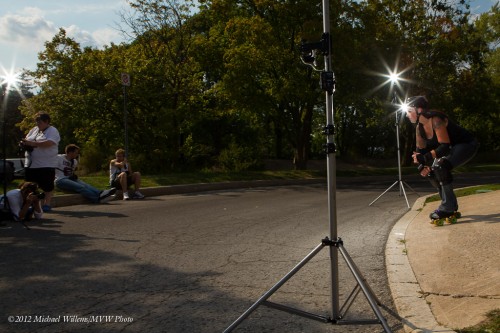
Those shots need you to take your time setting up, because you need equipment. But it can be simple equipment. like:

  1. Two lightstands with four speedlights driven by Pocketwizards: one right, one left, slightly behind the model. No modifiers.
  2. A lightstand with one speedlight, driven by Pocketwizard, behind the photographer. No modifiers.
  3. A pocketwizard on the camera to drive it all.
  4. You set your camera to ambient minus 1-2 stops, eg 200 ISO, 1/250th second, f/16.
  5. You set the speedlights to whatever power level you need to achieve f/16.

Like this:

Of course you need the brackets and cables and ball heads that are needed to connect the equipment together. But that is not rocket science.

Have a go – or come take one of my courses. Flash is wonderful light!


Speedlighter

I call this column speedlighter for a reason. Many, many of my shots are made with small flashes, “speedlights”.

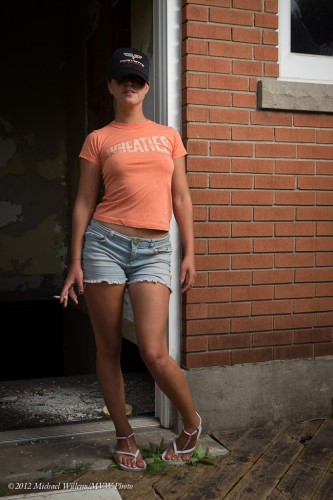
Like this one, of the model by a door at an abandoned house;

To get the moody look, I used

  1. The Canon 1Dx with a 24-70 f/2.8 lens
  2. The camera set to manual, 200 ISO, f/5.6, 1/200th second.
  3. A 600EX speedlight on the Camera, used only as a master (flash disabled other than that)
  4. A 580EX speedlight on a lightstand, fired into an umbrella; used as slave
  5. Simple automatic TTL flash metering!

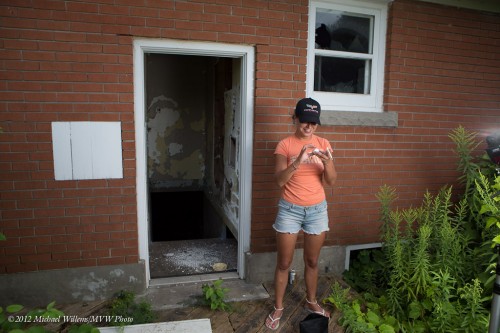
A pre-shoot setup test shot shows the light dropoff, and you can just about see the flash/stand on the right:

This was daylight, but the flash allows me to make the daylight basically disappear.

That’s the power of light, the power of added light, the power of flash: I do not like to think of what life was like before this. And a single speedlight, light stand, mounting bracket, and umbrella is all you need – and this is really speedy. They are called speedlights for a reason!


Limits

When you determine exposure for a photo, the principle is simple: only three things make a photo brighter, assuming everything else remains the same (which is the case when you are in manual mode, so this is how you should learn):

  1. Higher ISO
  2. Larger aperture
  3. Slower shutter

So it should be simple to get a beautiful darker background like this one here, in a recent picture – taken two weeks ago of one of my Sheridan College students:
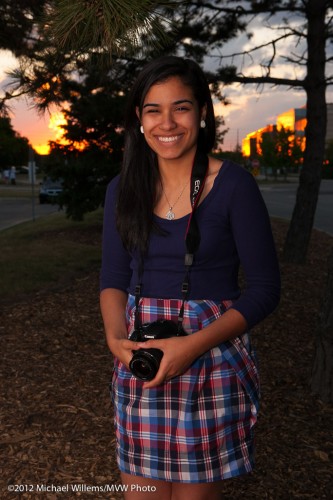
It is simple – once you realize a few things.

Darker or Lighter? It may not be obvious to you whether you want the background lighter or darker. In fact darker brings out (saturates) the colour, but you may think brighter is better. Your great advantage is that you have a digital camera, and each click costs $0, so the best thing I can advise you: practice.

What About The Foreground? You may need different light for the foreground. Here, I used an off-camera flash into an umbrella.  My advice is: worry about the background (the ambient light) first, as above; then worry about where you may have to add light.  One thing at a time!

But where do I start? You will soon get a feeling of what settings are in the “acceptable range”. One thing you could do, as a sort of training wheels, is set your camera to P (Program mode); see what ISO/Aperture/shutter settings the camera would suggest, and then use those as starting points in your manual settings. But soon, you will get to know what you want:

  • for motion (blurring or freezing), shutter is your first thought
  • for depth of field, aperture is your first thought
  • for quality, ISO is your first thought

And you will then have only two other variables to worry about. Combine that with ISO starting points (200 outdoors, 400 indoors, 800 in difficult light) and you have only one to worry about.

Learn The Limits. Learn what aperture will give you too-shallow DOF (e.g. f/1.4 when you are 2 inches away), What aperture will give you fuzziness (eg f/45). What shutter speed will give you motion blur (slower then 1 divided by the lens length). And so on!

Put all those together, and exposure becomes much easier. The key: reduce everything to the above very simple principles.

Exercise: this week, shoot only in manual mode. Both inside and outside, so you have big changes to deal with, This is the best way to handle learning exposure, and once you know exposure, photography becomes much easier.
 

A snap dissected

I thought perhaps I would show you a photo taken last weekend.. a snap, at first sight, but in fact a lot of thought goes into a photo.

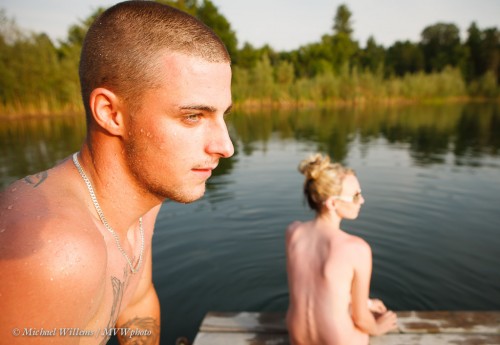
Here are Justin and Pam, who have been together for two years:

So what kind of thought goes into a shot like this?

  • The lens is a wide lens (24mm on a full-frame 1Ds Mk3), so we get depth in the image.
  • I shot late afternoon, so the light is good (nice and warm) and if I shoot at 1/25oth second, I can use f/4.5, so get a blurred background.
  • Nevertheless, this is not all available light – I aided the light by using an umbrella on our right with two TTL 430EX’s (yes, two, to overpower the sun). Hence the 1/250th second maximum (the synch speed).
  • I composed using the Rule of Thirds – Justin top left, Pam bottom right
  • I cropped to make the image suitable for distribution to their parents etc.
  • Since this is an environmental portrait, I kept the environment in – enough to see it is a dock on a lake, and they are skinny dipping.
  • The wave emanating from her feet produces a nice pattern and adds liveliness.
  • I avoid them looking at the camera in this shot.
  • And hence, very importantly, I make the viewer think; guess; wonder what they are looking at.  Each viewer wil have their own questions. Why is he not looking at her? Why are they apparently nude? What is the expression on his face telling us? What is she thinking?

As you see, if you apply basic rules – rules of composition, storytelling, light – your snaps can be more than just snaps. That’s what portrait photographers do, and with some training, you can, too.

___

Stand by for exciting news: the Never Not Naked: Natural Nudes solo art exhibition is coming to Toronto’s historic Distilery District, July 26 – August 26 at The Kodiak Gallery.


When all else fails…

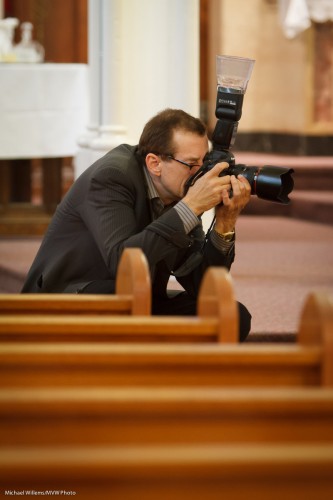
….then you use the Gary Fong Lightsphere. As I am doing here, in a recent wedding (the shot, in the church, is by my assistant that day, Merav):

You see, normally when using flash I want to direct the light – tell it where to go. I don’t want to just bathe the room in photons – and yet that is all I can do here with a Lightsphere.

But sometimes it is the only choice: namely, when there is no single good bounce surface, sending light everywhere can be better, and usually is better, than direct flash. You may need to increase your ISO to allow for losses, and watch for light going forward directly (I cover the front sometimes).

So while the Lightsphere is the antithesis of creative light, it is sometimes the only thing that will get you good photos. That’s why I carry one in my bag. I don;t use it much, but when I need it, I need it!


Light Meters Are Old Hat. Not.

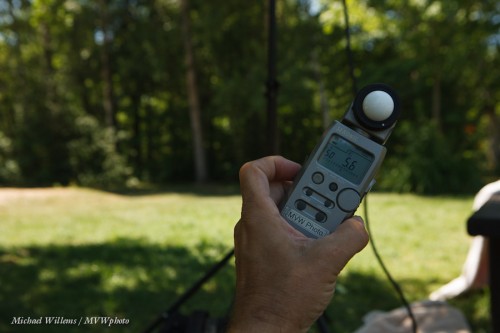
Not! A light meter is an indispensable tool if you want to ace your exposures first time.

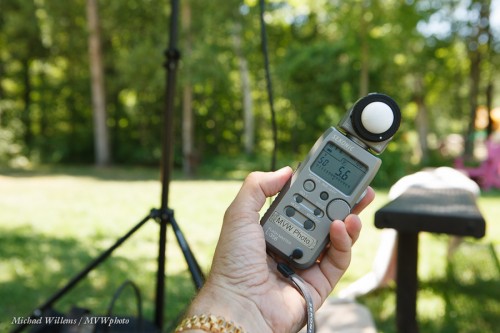
Take this scene (taken, incidentally, amidst a whole bunch of naked people):

That meter is well exposed. Perfectly, in fact. Values were 100 ISO, f/5.6 at 1/50th second.

How? By reading the values off the incident light meter (a meter you hold where the subject will be):

  1. Set the meter to ambient (not flash) metering
  2. Move the ball out
  3. Select the camera’s ISO and the aperture you want
  4. Hold the meter where the subject will be.
  5. Click and read the value for shutter.
  6. Set those values on your camera
  7. Click.

With the camera’s built-in light meter, however, the exposure came out like this, since the light background was also read by the meter:

That’s nice for the background, but if the meter is the subject, this exposure is all wrong – 2 stops too dark (the camera thought 1/200th was the correct shutter speed).  You would now have to adjust the exposure manually, or instead aim your camera, set to spot metering, at a gray card held there. Which is less convenient.

And that is why light meters are far from old hat. Pros use them all the time, even as ambient light meters as here.


What’s this Hi-Speed flash thing again?

A reminder for all you speedlighters.

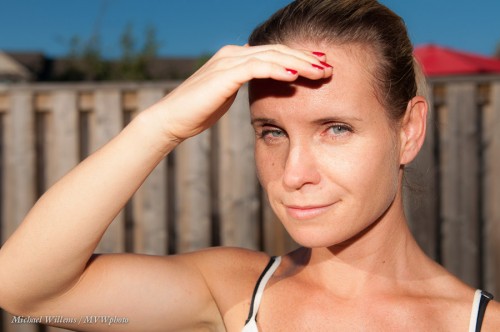
Say you want a shot like this, taken a few days ago,with your Nikon D90 or whatever SLR you have equipped with an external flash (like an SB900):

Yes, direct on-camera flash, when used outside and hence mixed with available light, can give you this – not bad eh? And the picture isn’t bad either. 🙂

But look at the background. It is blurry.

That means a large aperture was used (f/5.0 in this case).

But that means the shutter speed must have been very fast – even at low ISO, you need a fast shutter on a sunny day if you want the aperture to be large. I used 1/2500th second.

But hang on. When using flash, you cannot exceed the flash sync speed! Which is 1/200th second on this camera.

So how did I do this? I enabled “fast flash”. (“Auto FP flash” is what Nikon calls it; Canon calls it “High Speed flash”). On a Nikon, go into the flash part of the pencil menu and find flash sync speed, and set to Auto FP. On a Canon flash, indicate the little “H with a lightning symbol”.

Now the flash, whenever you exceed the sync speed, pulses rapidly instead of firing all at once, meaning that you can shoot at fast shutter speeds, where the shutter never fully opens all at once.

The drawback is that most power is lost, so you need to be very close. Aim the flash forward and watch the indicated flash range: as soon as you exceed the sync speed, that range drops rapidly. Stay within that range and you get great outdoors flash pictures!

___

NOTE: Come join me for a five day workshop at August’s Niagara School of Imaging – it is filling up but there is still space. Act now and spend five days with me on all this stuff, and emerge a flash pro.