One.

One light can be enough.

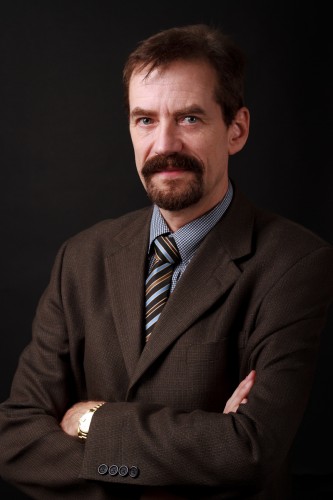
Look at this great image. How was it made?
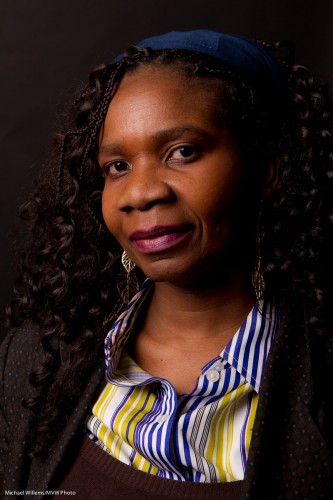
The answer is: one flash. Yes, that is all.

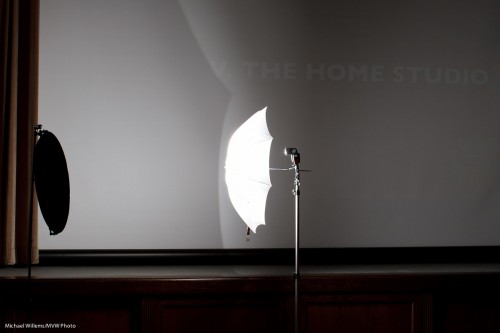
In this case it was a strobe, fired through an umbrella. But it could have been a speedlight.

The difference between those two options:

  • On a strobe, I measure the light with a light meter, and set my settings on the light and on the camera accordingly. And they are set for the entire shoot. So whatever the subject, the settings are the same. Done!
  • If I am using speedlights, however, the camera meters every shot. And it meters it by measuring light reflected off the subject. So the subject matters. A dark subject will fool the camera into overexposing, so you need to use negative exposure compensation. A very bright subject, the opposite – you will need positive exposure compensation.

Those are very essential differences. Read the above until you understand it, or ask me if you do not.

They have consequences:

  • If the subject distance will be static, use strobes/manual. If, however, the distance changes, then you should use TTL.
  • If the subject brightness changes from shot to shot, use strobes/manual. If, however, the subject brightness is the same between shots, TTL may be useable.

Confused yet? It is really very simple, once you know it. But then, the same applies to brain surgery.
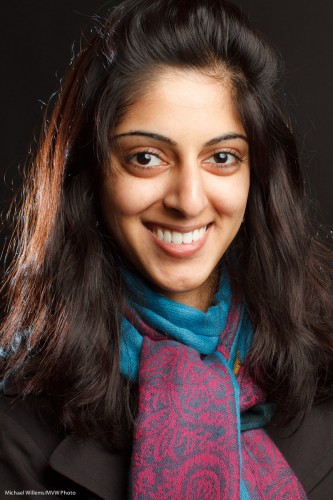
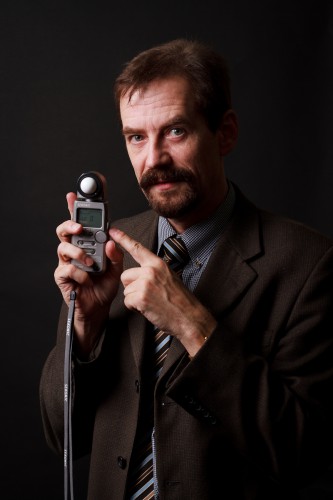
Simple Means.

Today, I taught a flash workshop that concentrated on the use of just small flashes. (Of course as you know I am doing an in-depth version of that workshop on March 19, with special Guest Star David Honl, yes? See www.cameratraining.ca/Flash-Honl.html – not to be missed!)

Anyway, simple portrait lighting with speedlites. You normally use wireless TTL for that – multiple flashes that the camera talks to using its wireless TTL technology. All major brands support this.

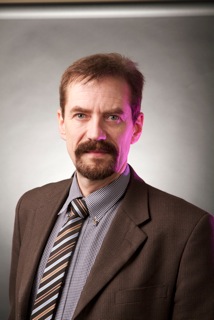
So here we have a simple shot of one of tonight’s students, using:

  1. a 580EX flash on our right…
  2. …shot through an umbrella, and
  3. a 430EX flash on our left…
  4. …using a Honl 1/4″ grid and a blue gel.

All this fired from a 580EX on a Canon Camera (if you have a Canon 7D or a 60D, or a Nikon, you can use your popup flash for this).

If you set the two flashes to different “groups”, i.e. A and B, you can set the ratio to what you like (e.g. A:B set to 4:1 means A is 4 times, or two stops, brighter than B). On Nikon, the system is the same although the way you set it is different (stops with respect to zero).

One important thing to remember: a key difference between strobes (you meter by measuring incident light, and it’s always good whatever the subject) and speedlites (TTL meters reflected light). So when using TTL instead of a studio, your subject makes a difference.

A subject with dark hair, a dark top, and against a dark background, will be overexposed so you need to use Flash Compensation of minus 1 to minus 2 stops. In the shot above, I used minus 1.3 stops.

Go try this if you haven’t. It’s fun. As a minimum, you need a camera with an on-camera flash (or use the pop-up on a 7D or 60D or a Nikon); one additional flash; a light stand; an umbrella; a bracket to mount them together; and a reflector (see yesterday’s post).

Reflect on this

I taught a very enjoyable class on “Portrait Photography” last night. I taught six students about studio lighting. Strobes, modifiers, light meters, backdrops, that sort of thing.

And one message was: it can be simple. One student wrote me just now:

I just wanted to tell you that I really enjoyed tonight’s workshop, which was excellent.  I learnt so much about studio lighting in just 3 hours.  I had always wondered how the big lights work prior to tonight’s workshop, and I have to say that you solved the mystery for me tonight.

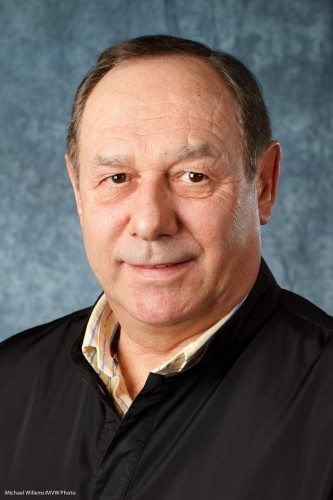
Yes it can be simple. Like in this shot, made with just one light (a Bowens 500 Ws strobe fired using pocketwizards, through an umbrella):

Michael Willems, by Franklin Wang

Michael Willems, by Franklin Wang

Observant readers (no no, not religiously observant – I mean readers who look carefully) will see that I am at 1/160s on the meter, and am using 200 ISO.

(Why 200 ISO? Should I, in a studio setting, not be using 100? Not when some students use Nikon cameras, which cannot easily go down below 100 ISO. That’s why. And why 1/160th? Because being slightly below your maximum flash sync speed, so ambient light does nothing while you avoid cutting off a bit of the image, is sensible in a studio. That’s why.)

So your settings in a studio might be:

  • Camera on manual;
  • 1/200th second at f/8;
  • 100 ISO;
  • Now set the lights to those values, using a flash meter.

I used a black background, away from the lights. That way it remains black.

So if you think that is a bit contrasty – we add a second light, right? And power it 1-2 stops below the first (2:1 or 4:1 ratio)?

Maybe.

Or maybe we just use a reflector. Saves the planet.

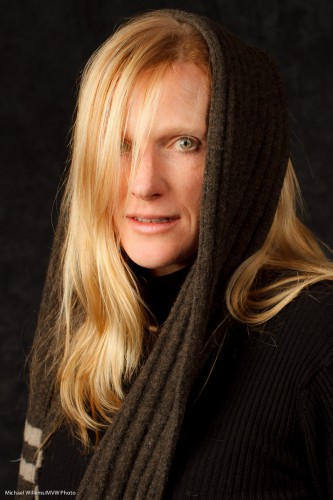
Michael Willems, by Franklin Wang

Michael Willems, by Franklin Wang

That way we save the second light which we can then use for the background, or for hair light, or for other funky effects.

The final picture is by another of the students:

Michael Willems, by Richard Smart

Michael Willems, by Richard Smart

Hey! Now that black background is light grey!

That is the point too. Black can be black (it is black when it has little light falling on it) or bright white (it turns white when it has lots of light falling on it). That is why I like black. White is much harder to control – it is easy to make it white, but tough to get it darker than mid grey in a typical studio.

As for the last picture: of course the top needs to be cropped off, but that is the point: these images are straight from the students’ cameras.

Oh – and the purple edge light is a simple 430EX speedlite, with a Honl grid and a Honl gel. Also fired using a Pocketwizard.

And yes, I think I can carry it off, purple.

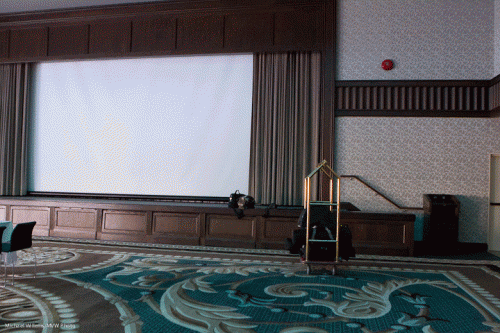
About that home studio

One more about the simple TTL home studio. I can give you some pointers to do your own.

Here’s how.

You need:

  1. A modern SLR camera.
  2. A lens – anything over 50mm will do. A 50mm f/1.8 might be a great choice: sharp and affordable (and if you need it, fast).
  3. If you have a Nikon, or a Canon 60D or 7D, just one flash (a 430EX/580EX for Canon or an SB600/SB900 for Nikon).
  4. If you have a different Canon camera, an additional 580EX to command the other flash.
  5. An umbrella (shoot through).
  6. A stand for the flash, with a mount for flash plus umbrella.
  7. A reflector (silver or gold or white, or a multi-purpose one).
  8. A stand for that reflector.

As an option, another flash with a small stand to light up backgrounds, but this is not a must have. You can just move the umbrella and subject closer to the wall if you want the wall to be lighter.

Now that you have the equipment:

  1. Set your flash to “slave” (Canon) or “remote” (Nikon) mode. Use the manual to find out how. On a modern Canon with a modern flash you can use the camera to set the flash.
  2. Set up your on-camera flash to be the “master” (“Commander”, on Nikon).
  3. Ensure that the on-camera flash is not going to fire (it will only  send commands to the remote flash, but it will not actually fire – else you get a shadow).
  4. Move the umbrella close to your subject. For a “standard” portrait, the best position is 45 degrees up, off to the side 45 degrees.
  5. Move the reflector close on the opposite side.
  6. Set your camera to manual exposure mode, f/8, 1/125th second, 100 ISO (or 200 on a Nikon).
  7. Take a test shot.
  8. Check the histogram. If you are shooting a dark subject against a dark wall, you may need negative (perhaps -1 stop) Flash Exposure Compensation; if you are shooting a light subject against a white wall, you may need positive (perhaps +1 stop) Flash Exposure Compensation.
  9. Make sure there is a catch light in the subject’s eyes. Ensure that any glasses do not reflect (move subject or umbrella if they do).

It is as simple as that. You will have studio quality shots, for very little investment. Shots like this (which I made with the exact setup above):

With a modern camera and flash and a little knowledge, it really can be that easy.

Granigif

That cryptic title means “Animated GIF at the Granite Club”. Which is where I was teaching portrait photography last night.

I cannot image a more fun way to spend an evening: some of the most committed, fun, outspoken, and friendly people I have had the pleasure of teaching.

So let’s start with how I set up. Click below to see it as an animated GIF. The time elapsed here was over an hour:

Studio Photography Lesson Setup, by Michael Willems

Studio Photography Lesson Setup, by Michael Willems

Last night was a lightning-fast lesson in portrait photography basics, from lights to pocketwizards to positioning techniques.

The interesting thing, I think, is that while for full control, the more “stuff” you have the better, you can often keep it remarkably simple.

A shot with “the standard four lights” might be this:

Portrait at The Granite (Photo Michael Willems)

Portrait at The Granite

That uses a key light (softbox), a fill light (umbrella), a hair light (Honl snoot), and a background light (Honl Grid).

But you can also keep it simpler. For a lady with light hair, I would not light up the background. We would also not really need the hair light. So now indeed it is simpler:

Robbin at The Granite (Photo: Michael Willems)

Robbin at The Granite

Beautiful, no?

But the real surprise is the simple setup on the left: you can just see it. A TTL flash through an umbrella. A reflector to provide fill light. And a background light to add a bit of brightness to the available background. Now all we are using, then, is two flashes and some affordable stands and a reflector.

That gives us:

Matt at The Granite (Photo: Michael Willems)

Matt at The Granite

You see: you can often keep a studio setup simple. Why use a light when a reflector will do just as well?

Studio photography is incredibly rewarding. If you think so too, I strongly recommend you take a course or private coaching and learn how to do it.

Another light example

Here is another lighting example for you.

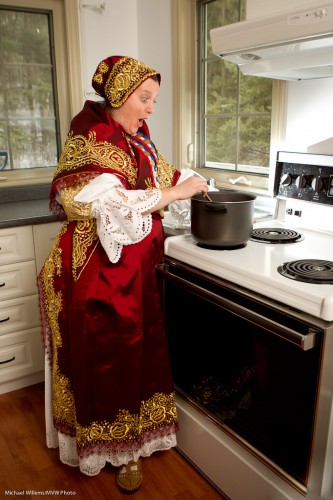
A very nice lady with an amazing traditional dress (which I am told took a year to make, which does not surprise me):

Croatian dress and mystery pot (Photo: Michael Willems)

Croatian dress and mystery pot

So how was that lit?

Here’s how.

  • First, I exposed properly for ambient light. That is why the background foliage looks good.
  • The camera, of course, is on manual.
  • Then, I added a main light on my right – a strobe in a softbox. This again gives us nice soft light. Fired by pocketwizards.
  • Then finally, I felt it needed more. So I used a speedlight in the sink, on manual, fired also by pocketwizards.

That’s how. Try some of the same if you have time!

A picture

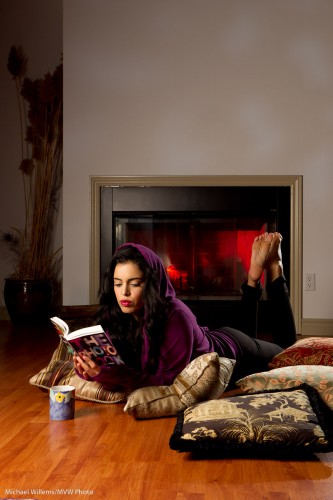
I would like you to look at this picture and see if you can tell how it was lit:

Tara Elizabeth (Photo: Michael Willems)

Tara Elizabeth (Photo: Michael Willems)

So I’ll give you a few. It is all artificial.

  • The main light is a strobe in a softbox on our left. This leads to nice soft light onto the model’s face.
  • Then, a flash with a grid, on our right, behind Tara. That gives us the oh-so important rim light.
  • Now look at the fireplace. Is that a fire? No – the wood would not light, so it is a speedlight fitted with a red Honl Photo gel. Those gels are incredibly useful!

The mottled light on the wall – that is more involved. Think cookie cutter (it too is artificial), and take one of my advanced lighting courses one day (see www.cameratraining.ca).

Also, keep March 19 open for a special Advanced Lighting course I am putting on in Toronto with David Honl (yes, the David Honl) as my special guest! The location and further details will be announced soon.

In the mean time: start thinking about how to light a scene with multiple lights.

Another reader question

A few days ago, reader David asked me this:

Just wanted to get your input on a upcoming event I will be shooting on Friday night. The events will be group shots (family and player) at a high school basketball game for their ‘Senior Night’. Since it will be in the gym with very high ceiling, bouncing off the ceiling does not seem to be a viable option. I was thinking about bouncing using a gobo card. Since the room will be filled with lovely (not) florescent light and wonderful (not x 2) swamp lights overhead, I could bounce the flash as a fill light to help get rid of the awesome green tones. The second option is to use an off camera 580EXII with a Honl Traveler 8 softbox (close to camera center maybe). The third option (since I believe in the power of 3) would be to use my Fong Reporter Whaletale with and on-camera flash. I am interested in “what would Michael do?” (As a a side note: I typically use a gray card to get a good white balance. I shoot everything in RAW, so flexibility in post-prod adjustment is not an issue.)

Good question, David.

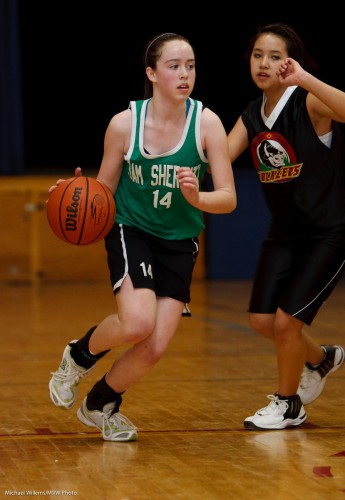
For basketball I would say the following. First, here’s an example of a basketball pic I shot.

That was 1600 ISO, f/2.8, and 1/300th second.

And… oddly for the Speedlighter, I used flash, straight-on. As you correctly surmise, ceiling bounce or wall bounce can be difficult.

So this is one case where, if it is allowed (Ask the coaches! In high school basketball it will often be allowed) you can use straight-on flash to fill in the light. Of course this means recharge time between shots,  but if allowed, you may want to do it. Also watch out, you could get red-eye – easy correction of course, but still, you have to do it.

Alternately, you can bounce of a larger bounce card. That will mean less power and more recharge time, but it can be viable.

Of course you can also choose to live with the light that is available.

You other options are good to try, too. Off-camera is not likely to be much help though since at the distance you are shooting at, it’s close to the camera even if held a few feet away. The softbox, ditto, and you lose light.

Also, the long lens is great but do not forget the wide lens for close shots. And:

  • If you can, bring two cameras
  • Ask the coaches if you can use flash
  • Get close ups
  • Shoot under the rim, but be careful behind it – balls will hit!
  • Shoot vertical shots
  • Get the back of shirts to get the numbers
  • Shoot emotion: happy, sad, angry
  • Shoot action: close up
  • Shoot static for each player too

I hope that helps… and yes, I did answer this reader before that Friday!

You know this.

But I want to show you again – and emphasize it once more:

Flash needs to be bounced.

I shall illustrate with three snaps of a kind volunteer in last Sunday’s camera course that I taught in Oakville.

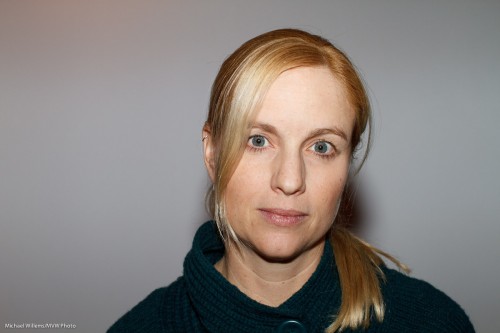
Snap one shows that aiming your flash straight at your victim ought to be a federal offense. (The young lady was warned and kindly agreed to be pictured this way, with a 580EX II flash straight into her face, using TTL, but knowing there would be better snaps to follow):

Not that she doesn’t look great, but the photographic qualities leave much to be desired.

  • Shadows under her ears;
  • And under her chin, a hard shadow;
  • “Deer in the headlights” look;
  • Skin looks reflective;
  • Face is flat;
  • Background is dark;
  • The catch light is in the centre of the pupil.

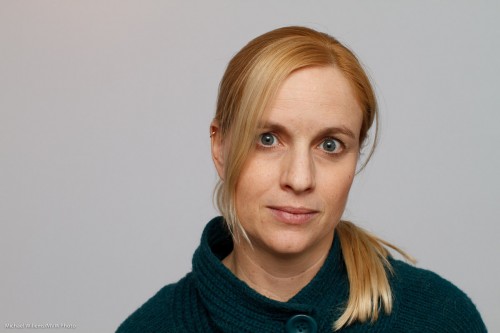
So then I turn the flash up at a 45 degree upward angle right behind me. That way the light comes from 45 above in front, from her perspective, and this is typical beauty lighting:

This is still using TTL, so all I had to do was to turn the flash behind me, and bang. A portrait instead of a snapshot. All the problems solved in one go!

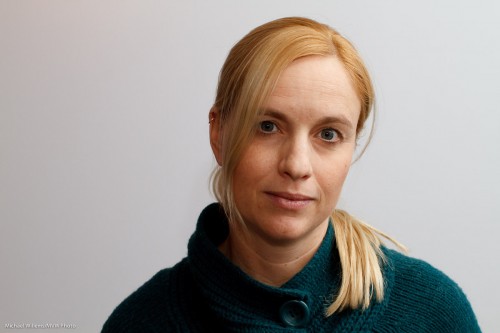
You could also turn the flash to the right or left, so she gets light from the side, above:

Now the face is more three-dimensional and sculpted.

I would normally use more straight-on lighting (pic 2) for women and more side lighting (pic 3) for men (because the latter tends to show “character”, which can be a euphemism for “age”).

Either way, though: avoid flash on camera aimed at your subject. This is why your pop-up flash is evil, and why my 1D and 1Ds bodies do not have one.

And with modern TTL flashes and cameras, you do not need to do anything other than “turn the flash head”.

Gridlock

Why do you use a grid on a flash?

A grid softens the light somewhat, an effect I really like. But the main use for a grid is to avoid the light going everywhere.

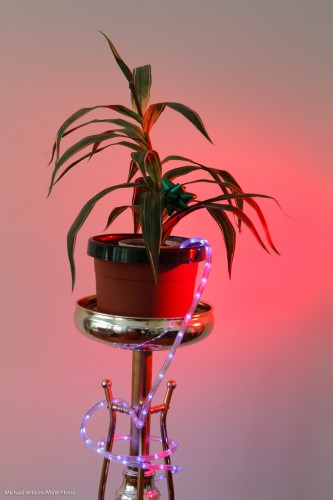
Look at this image: lit from the side with a bare speedlight (a Canon 430EX, which is equivalent to a Nikon SB600) with a red gel.

As you see, light hits the wall.

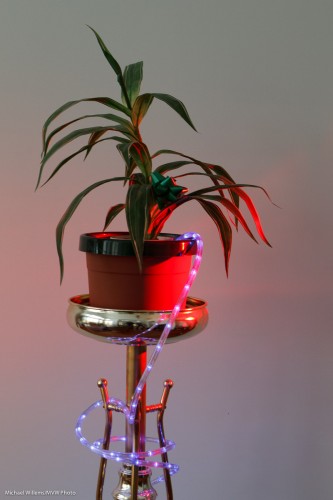
Now look what happens when I put a 1/4″ Honl Photo grid on the flash, with a gel on top of the grid.

Ah. No more light spill onto the wall.

That’s all. As simple as that.

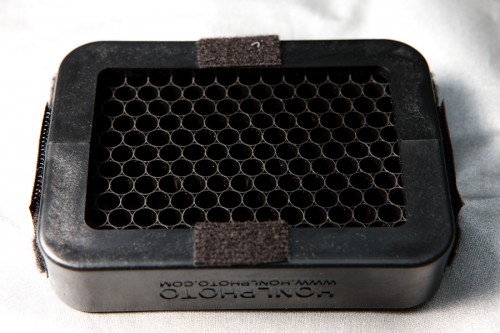
And here’s what a Honl grid looks like: