Sometimes you make do

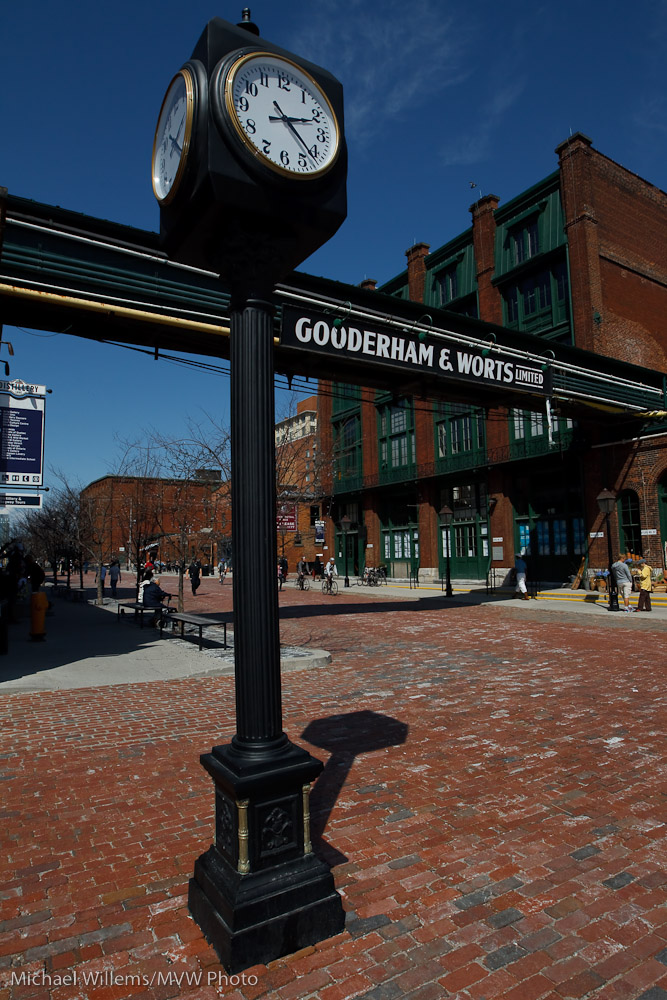
…with a hand, if you want a foreground object to light up with your flash, when for effect the background needs to be darker. Like just now in The Distillery District in Toronto:

Another snap:

Again, using flash for lighting up the foreground, while exposing down to saturate the background on a bright day around noon. Sure you can take pictures at mid-day.

You can do a lot…

…in spite of conventional wisdom. Conventional wisdom has it that the Canon 7D is not the best for high ISO shots. And that you need twice the lens length, so 50mm on a crop camera needs 1/160th second..

So you could not possibly do a shot like this at

  • 3200 ISO
  • in available tungsten light
  • with a 50mm f/1.4 lens
  • set to f/2 at 1/40th sec0nd,
  • hand-held:

Cat, 3200 ISO, f/2, 1/40th sec, Canon 7D, 50mm

Yes you can. Hand held, slight noise reduction applied in Lightroom.

That wired effect

Here’s a picture I just took of my favourite patient model. I used some technique to get that dramatic “Wired” effect:

The way I made this picture:

Camera:

  • Camera: Canon 7D with 50mm f/1.4 lens
  • Set to Manual, 1/125th sec, f/8, 100 ISO

Flash:

  • Multi-flash TTL with one on-camera and two off-camera flashes.
  • One “A” Flash on the camera (580 EX) as fill flash and “commander”;
  • The main lighting was rim lighting: two 430 EX flashes either side of the model, slightly behind, set up as “B” flashes.
  • I was using a 1:8 A:B ratio.
  • The 430 flashes were each equipped with a Honl 1/4″ grid, to stop their light from hitting the entire room.
  • Flash compensation -1 stop to avoid overexposing the rims (this is common when your main flash lights only a small part of the picture).

Post:

  • And finally, I desaturated the colours in Lightroom: Presence +15, Vibrance -20 and Saturation -40. I also did a version where I desaturated only red and orange, and increased sharpness, which is the usual technique.

Try it yourself, or come to our two-day Light workshop 10+11 April to learn exactly how to do this.

Learning light

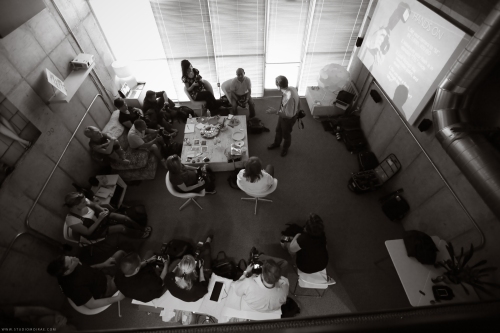
Here’s the workshop I taught last week in Phoenix, AZ, with David Honl, at Studio Moirae in Phoenix, AZ:

I like teaching small, intimate workshops like that, and Studio Moirae was a great environment for this.

So is my country home in 15 acres of Niagara Escarpment land in Mono, Ontario, an hour north of Toronto, where in a week’s time, Joseph Marranca and I are teaching a two-day all-in Weekend Workshop on Advanced Lighting: information here.

Good news: this too will be a small workshop, and there are still several spots available. This will be a very intense two-day workshop where participants will learn about lighting, including:

  • Available light
  • Available plus flash
  • Small speedlights
  • Studio strobes
  • Mixed light
  • One flash
  • Multiple flashes
  • Modifiers
  • Gels
  • Dramatic light
  • Action
  • High-Key and Low-Key

The emphasis is on doing, not just sitting and learning. A model will be provided to shoot.

The great benefit of these workshops is that they are two days of living, talking, breathing and doing photography. If you are interested and have an SLR and know how to use it, but want to learn contemporary pro lighting, this is your chance.  Go to the web page and sign up.

Portrait using two flashes

Here’s an impromptu portrait I took on Tuesday, of a lovely student who kindly volunteered to be the subject, in the Flash for Pros course:

And here’s how I did this:

  • Camera: The camera was a Canon 7D
  • Lens: I used a 50mm f/1.4 lens. (50mm on a crop camera, even the very cheap f/1.8 version, makes a great portrait lens).
  • Settings: The settings were Manual mode at 1/30th second, f/5.6, 400 ISO
  • Flashes: I used two 430 EX flashes on light stands, fired from the pop-up flash (like most Nikon cameras, the 7D allows this). Other than that, the pop-up flash was disabled. (I could also have used a 580EX on the camera as master.)

And how I used those flashes:

  • I used e-TTL, so I did not have to meter and set the flashes manually.
  • The main flash (“A”) was on camera left: a 430EX fired into a Honl gold/silver (half CTO) reflector. It was about a foot away from her.
  • The second flash was also a 430EX; this one fired straight at her from 45 degrees behind, through a Honl 1/4″ grid. This flash was also about a foot away from her.
  • I set an A:B Ratio of 4:1, so the main light was two stops brighter than the hair light.

Another student that night wrote a blog post, here, where you can see a few pics with some of the modifiers I used.

So it’s actually quite simple: now you go try. It is amazing what you can do in just a few seconds with just a couple of flashes (speedlites) and some small, light, convenient modifiers.

My "two stops" technique

Here’s a quick start tip for using flash indoors.

First, set your camera to:

  • Manual mode
  • f/4
  • 1/60th second
  • 400 ISO

Now check the light meter in your viewfinder. You want it to read about minus two if you point at a representative part of the room.If it reads higher or lower, adjust aperture and shutter speed until it reads -2. If possible, try to keep the shutter between 1/30th and 1/200th second.

By using this method, your ambient lights shows (avoiding black backgrounds), and it becomes your “fill light”, two stops below the key light. And of course while your ambient is set manually, the flash is still automatic.

And finally: bounce that flash off a wall or ceiling behind you!

Light direction tip

Here’s a “quick start” for lighting a face:

  • For a man, start with having the main light come from 45 degrees above, at an angle of 45 degrees left or right (“Rembrandt lighting”)
  • For a woman, start with having the main light come from 45 degrees above, straight in front (“Butterfly lighting:)

The latter looks somewhat like this:

I took that snap at last Tuesday’s Phoenix “Advanced Flash” workshop. And you can see how: another course participant is holding a 430EX flash off camera, which I am firing from the main camera using TTL light control. Aperture and shutter speed, and ISO, are set so that available light is two stops darker (i.e. it provides the fill light).

Why this rule-of-thumb of “from straight in front” for women? Because it minimizes texture and features, and hence best shows beauty.

Please do not be hung up on these “rules” – they are merely good start points.

To some extent this snap is also an example of “short lighting”: I am lighting the side of the face that is narrower to the camera. This thins, which in the case of this beautiful woman is not necessary, but in case of larger people, or people with very round faces, can be a useful technique.

Accessorize.. accessorise.

Especially when it’s useful. Like in this case: the Honl Photo light modifiers’ carrying case. If you don’t have one yet, get one:
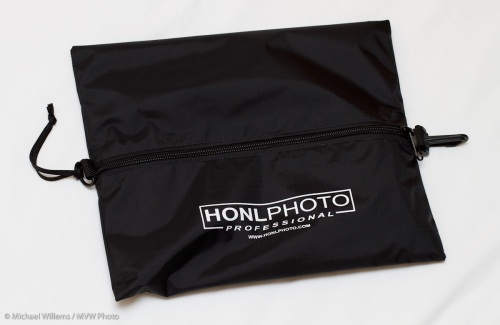
Very handy bag to keep all your modifiers, like bounce cards, gels, and snoots in one convenient place. And it attaches to a light stand, camera bag, etc, with a convenient clip.

Mine carries things like the reflector you see David Honl himself aiming at Studio Moirae’s Christie, when he joined me for my flash workshop in Phoenix a few days ago:

These small modifiers really have made a tremendous difference to the utility of small speedlites in professional lighting. If you do not yet have the range of Dave’s bounce cards, reflectors, gels, grids and more, then get them now.

Joe McNally is rumoured to have said that “if your subject is interesting, don’t light all of it”. That would be right if he had, and it is there that Dave’s range of modifiers shine: there and in being small, affordable, light and especially, durable, so that I can use them on the road.

That’s not all. There’s more exciting news coming soon from David Honl soon. Stay tuned until I can reveal the latest modifier.
Eye of the beholder

Brightness is in the eye of the beholder.

For a creative photographer, it is meaningless to say “the sky is this bright” or “the sky is this dark”. Instead, on a given day with a given sky, you might say: “I’ll make the sky bright”:

Or “I’ll give it some colour”:

Or “I’ll turn it dark so I get dramatic saturation”:

You do this by exposing it more, or less. A blue sky can be anything from white if I overexpose it, to almost dark whrn I underexpose it.

That’s how I get pictures like the desert pictures the other day, or this, of my sister-in-law the other day too, on a bright Arizona afternoon:

Of course when I underexpose like that, she would be dark too, except I am using my flash to fill in the foreground.