50

Today, I took photos at the Classic British Car show in Burlington, Ontario. And apart form a few aerial shots, I used only my 50mm lens (that is, a 50mm on my full-frame camera; i.e. if you have a crop sensor camera, you would use a 35mm lens to get the same view).

So, why a 50 (or 35)?

  • It imposes a certain discipline and consistency in the images. Sure, it is inconvenient to sometimes have to take a step back, but so be it. My images all have the same look and feel, which can be nice.
  • It is a nice “neither wide nor long” length. It used to be called a “normal” lens. Most of what I want to shoot, I can shoot with a 50, if it’s what I happen to have.
  • It is fast (1). It is an f/1.2 lens, meaning I get fast shutter speeds, if I want.
  • It is fast (2). It is an f/1.2 lens, meaning I get crazy blurry backgrounds, if I want.

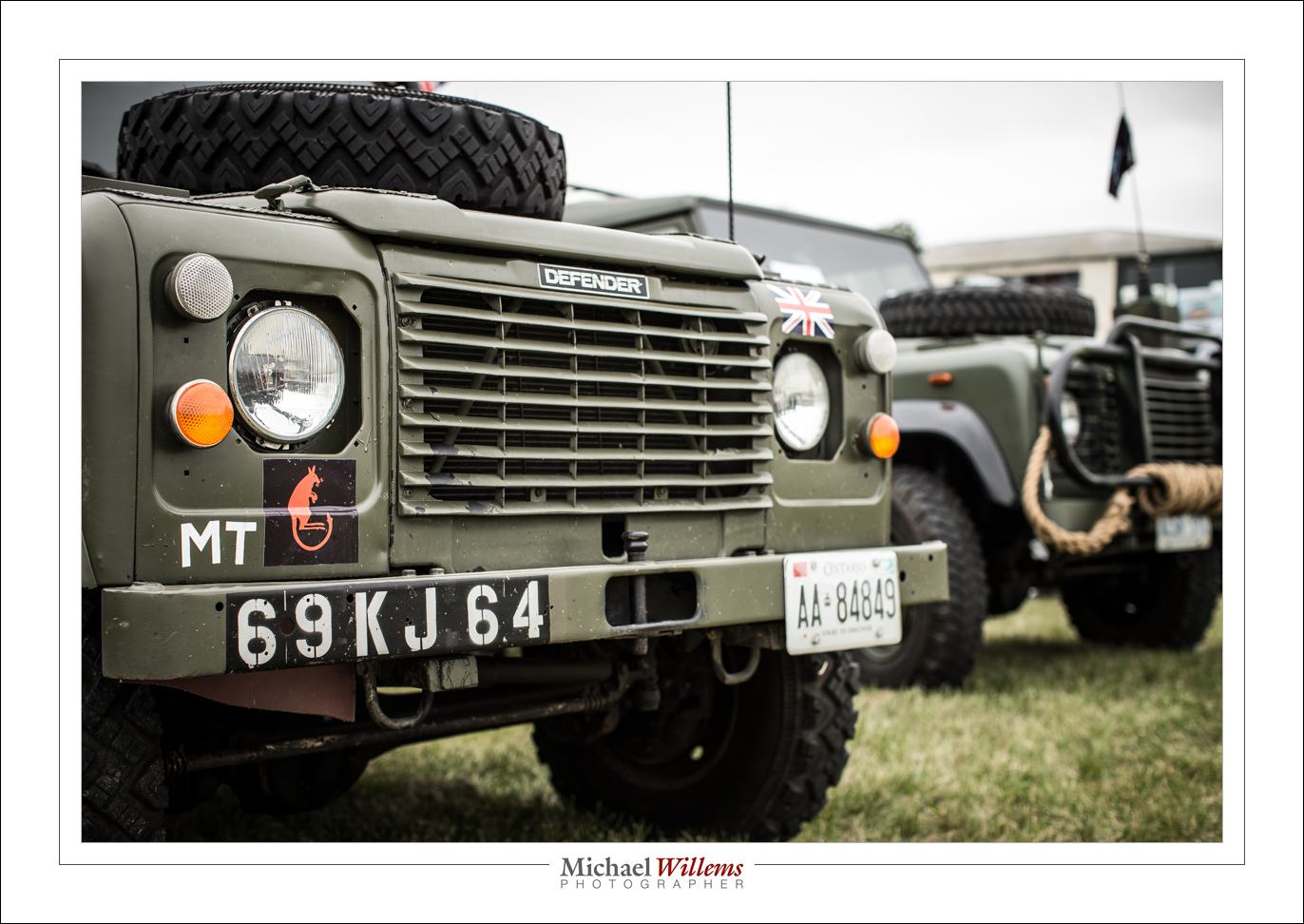
In practice, all that means that I can get perspective by getting close:
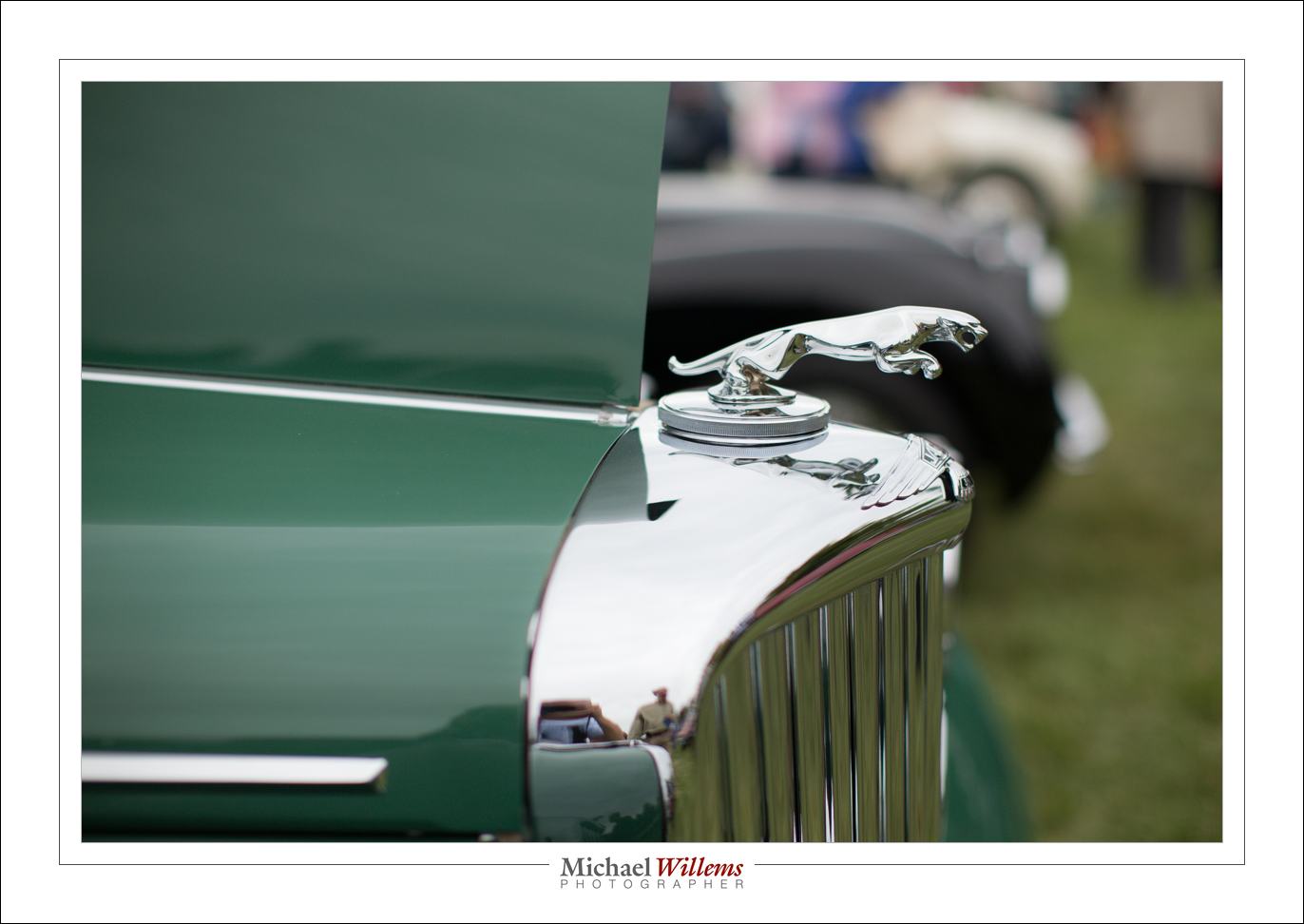
And I can simplify, by getting closer:
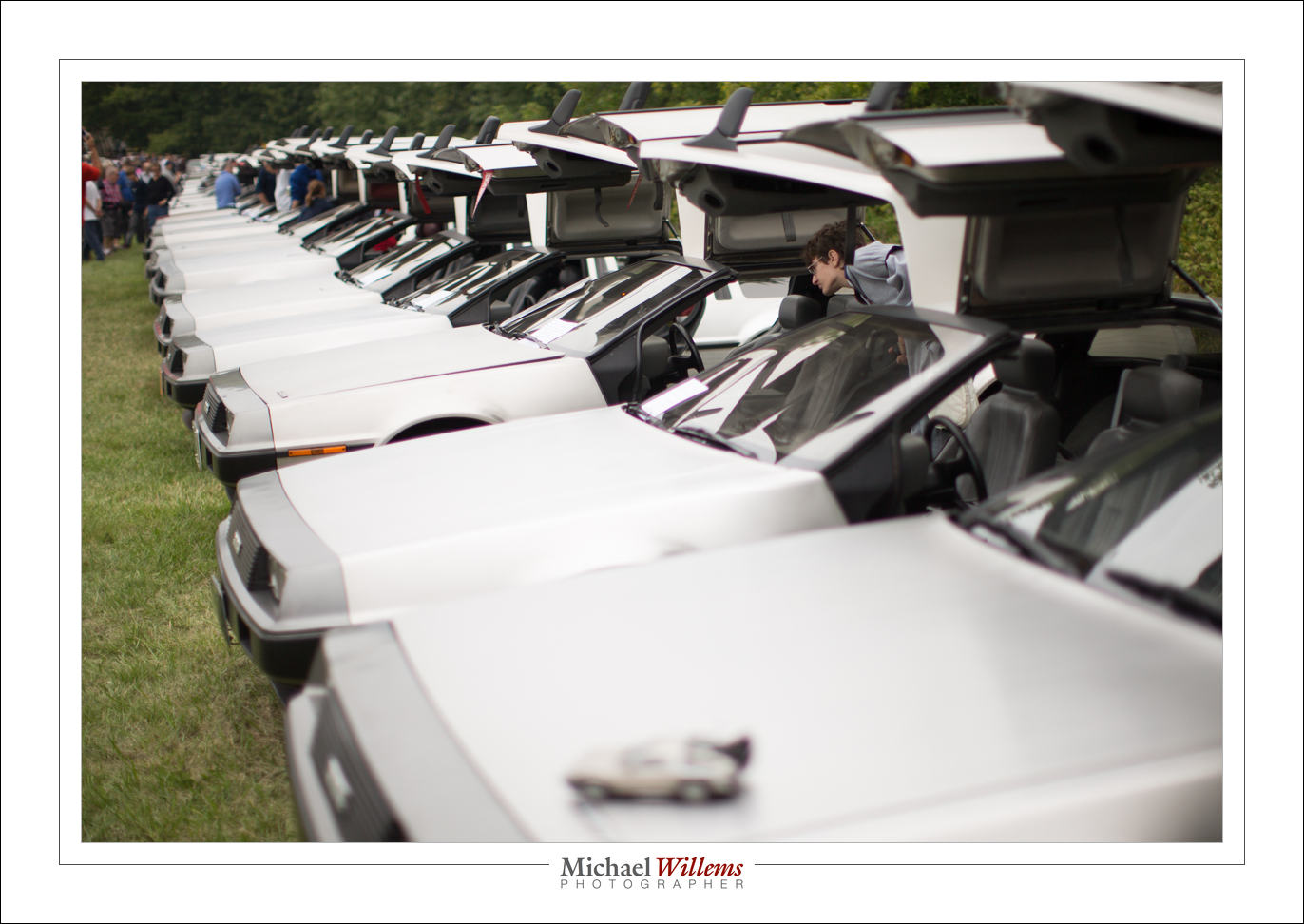
I can create diagonals, almost as if I am using a wide angle lens:
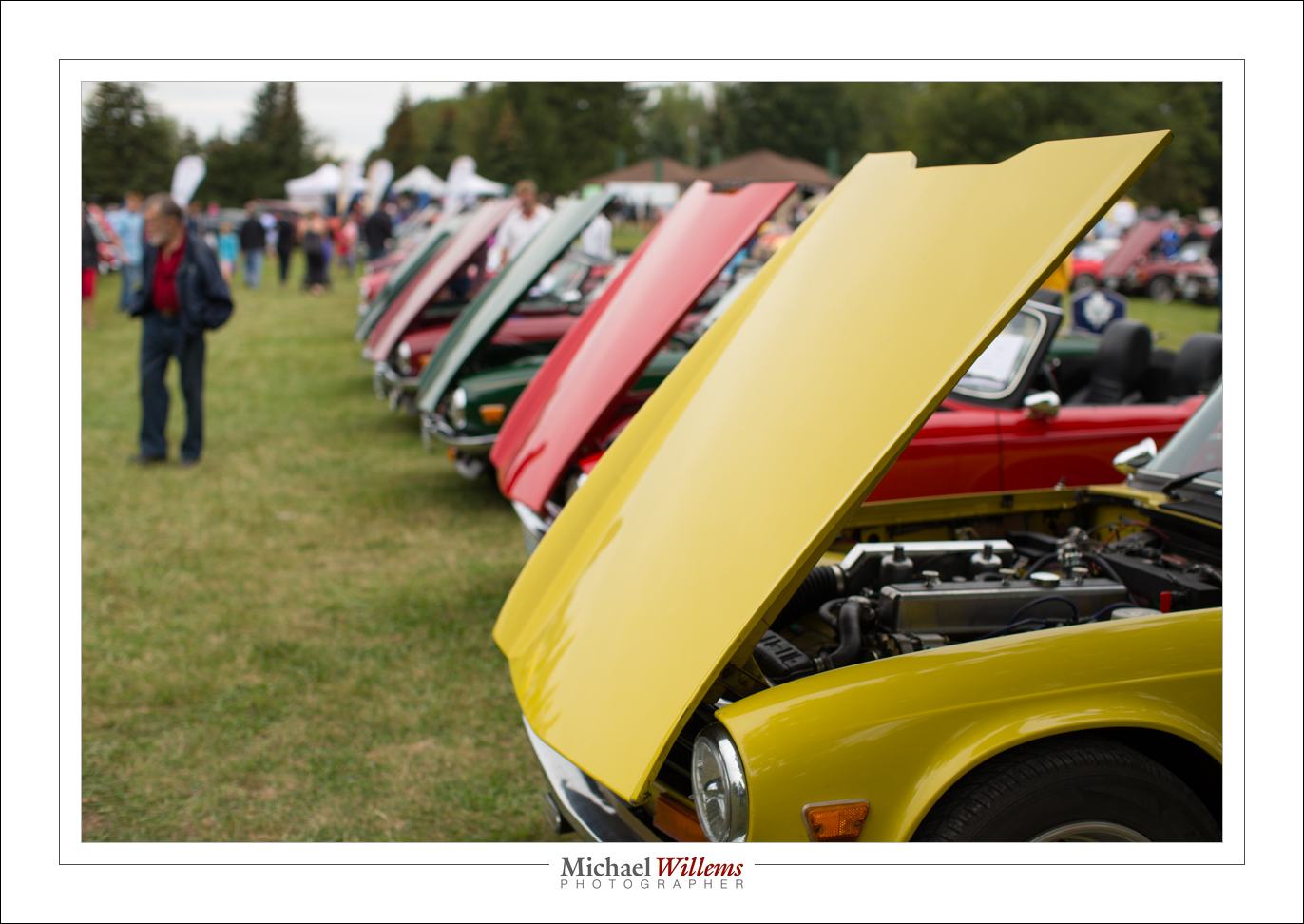
And yet I can “get enough in”:
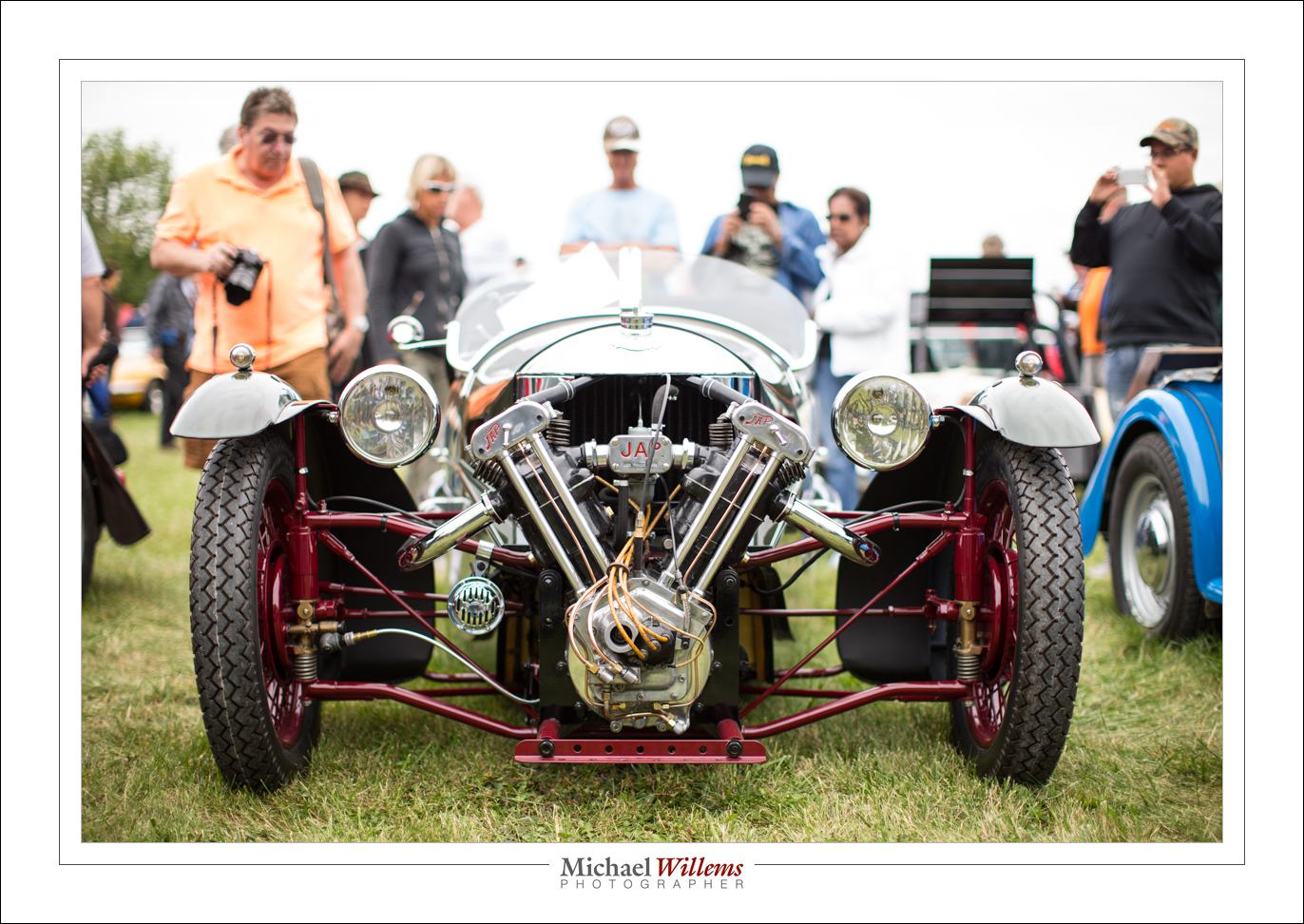
I can even combine foreground and background (“old and old”, here):
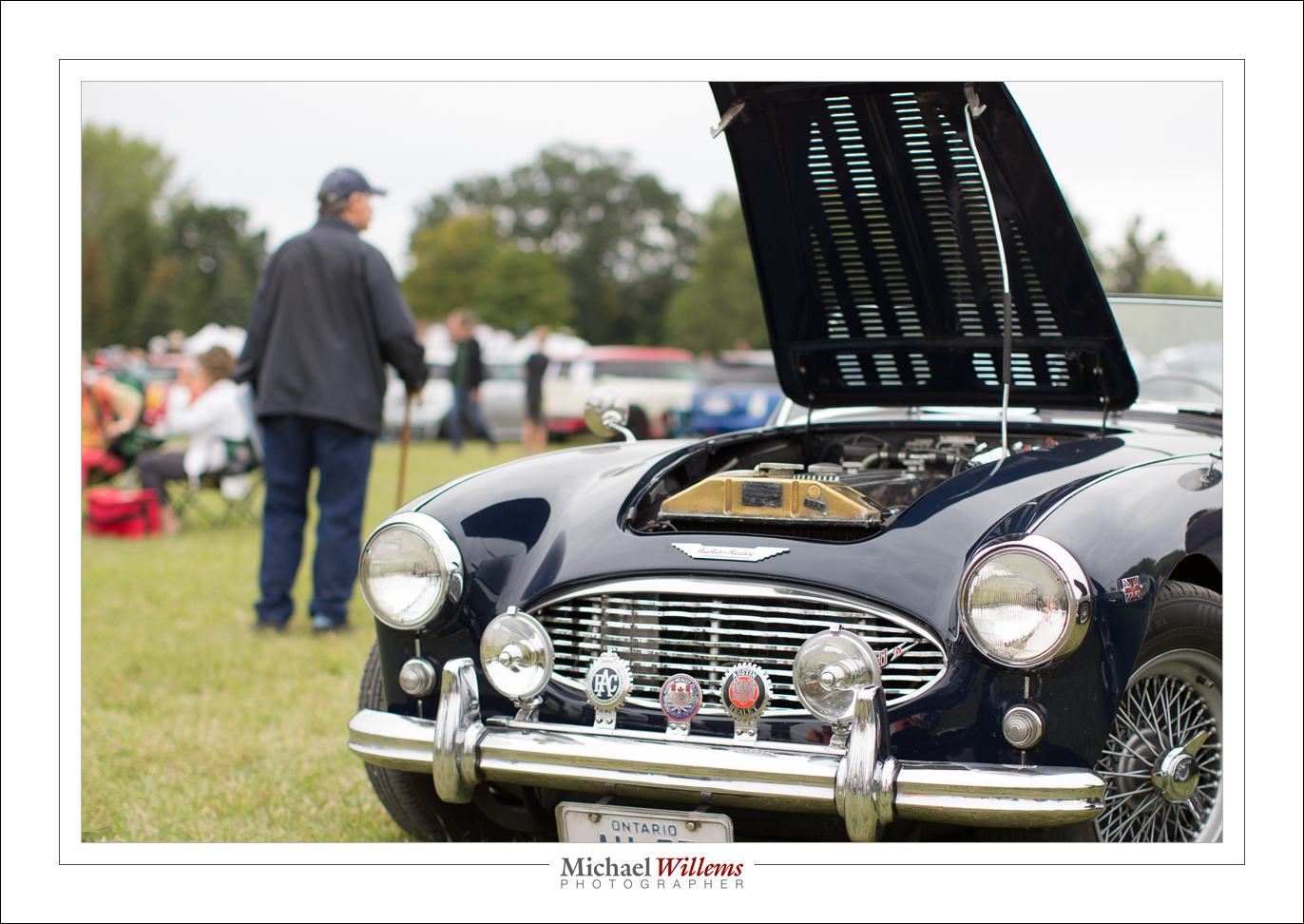
And I can get in close enough to show detail without showing other all the people crowding around:
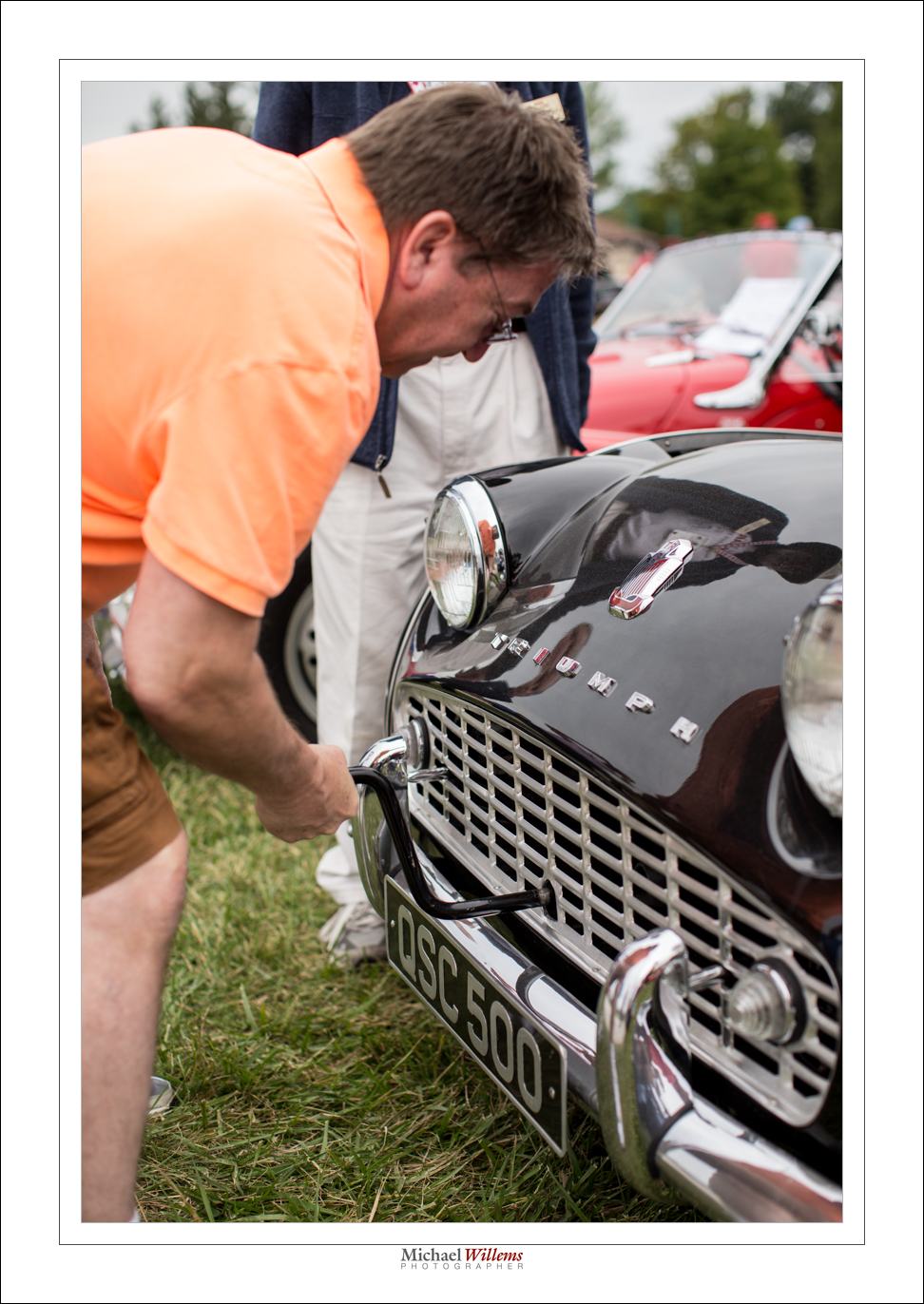
Um, and did I mention I like hood ornaments?
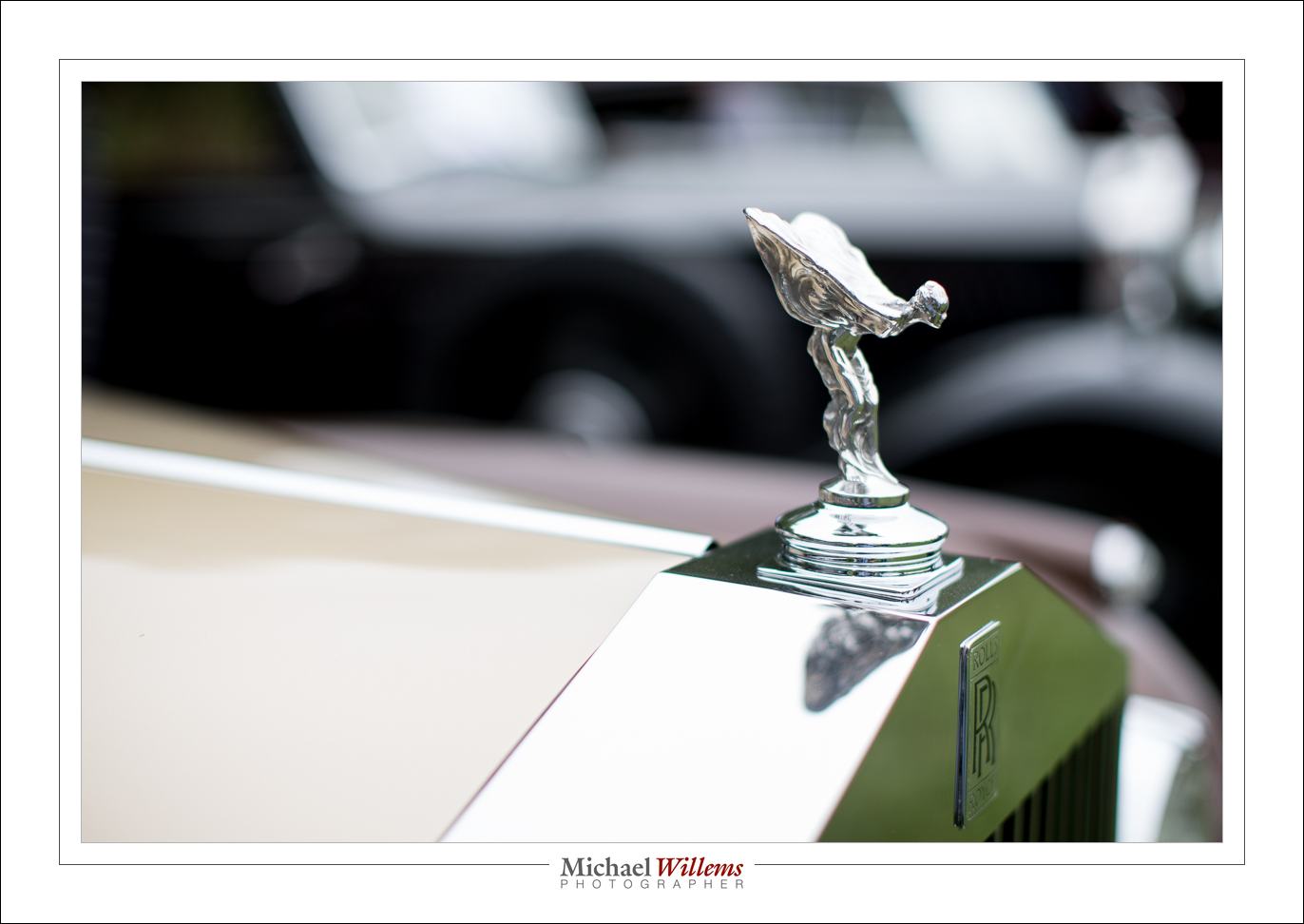
I also save time by not having to decide zoom factor. So, primes rock, for me. But that does not mean I can do everything. A very wide “close-far” shot would be impossible. So I decide on a lens-  in this case the 50 – and take photos appropriate to that p[articular lens choice.

And that is how that works, folks.


Another Selfies

Nope – that is not a grammatical error. It is simply taking liberties with grammar. It’s a selfies in the sense that, if you look carefully, it combines two into one:

Me looking at me!

And I thought that today I would explain the thinking behind this portrait and its execution.

First, my choice of model. I used “me”, because I am extremely patient with me; I do not get drunk; I do not stand me up; I do not fall asleep; I do not say “are you done yet”; I do not mind retrying a shot many times if need be. Not that all models are difficult: a true pro model would never make any of these mistakes – but not everyone is a true pro.

So, seeing as it’s me, I wanted an environmental (a.k.a. “situational”) portrait. And what better than my work environment? So that is settled.

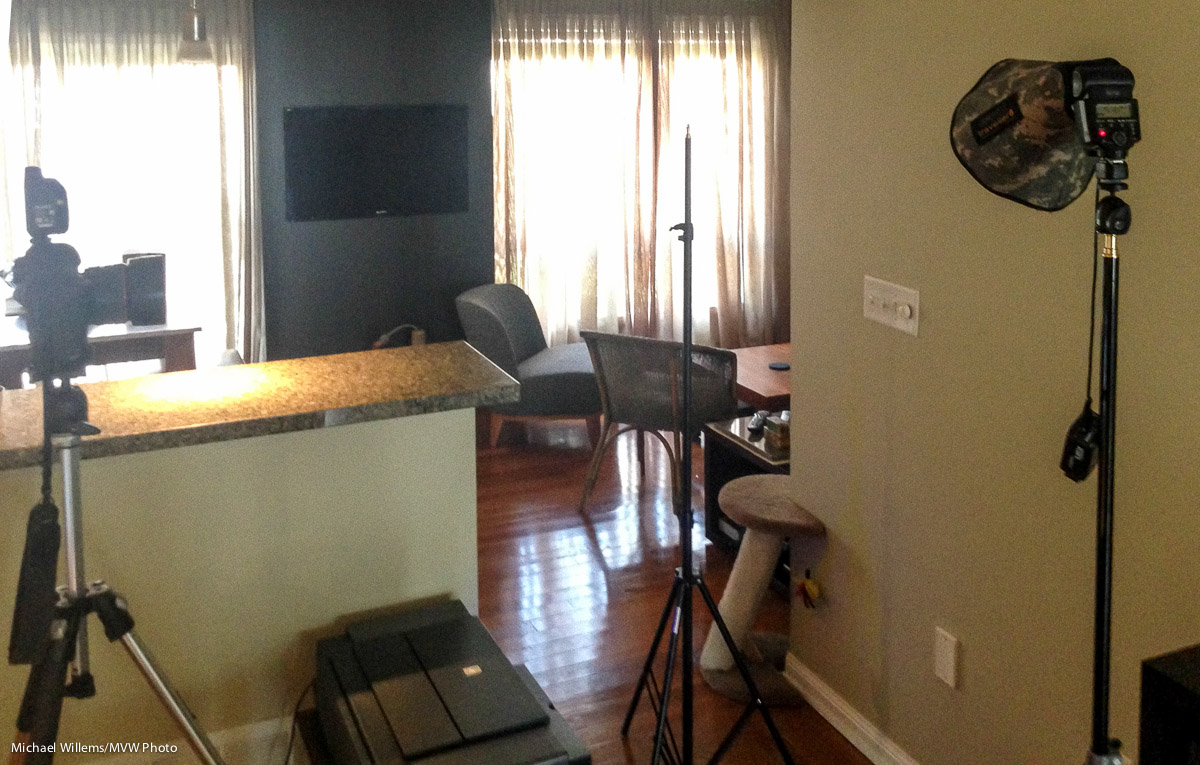
Next, then, the choice of lens. I chose a 50mm lens (full-frame: if you had a crop camera you would use a 35mm lens). A little longer than usual: for an environmental portrait I would normally use a 35mm lens, but I wanted to go a little tight to get rid of other “stuff”, like the flash on our left and the printer on our right: both now out of the picture.

Then the light. I wanted to light me with a flash, with a small softbox; but in this case, the ambient light is very important. I wanted the screen to be visible, and I wanted the tungsten and LED lightbulbs to be visible.

But I needed a small aperture. Why? Focus had to be set manually, and I would probably not be entirely accurate in positioning myself. That meant I needed f/11 for depth of field. So given that f/11 and the need to see ambient light, this meant I needed 400 ISO and 1/20th second.

And at the distance I needed, with the Honl Traveller 8 softbox, that “f/11 at 400 ISO” setting needed full power from a 430EX flash, in order for that flash to be the right power. The flash is just upside the picture on our left, on a light stand.

So the first shot:

And finally, the final flash direction. I tried it fairly straight on for the test shot, but for the final shot, wanted more short lighting (making my face thinner). See top.

Then all I needed to do is load that into Lightroom, and take the second shot; and apply the same lens corrections/cropping to both shots. Done!

____

Want to learn? I have just scheduled a special all-evening Flash course on 3 Oct; as well as a five-evening basic photography course, starting Oct 2, aimed at novice to intermediate users who want to learn to use their DSLR properly once and for all.

These courses are very special in that they are like private coaching: I will only take up to 5 students for each course. The Flash course includes the Pro Flash Manual, and the five-evening course includes course materials and homework. Both are now available for signing up on www.cameratraining.ca/ – see the flash course details on this page.

Do you have the flash manual e-book yet? Click on “Pro Flash Manual” above and learn how to do this!


Selfie…

Self portraits are tough. Because you do not know what you are doing. And you cannot focus. And the camera doesn’t hold itself. Above all, it’s a drag, because you want to see to compose, but you cannot. Not until afterward, anyway, and that tends to be a pain too.

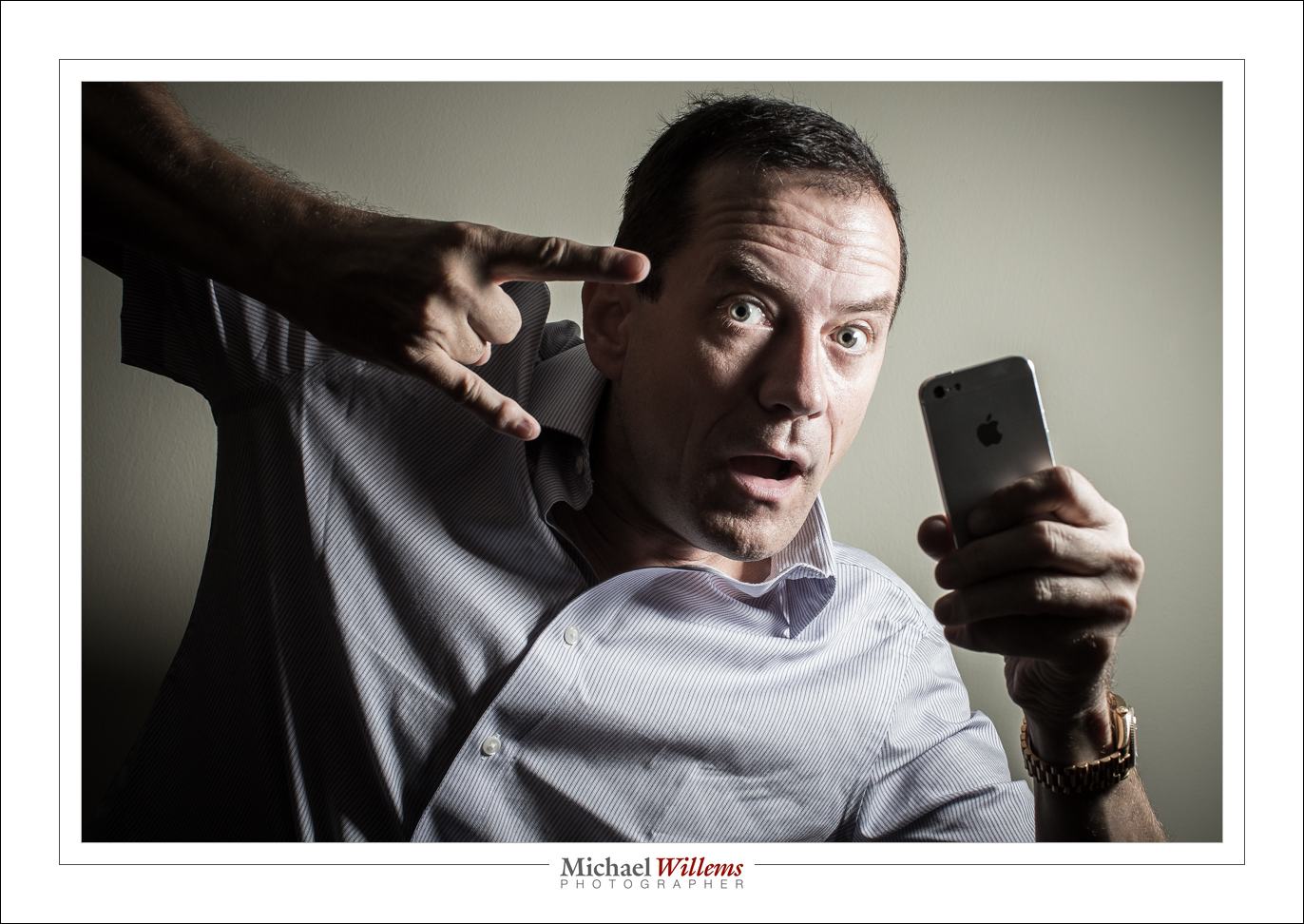
And yet, I do them all the time. Including this, the never do this at home, folks shot:

Yeah. The duck face. With gang symbols, and an iPhone. Ouch. These are usually shot in a washroom, and then you post it on Facebook, if you are a teenage/20s girl, and immediately all your fine feathered friends say “AWESOME PHOTO!!!”, while in fact it’s usually an awful photo.

But as you see, my selfie is technically good. So here’s how I do it:

So here’s the TEN WAYS TO A SELFIE:

  1. The camera is mounted on a tripod.
  2. It is set to manual mode, 200 ISO, f/8, 1/125th second (with these settings, only the flash will do any work, and ambient light will not interfere).
  3. It is set to the 10-second self timer mode.
  4. It is equipped with a Pocketwizard (set to send, or “remote” mode).
  5. The flash is mounted via a ball head onto a light stand. The ball head allows me to point the flash conveniently. I have it positioned 45 degrees up, as seen from where my face will be.
  6. The flash, too, has a Pocketwizard (in receive, or “local” mode), and it fires the flash via a flashzebra.com hotshoe-cable.
  7. It is equipped with a Honl Photo Traveller 8 portable softbox.
  8. The flash is set to manual, quarter power. That gave me f/8, at that distance and at 200 ISO.
  9. See that additional light stand? A-ha! I put it where the subject (i.e. I) was going to be. Then I focused accurately on it. Then, with that focus distance set, I set the camera to manual focus. Then, when taking the shot, I moved the light stand away, and positioned myself exactly where it had just been.
  10. I aimed my face toward the softbox, in order to get the lighting pattern you see here.

That’s how I did this shot.

Oh yeah.. you see the iPhone pretending to be flashing? That’s an app, FlashLight, that allows me to turn the light on permanently.

And finally, you see that I also went close, and that I composed using the rule of thirds. Mission accomplished. Including Dreaded Duck face!

Here. One more. In case the duck face was too much to take:

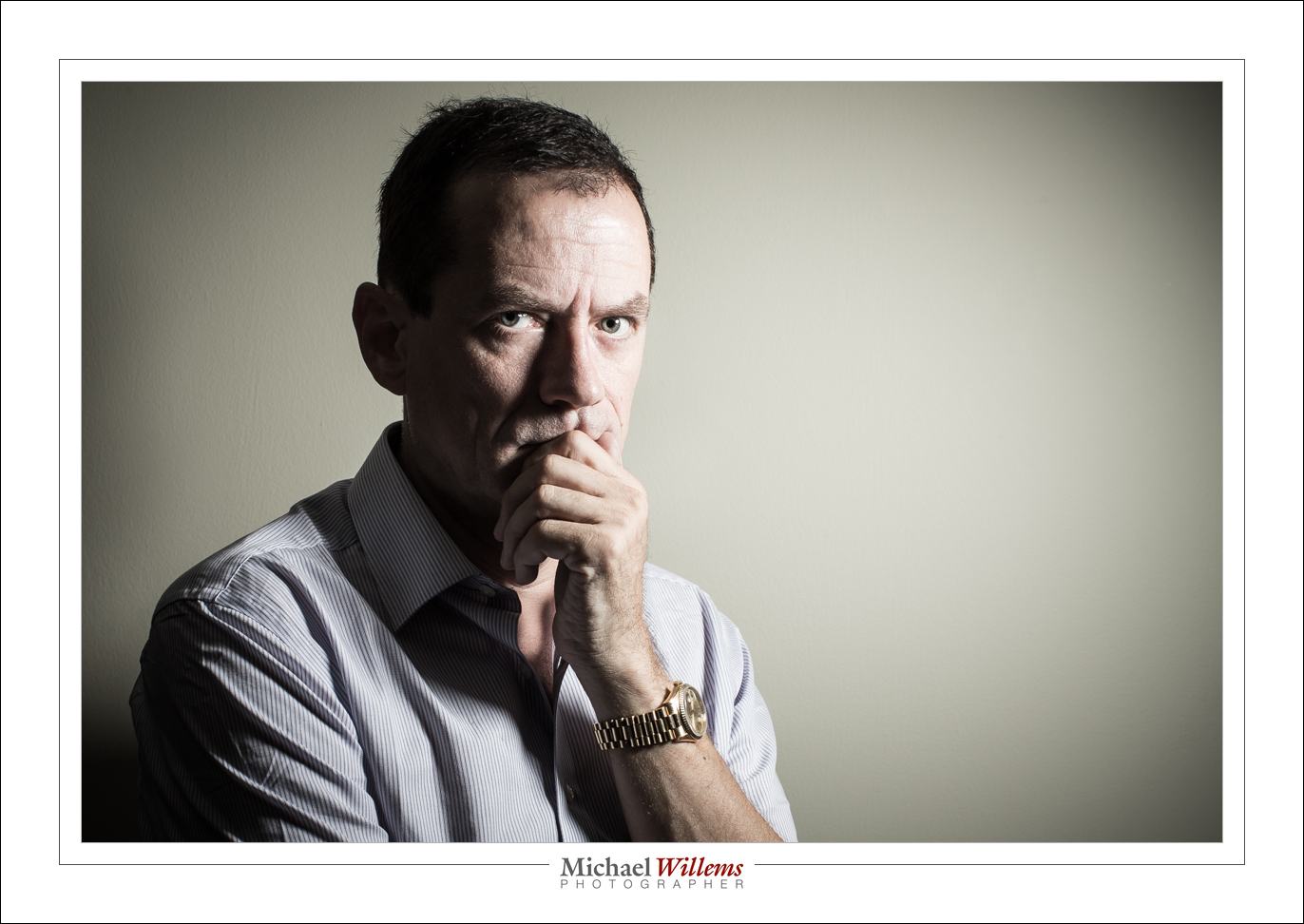
Oh, OK, OK, here’s a more serious one, where I went closer:

And one last one from the same setup:

Now you go try!

____

Want to learn? I have just scheduled a special all-evening Flash course on 3 Oct; as well as a five-evening basic photography course, starting Oct 2, aimed at novice to intermediate users who want to learn to use their DSLR properly once and for all.

These courses are very special in that they are like private coaching: I will only take up to 5 students for each course. The Flash course includes the Pro Flash Manual, and the five-evening course includes course materials and homework. Both are now available for signing up on www.cameratraining.ca/ – see the flash course details on this page.


Post hoc

..ergo proper hoc? No – forget that: I am not talking about logical fallacies.

I am talking about what happens to photos after you take them.

Here’s what happens after a shoot, quite often:

  1. You shoot.
  2. You get home and look.
  3. You think “Oh, I am not very good”
  4. You think “Oh – I am amazing, actually”
  5. Repeat 3 and 4 a few times
  6. After oscillating a while, you settle down and pick some images to use
  7. You share those, and you are done.

But what you should do is also: look again later. You increasingly see your images as what they are, not as “what you were doing when you shot them”. This is why you use Lightroom, and this is why it is useful to go back and review your work – even years later.

For example, three years ago, I shot an event with showman/radio person JT Foxx (brother of a then friend of mine) on a visit to Toronto. At the time, the event pics were good, but he did not like the portraits – and indeed, he had not had the best night before, and the light wasn’t great, and I had no off-camera flashes, and so on. So – I got some snaps, but I was not terribly happy with them either.

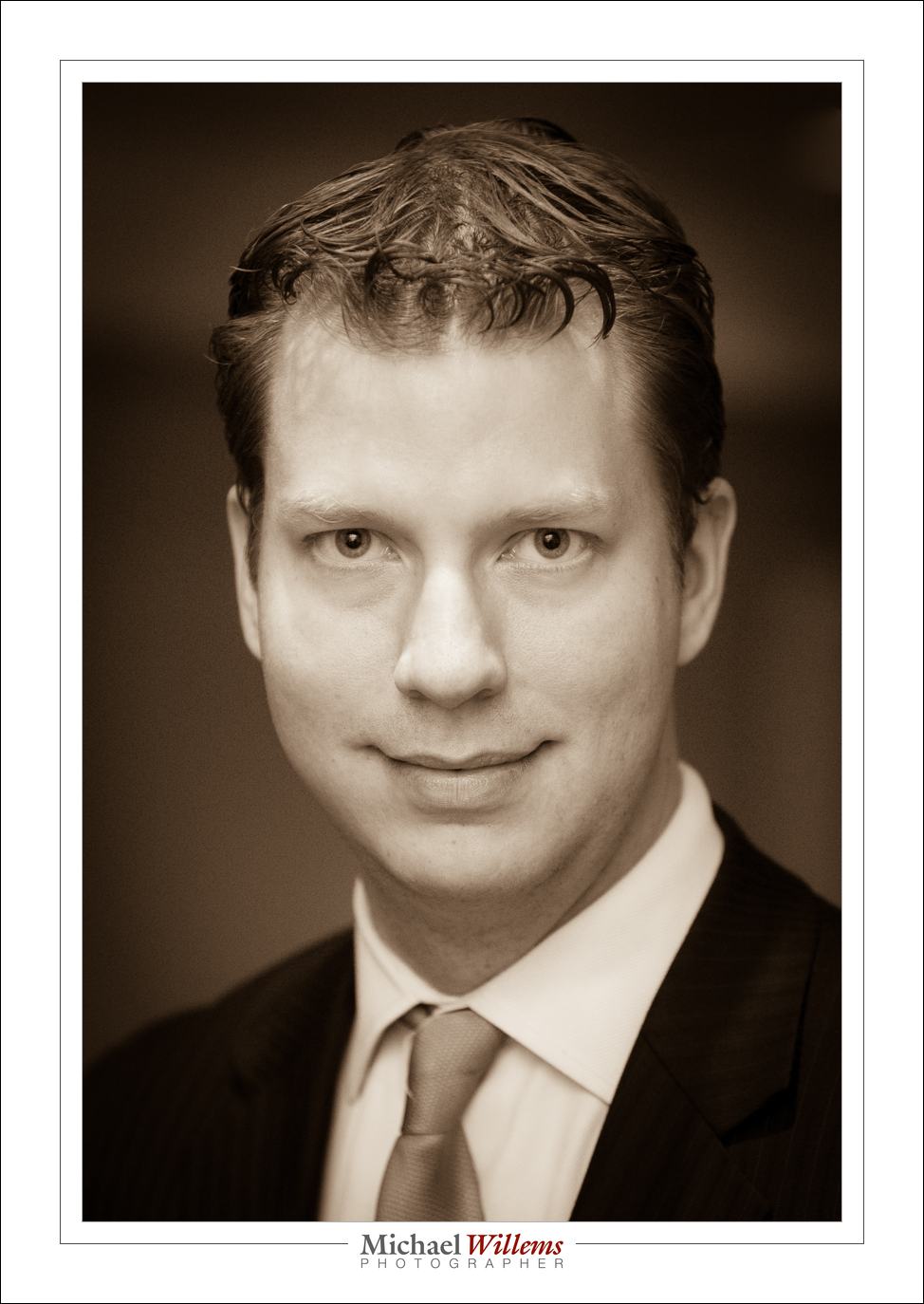
Until I just changed upon them again – three years later. I think, now, that this is actually a very good portrait, showing his personality:

(95mm, 1/125th sec at f/2.8, 800 ISO, bounced flash).

So I got a portrait out of this shoot, three and a half years after the shoot. And that is my point – look again at your images. Try a different crop (or, as in this case. sepia instead of colour). Have a new eye – and even years after a shoot you will discover gems that you did not know where there. Your image library is a mine – and sometimes a gold mine.


Selfie…

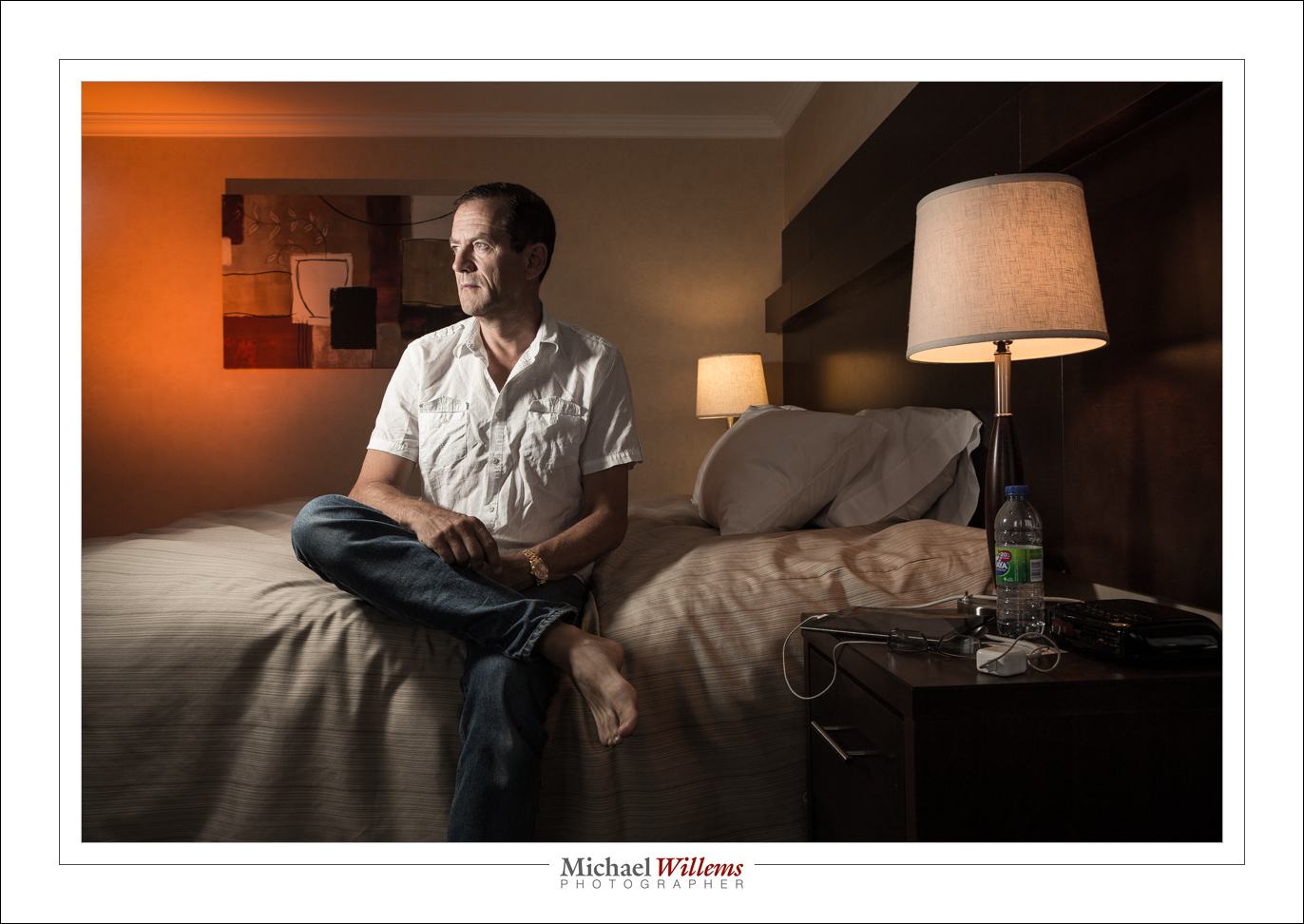
From Hopper to Leibovitz, hotel rooms have always been a fascinating setting for art portraits.

I portrayed myself in a hotel in Timmins, Ontario, Wednesday morning, evoking feelings of these prior artists, but especially, creating with light. Straight out of the camera.

If I say so: my best self portrait. Ever.

Click to see larger:

I did this in my suite in the Timmins Day’s Inn. I was alone and I used:

  • Camera perched on an upturned Ottoman
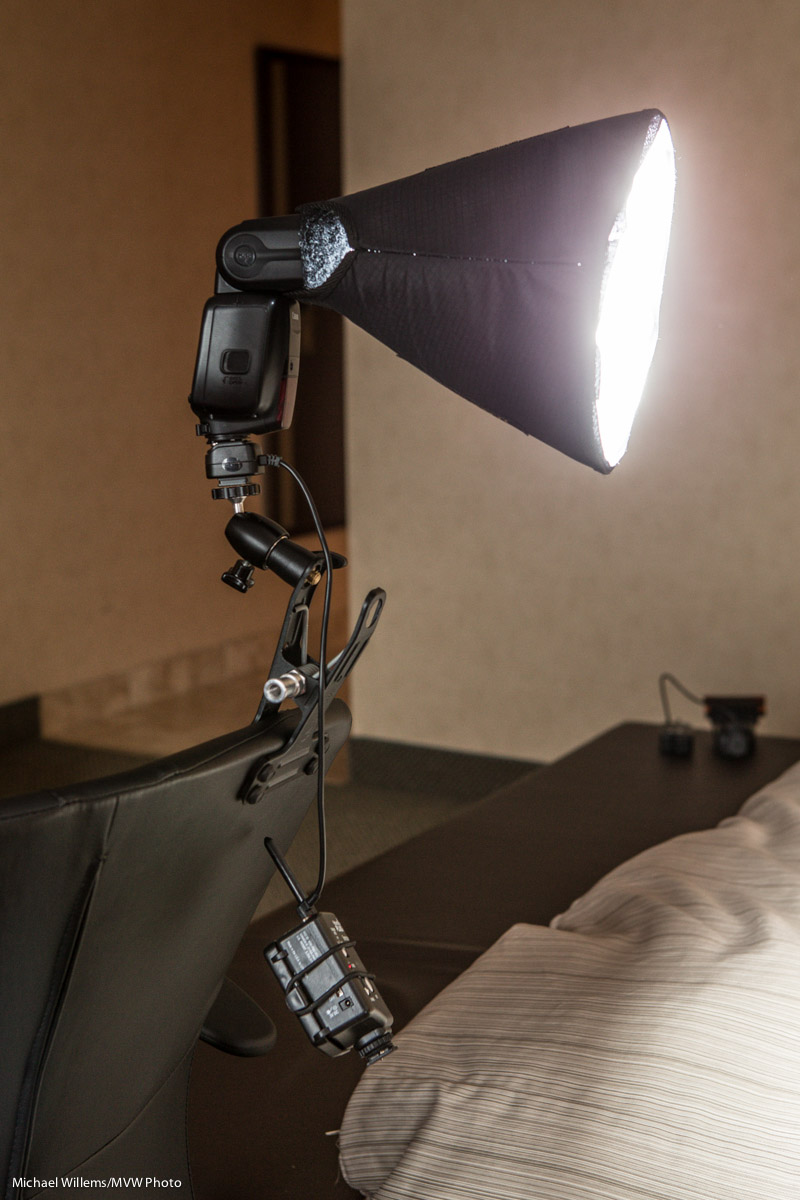
  • Main light is a 580EX flash with a Honlphoto Traveller 8 softbox, clamped to a desk chair.
  • Additional flash is a 430EX speedlight with a Honlphoto Rust coloured gel, for some nice warm light.
  • Camera at 100 ISO, f/5.6, 1/60th second.
  • Flashes fired with Pocketwizards.

Camera prefocused and using its self timer. This took me only a couple of attempts to get right.

The main light: a flash connected with a Flashzebra cable and mounted with a ball head onto a clamp, clamped to a chair. Note the second flash sitting in the background.

And no, the name “selfie” doesn’t do it justice, does it?


That long look

As you all know, there are three ways to get “blurry backgrounds”:

  1. Large aperture (“low f-number”).
  2. Get close.
  3. Use a long lens focal length (“zoom in”).

The first one is the one everyone thinks about – but the last one has a very recognizable look. Like this, yesterday, at 190mm at f/8:

Compare that look and that background blur with this, taken at 70mm:

Both nice, but the first one (viewed full size) has that distinct “long look”, and the background is blurrier. Reason I like the 70-200mm lens for fashion shoots if I have enough space!

___

Want to learn this? There are a couple of spots still open on my Oakville Photo walk, this coming Sunday from 1-5pm. Go to www.cameratraining.ca/Schedule.html and follow the BOOK link.

Hippie Chick and Death Star

From today’s NSI course:

The pretty woman in front of the dystopian death star. The background underexposed by two stops, as usual.

This was done with a softbox on our right, and two more speedlights, on on the right and one on the left.

This was shot in a similar way:

The secret: underexpose the background by about two stops. 1/250th sec at 100 ISO at f/10; and then set the lights to give you those values.


Test Shot

I spent yesterday shooting portraits. And here is my test shot:

Why “a test shot”?

For outdoor portraits, I set up a single softbox. I check my ambient light and underexpose that slightly: I start with 100 ISO, 1/250th second, then see what aperture that needs. Then I set my flash to the desired brightness to give me that aperture.

But then I do one single test shot – that is all I need. I check:

  1. Is the background dark enough? (*)
  2. Is the foreground bright enough? (*)
  3. Do I see a catch light?
  4. Are glasses free of reflections?
  5. Are the shadows in the right places?

(*) I judge this by means of using a Hood Loupe, and/or using the histogram, and the “blinkies”. Not just visual inspection of the rear LCD in bright sunlight!

Of course here since I am holding the camera and a pocketwizard, my expression and the composition are not quite right, but that is not the point. The light is right.

And provided I do the setup right, one test shot is all I need.

Come to NSI to learn more – Sunday-Thursday next week!


A small adjustment

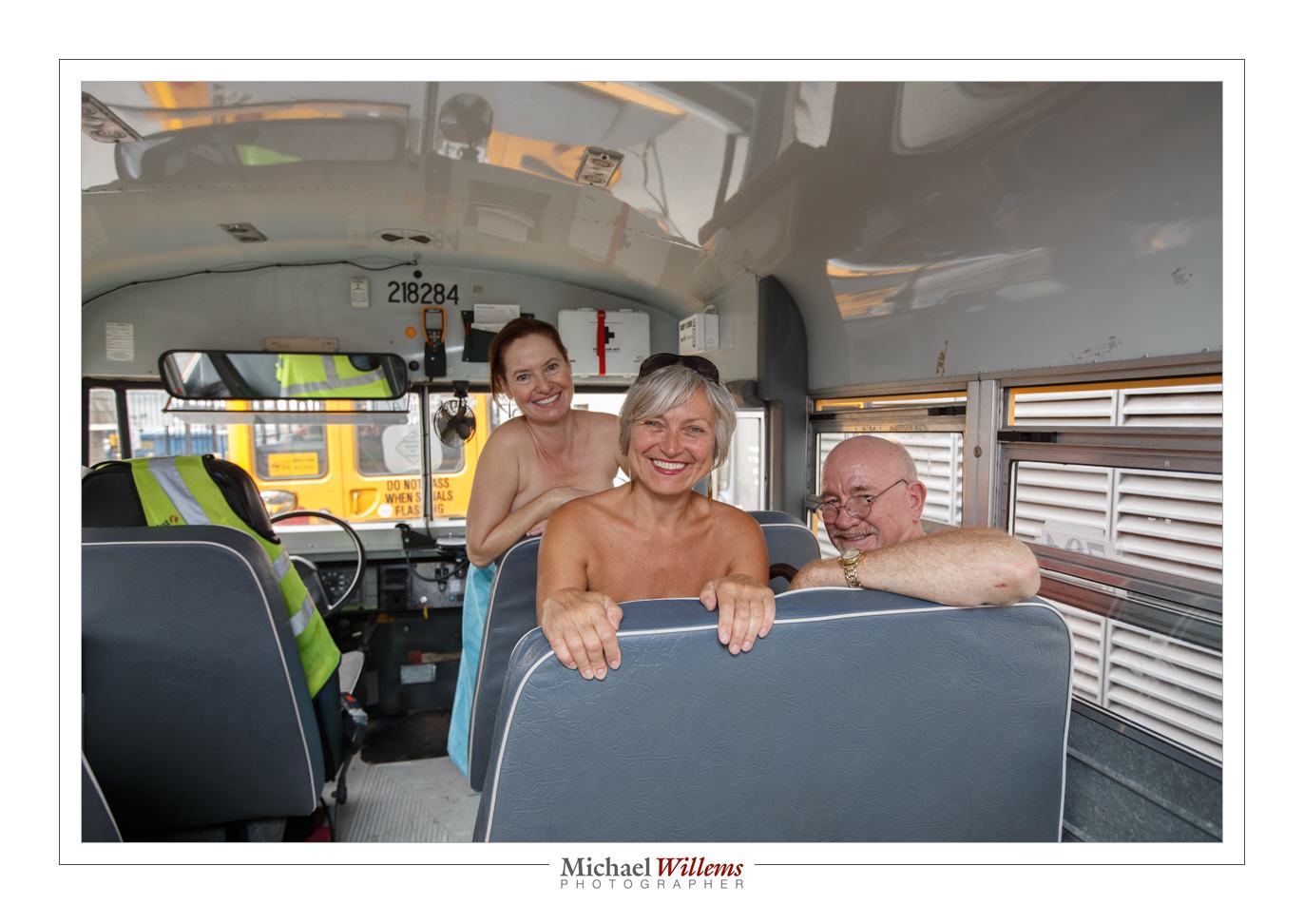
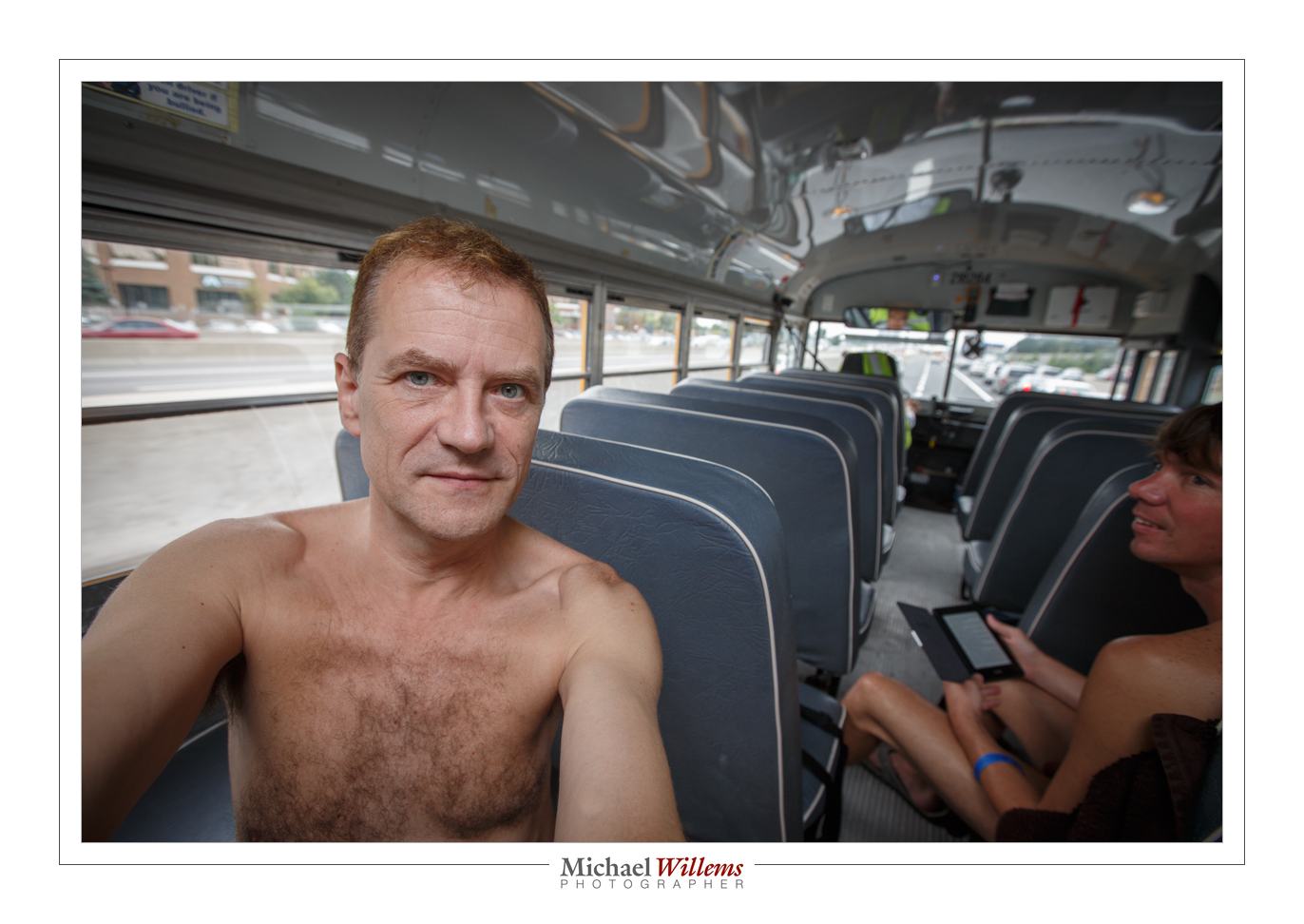
If you photograph people against windows, as in this “Bare Bus” picture of two days ago, between Bare Oaks resort and Toronto’s Hanlan’s beach, what happens?

Usually, you will either get silhouetted subjects or blown out windows, i.e. you do not get a well-balanced picture like this:

In that picture, the background is not overexposed. Same as in this one:

So – how do I do this?

Either of:

  1. Expose for the background (using, if you like, a spot meter) and light up the foreground with (bounced) flash.
  2. Overexpose the background a little, yes, but use RAW, so you can drag the “Highlights” back in Lightroom (and the “shadows” up). This minimizes the difference between dark and light. I.e. keep it within limits, so you can fix the issues in Lightroom.
  3. A combination of (1) and (2) above.

And that is what I do when I shoot: I keep it under control so I can fix any issues later. I.e. make sure that if you overexpose, you only overexpose a little, and the same for underexposing.

Here, one more sample – this one even more difficult because it was a self portrait:

Note that for a self portrait I will let the camera choose where to autofocus – and that is very rare. Normally, I choose, But when I am not looking, I cannot choose. So the camera chooses – and it chooses the closest subject.

This, by the way, was a special bus tour, leading to a beach visit with photos, and a photography course the next day; and portraits Saturday. Stay tuned for more.


Outside Fill Flash

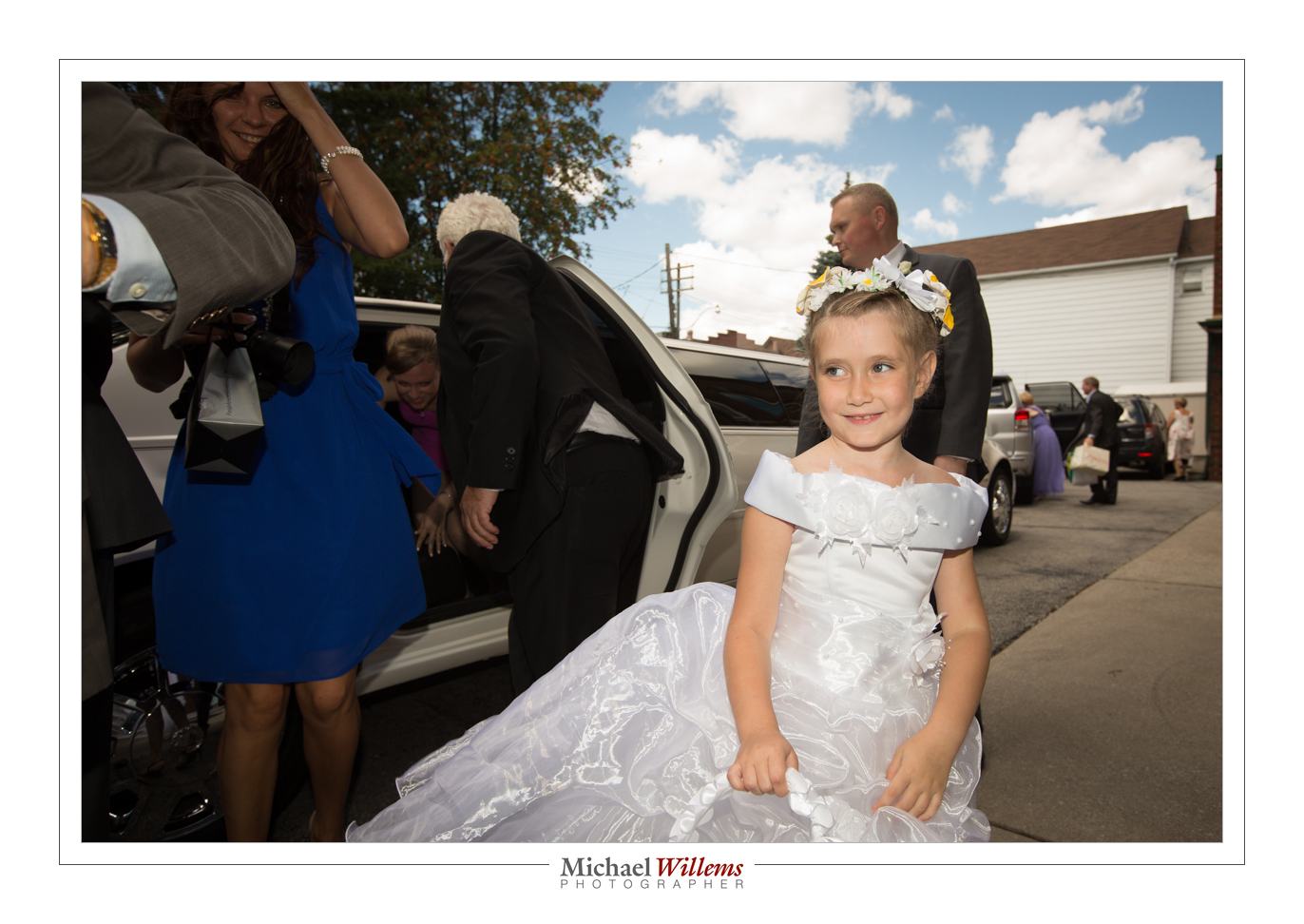
Look at me, yesterday, taking a picture of the flower-girl at Halyna and Vitali’s wedding in Toronto:

You see that in spite of it being bright daylight (1pm on a sunny summer day), I have my flash aimed at the girl. And you see I am getting down to child level. And here is that picture, taken the very same second:

The look is defined by me:

  • Underexposing the picture a little; the ambient part, that is, to bring out the colour in the sky. Look at the pavement to see how much darker I made my ambient (about two stops).
  • Using a wide angle lens (16-35 on a full frame camera).
  • Getting down to the ground.
  • Using the rule of thirds.

Flash outdoors, then. But because I used the flash to enable me to darken the ambient by a couple of stops, it is more than fill flash.

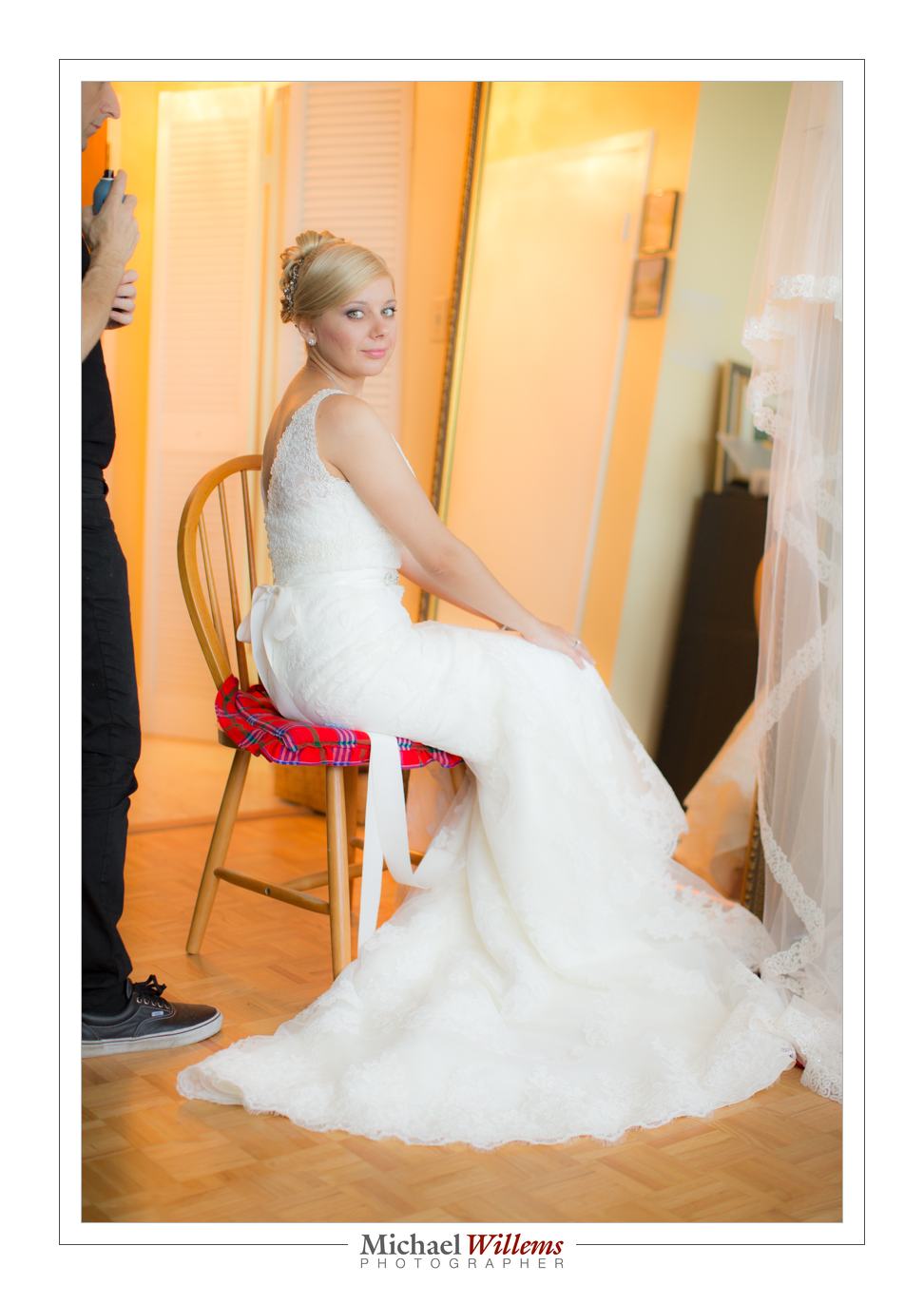
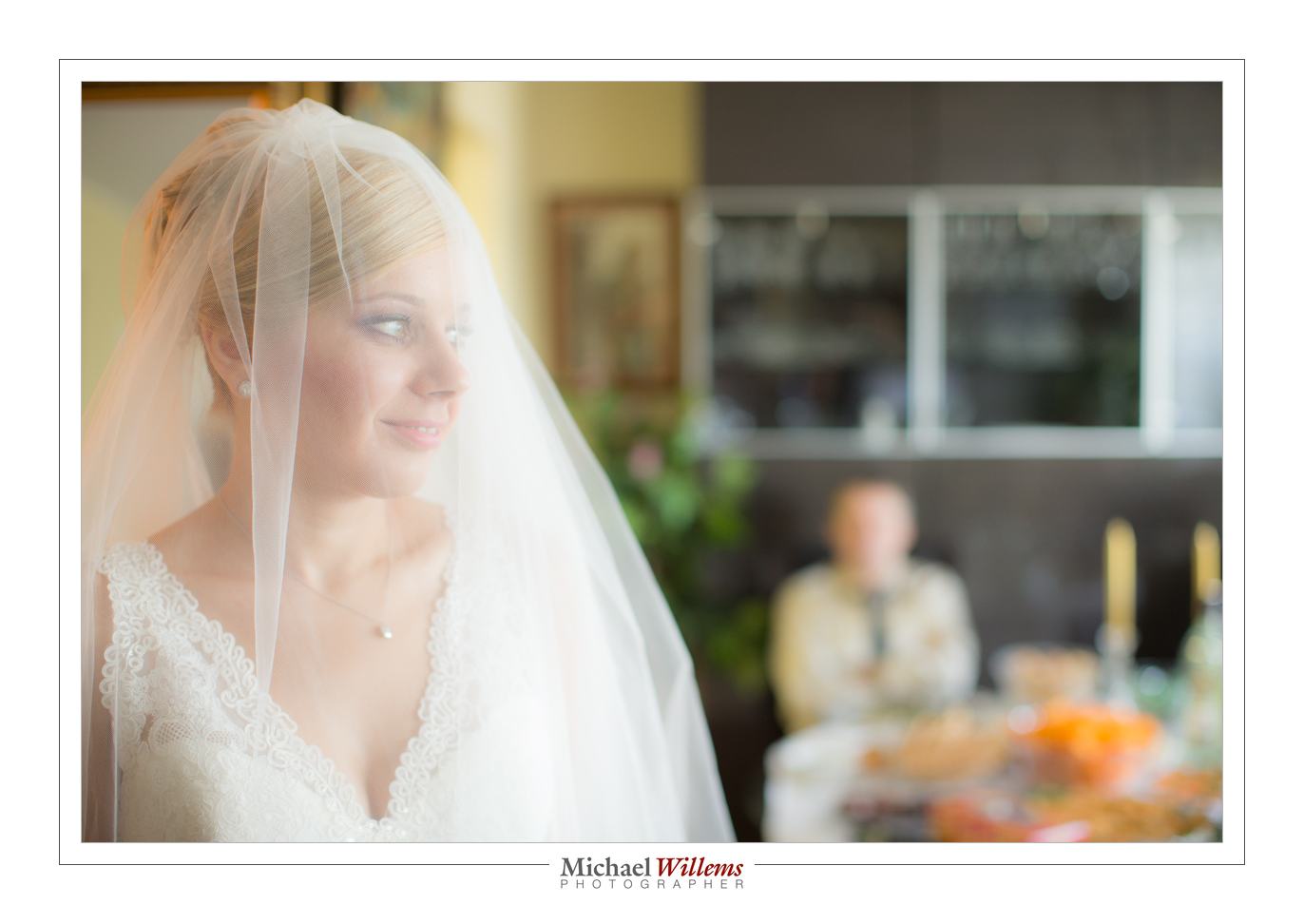
Indoors, on the other hand, I used no flash yesterday, not at all, in the house or church. Unlike me, but the results were good:

Instead, I used a higher ISO and a prime lens, almost wide open (like at f/2 – f/2.8). It’s all what’s needed: no dogma!