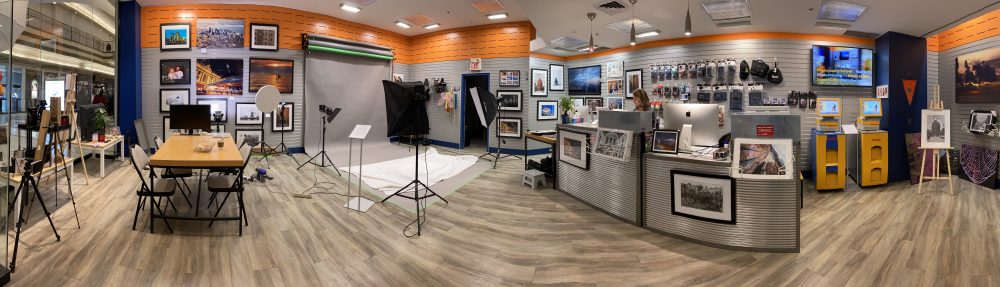
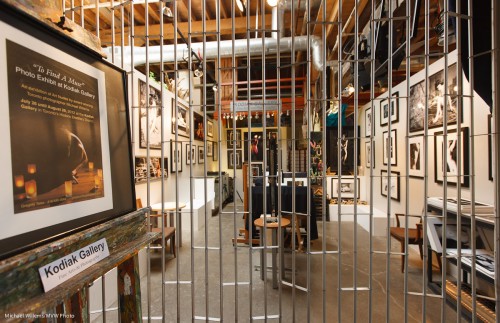
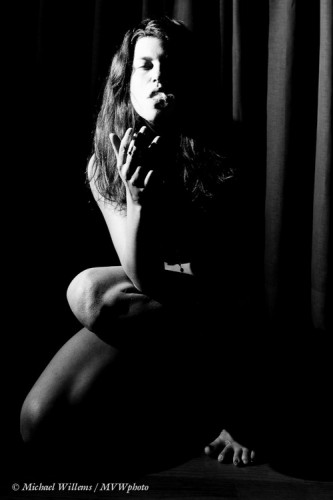
Here is (Part of) the “To Find A Muse” exhibition, yesterday prior to its daily opening.

The exhibit is open until the end of August; Daily, Noon-5pm, at the Kodiak Gallery in Toronto’s Historic Distillery District.

All prints are for sale, framed or unframed: here’s your chance to make one of them – a unique original! – your own. See you there?


Simple secret…

Namely: keep it simple. One of the easiest ways to improve your photos is to take stuff out.

You can do that in many ways. Zoom in. Get closer. Rotate. Blur the background. Move things. Change your position. Use obstacles in between. Use light, or rather darkness. Even for simple shots, always think “what can I take away?”.

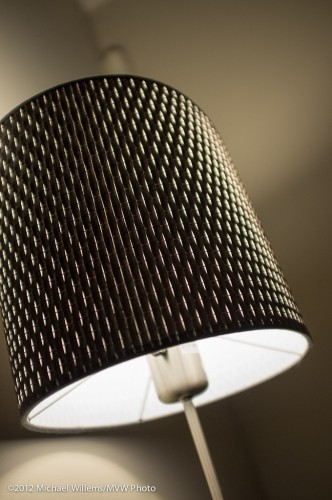
Like in this snap of one of my bedside lamps, just now:

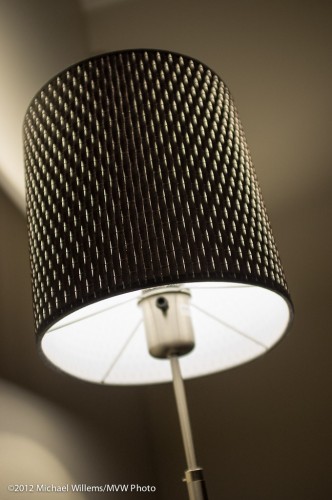
Just a Fuji X100 snap while testing a setting. But even for a simple snap: what is the alarm sensor at the top doing in the picture? A simple change of viewpoint and rotation gives me this:

Now what would you do in addition?

Personally, I would crop off the bottom. That joint between the two rods has no place in a picture. Since the x100 is a fixed lens camera, it is best done in post-production here.

Simplifying your pictures is easy, as long as you remember to do it. My rule: everything in a picture has to be in it for a reason – or it shouldn’t be in it. If you start doing this even for snaps, it will become second nature, and your photos will look more “professional”.


Exhibit on today

Word. In case you missed it: today is the start of the solo exhibit “To Find a Muse”. It is at the Kodiak Gallery at Toronto’s Historic Distillery District, and the official opening is today, 26 July, 5-8pm. See www.michaelsmuse.com for more details.

I shall be there at the opening, of course. See you there? (If so, please RSVP on the Facebook page, linked from the web site).

Michael

Weather

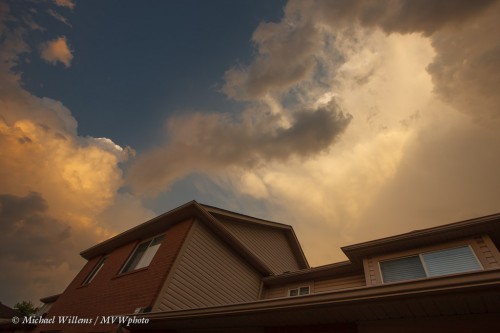
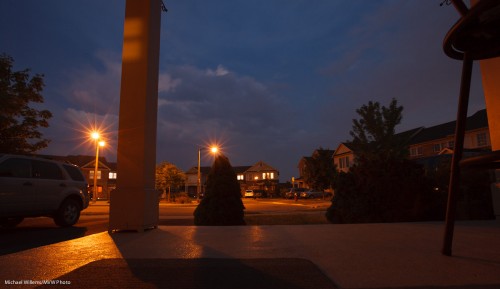
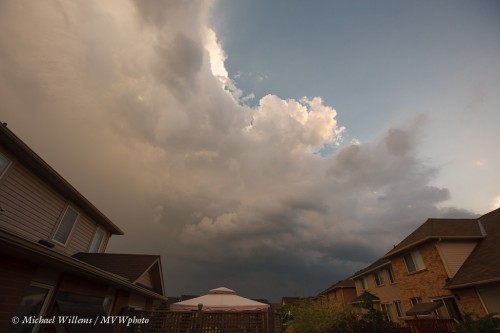
It can be quite interesting to make pictures of weather. Like the weather I had here outside my home a couple of days ago.

These were made with a wide angle lens, with the camera held steady on tables, on the floor, etc., using long exposures and low ISO. 200 ISO, 1/200th second, f/5.6 -and of course in manual mode.

So when you see nice clouds, get out the camera!


Déja Vu All Over Again

One thing I must emphasize to my students over and over: your pics are a resource to be mined. Again and again. Your emotional involvement with the images decreases, and that gives you a new, fresh look.

After a shoot, I do the post work, meaning largely that I select what I like. But I go back to the shoot later. And later. And later again. Today I found many winners in shots I did six months ago. Years ago, even. That is why it is unwise to delete  pictures. Buy a bigger hard drive instead.

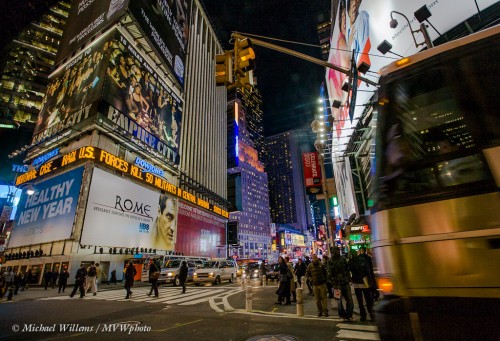
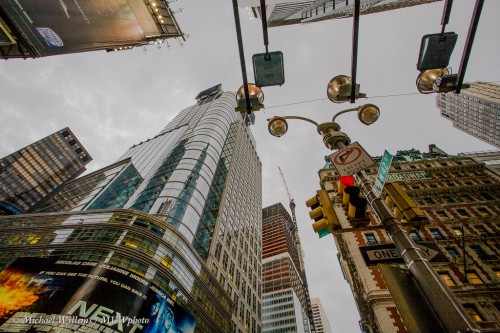
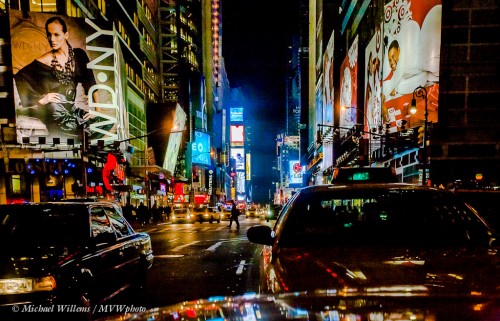
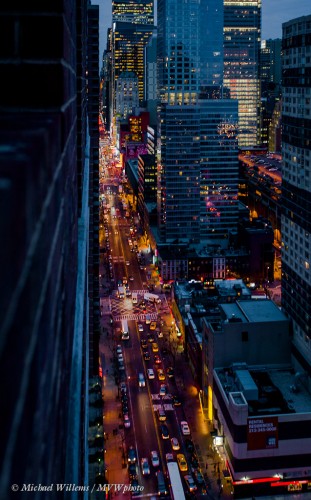
Just now, I went back to 2007 and looked at a few new York pics. And I had a little “post hoc HDR”-fun with them digitally – which I normally do not do, but this time, hey, why not. Here’s four samples:

Just a few fun images that I did not even notice the first six times I looked at this 2007 shoot. Goes to show, doesn’t it? So if you want to have some fun, open Lightroom right now, go the the first ten shoots in your catalog, and see iof youcan find images taht never struck you before. I bet you can.

___Note: Tomorrow’s two courses at Vistek in Mississauga still have open spaces. Sign up now, or just turn up tomorrow morning (Digital SLR Basics) or afternoon (Advanced Digital SLR use). You will not regret it! Space is limited: see the list, and sign up, here.


Warming!

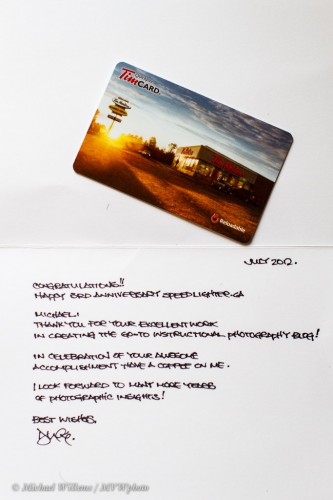
I recently announced that this daily blog celebrated its third anniversary – and a number of you have very kindly taken me up on the “buy me a coffee?” that I mentioned. This is heartwarming, and here is the latest one – in today’s mail. Thank you Duke!

And I look forward to continuing this free resource, hopefully for many more years!

Michael

PS and here’s a tip: to take a photo of a piece of writing like this, use a longish lens (50mm on a crop camera, for instance), and use an ISO that ensures you get a fast enough shutter speed (at least “1 divided by the  lens length”, preferably twice as high). If using an automatic mode, use exposure compensation +1 to +2 stops (it’s white paper, after all).


Wide Lens Caution

I am a big fan of wide lenses – 16-35mm on my full-frame camera, or 10-20mm on your crop camera.

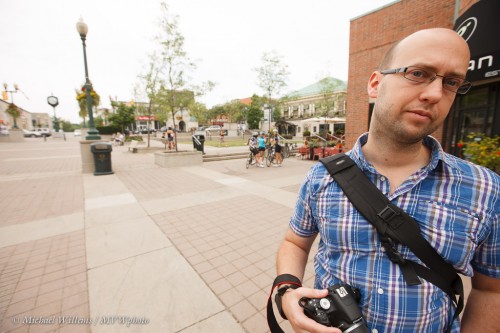
But there is one thing to watch out for: do not get too close to people. Especially, do not put them into the corner: here is volunteer student James on Sunday:

Avoid the corners!

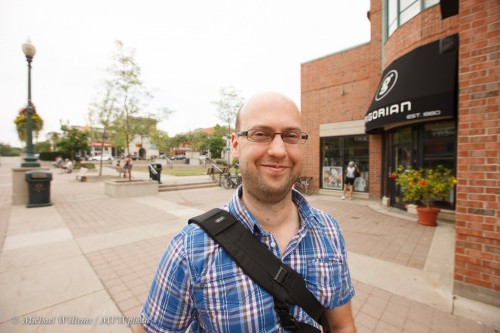
And avoid getting too close in general. As in this one, which is much is better, but the extreme proximity to my subject still distorts his face:

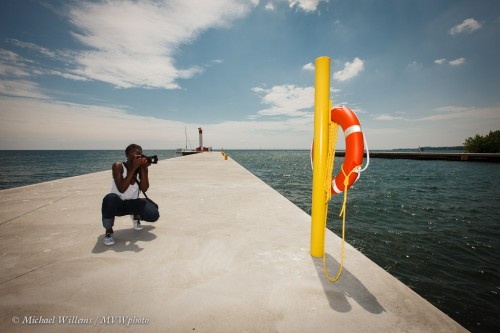
Wide lenses rock, as long as you avoid this gotcha. What they do do is give you diagonals. depth, perspective, and a few technical advantages also: the ability to shoot at slow shutter speeds, and almost infinite depth of field. so if you do not yet have a 10-20, go buy one, and shoot this kind of image:

QED.


A snap dissected

I thought perhaps I would show you a photo taken last weekend.. a snap, at first sight, but in fact a lot of thought goes into a photo.

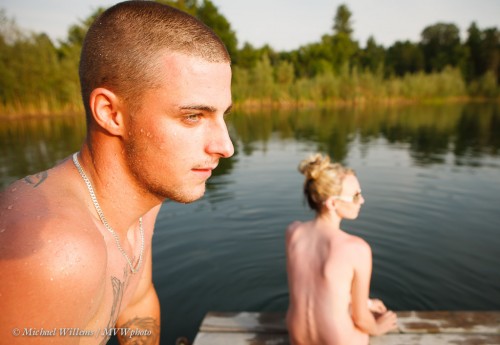
Here are Justin and Pam, who have been together for two years:

So what kind of thought goes into a shot like this?

  • The lens is a wide lens (24mm on a full-frame 1Ds Mk3), so we get depth in the image.
  • I shot late afternoon, so the light is good (nice and warm) and if I shoot at 1/25oth second, I can use f/4.5, so get a blurred background.
  • Nevertheless, this is not all available light – I aided the light by using an umbrella on our right with two TTL 430EX’s (yes, two, to overpower the sun). Hence the 1/250th second maximum (the synch speed).
  • I composed using the Rule of Thirds – Justin top left, Pam bottom right
  • I cropped to make the image suitable for distribution to their parents etc.
  • Since this is an environmental portrait, I kept the environment in – enough to see it is a dock on a lake, and they are skinny dipping.
  • The wave emanating from her feet produces a nice pattern and adds liveliness.
  • I avoid them looking at the camera in this shot.
  • And hence, very importantly, I make the viewer think; guess; wonder what they are looking at.  Each viewer wil have their own questions. Why is he not looking at her? Why are they apparently nude? What is the expression on his face telling us? What is she thinking?

As you see, if you apply basic rules – rules of composition, storytelling, light – your snaps can be more than just snaps. That’s what portrait photographers do, and with some training, you can, too.

___

Stand by for exciting news: the Never Not Naked: Natural Nudes solo art exhibition is coming to Toronto’s historic Distilery District, July 26 – August 26 at The Kodiak Gallery.


July Celebrations

We had July 1st in Canada yesterday, and our US friends have July 4th in a few days.

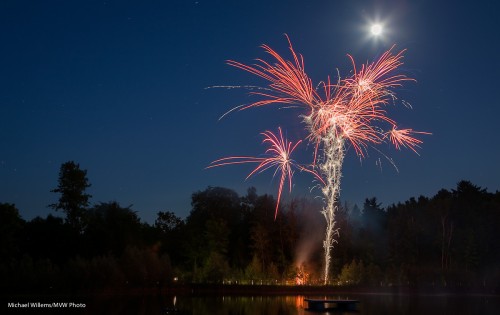
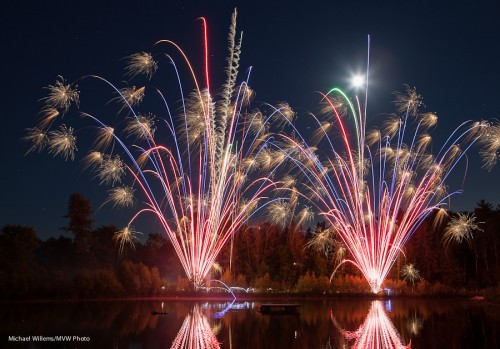
This is from our Canadian July 1st celebrations, in Newmarket, Ontario:

Technical tips:

  • Mode: Bulb, with remote release
  • ISO: 100
  • Aperture: f/8 – f/11
  • Shutter: 1 to 30 sec; usually 2-5 seconds if there is some background light at all.
  • Focus mode: Manual focus, prefocused “where it will happen”
  • Shutter mode: One shot
  • Camera mount: Tripod (this is mandatory!)

And the usage tips:

  • Set up your camera on a tripod, and aim at the fireworks source
  • Avoid being downwind (the smoke will ruin some of your pictures).
  • Manually pre-focus where the fireworks will go up (or on “infinity”).
  • Use wire/radio release, so you do not need to touch the camera.
  • Start before or as a particular firework goes up, and hold the shutter open until that one  is done (but avoid getting the next one in the picture, unless it is aimed differently). This will usually take 2-5 seconds but can take longer to get light into the background.

Because it was an extremely dark country setting, the venue yesterday needed 30-60 seconds per shot to get any light into the background at all, so you can imagine I was happy that there was a short break between firework volleys going off, so each time I was able to open the lens for 30 seconds prior to the fireworks. Otherwise the background here would be pitch dark.

Try it out – above all, have fun, and happy 4th of July!


Prom Season

To help out a proud mom, I shot some images the other night of a young couple about to go to their high school prom. I thought I might share that process here.

The day was wet and dark – warm, but raining. And then it stopped raining – but it was still very dark, totally overcast, and remained that way.

Perfect. We want dark, so that:

  1. The sun will not cast harsh shadows;
  2. Our speedlights can overpower the ambient light, to make our subjects the “bright pixels”;
  3. We can render colours saturated (darker is more saturated).

So let’s start. First of all, of course I shoot manual. I set my camera to “sunny sixteen”, i.e. 200 ISO, 1/200th second, f/16. Then I go to f/5.6 to match the light (look it up: Sunny Sixteen, and totally overcast, no visible shadows). Then I go back to f/11 to make everything two stops darker. Then I go to 1/300th and f/9.0 – that is the same exposure but f/9 makes my flash more powerful than it would be at f/11, while the shutter speed makes no difference – provided I stay at or below my sync speed (on the 1D4 this is 1/300th).

Then I added flash – off-camera flash firing into an umbrella. My on-camera 600EX was disabled except for commands; the 430EX in the umbrella did all the work. So all I carried was a camera, two flashes, and a light stand with umbrella, with bracket to mount on pof those flashes. Light and easy.

Then, the setting. As the Speedlighter, I opted for outside, of course. A great back yard with a pool gives us this shot:
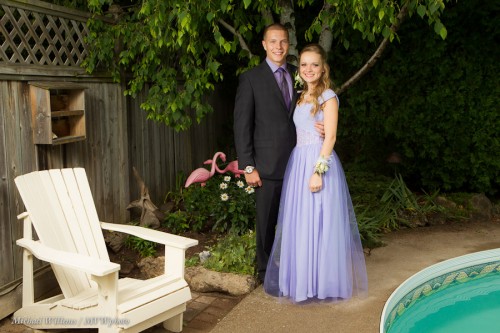
Note the Rule of Thirds, and note that I wanted a “home backyard prom” look, not a studio look, so while I photoshopped (Lightroomed, actually) away some items I did not want, I did want the chair, the pool, the lovely pink flamingoes, and the other items that show where we are.

Still, I did also take one more traditional vertical shot without all those trimmings:
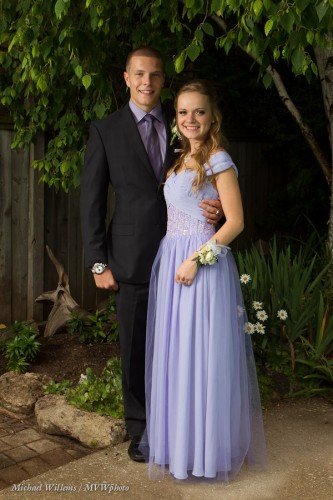
The important thing is to have models look toward the umbrella: always watch where the light is.

I used TTL flash for this, so needed to occasionally change Flash Exposure Compensation (FEC).  Note: In my courses I teach you all this stuff. I do private coaching – and stand by also for my seminars at Vistek in Mississauga, starting 21 July – dates here soon.

Finally, I made some that make the scene even more of a home scene. In the following shot I electronically removed a container of chemicals, a barbecue gas tank, and a decorative frog:
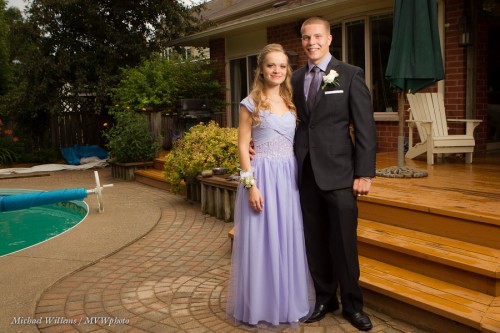
…but I also made sure to zoom in and do a close-up:
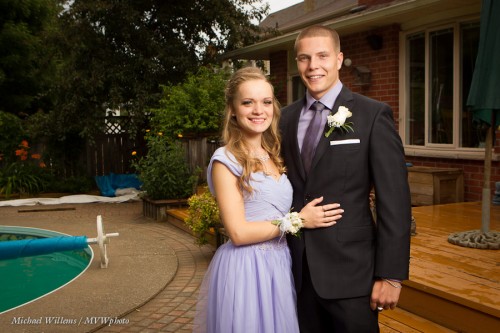
In the above shots I had the umbrella on my right so that Vanessa was looking into the light – flattering for women – while her date James gets Rembrandt Lighting – flattering for men.

Postscript: when I say “looking toward” – I should be clearer, I mean “their faces turned toward”. Photographer’s jargon!

Do you see how this all works? Fun, isn’t it?

___

If you are in the Toronto area or elsewhere where I find myself and want lovely family portraits or “senior shots”, please contact me – you owe your family some great heirlooms…!