Picture of the day

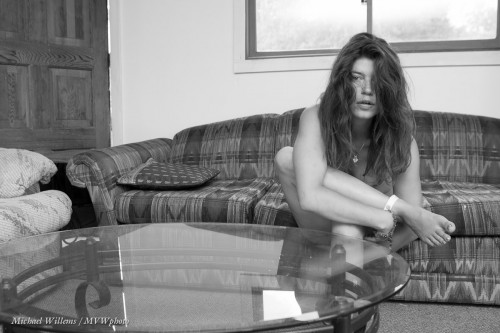
Today, the picture of the day is a simple picture of a girl on a kitchen table:
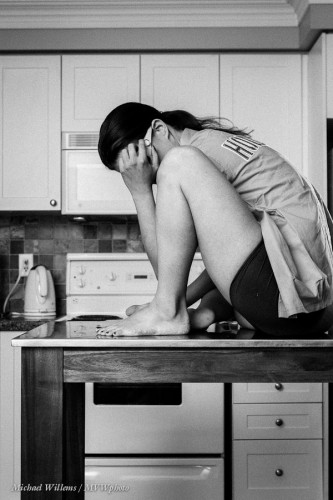
That is Kim, my favourite model. I shoot her a lot: see my Fine Art Nudes site, mvwphoto.tumblr.com, as well as this blog. I shoot her all the time because she is a great model, very talented, and especially because we consistently create art together.

And that is a special gift for anyone in arts – someone to make art with (and no, get your minds out of the gutter, it’s nothing more than that). An artistic muse. She features heavily also in my upcoming Fine Art Nudes exhibit, www.michaelsmuse.com – I hope to see some of you there for the official opening on Saturday.

And today, I also wanted to show a picture like this to re-emphasize what makes a picture interesting. Worth seeing. And I think there are several.

  • Of course an image has to be technically good. Namely well exposed, in focus where it needs to be, and well lit.
  • Most importantly – it should involve some sort of storytelling, or perhaps rather, evoking questions. An image has to have some connection with something happening. It has to have the ability to make the viewer wonder what it is that is happening; perhaps to make sense of it, to make the viewer work in out in his or her mind.
  • This picture is black and white. That often adds to the storytelling. It also stops distractions – the subject and the story are important, not the colours of the kitchen implements.
  • The setting needs to be relevant to the story.
  • The close crop adds extra tension. This is sometimes allowed – ask Degas.
  • For extra mood, I even added some film grain.

So a picture like this can actually have a had fair amount of thought put into it.
When a shoot is done…

…it is not done. In some ways, it is just beginning.

Apart from the obvious finishing, which includes things like:

  • Choosing images to use
  • Cropping
  • Rotating
  • White balance correction
  • B/W conversions
  • Lens corrections
  • Exposure adjustments (especially if you “shoot to the right”)
  • Skin adjustments if needed

… there is a very important aspect to finishing: “look with fresh eyes”.

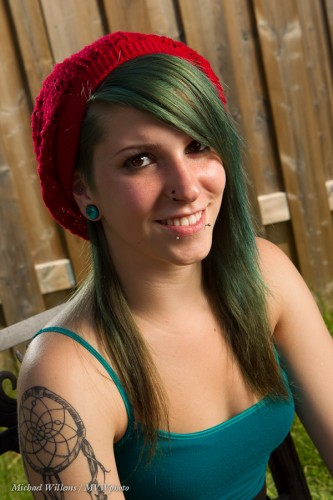
I shot portraits of new model and photography student Khoral today. She is young, pretty, and very photogenic. She has an amazing quality: she always smiles. A quality which will see her achieve big things in life. Here’s a sample:

And my point is: that is a sample. Out of the several hundred images I did a preliminary pick of around 100 to present to her, with around 30 top picks: a higher than normal number for a first shoot. When photographer and subject know each other, the shoots get ever better.

But I am stopping there for tonight. Because when I look again tomorrow or the next day, I am more detached and see the art as art, not as “what we were saying and doing at the time”. As a result, I will find several images I overlooked today. Even months after a shoot, a new look yields new winners.

My advice for today: always put your photos away after you shoot, and look again a few days later with a fresh pair if eyes. You will often be amazed at how you did.

I shall leave you with a couple more snaps. But in the next days, when I look properly, I shall be able to choose my winners.


The Art of the Dramatic Portrait, Continued

At the risk of being repetitive, let me deepen your understanding of dramatic portraits a little.

A dramatic portrait, in my world, is one where:

  1. I emphasize the subject.
  2. I darken the background.
  3. I make the subject the “bright pixels”.
  4. I carefully shape the light.
  5. I carefully direct the light.

You have heard me say this many times, but as said, let me deepen your understanding.

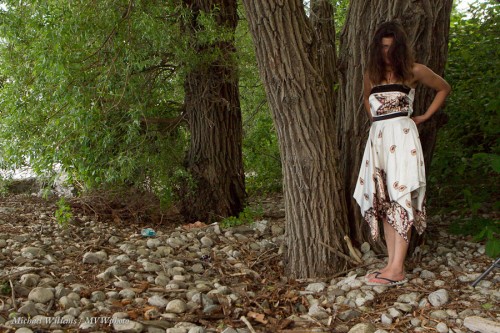
To show you want I mean, look at a few samples from a recent shoot the other day. These are outtakes, but they serve well to see what I mean (for actual shots, come see the Never Not Naked: Natural Nudes exhibit – an exhibit with a twist, June 22-July 8).

Let us start with a typical snapshot. 100 ISO, f/5.6, and this would be around 1/30th second. This is what available light and “Auto” or “Program mode” would give you:

Fine, but there are several things that can be improved.

  • The subject’s face is lit uneventfully and insufficiently.
  • The subject is “dark pixels”, not sharp “bright pixels”.
  • The subject competes for attention with pretty much everything else.
  • The tree bark’s texture does not really come out very well.

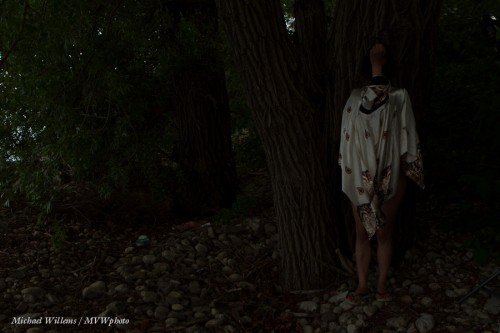
So now let’s do it properly. When I say properly, I mean “Michael Dramatic”. And “Michael Dramatic” for me means three stops below ambient. So I move the shutter to 1/250th second. Three stops darker than a “normal” exposure, in other words. (1/30 to 1/60 is one stop; 1/60 to 1/125 another; 1/125 to 1/250 the third stop).

Three stops is my dramatic portrait. Often, of course, you use less than three stops darkening. Like when you want less drama. Or when your flash is not powerful enough to provide three stops above ambient light.

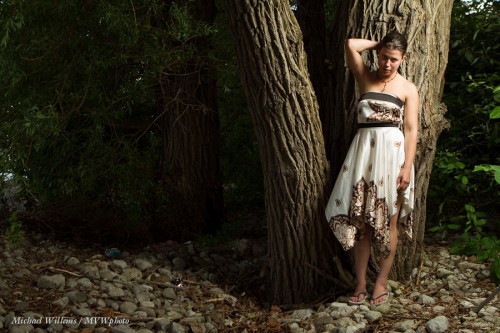
Anyway, three stops below gives us this:

That’s dark. Um yeah, that is what I had in mind.

Because now, finally, we add a flash. And we get what we came here for:

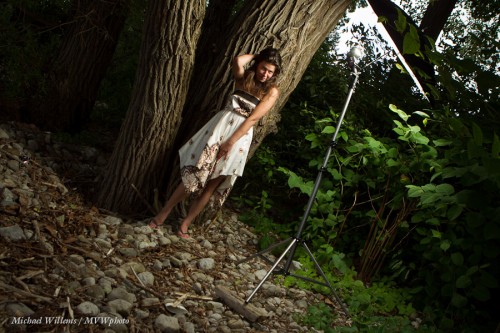
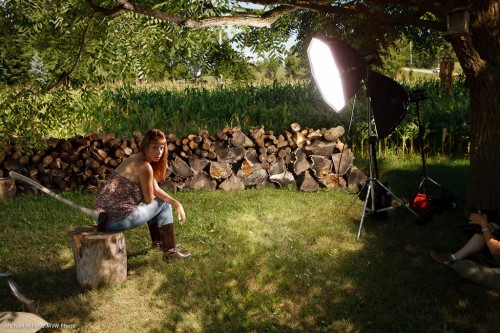
That was done with a single off-camera 430EX speedlight close by, fired into an umbrella. Like this:

You see there are several aspects to this, right?

  • The darkening of the non-flash lit part of the image (the “background”).
  • Properly lighting the subject.
  • Softening the light for the human.
  • But also the shaping and directing of the light. When I see a tree, I think “texture”, and side lighting brings out that texture.
  • Good composition.
  • The Inverse Square Law: light drops off away from teh flash.

Yes, all this needs to come together for a good shot. Go try a photo like this, and tell me how you did!

___

Note: You really can learn this, and in not many hours. My June Special is stil on: $75 per hour plus tax for private coaching, for June only (normal price is $95 per hour).


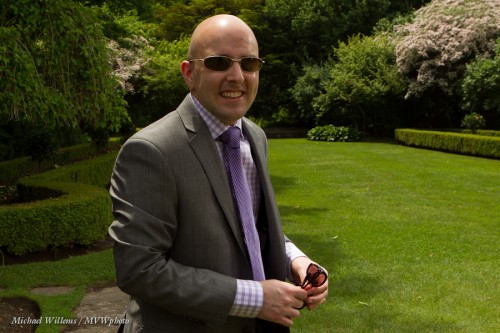
Here’s Matt, the groom at the wedding reception we shot recently:

That is the kind of picture you would get without flash. Matt is too dark, so I could of course add to the exposure (open the aperture, slow the shutter, or increase the ISO). That would make matt’s face well-lit, but it would also make the background brighter and hence less saturated.

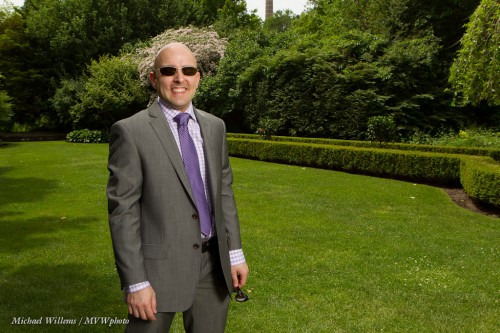
The solution is to use flash, of course, as all my regular readers know. A strobe into an umbrella and we get this instead:

Cool, no? And I do not just mean Matt, who is indeed very cool with the shades, but I mean the light as well. Try this, as the sunny days of summer approach.


A Group Shot

One of the most fun weddings I have shot was Matt and Lucy’s. Such wonderful people, a great fun bride and groom, a relaxed atmosphere, an ultra-friendly crowd: this is how a wedding should be!

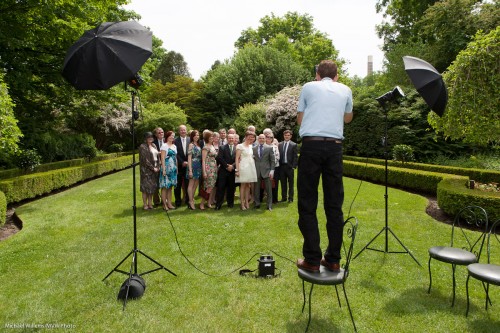
The reception was last Saturday, and at the end, we set up some group shots. Here’s one of them being set up, and me preparing to press the shutter:

I used two Bowens strobes powered by a battery. That was enough light to get me f/10, which gave me a nice dark background at 1/300th second (thank you Canon for making the 1D MkIV shutter nice and fast). Camera on manual, flash set manually.  The flashes were driven by two pocketwizards.

For a shot like this you need to look down, or you will never see the second and third rows. A chair is what I used: that gave me enough height.

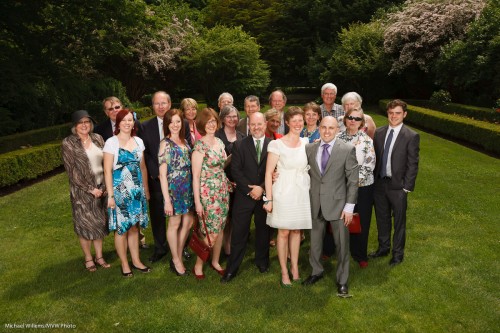
All that gives me this:

Much better than the simple available light shot on a bright day like this – remember: flash can make your backgrounds darker.


The art of implying

Among  many other types of photography, I shoot art nudes. And when shooting nudes, to make them interesting, a few things need to happen.

First, try to tell a story. Or rather, try to make the viewer discern a story. That makes  an image much more interesting. “What’s going on here” makes the viewer do some work.

Second, make them civilized. There is a huge difference between art nudes and sexy nudes, or porn. It’s not about the bits.

Third, try black and white – so much more interesting, since nothing distracts from your subject.

Like in this image, taken last week:

Two news items:

1. Colleague Kristof and I are doing a workshop 17 June: The Art of Photographing  Nudes. Click here! There is space – sign up now if you are interested.

2. Exhibit coming: 22 June to 8 July: “Never Not Naked: Natural Nudes”, at Bare Oaks Naturist Resort near Newmarket, Ontario. Come see the art … and be naked while you see it!


Wedding Crowd

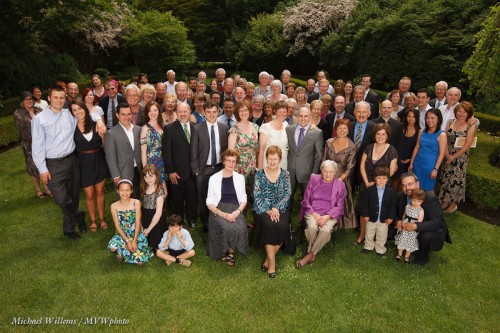
A great crowd today at Matt and Lucy’s wedding in Toronto.  And so Kristof B and I, who shot the wedding together, thought of a crowd shot:

For this shot, I used:

  • Two strobes (big flashes), one on the left and one on the right; powered by a battery.
  • To overpower the sun we set the strobes to full power, which gave us f/8 at 1/250th second and 100 ISO. That’s dark enough to get a nice dark background even in full sunlight!
  • I used a wide angle lens (16-35mm on a ful frame camera)
  • And finally, I used a stool to stand on. That gave me an angle which allowed all the crowd to be visible.

Great crowd, great wedding, great light. And I hope you agree, a great shot.


Open Shade

A shot I took in Open Shade – because I forgot my flash!

“Open Shade” means bright shade that is lit by reflected light. This gives you nice soft light. You cannot direct it, so you may have to direct your subject or model. Try Open Shade for your next shots, to get a good feeling for what it can and cannot do. And do not forget your white balance: set it to “Shade”!


Outdoors Light

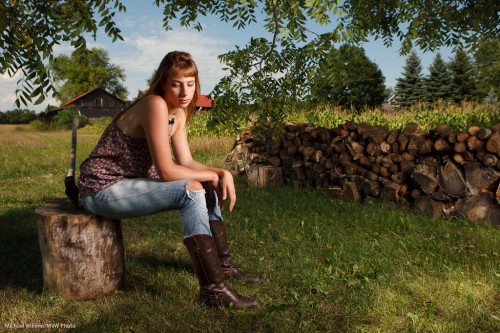
Outdoors, a flash, a powerful one, will often make good images into great images. Because you can make the background darker:

Here’s how we took a shot at a creative light workshop last year:

Which leads to this shot:

As always:

  1. Get the background right first; remember to keep the shutter speed below your maximum flash sync speed (like 1/250th sec).
  2. Then add flash.
  3. Set the flash power to the aperture you have gotten to in step 1.

Really simple, no? Provided that you have a powerful enough flash to overpower the sun, of course.