Today, part 2 of Phoenix

Today, part two of the Phoenix workshop at Studio Moirae. A repeat with a different emphasis; we go a bit deeper into the technology and we practice TTL multi-flash (both Nikon i-TTL/CLS and Canon E-TTL).

Yesterday, David Honl (yes, the David Honl) joined me, and he and I presented the workshop together. And we had fun: did we ever. A bright and energetic bunch of local photographers here in Phoenix.

Here’s David getting ready. In this shot I set my White Balance to “Tungsten”, which makes the background blue. Then a full CTO gel on the speedlite ensures that the subject, which after all is lit by the flash much more than by the ambient light, does not turn blue, but looks normal:

Here’s one of the set-up shots:

David setting up a speedlite, fired with a pocketwizard, with a half CTO-coloured Honl 8″ gold/silver reflector (while I blind Christy by actually firing the flash):

David carefully adjusting the subject’s head:

Tough job, but someone has to do it.

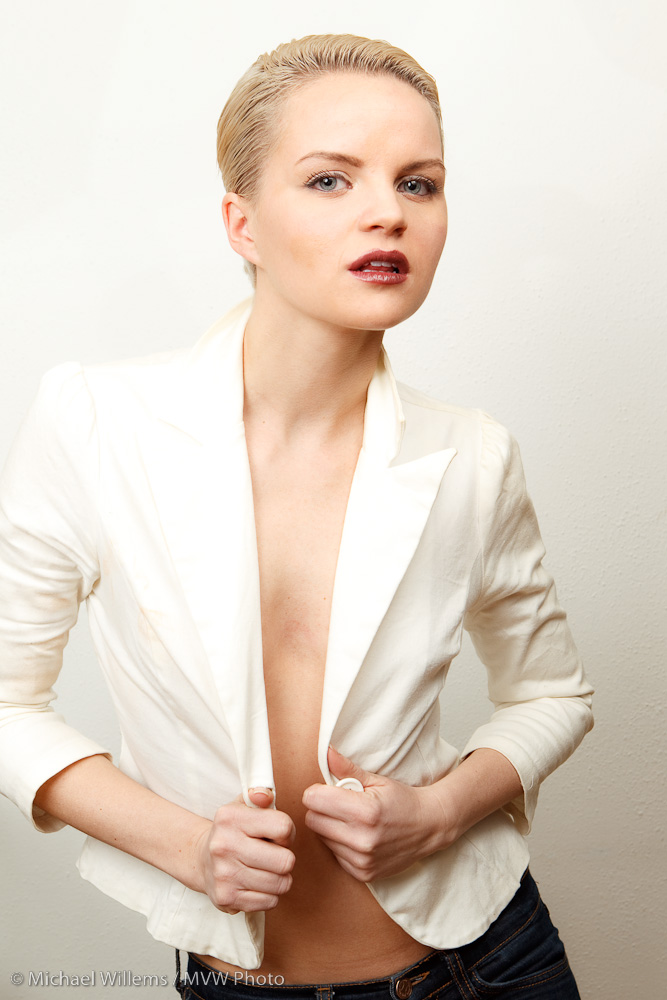
And here’s my shot of Christy, using this light:

All I can say is, I am glad the model we hired did not show up, because Christy is an amazing subject to work with. Which is rare for photographers.

And finally, fair’s fair: one more picture by Christy of David and me. Slow shutter, turning the camera during the shot.

Can you see that direct flash can be great light? And that shadows do not necessarily need to be avoided?

Jewellery

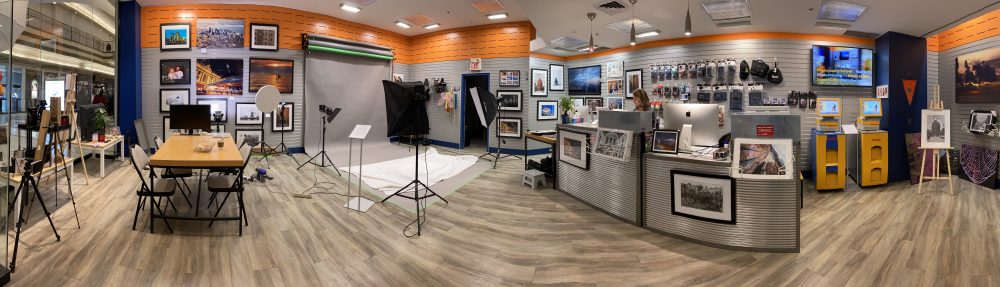
Thanks to fellow local photographer Anita, I shot Jewellery yesterday, on location in St Catharines. This was the setup in the store:

An improvised table with a curved white background, lit by two speedlites in an umbrella, with an opposite reflector; then one”sparkler” speedlite in a Honl snoot to aim at the jewellery.

I used

  • A 580EX II on the camera
  • Two 430 EX flashes in an umbrella
  • Wireless TTL with +2 stops flash compensation
  • A 100mm f/2.8 macro lens
  • A Canon 1D Mark IV camera.

A few tips:

  • Use aperture in the 5.6-16 range. More is better, except when you go much above f/8-ish, most lenses get blurrier again.
  • Use a tripod!
  • Focus using manual focus. Use Live View and x10 magnification to set this focus accurately.
  • Expose carefully, using flash compensation as needed. Use the histogram and “highlight alert” to verify.
  • Use the sparkler straight on to add life, especially to diamonds.
  • Watch reflections carefully
  • Use a black reflector if needed to add the black reflections in diamonds.
  • White balance carefully.
  • Clean the jewellery well.
  • Use Photoshop to clean up any remaining dust. Jewellery photos need to be finished in photoshop.
  • Use Play-do to mount rings, etc.
  • Consider an acrylic stand to separate jewellery from the background – this avoids shadows.
  • Black acrylic works too – nice reflections. Black slate can work, too.
  • Did I mention you should use a tripod?

This got me shots like this one:

Jewellery can take many hours to shoot, so yesterday worked out well – 20 products shot in four hours.

Tonight:

I just got back from The Distillery District, where today we opened the second ever showing of “IV”. It is raining tonight:

That’s Av and two stops negative exposure compensation, and 5,000 ISO. Here’s another one:

I took this handheld. That meant:

  • Aperture mode
  • Minus two stops exposure compensation.
  • Because of the darkness and the lack of a support I used high ISO of 5,000.
  • This gave me 1/15th second at f/5.6 (I wanted depth of field).
  • The lens was a 16mm lens on a Canon 1D Mark IV, crop factor 1.3, so really 16×1.3 = 21mm.
  • Finally – because it was hand held, I took five or six shots.

Now relaxing a bit… tomorrow, teaching Flash at Henry’s in Oakville, and Monday a PPOC guest appearance at Fanshawe College in London.

Shot of the day

…of yesterday, that is:

I used my 1D MarkIV, and light was two direct speedlights with Pocketwizards on the left and right (full power), and one behind me for fill (also direct, but on half flash power).

How this is done is something I will explain more on the weekend lighting workshop I am holding, with Joseph Marranca, at my country retreat in early April. Details to follow!

Catch that light

Every portrait, classical rules have it, needs a single “catchlight” in the eyes.  While I am not religious about this, I do tend to ensure that this is present. This very recent portrait shows the catchlights clearly. I used two umbrellas with speedlights, fired with E-TTL, and a light on the camera aimed backwards to add a bit more softening.

This is a high-key portarit: everything bright.

A rose by any other name

I took this “grab-shot” at the Kodiak Gallery the other day with a Canon 7D and 50mm f/1.4 lens:

Canon 7D, 50mm f/1.4 at f/1.4, 1/250th sec, 800 ISO

This shows that with the right lens, you do not need flash. You also do not need a macro lens every time. You can use what you have, if you keep your eyes open.

Also note:

  • The secondary subject blurred in the background
  • I used exposure compensation (+) to ensure the white background showed as white, not gray
  • I am not afraid to go to 800 ISO or beyond to get the right fast shutter speed.
  • I am using off-centre composition, rather than Uncle Fred’s “subject in the middle”

Simple. Just keep your eyes open.