
Ft Worth, Texas, Sept 2009
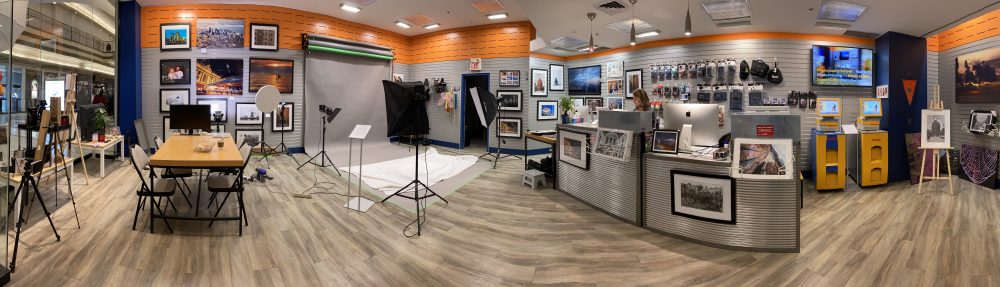
Ft Worth, Texas, Sept 2009
Wide angles are nice. And so are the colours we see in cities when buildings reflect light. Like in Toronto the other day, on my way to work on Queen and Church:

For a handheld picture like this, I do the following:
It’s simple – set it up that way, and then you just snap away.
This is one of my standard party shots:

It is three-dimensional, shows fun, and shows the subject well. If the subject is the worse for wear, the blurring hides that, which subjects tend to like for some reason.
You get a picture like this by:
Oh dear, I seem to have given away another secret.
Guess what. The days that “giving away secrets” was a bad thing are long gone. We call this The Internet. You can come here every day in the secure knowledge that I will never “hold back information”. My mission is to fill the world with better photographers, and to show you all how simple this is. Because it is.
Just a picture to while away the minutes. My sister-in-law’s cat (as pictured last night with my two-hour old 7D equipped with the 35mm f/1.4L lens):

I always carry my camera. So I can shoot things from the car too. Like this Toronto street some months back. Jewellery, Happy Kids, best convenience,signature wear, Good life. Doesn’t exactly shout happy. But it does show the city the way it is, for many people.

Here’s a few demo shots from a kind volunteer (a student’s daughter) at a recent camera course I taught. This bit was about “flash”.
First, pop up the flash and use “P” or “Auto” mode and you get the picture that makes people hate flash:

Then enable “Slow flash” or “Night portrait mode” and you get a better picture.. yeah, it’s better. But not all that much:
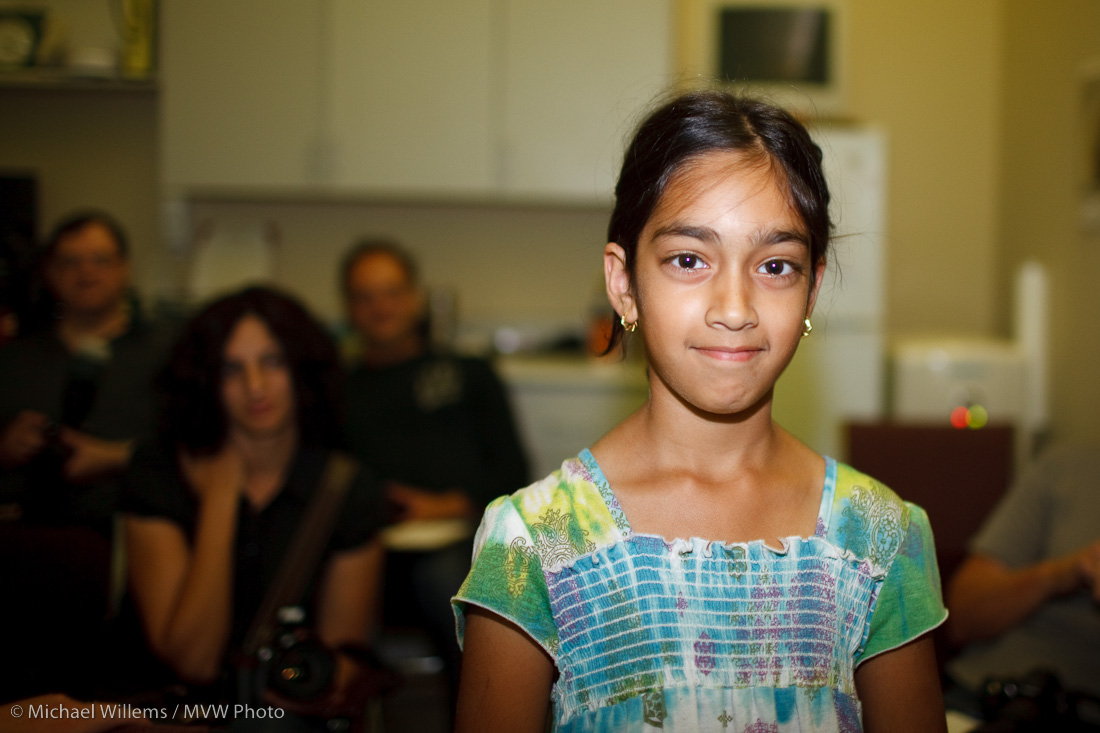
Then put your big flash on top of the camera (e.g. an SB-900 or 580EX II, or their slightly smaller equivalents SB-600 or 430EX II). And aim that flash behind you.
Yeah. Behind. So it bounces off ceilings and walls behind you.
Much better. Much. See:

And then if you want extra “character” and “depth”, bounce off a side wall, if you can find one.
Now you get three-dimensionality, depth, character as well:

I mean – how cool is that? And all this was done in “P” mode, with no special stuff, with no settings on the camera, no required knowledge of aperture, no complicated techniques.
Flash is wonderful once you learn how to play with it. And it is easier than ever.
I photographed Richard Dawkins tonight. In the sold-out Bader theatre in Toronto, where he introduced his new book to an enthusiastic crowd:
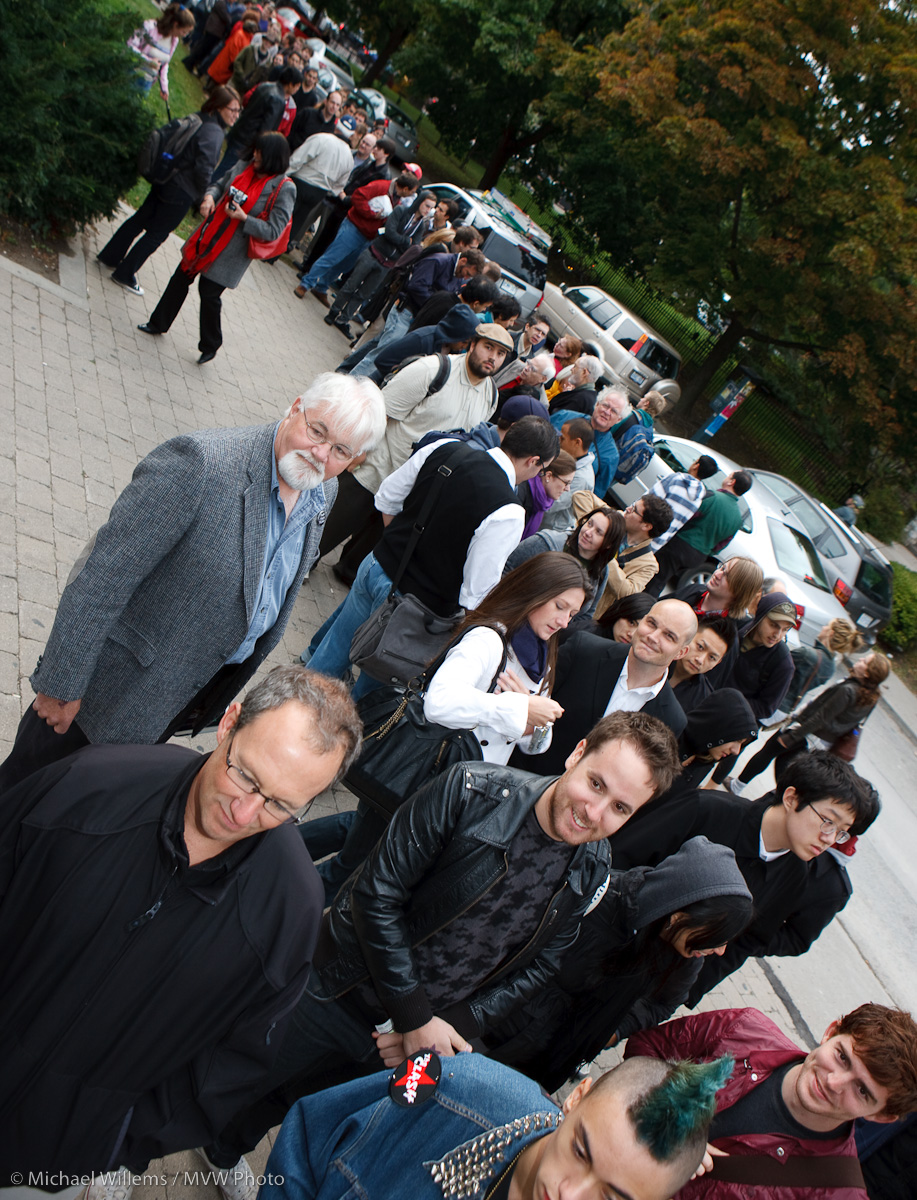
Usually, theatre lighting is quite simple – if you get to sit in the right place. Since my son Daniel and I sat in the very front row, today was no exception. The background is dark but the subject is lit brightly:

I did not need more than 400 ISO, which gave me 1/100 sec at f/2.8. In manual exposure mode, of course.
“No flash“, the slightly inept people from the publishing house (who did not believe I had talked to their colleague on the phone earlier – Simon and Schuster Canada, you lost out on some free shots!), said time and time again. (The Dawkins web people aren’t very responsive either: four attempts to contact them. to multiple email addresses, offering free coverage – and zero responses: instead, I helped their own shooter, who was an ’emerging pro’ and asked for some advice).
No problem!
The only problem was focus. My 50mm f/1.4 lens front focused on the 1Ds MkIII by at least 6 inches, which is disastrous. I had to adjust it to a setting of “+17” (out of a possible 20!) in the ten or so minutes before prof Dawkins arrived. The 35mm f/1.4 and 24-70mm lens would not properly focus at all in this light (they were consistently way off), so while I switched many times, I kept coming back to the 50mm lens with +17 adjustment.
One day Canon will make a camera that focuses well. Perhaps. I am not holding my breath.
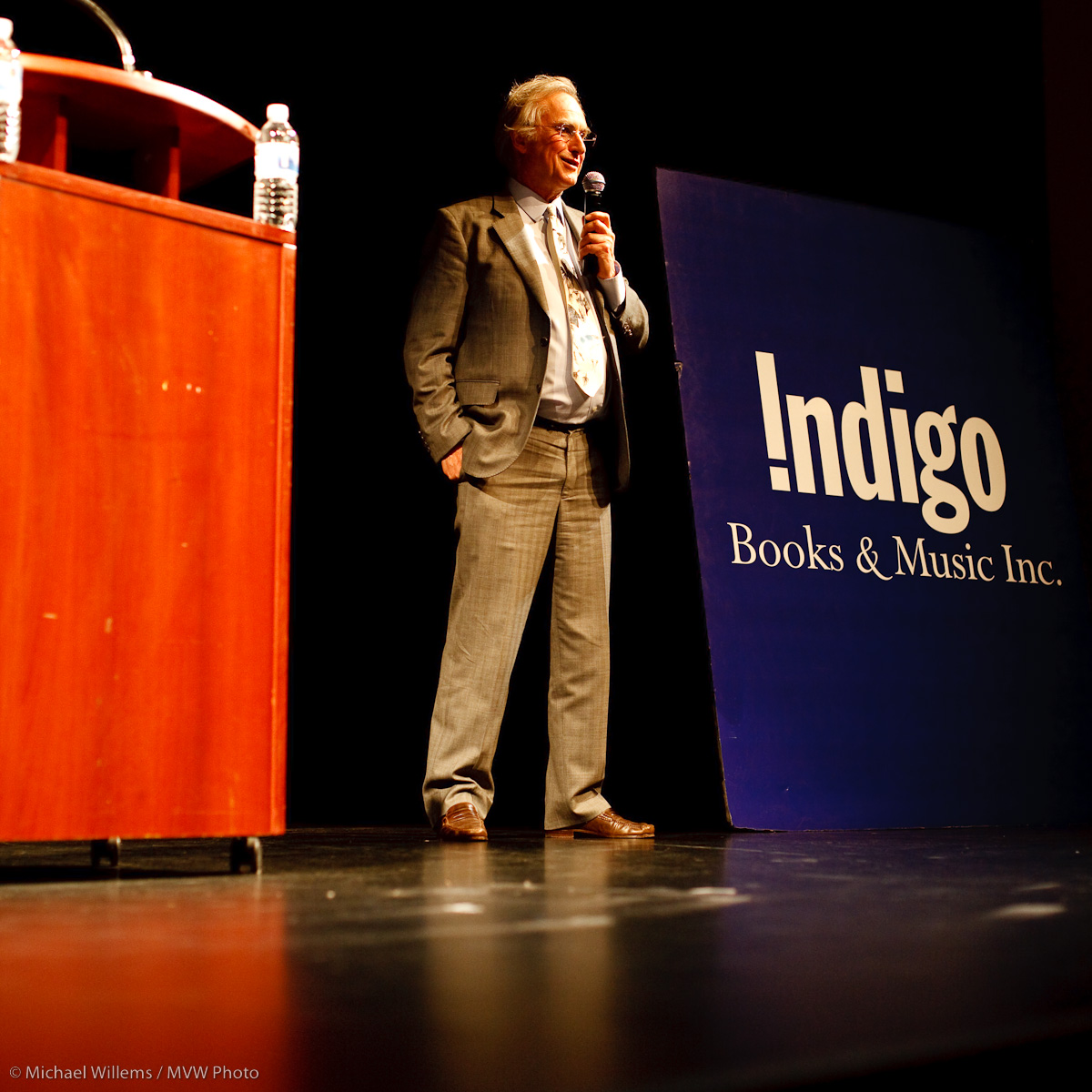
Anyway, I got some nice shots. Photojournalism is never easy, but sitting about 10 ft away from Richard Dawkins makes up for a lot.

(A few more shots here)
In composition, if you can spot opportunities to use shapes and curves, your portraits will benefit.
S-curves in particular are pleasing, like the gentle curve of the background beach coastline here on Toronto Island during the model shoot a week ago, last Monday:
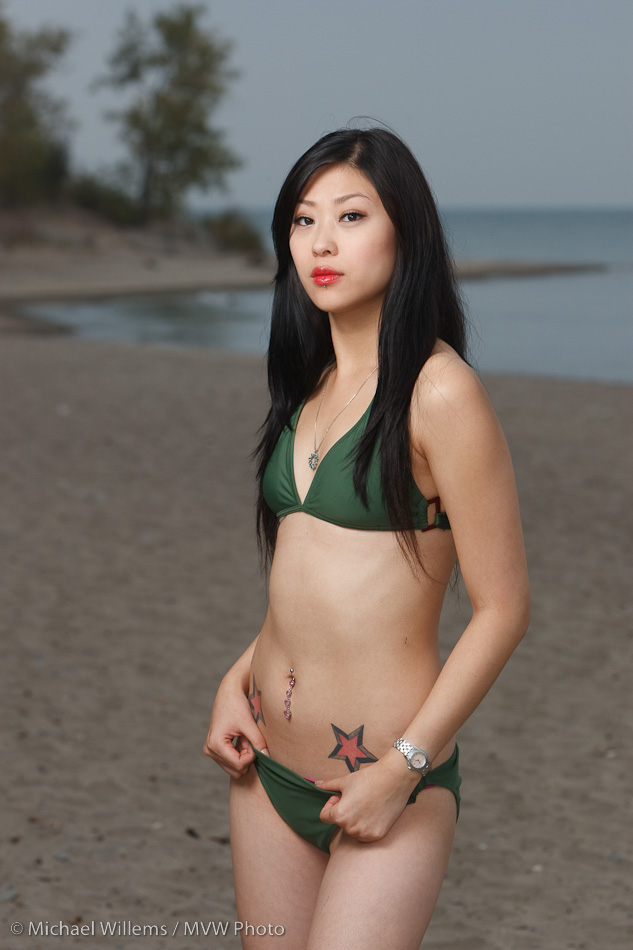
The trees too provide a useful counterpoint to the lovely model.
Now, not that I want to compare my work to that of great artists, but does that background remind you of something?

It does me. No coincidence of course:I recognised the possibility of the nice background because I have been trained to see it by being exposed to great art.
Which goes to show that the way we react to composition has not changed much in the last few centuries. If you want to learn about composition, go visit a museum.
..is me shooting my friend Dal yesterday on the Lakeshore in Port Credit:

As you see I am reflecting in his glasses (with brightness enhanced to show me, not him, of course). I am using my 1Ds MkIII with a 580EX Flash on it, and a 430EX in my left hand close by, fitted with a small Lumiquest Softbox connected to a Honl speedstrap.
That softbox (held at about the same distance from the face as its size) gives nice soft light, which is very important for someone with darker skin. You can see my favourite Domke camera bag in the background.
And yes I tend to wear a tie.
And I’ll show you the photo tomorrow.
Another “fill the frame”-shot here for your edification.
Shot while I was having dinner at a wedding – I was one of the two photographers but we were fed, at a very nice table in a good position. And even there I was shooting. Like the arrangement at the centre of the table.

You can get good pictures anywhere you try. The closer you get, the easier it is. I used my 70-200mm lens for this. So whenever you think “what do I shoot now”, you can always pick some interesting item, zoom all the way in on it, and shoot.