A few more pictures

Today, a few more pictures for you for the recent walkarounds.
Door and leaving

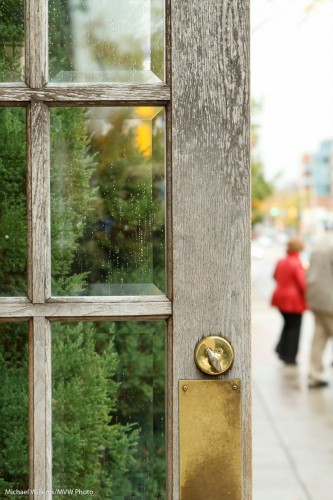
Door and leaving

You know how I always talk about story telling? One way to do it, one I have mentioned many times before, is to have a blurry subject in the background and to hence make the viewer work out what is happening. Having to work it out adds to a photo’s interest. In this picture, “Door” and “Leaving” are of course connected. And you see the rule of thirds being applied, I prusume?

I am called The Speedlighter. Speedlights are often handy, like in this picture.
Fall leaves lit with flash

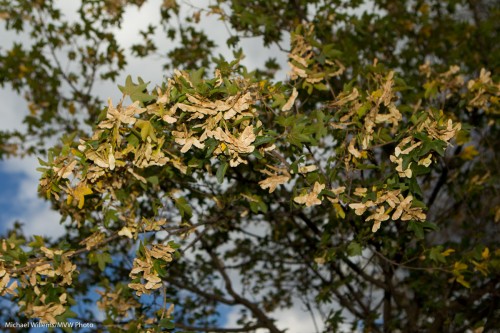
Fall leaves lit with flash

I underexposed the background by two stops or more. And to get the background blurry, I took this at f/4. This needed 1/4000th second if I recall correctly. That is beyond the flash sync speed, so I had to use High-Speed flash (FP Flash). Nice result, no? Looks surreal, and that is what you get by combining depth of field control with light control.

Last one. Use unusual effects.
Oakville Hotel, October 2010

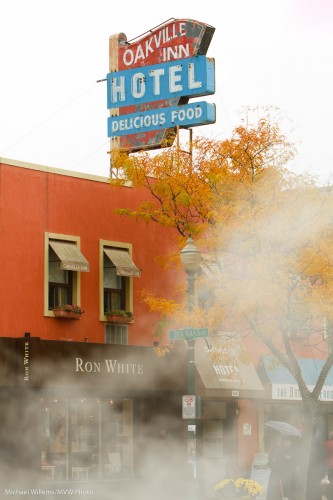
Oakville Hotel, October 2010

Like smoke from a barbecue to get an unusual picture of a familiar sight.

As always, photos look best when viewed full size.

Now: time for you to take the lens cap off, if you even use one, and go shoot!
Snaps du jour

Today, a few snaps of the day.

From a recent walk through Oakville:

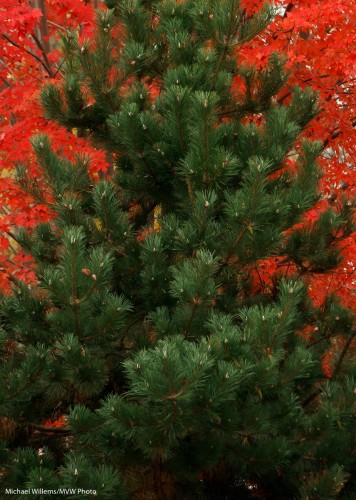
Coniferous vs. deciduous in October

Coniferous vs. deciduous in October

Keep in mind here:

  • Red versus green is a good contrast.
  • Crop carefully.
  • Zoom in close to remove distractions (they were all around).
  • Foliage is dark; so underexpose (in this case by almost two stops).

One more:

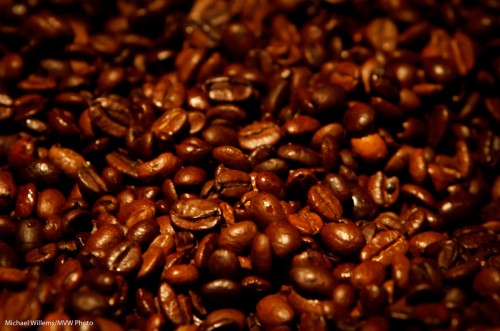
Coffee beans

Coffee beans

The message here: get close and shoot detail.

Just one more today, because my eyes are closing with exhaustion.

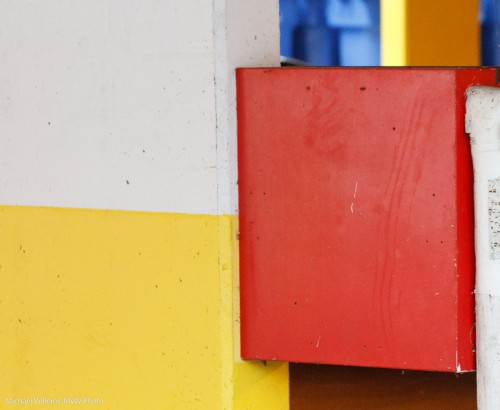
Red, yellow and blue in a car park

Red, yellow and blue in a car park

Yes, you can find Mondrianesque art in a car park. Thanks, town of Oakville for the blue bins).

Reader question

A reader asks the following question:

The issue of aspect ratio: most D-SLR cameras don’t shoot in the traditional 4×6 ratio (or at least I don’t think they do). That’s why whenever I send my photos to be printed off (in 4×6) they always come back a little cropped around the edges.

Good question. Infuriating,  isn’t it?

And yes, you are almost right: other than 4×6, other photo sizes tend to be different: 5×7, 8×10, 13×19 and so on. So why 4×6 is cropped I do not know: most DSLR sensors are 3×2, which is 4×6. So it must be the printing process.

But your question stands: most aspect rations are very different, as are most frames. And the reason is simply history.

And the solution: crop them yourself to the correct aspect ratio, in Lightroom. That way the lab does not have to guess (bad) and you get full control.

Either that, or print at the original aspect ratio on larger paper (i.e. with edges), and then cut those off.

Flash method

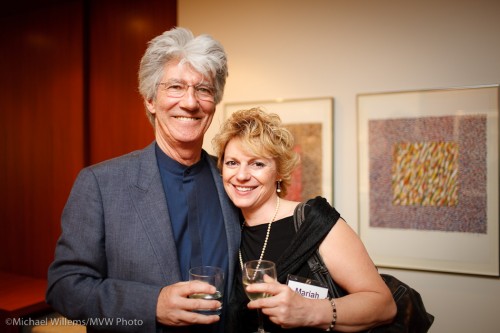
Let me reiterate a simple flash method for camera-aware (i.e. “grip-and-grin”) people pictures at events (like receptions, parties, etc).

  1. Set your camera to “manual”.
  2. Attach your flash.
  3. Bounce your flash off the ceiling or wall just behind you if you can. If you cannot do this, use a reflector (like a Honl reflector) or worst case a Fong sphere. Think about where you bounce in terms of returned light direction.
  4. Use a wider angle lens (say 35mm). I love my 35mm prime on the 1Ds for this type of photo.
  5. Start at these settings: 400 ISO, 1/30th second, f/4
  6. With those settings, aim at an average part of the room (not dark, not light). Watch your light meter. It should read roughly -2 stops. If it reads more, like zero stops, go to a faster speed. If it reads less, go to a wider aperture (and if you cannot then a higher ISO or even a slow speed).

The result will be good.

Grip and grin

Grip and grin

Note that you may, in dark environments, have to go to slow speed and wide open aperture even at high ISO.Watch the light meter and aim for -2 stops ambient light when aimed at an average room area. In a dark night club I may occasionally be shooting at f/1.4, 1/15th second, 1600 ISO!

Negative Space

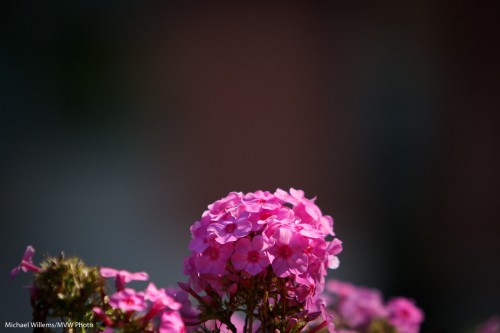
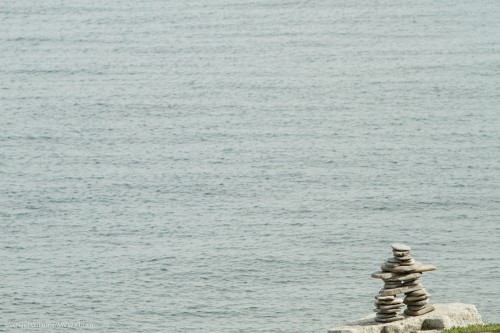
Sometimes you draw attention to your subject not by making it big (which is often a great solution), but by making it small, and surrounding it by “essentially nothing”.

By what we call “negative space”.

Flower and negative space

Flower and negative space

The negative space does not have to be empty – it can have patterns, or as in this example, waves:

Lake Ontario, Oakville

Lake Ontario, Oakville

The point it, it is devoid of information. And that forces attention to your subject.

It also puts your subject into a large space, emphasizing its place in this big world.

And finally, this technique is a good way to simplify. Always important on making your images better.

Try it today!

Prints

Mmm. One of life’s little annoyances. I left a red box of 13×19″ prints somewhere this week. My portfolio of recent work. But where? It appears gone without a trace… So to all local friends: if you see it anywhere, you’ll know to call me.

Accountants of the wild frontier

Today was a good example of n event shoot.

Colleague Joseph and I got to the Metro Toronto Convention centre to shoot a few hundred accountants pointing laser pointers at the ceiling. A very un-accountant-like event!

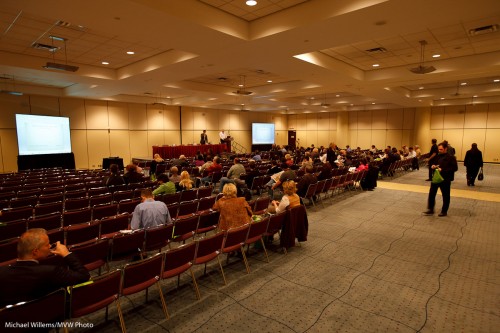
So we set up ladders and camera with the light just right. We use a combination of ambient and gobo’d flash. Test shots of the room looked like this:

Convention hall

Convention hall

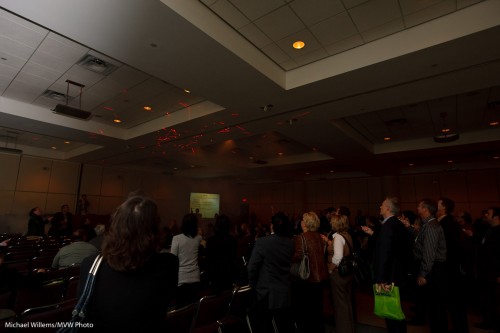
The event starts. And as the fog machine we had arranged starts and on command, the accountants’ laser pointers aim… unexpectedly, someone dims the lights to just about zero.

So we get this:

Convention hall

Convention hall, lights dimmed

No time to say anything: we only have moments to shoot.

So I quickly had to:

  • open up the lens to f/2.8,
  • shoot at 1/15th second,
  • at 800 ISO,
  • I quickly set the flash to 1/16th power manual and bounced behind me (if I had had more time I would have gone up to 1/8th power),
  • ….and then at home, push the exposure another stop!

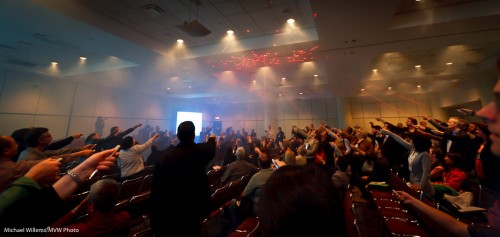
In the end, this gives this:

Convention hall with lasering accountants

Convention hall with lasering accountants

Not too shabby eh? Ever seen such a fun group of accountants?

The moral of this post: you have to be quick on your feet and problem-solved instantly when someone is hiring you for a shoot. You cannot come home with excuses: need photos instead.

And it never hurts to shoot RAW.

Side lighting

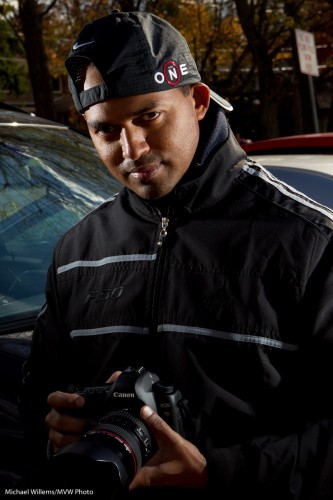
Look at this picture, of a photographer student I shall call “Rapper MA” (although he is not a rapper of course – it is just the look and the light and the hat!):

Edge-lit Photographer (Photo: Michael Willems)

Edge-lit Photographer

This was made in bright sunny daylight.

How did I light it?

  • Camera on manual
  • 100 ISO, 1/160th second.
  • Now set aperture to expose for the background. In this case f/13.
  • Use two flashes, left and right, slightly behind the subject.
  • Flashes on stands, aimed at subject.
  • Connected to Pocketwizards via Flashzebra cables.
  • Pocketwizard on the camera.
  • Set power to that aperture (using the light meter). Adjust shutter/aperture as needed.

That’s how.

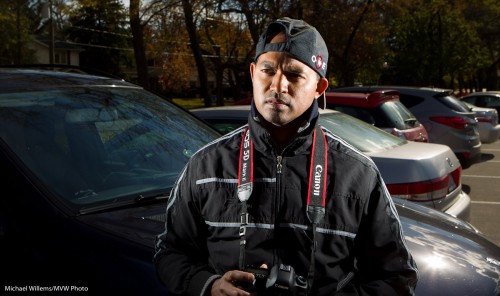
Here’s one more illustration with a bit more background:

Edge-lit Photographer (Photo: Michael Willems)

Edge-lit Photographer

Small speedlites can overpower the sun. That is why this site is called “speedlighter”. Have fun with your speedlights!

I was having a coffee…

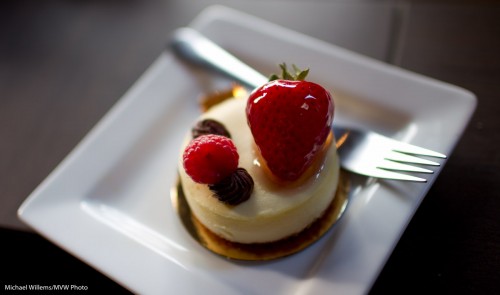
…when I decided a cheesecake would be good. So I bought a piece.  And shot it.

Cheesecake (Photo: Michael Willems)

Cheesecake

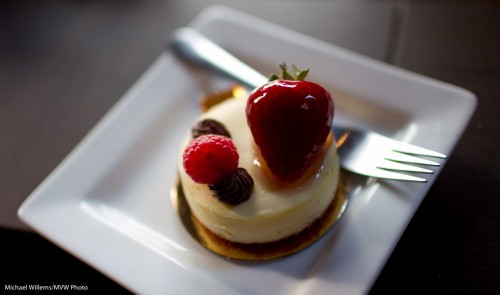
35 mm lens, f/1.4, 1/60th second at 100 ISO. You see what those nice fast lenses can do? I cropped a tiny bit of light from the top – no other adjustments.

The moral of this post:

  • Be ready to shoot your food.
  • Fast prime lenses are good: available light works.
  • You do not always need flash.
  • Low ISO is good.
  • Wide open is good: selective focus is great.
  • A wide angle lens can be used to shoot a macro food shot!

Exhaustion prevents me from working more tonight – but more soon.