Just say NO.

What do professional photographers often say NO to? The very things amateurs say “Must Do” to. Like these:

  • Camera bags. You do not need your camera in a bag. When it is in a bag, you cannot use it. Your camera is for picture taking, not for storing. I carry a camera on one shoulder, and a bag with lenses, flashes, filters, and so on on the other shoulder.
  • Filters. A filter will sometimes do more harm than good. In particular, it can increase lens flare. What happens when you are shooting in the direction of a strong light source. So a filter can decrease your quality, while it can never increase it. But does it not protect? Yes – so when I am shooting in snow, rain or a sandstorm I may put on a filter. Otherwise, no. (But note, I always, always use lens hoods. They reduce flare and prevent damage).
  • Lens caps. A lens cap is a great picture preventer. Need I say more?

Sometimes, less really is more.

I am not saying you cannot use bags, lens caps and filters. What I am saying is that if like me you choose not to, you should not feel guilty. You may find the experience lliberating.

Chelsea, or what one image can do

When I was 16, I first saw Patti Smith’s album “Horses”.

The cover photo of that album changed me: I know instantly I wanted to be a photographer. Here is that one photo, taken by Robert Mapplethorpe of his then girlfriend Patti Smith:

Everything comes together. The light, the high-key shot, the left-right angle, the way we slightly look up at her, her hands, the expression, the coat over her shoulder, the contrast, the greys.

I think I have been in love with Patti ever since. And with photography.

A few years ago I stayed at The Hotel Chelsea in New York, where all this happened. I felt in the presence of greatness, of history… everything happened here. Leonard Cohen. Bob Dylan. Andy Warhol. Dylan Thomas. Arthur C. Clarke. The list is long.

Hotel Chelsea, photo by Michael Willems

Hotel Chelsea (Michael Willems)

And the hotel has, um, character:

Hotel Chelsea, photo by Michael Willems

Hotel Chelsea, Reception Desk (Michael Willems)

And art. And a sense of history, and time. I mean… I actually stayed where this was made, the picture that set off my interest in photography: how cool is that?

Patti Smith and Robert Mapplethorpe together at the time, by an anonymous photog:

And Patti Smith, by Robert Mapplethorpe, at The Chelsea:

Another beautiful photo.

And finally, one more from me: the view from the hotel – what Patti would have seen if she looked straight ahead:

Chelsea, NYC, view from The Chelsea Hotel (Photo Michael Willems)

View from The Chelsea Hotel (Photo Michael Willems)

I just ordered “Just Kids”, Patti Smith’s autobiography of that time, on Amazon.

Inspired, I continue my day.

Need for speed.

The need for LOW speed, that is. Not every picture has to be razor sharp. In fact, often, to give the impression of speed and movement, you need to blur parts of a picture. The background parts.

You do this by panning.

To pan a picture, you need a slow shutter speed. Like 1/15th of a second. Panning gives you pictures like this:

Panning picture by Michael Willems

Panning picture by Michael Willems

Panning picture by Michael Willems

Panning picture by Michael Willems

To do this:

  1. Set your camera to Tv/S mode
  2. Select a shutter speed of 1/15th of a second
  3. Wait for the car. bike, child, etc to approach
  4. Start following them with the camera, keeping them in the middle
  5. When they are half way, right in front of you, SHOOT!

To focus, you can either focus quickly, or pre-focus “where they will be”, or use AI Servo/AF-C mode.

You can vary the shutter speed as you like, of course.

Have fun!

GF1 self portrait

A self portrait I took a few minutes ago:

Michael Willems, photo by Michael Willems

Michael Willems, photo by Michael Willems

I shot this with the Panasonic GF1:

  • Camera on manual, f/4.0, 1/60th second, 200 ISO
  • Using multiple-point autofocus
  • Pocketwizard on the camera
  • Pocketwizard on a 430EX flash, connected with Flashzebra cable
  • Flash set to manual, 1/32nd power
  • Honl Photo Traveller 8 softbox on the (handheld) flash

To lower the noise (“increase the signal to noise ratio”, for engineers) I exposed to the right (i.e. I exposed high, but without actually overexposing anything) and then pulled back a stop in Lightroom.

The 20mm lens (yes you can use 40mm, for that is what it is, for portraits) gives me that wonderful sharpness. Click and view full size to see how sharp it is.

The Honl softbox gives it that nice soft look and the unique round catchlights.

And I have said it before: for creative photography, lighting a subject is as much about what you do not light than about what you do light.

Postscript: And here’s one more: son Jason just now (similarly lit, also shot with the GF1)

Jason Willems, photo Michael Willems

Jason, shot with GF1/430EX

Street stories

I have said before that pictures are more interesting when they keep you guessing.

Today I had five minutes to do a few street shots, before an appointment with a friend and client on  Toronto’s Victoria Street. So I used those five minutes to take a few snaps at Yonge and Dundas Square in Toronto:

Yonge-Dundas Square, 27 July 2010, photo by Michael Willems

Yonge-Dundas Square, 27 July 2010

Yonge-Dundas Square, 27 July 2010, photo by Michael Willems

Yonge-Dundas Square, 27 July 2010

Yonge-Dundas Square, 27 July 2010, photo by Michael Willems

Yonge-Dundas Square, 27 July 2010

Yonge-Dundas Square, 27 July 2010, photo by Michael Willems

Yonge-Dundas Square, 27 July 2010

Yonge-Dundas Square, 27 July 2010, photo by Michael Willems

"Separate Lives" - Yonge-Dundas Square, 27 July 2010

Oh, I do love street photography, and I do love the new GF-1 that allows me to snap away unobtrusively.

Panasonic GF-1 notes

So now that I have used the Panasonic GF-1 for a few days, a few quick notes. This is part of a new category on the blog: “Michael’s Quick Judgment“.

Executive summary: I love it, and it will be a very cool addition to my toolbox.

Cool, and sexy:

But that is not enough to spend money. So why would I actually buy a small camera?

Well, for one, because it is lighter and smaller than an SLR. My other cameras (a Canon 1D Mark IV, a 1Ds Mark III, and a 7D) are all very considerably heavier and bigger.

Second, it is easy to take street photos with a small point and shoot. And you can always carry it.

And it is allowed where “pros” are not (London’s Trafalgar Square, Oakville Place Mall, and many other places where “professional” cameras are frowned upon.

So there are places where it fits in, in spite of not being an SLR.

But until recently, small cameras weren’t quite good enough. The small sensor created a lot of image noise at any ISO greater than 100. No longer. With large sensors like the one in this “Micro Four Thirds” spec camera, this is becoming practical.

I came late to the party. These cameras have existed at least since last year. But I like to be a settler, not a pioneer, and as said, David Honl’s Leica two weeks ago in Las Vegas really inspired me. I was carrying a big SLR; Dave had a point and shoot. And got essentially the same shots.

So to start off, here is a shot I took during last Sunday’s Creative Urban Photography course in Oakville:

Knox Presbyterian Church in Oakville, by Michael Willems

Knox Presbyterian Church in Oakville

And a full size detail from that shot (click to see it at its actual size):
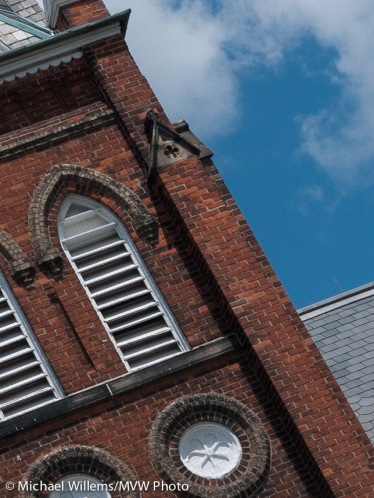
Knox Presbyterian Church in Oakville, by Michael Willems

Knox Presbyterian Church in Oakville (detail)

Now I noticed that Lightroom introduced a little noise there; noise I do not see in the original. Look at the sky. Odd, but a very small tweak of Lightroom’s excellent Noise Cancellation fixes that:

Knox Presbyterian Church in Oakville, by Michael Willems

Knox Presbyterian Church in Oakville (detail 2)

So let me summarize my feelings about this camera:

Likes:

  • The coolness, let’s face it. This camera is very cute, almost Leica-cute.
  • The great image quality. And that is what it is all about.
  • The large “micro four thirds” sensor.
  • That flat 20mm f/1.7 lens (equivalent to 40mm). They call them “Pancake” lenses because they are thin, and they do not come out when you turn on the camera.
  • The small form factor.
  • The ultra-sharp live-view LCD.
  • The flash hotshoe – for my pocketwizards.
  • A very convenient (and customizable) AE lock button.
  • RAW images.
  • Customizable Fn button.
  • Great manual focusing, when you choose to use it (turn the ring and the preview zooms in).
  • In general, the amazing camera customizability (including tweaking the LCD colours!). This is a camera for pros.
  • Super fast response speed: no shutter delay, like on cheap point-and-shoots.

Muuh… neither here nor there; “I can live with it”:

  • No viewfinder (an optional extra).
  • The tiny fragile flash.
  • No in-camera image stabilisation.
  • No continuous focus with the 20mm lens.
  • Video (but I do not use this camera for video: I have my SLRs).
  • Face recognition (including some stored individuals).
  • Scene modes (I don’t need them: laudably, you can disable them).
  • The way the custom modes work.

Minor dislikes:

  • The slippery, nigh-impossible to turn control wheel.
  • The click wheel: push to switch functions. Combined with “slippery” above this is a bad combo.
  • The “My Menu” that you cannot store the way you want it.

Overall: I am lovin’ it so far, and I have no doubt that this will continue. Amazingly, I am waking around with a small point and shoot.

The big sensor is smaller than an SLR’s, but large enough to give me great selective depth of field, and low noise at higher ISOs. The depth of field and the ability to use fast prime lenses are the main reasons I chose this camera over the excellent Canon G11.

I would normally not dream of shooting the police scanner on my desk in dim office light at 320 ISO and at f/1.7:

Scanner, by Michael Willems

Scanner at f/1.7, 320 ISO

But now I can. And do. Look at the images in yesterday’s post. And at this: the 20mm f/1.7’s lens has an amazing ability to produce those wonderful blurred backgrounds. Large aperture and close focusing ability (20cm) produce pictures like this:

Camera strap, by Michael Willems

Camera strap, GF1 with 20mm f/1.7 lens

Beautiful bokeh – but the amazing thing is that there is any bokeh at all in a small camera.

And then there is the ability to judge exposure before you take the shot, and to lock the fast-reacting spotmeter on a mid-grey object: very cool even for an experienced SLR shooter.

Megapixels, you ask? Not important. If it has more than six, it’s enough. Too many means more noise. This camera has 12, which is about the ideal number. ‘Nuff said.

Of course Nikon, Canon et al are also going to do “small cameras with big sensors”; and in any case, if I had a spare $8k I’d go with a Leica for fun, but this is almost as good and it’s here now, for a fraction of that cost.

Michael’s Quick Judgment: highly recommended, 8/10.

Postscript: see a few more GF1 shots in today’s blog posts, including some taken with an external flash and Pocketwizards.
A few more GF1 snaps

A few more snaps, taken just now, with the Panasonic GF1. Around the house using available light.

This shows me how international my life has been. A random selection of items in my house:

From the Netherlands, and from a time when flying was fun. On KLM, business class and first class passengers used to receive items of Delft Blue chinaware (the houses filled with liquor, which alas has all evaporated in these past 25-plus years):

Delft Blue, photo by Michael Willems with GL1 and 20mm f/1.7 lens

Delft Blue - GL1 with 20mm f/1.7 lens

Indonesia: this figurine takes on all the shame and bad feelings in the household, thus freeing the people who live in the home from them:

Shame! Photo Michael Willems with GL1 and 20mm f/1.7 lens

Shame! Indonesian figurine - GL1 and 20mm f/1.7 lens

Middle East: a chess set bought in Jerusalem:

Chess pieces - Photo Michael Willems with GL1 and 20mm f/1.7 lens

Chess pieces - GL1 and 20mm f/1.7 lens

England: Wedgwood from Harrods:

Wedgwood - Photo Michael Willems with GL1 and 20mm f/1.7 lens

Wedgwood - GL1 and 20mm f/1.7 lens

Libya: a primary drill bit I found in the desert:

Primary Drill Bit, Libya - Photo Michael Willems

Primary Drill Bit, Libya - Panasonic GF-1, 20mm f/1.7 lens

China: a souvenir

Soldier Souvenir, China - Photo Michael Willems

Soldier Souvenir, China - Panasonic GF1

Eastern Europe, a crystal glass:

Crystal glass, photo Michael Willems

Crystal glass, Panasonic GF1 with 20mm f/1.7 lens

Life is one great adventure.

Oakville Sunset

Friday evening, this was the sunset as I was almost home:

Oakville Sunset, photo by Michael Willems

Oakville Sunset, photo by Michael Willems

That colour is not photoshopped: it was real.

For sunset pictures, remember this:

  1. Set your white balance to “daylight” (on the camera or, if shooting RAW, in Lightroom later).
  2. Expose right (if using evaluative metering, then use -1 stop Exposure Compensation). This saturates the colours.

I prefer to set the WB on the camera even when shooting RAW. That way, I can see on the LCD roughly what I may be getting.

Today

“Creative Urban Photography”: a snap from today:

Kid at Lake Ontario, photo by Michael Willems

Kid at Lake Ontario, photo by Michael Willems

Fun course, fun students, great weather: what could be better?

Oh alright, just a few more.

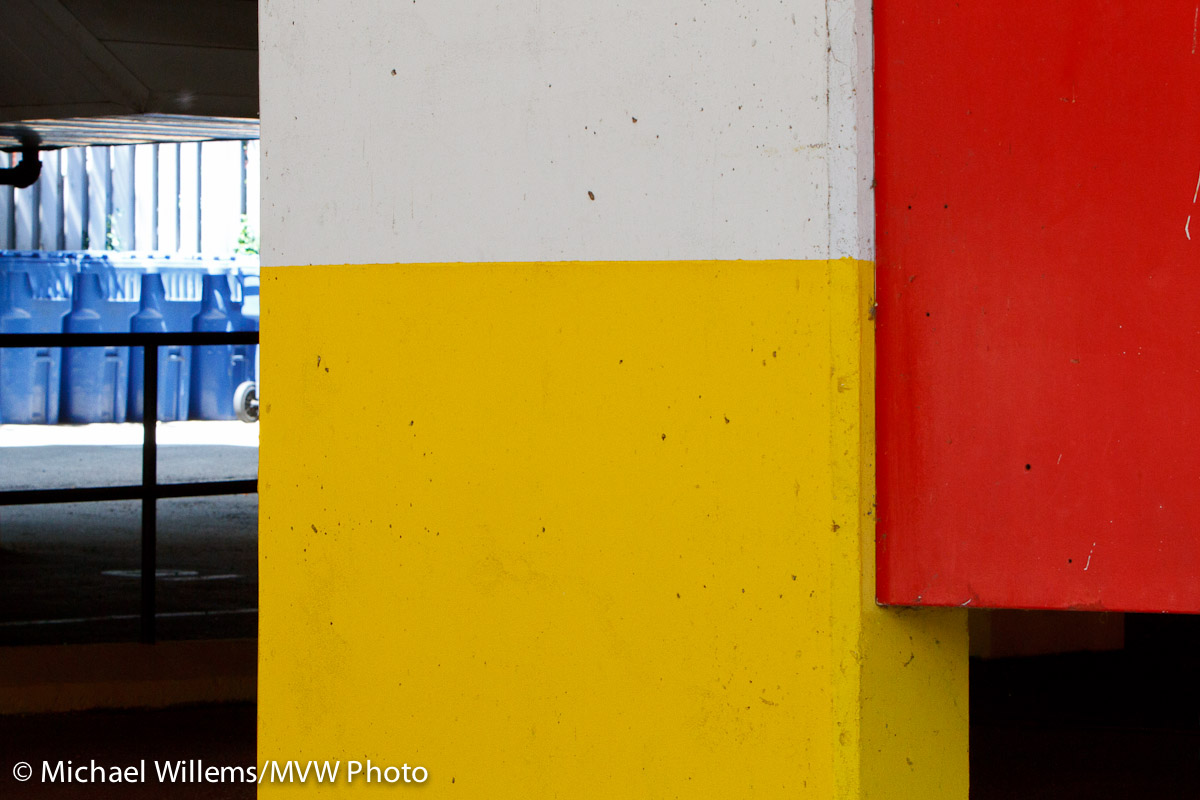
Composition with Yellow, Blue and Red; art in a car park; Photo by Michael Willems

Composition with Yellow, Blue and Red

Coffee by wall, photo Michael Willems

Coffee by wall, photo Michael Willems

Bike detail, photo Michael Willems

Urban Bike detail, photo Michael Willems

Erin, by Michael Willems

Erin with flash, by Michael Willems

Ha ha… can you see my flash (with Honl 1/4 CTO gel) in the last picture?

EDIT: Alright, one more, taken with the GF-1:

Flowers in Oakville, by Michael Willems

Flowers in Oakville, by Michael Willems

CUP

Today I am doing a walkaround in Oakville: “Creative Urban Photography”. A three-hour mix of tech review, storytelling, and more.

What kind of situations do we look for? Things that tell our story. Whatever it may be (and we go into that).

But also, there are visually interesting things we always look for, because they may contain interest. For example, in no particular order:

  1. Curves, particularly S-curves
  2. Converging lines
  3. Reflections
  4. Frames
  5. Colours (contrasting or strong)
  6. Textures
  7. Overview – medium view – detail view: don’t forget the detail
  8. Juxtapositions (often funny ones)

There’s more, of course, much more. On these walks we explore that.

Steeling up to carrying bag and cameras all afternoon!