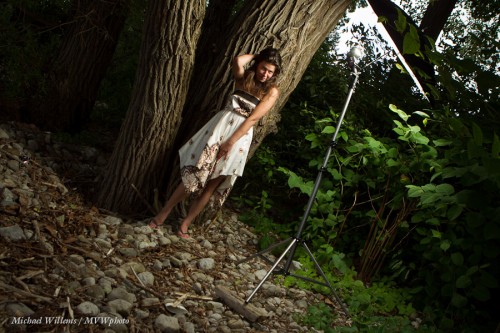
Challenging Shots

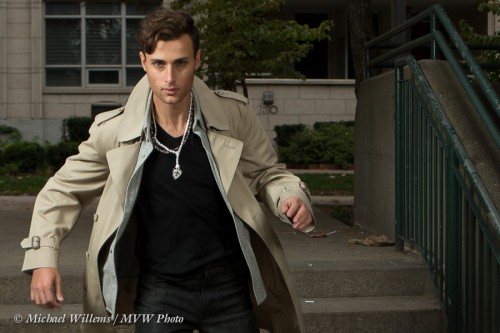
Some shots can be a little tricky. Like this one, from Sunday’s shoot:

Tricky why? Because the model is jumping, making it hard to focus.

The solution? You could try AF-C/AI-Servo, i.e. continuous focus. But often in these cases a better solution is this (and that is what I did): pre-focus, then hold that focus while he jumps. So I had the model stand where he would be when I take the shot; then focused there and held that focus while he moved back and jumped; then I shot when he was once again in the same place.

Why is he not blurry? Because he is substantially lit by the flash, which fires faster than 1/1000th second.

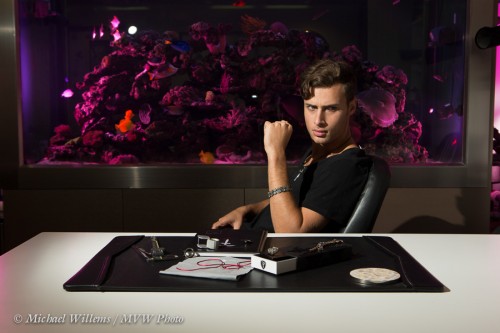
Another, different challenge was presented by this shot:

Why? Because the original plan was to light the aquarium in part from behind. But I was shooting TTL, and guess what? I found out on Sunday that the light-driven TTL does not work through an aquarium. Fancy that. You learn something new every day, even when you have been doing it forever.

The solution was to light it from the sides instead, after removing the aquarium side doors. Sometimes you just have to change your plans a little bit!

Enjoy your speedlighting, everyone. I am off to sleep – finally, at 3AM.

You can do this too.

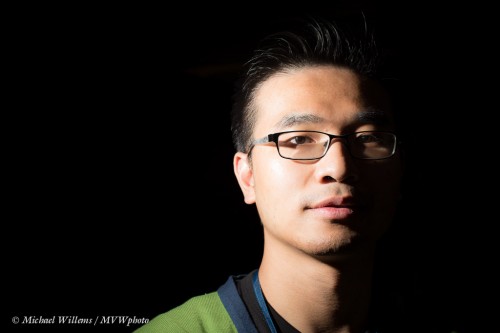
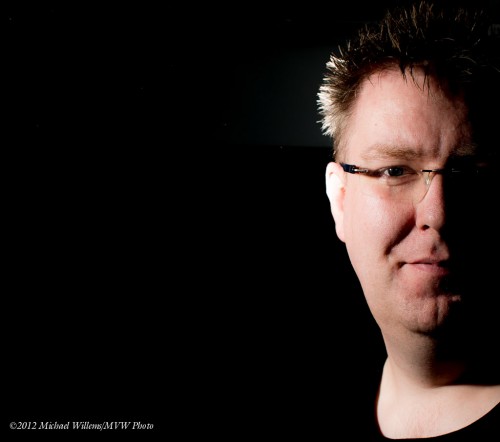
Here’s a quick portrait of Ivan, the manager of Mississauga’s Vistek store.

Took about… oh, all of one minute.

Here’s how.

  1. Set camera to manual exposure.
  2. Select values for Aperture, ISO and Shutter Speed that will make the room go dark. Here, that was 1/160th sec, f/8 at 100 ISO.
  3. Put a flash on the camera in MASTER mode (a Canon 600EX here, set to using light, not radio, as a master). (You can use the popup flash on a Nikon or on modern Canons like the 7D, 60D, etc.)
  4. Make sure that this master flash will not fire during the shot – it fires only commands (“morse code”) to slave flashes, prior to the shot. Set this on your flash or camera.
  5. Hold a slave flash (in my case a 430EX in slave mode) in your left hand.
  6. Ensure that this flash in in TTL slave mode on the same channel as your master flash.
  7. If the room is very small, put a grid (eg a Honl Photo 1/4″ grid) on the slave flash.
  8. Aim that flash directly at the subject (really).
  9. Focus, recompose
  10. Shoot!

It really was as quick as that. When you learn good technique, you too can be quick with creative shots like this.


Portrait lesson

A quick portrait lesson today.

Here’s student and photographer Emma, in a coaching session on Friday:
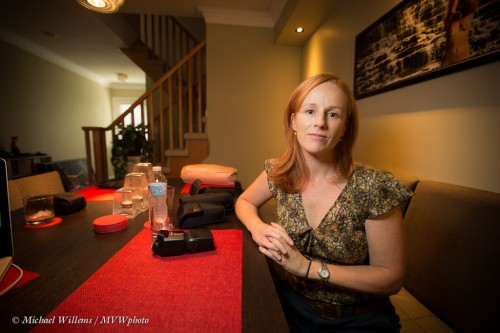
For this photo I used a 16-35mm lens, set to 16mm. On my full-frame Canon 1Dx camera, that is a proper wide angle lens – like a 10mm lens on your 5D, 60D, Rebel, D90, or similar.

So first, let’s put paid to the adage that “you cannot make portraits with a wide angle lens”. Yes you can: environmental portraits, where you do not fill the frame with the subject. Distance between subject and photographer is the only important thing, not lens angle. A wide lens gives you that wonderful “wrap around” effect that we love in this type of portrait – the subject in, and as part of, her environment, rather than as a standalone object.

So that out of the way, what about camera settings?

I used the Willems 400-40-4 rule for indoors flash. Since our indoors environments are often roughly the same brightness, a manual setting of 400 ISO, 1/40th second, f/4 will give you a starting point that is ambient minus two stops.

Which is what I want if I want to see the background, but not too brightly: just like Rembrandt, I want to make my subject the “bright pixels”. Because as a reader here you also know Willems’s Dictum: “Bright Pixels Are Sharp Pixels”.  So that means a slightly darker background.

OK,  so that is the background  taken care of: -2 stops, give or take. How about Emma?

I used an off-camera 600EX speedlight, driven by an on-camera 600EX that was set to only command the other flash (using the new radio interface). I equipped the flash with a Honl  photo Traveller 8 softbox for that wonderful light – and that wonderful circular catchlight in Emma’s eyes:

Good, so we are set.

But what about the idea of making it a monochrome image, to stop the red distracting us? In Lightroom, simply select “B/W: in the Develop module:
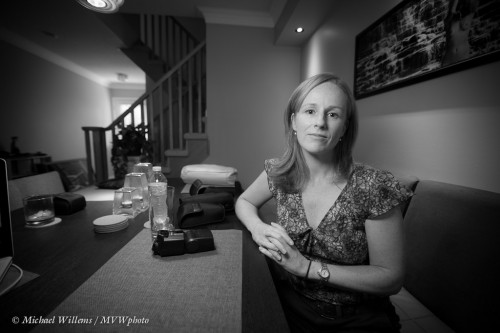
You may or may not prefer that to the colour image. If you do, then consider dragging the red to the left a little in the B/W module. That means red light will be used less in the conversion, i.e. it will be less bright in the black and white image:
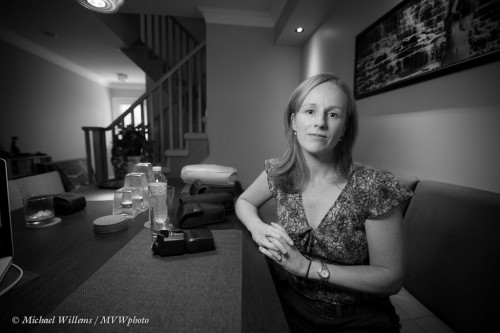
Now we have gotten rid of the red place mat almost entirely, allowing us to concentrate on Emma. That is often a good reason to go to black and white: you get very extensive creative options.

Mission accomplished, in a very simple-to-do shot that is miles beyond a snapshot.

Yes, simple – once you know how (this is what I do, and it is also what I teach).  Invest some time and effort in learning these techniques – you will love what your new photography allow you to do creatively.
 

Outdoors modifiers

Reader James asks:

I’ve read you advocating for unmodified on camera flash outdoors (as fill), and for on camera flash diffusers (Bounce card, Gary Fong,etc), but is there a reason you don’t use the techniques together? Why not use a diffuser while using fill flash outdoors? Wouldn’t that produce better images?

Good question, and one I am grateful you asked. To avoid confusion: yes I certainly do advocate modifiers outdoors.

Like an umbrella, as in this image:

(That image, by the way, was my tribute picture to Rineke Dijkstra, famous Dutch photographer whose work is in MOMA and many other museums. I was amazed that in The Netherlands, several people, when seeing this image, immediately said “That’s a Rineke Dijkstra”! Europeans really do have a great sense, and knowledge, of art.)

So why do I often advocate direct flash outdoors?

I have several reasons.

  1. Main reason: modifiers take power, and with a speedlight, you are fighting the sun at top power already; taking away a few stops of light (and you take away at least that!) is fatal: in bright sunlight you would now need to move the flash very close to the subject.
  2. Ancillary reason: It is quicker and simpler. Often, you have to move quickly; an on camera flash is convenient in those circumstances. Imagine carrying an umbrella with you when sightseeing in a foreign city!
  3. Ancillary reason: outdoors you are mixing with lots of available light, so you can get away with the shadows direct flash gives you: these are filled in by the ambient light.
  4. Ancillary reason: sometimes you want harsh shadows. Rarely, but it does happen!

And that is why I often use direct flash. But generally, modifier, softened flash is better, absolutely.


Cropping is allowed…

Take this image, of a student in last week’s Rotterdam workshop:

Single flash, off camera, using TTL. Flash fitted with a 1/4″ Honlphoto grid. Aperture/shutter/ISO set to make the background dark.

Not bad, but how about we cut off the distractions on the right? Let’s see:

I think that is a much stronger image. Yes, you can crop off half a face – why not?

Every time you simplify an image, there is a good chance it will become a stronger image.

I am back from Europe, and I drove to and from Montreal yesterday  -12 hour in the car – soon, back to longer tips and tricks here on speedlighter!

Speedlighter

I call this column speedlighter for a reason. Many, many of my shots are made with small flashes, “speedlights”.

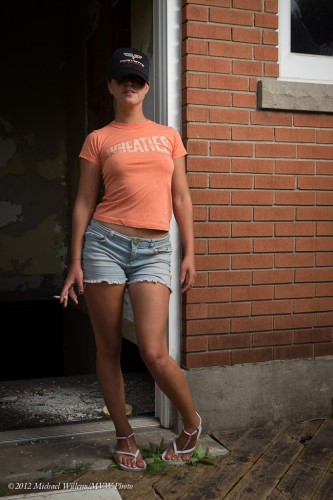
Like this one, of the model by a door at an abandoned house;

To get the moody look, I used

  1. The Canon 1Dx with a 24-70 f/2.8 lens
  2. The camera set to manual, 200 ISO, f/5.6, 1/200th second.
  3. A 600EX speedlight on the Camera, used only as a master (flash disabled other than that)
  4. A 580EX speedlight on a lightstand, fired into an umbrella; used as slave
  5. Simple automatic TTL flash metering!

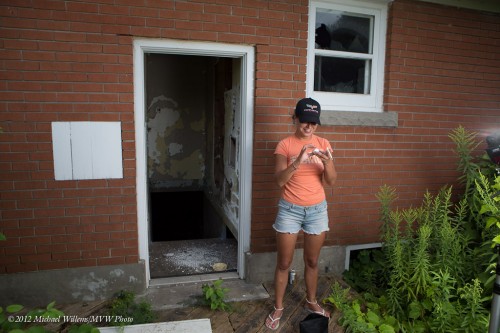
A pre-shoot setup test shot shows the light dropoff, and you can just about see the flash/stand on the right:

This was daylight, but the flash allows me to make the daylight basically disappear.

That’s the power of light, the power of added light, the power of flash: I do not like to think of what life was like before this. And a single speedlight, light stand, mounting bracket, and umbrella is all you need – and this is really speedy. They are called speedlights for a reason!


What’s this Hi-Speed flash thing again?

A reminder for all you speedlighters.

Say you want a shot like this, taken a few days ago,with your Nikon D90 or whatever SLR you have equipped with an external flash (like an SB900):

Yes, direct on-camera flash, when used outside and hence mixed with available light, can give you this – not bad eh? And the picture isn’t bad either. 🙂

But look at the background. It is blurry.

That means a large aperture was used (f/5.0 in this case).

But that means the shutter speed must have been very fast – even at low ISO, you need a fast shutter on a sunny day if you want the aperture to be large. I used 1/2500th second.

But hang on. When using flash, you cannot exceed the flash sync speed! Which is 1/200th second on this camera.

So how did I do this? I enabled “fast flash”. (“Auto FP flash” is what Nikon calls it; Canon calls it “High Speed flash”). On a Nikon, go into the flash part of the pencil menu and find flash sync speed, and set to Auto FP. On a Canon flash, indicate the little “H with a lightning symbol”.

Now the flash, whenever you exceed the sync speed, pulses rapidly instead of firing all at once, meaning that you can shoot at fast shutter speeds, where the shutter never fully opens all at once.

The drawback is that most power is lost, so you need to be very close. Aim the flash forward and watch the indicated flash range: as soon as you exceed the sync speed, that range drops rapidly. Stay within that range and you get great outdoors flash pictures!

___

NOTE: Come join me for a five day workshop at August’s Niagara School of Imaging – it is filling up but there is still space. Act now and spend five days with me on all this stuff, and emerge a flash pro.


The Art of the Dramatic Portrait, Continued

At the risk of being repetitive, let me deepen your understanding of dramatic portraits a little.

A dramatic portrait, in my world, is one where:

  1. I emphasize the subject.
  2. I darken the background.
  3. I make the subject the “bright pixels”.
  4. I carefully shape the light.
  5. I carefully direct the light.

You have heard me say this many times, but as said, let me deepen your understanding.

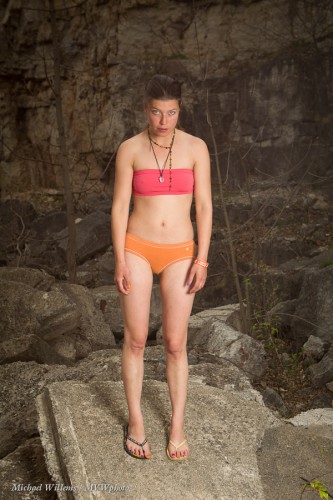
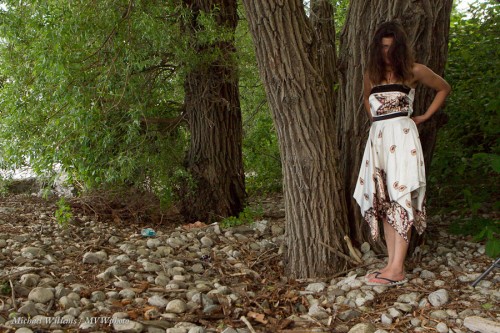
To show you want I mean, look at a few samples from a recent shoot the other day. These are outtakes, but they serve well to see what I mean (for actual shots, come see the Never Not Naked: Natural Nudes exhibit – an exhibit with a twist, June 22-July 8).

Let us start with a typical snapshot. 100 ISO, f/5.6, and this would be around 1/30th second. This is what available light and “Auto” or “Program mode” would give you:

Fine, but there are several things that can be improved.

  • The subject’s face is lit uneventfully and insufficiently.
  • The subject is “dark pixels”, not sharp “bright pixels”.
  • The subject competes for attention with pretty much everything else.
  • The tree bark’s texture does not really come out very well.

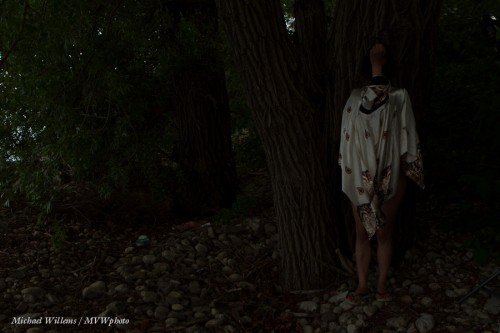
So now let’s do it properly. When I say properly, I mean “Michael Dramatic”. And “Michael Dramatic” for me means three stops below ambient. So I move the shutter to 1/250th second. Three stops darker than a “normal” exposure, in other words. (1/30 to 1/60 is one stop; 1/60 to 1/125 another; 1/125 to 1/250 the third stop).

Three stops is my dramatic portrait. Often, of course, you use less than three stops darkening. Like when you want less drama. Or when your flash is not powerful enough to provide three stops above ambient light.

Anyway, three stops below gives us this:

That’s dark. Um yeah, that is what I had in mind.

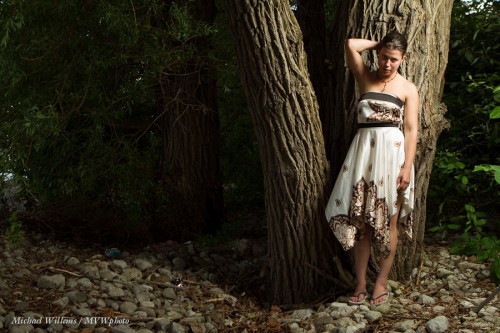
Because now, finally, we add a flash. And we get what we came here for:

That was done with a single off-camera 430EX speedlight close by, fired into an umbrella. Like this:

You see there are several aspects to this, right?

  • The darkening of the non-flash lit part of the image (the “background”).
  • Properly lighting the subject.
  • Softening the light for the human.
  • But also the shaping and directing of the light. When I see a tree, I think “texture”, and side lighting brings out that texture.
  • Good composition.
  • The Inverse Square Law: light drops off away from teh flash.

Yes, all this needs to come together for a good shot. Go try a photo like this, and tell me how you did!

___

Note: You really can learn this, and in not many hours. My June Special is stil on: $75 per hour plus tax for private coaching, for June only (normal price is $95 per hour).


What to start with?

So you are outside and want to darken the background for a mixed light picture. You’ve heard me talk about this repeatedly.

What can you do? Yes, the triangle, of course. Aperture smaller, shutter faster, ISO lower. But which do I prefer?

Outside in bright conditions your flash is competing with the sun. So you do not want to reduce effective flash power. Yet both aperture and ISO do not just reduce the background: they also affect the effective flash power.

So in those conditions:

  1. You start with the shutter, always. As fast as you can, which is the shutter sync speed: 1/200th sec on cheaper cameras, 1/250th on most, and 1/300th on some (like my 1D  Mk IV). Go to that speed.
  2. Then, and only then, if you still need to darken more, start messing with higher “f-numbers ” or lower ISOs.
  3. If you now end up with insufficient flash power? Add flashes. Bring the flash closer. Use more powerful flashes. Zoom in with your flash heads. Or as a last resort, wait until the light is less intense.

Simple rules make the technical aspects of photography simple and that is what we want.

After the click, an image taken thus at 100 ISO at 1/300th at f/6.3. (It’s a slightly NSFW image so it is after the click. For those of you uncomfortable with the unclothed human body, like those of you in Anglo-Saxon or Muslim countries, or who buy at large photo retailers in Ontario: you may not want to click. Everyone else: click away, it’s entirely harmless!):

Continue reading