About that home studio

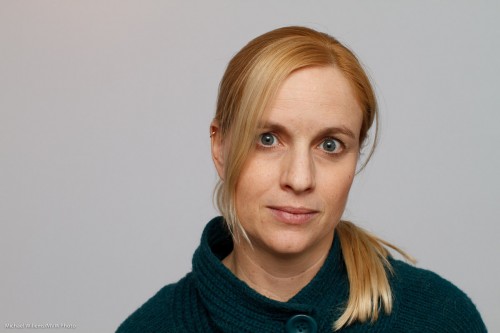
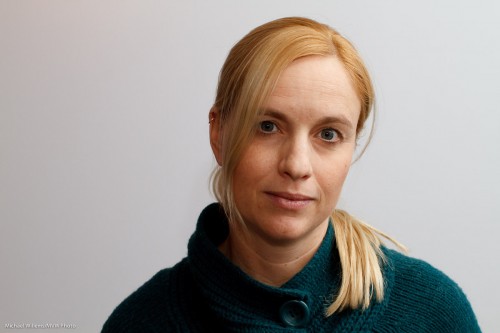
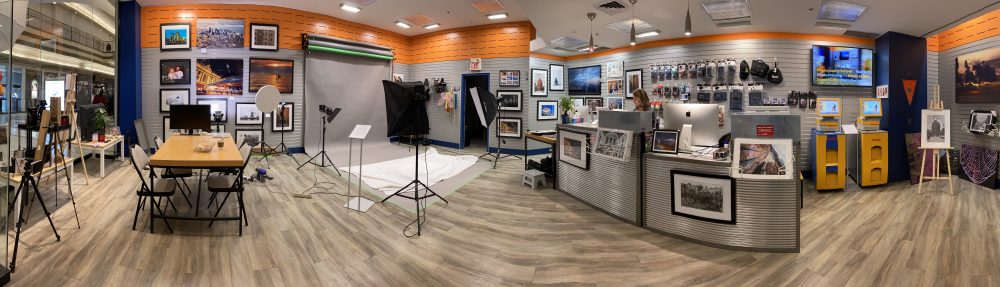
One more about the simple TTL home studio. I can give you some pointers to do your own.

Here’s how.
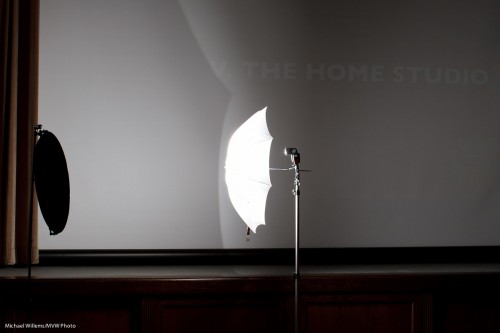
You need:

  1. A modern SLR camera.
  2. A lens – anything over 50mm will do. A 50mm f/1.8 might be a great choice: sharp and affordable (and if you need it, fast).
  3. If you have a Nikon, or a Canon 60D or 7D, just one flash (a 430EX/580EX for Canon or an SB600/SB900 for Nikon).
  4. If you have a different Canon camera, an additional 580EX to command the other flash.
  5. An umbrella (shoot through).
  6. A stand for the flash, with a mount for flash plus umbrella.
  7. A reflector (silver or gold or white, or a multi-purpose one).
  8. A stand for that reflector.

As an option, another flash with a small stand to light up backgrounds, but this is not a must have. You can just move the umbrella and subject closer to the wall if you want the wall to be lighter.

Now that you have the equipment:

  1. Set your flash to “slave” (Canon) or “remote” (Nikon) mode. Use the manual to find out how. On a modern Canon with a modern flash you can use the camera to set the flash.
  2. Set up your on-camera flash to be the “master” (“Commander”, on Nikon).
  3. Ensure that the on-camera flash is not going to fire (it will only  send commands to the remote flash, but it will not actually fire – else you get a shadow).
  4. Move the umbrella close to your subject. For a “standard” portrait, the best position is 45 degrees up, off to the side 45 degrees.
  5. Move the reflector close on the opposite side.
  6. Set your camera to manual exposure mode, f/8, 1/125th second, 100 ISO (or 200 on a Nikon).
  7. Take a test shot.
  8. Check the histogram. If you are shooting a dark subject against a dark wall, you may need negative (perhaps -1 stop) Flash Exposure Compensation; if you are shooting a light subject against a white wall, you may need positive (perhaps +1 stop) Flash Exposure Compensation.
  9. Make sure there is a catch light in the subject’s eyes. Ensure that any glasses do not reflect (move subject or umbrella if they do).

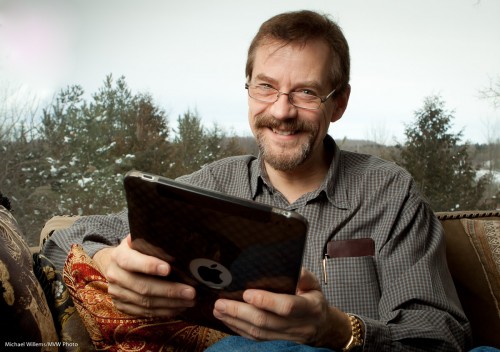
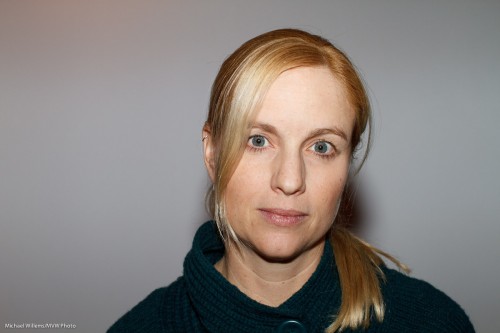
It is as simple as that. You will have studio quality shots, for very little investment. Shots like this (which I made with the exact setup above):

With a modern camera and flash and a little knowledge, it really can be that easy.
Another reader question

A few days ago, reader David asked me this:

Just wanted to get your input on a upcoming event I will be shooting on Friday night. The events will be group shots (family and player) at a high school basketball game for their ‘Senior Night’. Since it will be in the gym with very high ceiling, bouncing off the ceiling does not seem to be a viable option. I was thinking about bouncing using a gobo card. Since the room will be filled with lovely (not) florescent light and wonderful (not x 2) swamp lights overhead, I could bounce the flash as a fill light to help get rid of the awesome green tones. The second option is to use an off camera 580EXII with a Honl Traveler 8 softbox (close to camera center maybe). The third option (since I believe in the power of 3) would be to use my Fong Reporter Whaletale with and on-camera flash. I am interested in “what would Michael do?” (As a a side note: I typically use a gray card to get a good white balance. I shoot everything in RAW, so flexibility in post-prod adjustment is not an issue.)

Good question, David.

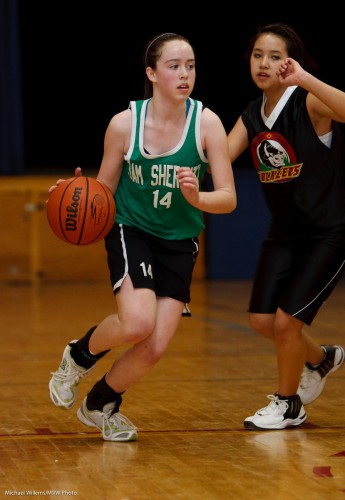
For basketball I would say the following. First, here’s an example of a basketball pic I shot.

That was 1600 ISO, f/2.8, and 1/300th second.

And… oddly for the Speedlighter, I used flash, straight-on. As you correctly surmise, ceiling bounce or wall bounce can be difficult.

So this is one case where, if it is allowed (Ask the coaches! In high school basketball it will often be allowed) you can use straight-on flash to fill in the light. Of course this means recharge time between shots,  but if allowed, you may want to do it. Also watch out, you could get red-eye – easy correction of course, but still, you have to do it.

Alternately, you can bounce of a larger bounce card. That will mean less power and more recharge time, but it can be viable.

Of course you can also choose to live with the light that is available.

You other options are good to try, too. Off-camera is not likely to be much help though since at the distance you are shooting at, it’s close to the camera even if held a few feet away. The softbox, ditto, and you lose light.

Also, the long lens is great but do not forget the wide lens for close shots. And:

  • If you can, bring two cameras
  • Ask the coaches if you can use flash
  • Get close ups
  • Shoot under the rim, but be careful behind it – balls will hit!
  • Shoot vertical shots
  • Get the back of shirts to get the numbers
  • Shoot emotion: happy, sad, angry
  • Shoot action: close up
  • Shoot static for each player too

I hope that helps… and yes, I did answer this reader before that Friday!

You know this.

But I want to show you again – and emphasize it once more:

Flash needs to be bounced.

I shall illustrate with three snaps of a kind volunteer in last Sunday’s camera course that I taught in Oakville.

Snap one shows that aiming your flash straight at your victim ought to be a federal offense. (The young lady was warned and kindly agreed to be pictured this way, with a 580EX II flash straight into her face, using TTL, but knowing there would be better snaps to follow):

Not that she doesn’t look great, but the photographic qualities leave much to be desired.

  • Shadows under her ears;
  • And under her chin, a hard shadow;
  • “Deer in the headlights” look;
  • Skin looks reflective;
  • Face is flat;
  • Background is dark;
  • The catch light is in the centre of the pupil.

So then I turn the flash up at a 45 degree upward angle right behind me. That way the light comes from 45 above in front, from her perspective, and this is typical beauty lighting:

This is still using TTL, so all I had to do was to turn the flash behind me, and bang. A portrait instead of a snapshot. All the problems solved in one go!

You could also turn the flash to the right or left, so she gets light from the side, above:

Now the face is more three-dimensional and sculpted.

I would normally use more straight-on lighting (pic 2) for women and more side lighting (pic 3) for men (because the latter tends to show “character”, which can be a euphemism for “age”).

Either way, though: avoid flash on camera aimed at your subject. This is why your pop-up flash is evil, and why my 1D and 1Ds bodies do not have one.

And with modern TTL flashes and cameras, you do not need to do anything other than “turn the flash head”.

Flash Outdoors?

Another quick travel photography tip for you all today. My cold is still getting ever so slightly better every day – soon, longer posts. Until then I concentrate on useful!

Flash. Use it outdoors. When it’s sunny.

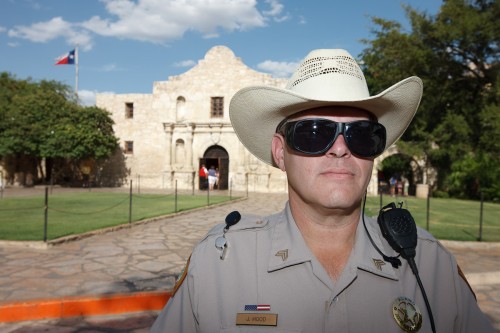
Yes, you need flash when it is bright and sunny! Like here:

Officer Hood at the Alamo

Without flash, his face would have been dark.

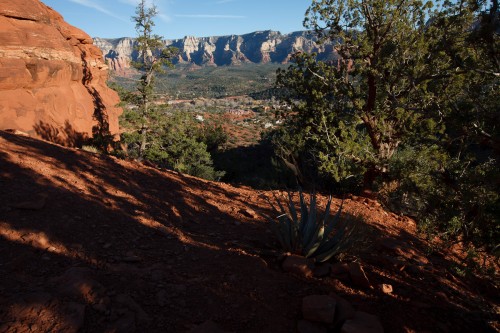
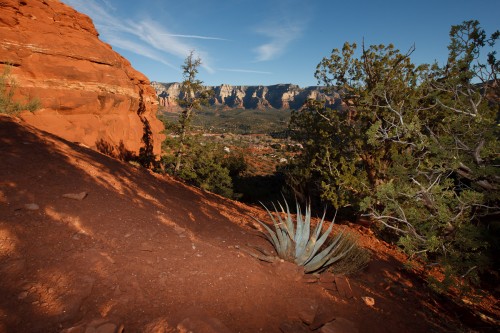
And look at this no-flash shot. Can you see what’s wrong?

Sedona Sunset

Right, so now we light up the foreground with our speedlight:

Sedona Sunset

Sedona Sunset - with flash

See how much difference that makes? In that last picture, I used a flash exposure compensation setting of -1 stop, to avoid the flashed part of the image becoming too bright. All I wanted is some fill.

Smiiile!

OK, so – no, don’t ever say that to a subject. The command “smile” is like saying “look weird”, “look unnatural”, “assume a pose”. And not only to young children.

Instead, tell stories, say something funny, get the subject to relax. This picture of me was taken by a student a day or two ago:

Michael Willems - smiling

And I never smile. But, mention certain subjects and I smile naturally, not because I am told to smile – that never works.

This is one reason portraits can take time to make. Getting a subject to relax cannot be done in a hurry.

How did we light this?

  1. Expose for the background. Ensure the background light does work as “fill light” for the subject.
  2. Use an umbrella-mounted speedlight (shooting through the umbrella if you can), connected via pocketwizards.
  3. Position the umbrella somewhere 45 degrees above the subject, and for a male, 45 degrees to the side if you like.
  4. Set the flash power according to the exposure you worked out for the background. Use a light meter to verify that.

Bob’s your uncle: Practice that technique and you will do much better when shooting portraits. And remember, never say “smiiile”.

Power!

Power. To the Speedlighters.

When you are using  a flash outdoors, power is the greatest need, and potentially the greatest problem. If your flash is to be comparable to outside light, or even brighter than it (“nuking the sun”), you need lots.

So I have two tips for those of you using speedlights (small flashes) outdoors.

  1. Do you have enough power? To find out, Set your flash to MANUAL mode (on the back of the flash). Now set it to full power (100%, or 1/1). Now Fire! If you get overexposed parts, you have enough power, so any dark pictures are due to your settings or metering. Carry on and find the problem. If not, you simply do not have enough power, so forget it or move the flash closer.
  2. Need more power? Then zoom in your flash manually. Eg when using 50mm lens, zoom the flash to 105mm. Again, using buttons on the back of the flash (you may need to, dare I say it, read the manual!). This zooming in gives you a centralized, concentrated beam of power. The outsides will be darker but wherever you aim your flash wil be lighter.

Those two tips have saved me many times. I bet they will do the same for you.

I’m Gellin’

A very short article today about gels.

And by the way, I apologize for the recent short posts, but having 100 things to do, and being the proud owner of a to-do list that extends more every day, I must prioritize. Finishing “Event Photography” (stay tuned here, and keep checking the Henry’s School of Imaging as well) and “the art of photographing nudes” (see www.cameratraining.ca – one week to go!) come first. Filing my taxes comes down the list somewhere.

Gels are little coloured pieces of plastic. They used to be made out of gelatine, hence “gel”. You put then in front of the flash to colour the light. As in this shot, where I used a quarter CTO (“colour temperature orange”) Honl Photo gel on my speedlite:

Event, lit with CTO-gelled flash

And as in this one, where I used a full CTO:

Event, lit with CTO-gelled flash

The CTO gel, in these cases,makes the flash-lit subject look like it/he/she is lit by beautiful setting-sun “golden light”. A quick and easy way to lend your images a bit of pizzazz.

The horror.. the horror…

…of walking into a venue where you have to shoot, only to discover that the ceiling is about 1,000 ft high and the walls are black, and there is zero light.

1600 ISO, 1/30th second, f/1.4

My strategy?

In this order, I:

  1. Reduce Shutter to what I am comfortable with.
  2. Open Aperture to what I am comfortable with.
  3. Increase ISO as much as needed.

That is how I got to those values above. Using, of course, my prime 35mm f/1.4 lens. I reduced the shutter to 1/30th, which is as low as I want to go with a 35mm lens if I can help it. Then I went to f/1.4: wide open (focus carefully!). Then I raised ISO until I got light into the background. Phew!

Learning opportunity! Stay tuned for an exciting new “Events Photography” course – details soon. And there are also still spots on “The Art of Nude Photography”, Sunday January 16, 2011 (See yesterday’s post).

TTL: 10 Problems, 20 Strategies

I shot an event yesterday that prompts me to give you some TTL management strategies. This is a long post – one that you may want to bookmark or even print and carry in your bag.

TTL Management Strategies? Huh?

Yup. TTL (Through The Lens) flash metering is great, but it can have its challenges. Unpredictability, or perhaps better variability, being the main one.

So why use TTL at all? Well, for all its issues, it is the way to do it since you are shooting in different light for every shot, and you have no time for metering. Metering and setting things manually (or keeping distances identical) in an “event”-environment, especially when bouncing flash, is usually impossible. So TTL (automatic flash metering by the camera and flash, using a quick pre-flash) it is.

Cheers! (a Michael Willems signature shot)

Yesterday’s event was in a restaurant that had been closed to the public for the night. Challenges for me were:

  1. Light. It was dark. Very dark, meaning achieving focus was tough and settings needed to be wide open and slow.
  2. Consistency. The venue was unevenly lit: parts were light, parts even more dark. Meaning that achieving “one setting” is difficult.
  3. Space. Space was limited: hardly enough space in a small venue to walk around, let alone to compose shots.
  4. Bounceability. Walls were all sorts of colour, mainly dark brown, making bouncing a challenge.
  5. Colour. This also created coloured shots. Orange wall = orange shot.
  6. Predictability. Long lens? Very wide? Fast lens? Every shot seems to need another lens – which is impractical.
  7. Reflections. There is a good change reflections of glass or jewellery will upset your shots, causing them to become underexposed.
  8. Motion. People kept moving (uh yes, especially when the chair dances started).
  9. Technology. Batteries run out. Flashes stop working. Cards get corrupted. Nightmare scenarios we all know.
  10. Time. People were not there for me – it was of course the other way around. So my ability to ask people to pose and to move was limited. They are there for a party, not for the photographer.

So then you shoot and you notice that shots are too dark. or too bright. Or faces are too bright while backgrounds are too dark. But this is all in a day’s work for The Speedlighter… that is what I do for a living!

Mazel Tov!

I am sure everyone who has ever shot events is familiar with these issues. To solve them and come up with solutions, I have developed a number of strategies. So let me share some of them with you here.

(Click to continue and read the solutions…)

Continue reading

Merry

Mono Landscape

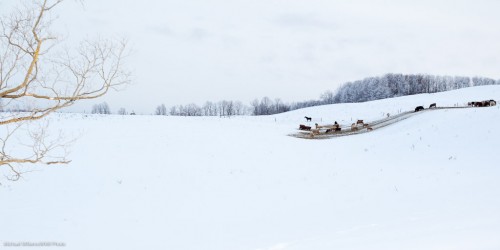
..but cold. Can you see it’s cold?

Why? Because it’s bright and snowy, and a little blue (“cold”, even in photographer’s terms – which by the way are opposite to physicist’s terms).

Can you also see:

  • Negative Space (much empty space to emphasize the animals’ isolation)
  • The rule of thirds (“off-centre composition”)

Back to the light. To get that brightness, I had to increase exposure compensation to +1.7 stops. To get the colour, I had to choose the right white balance.

Conversely, a little later I wanted the background to be darker. I decreased exposure compensation, to minus one or two stops. That gave me this:

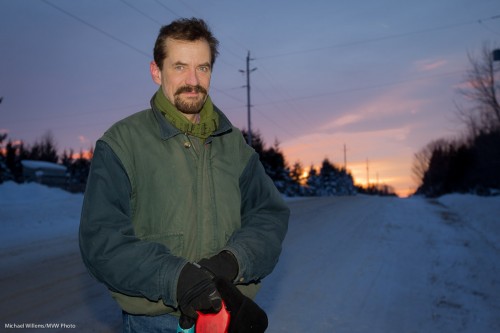
Michael in Mono

Yup. Me. And a few minutes later:

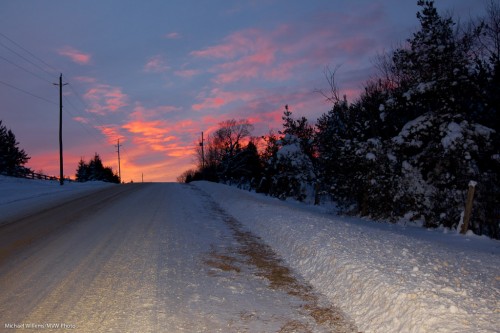
Mono Winter Sunset

You see, lower brightness means more saturated colours (saturated means “not mixed with white light”).

And of course my speedlight is on the camera, to throw a little light onto the foreground. You would expect nothing less from the speedlighter.

I hope many of you can take similar landscape pictures this season.