Fun with Gels 3

I shot a night club yesterday.

Dark (black) walls, low light, stark modern furniture, not easy to shoot.

First, I used a wide angle lens (16-35 on a full frame camera). That got me the ability to get it all in, as well as freedom from focus and shake worries (the wider a lens, the easier it is to shoot at low speeds and the easier it is to focus on everything). I used a tripod, so the low speeds did not matter, but the focus all the more.

Available light was dull. Like this:

Berlin Night Club in Oakville, using simple light

Night Club using simple light

So I got out my bag of tricks:

  • A Pocketwizard on the camera
  • Four small flashes with pocketwizards: for the next shot I used one 430EX through a white umbrella and one direct, equipped with a red Honl Photo gel.
  • I set the flashes’ power levels manually, using simple trial and error and the histogram.

Now I got this:

Berlon Nightclib using two flashes

Nightclub using speedlights and gels

Isn’t that much more interesting?

Same here in the following picture. First, with just the flash in the umbrella:

Not bad, but a bit like a furniture catalog. How about with a nice red gelled flash also:

More like a club where things are happening.

The following shows part of my setup for another part of the room, with alcoves:

Light setup with multiple=

Which, when properly positioned, got me pictures like this:

Nightclub lit with multiple=

Look at the stool’s legs: do you see how much difference that red accent makes?

Later still I used a white umbrella plus a red gelled 430, a Honl Folies Purple gelled 430EX in the dance cubicle upstairs, and a red plus an egg-yellow gelled 430 as well. All of this done with Honl gels and Honl speedstraps.

Before:

..and after:

Of course some scenery needed no gels to pretty it up, just one bounce flash:

I did have to move her to the right where the bar had a small ceiling area to bounce off.

Flash Modifiers, when to use: 1 – The Fong Thing

Some photographers love the Gary Fong lightsphere because it throws light everywhere and makes it simple to shoot. Others hate it because it throws non-directional light, meaning “no art”.

They are both right. Every modifier has a range of situations where you use it, and a range where you do not use it. The key is not just to learn how to use a modifier, but it is to learn when to use it in the first place, and when not to.

So the Fong Lightsphere is a modifier that:

    1. You put on your flash
    2. Aim upward
    3. Use without the dome if you have a white ceiling; else use with the dome (the round side down).
    4. And which then throws the light everywhere.

      And I mean everywhere. Left, right, up, down, front, behind: photons bathe the room. And reflect off anything that can reflect. Which is the Lightsphere’s benefit.

      It is therefore good to use in situations where:

      1. It is dark.
      2. It is impossible to find a good bounce wall/ceiling behind you. A good wall/ceiling is almost always preferable if you can find it.
      3. You are looking for anything to get light into the room: you are not interested in artistically shaping light.

      Like in this unedited image of the Wendel Clark restaurant I shot yesterday:

      Using a Gary Fong Lightsphere

      Using a Gary Fong Lightsphere to light a restaurant

      Note that I was using my Gary Fong Lightsphere on a separate flash in my left hand, aimed at the ceiling. I was using TTL to fire that flash from the one on my 1Ds camera. Yes, you develop strong hands as a photographer – that, and arthritis.

      That off-camera use is a key technique for me: I often like to use the Fong off-camera to give me at least a little bit of shaping.

      Here’s another picture from that shoot:

      Wendel Clark Restaurant lit with an off-camera Lightsphere

      Using a Lightsphere

      So while as you all know I normally much prefer the Honl lightshapers – they allow me artistic control over where the light goes – “trendy venues” is a prime case where I use the Fong Lightsphere.Because Trendy Venues have no simple walls or ceilings, and those that there are tend to be black. So you need to bounce those photons off anything that wiull reflect them, anywhere in the room. Enter the Fong Thing.

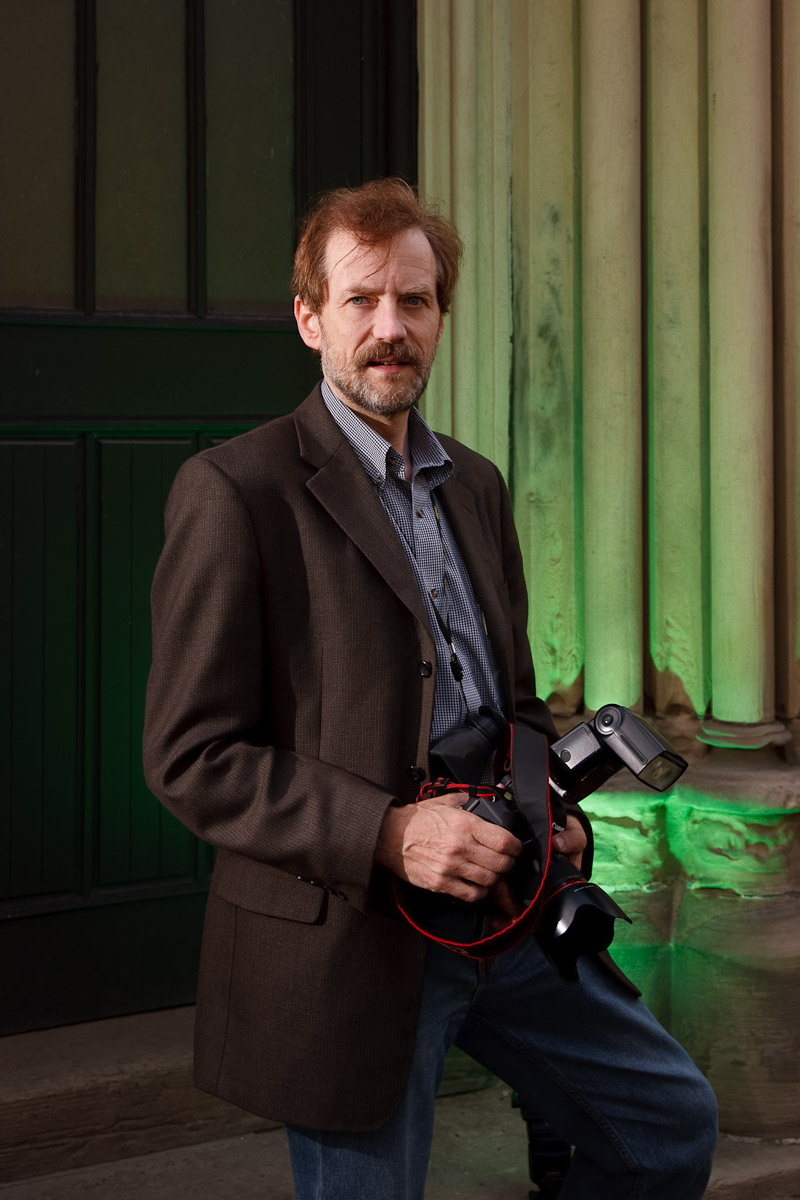
      What does the Fong Thing look like: Here’s me with one on the camera.

      Off-camera flash kept simple

      Sometimes it can be simple: off-camera flash can be really easy. Like in this student’s recent portrait:

      Off-camera flash portrait

      Off-camera flash portrait

      You can also see how nice the splash of colour is in the background, right?

      A matter of choosing manual mode with just the right combination of aperture and shutter speed and ISO to get enough light into the background. And Flash White Balance makes the tungsten light look nice and orange.

      My message today: although flash can be done in a very sophisticated manner, it is not always necessary to make it complicated. Often, very simple is all you need. “Off camera” is often enough to just make it work. And an off-camera flash cable, while not cheap, is the simplest way to achieve this.

      Why would you use flash outdoors?

      So why would you use flash outdoors during the day?

      Sometimes it is obvious: to fill in shadows on backlit subjects. Or to soften hard shadows. But sometimes you do it for more artistic reasons.

      Let me illustrate this with a shot taken during the Get Out and Shoot run we did in Toronto early this week – the workshop I wrote recently.

      Imagine you are shooting someone – me, say – on a bright day, but in a spot where I am in the shade against the shady side of a grey building. Before you know it you get a dull picture: grey and low-contrast on all counts: blaah.

      So that’s when you bring out the flashes. Say, two remote “slave” flashes, fired by a “master” flash on the camera. One slave to the camera’s left, shining into a Honl reflector, and aimed at the subject’s face, to add bright light to the subject. The second flash is equipped with a Honl Speedstrap and on it, a green gel, and this flash is aimed at the grey wall behind the subject to make it less grey.

      Now you get this:

      Outdoors Flash

      Outdoors Flash Used During the Day

      You will agree, I hope, that this is a lot better than it would have been without the help of flash. Even, no, especially, on this bright day.

      Want to learn about all this stuff: read here of course, but also: join me for training.

      (Thanks to colleague photographer Rob Corrado for the picture)

      My day

      First, more episodes of season 7 of “24”… the inimitable Chloe… one episode to go 🙁

      Then, teaching, and then to the gallery in Toronto’s historic Distillery District:

      That was a wide angle lens: 16mm on a full frame camera. Aperture mode, exposure compensation minus two stops, and flash on. (Aren’t wide angles great?)

      Then, in the gallery, a snapshot of a gallery visitor and potential student of flash:

      That was done with:

      • The camera on “Manual”…
      • …with exposure set to around minus two stops.
      • A CTO-gelled 580 EXII flash aimed to my right.
      • …and white balance on “Tungsten”

      Isn’t TTL wonderful?

      Balancing light

      One subject photographers need to learn all about it balancing light. In particular, I mean balancing background light with foreground light.

      If you take one of my workshops I’ll teach you all about “overpowering the sun”.

      As an illustration of that, three years ago almost to the day I took a few snaps of my son in Army Cadet uniform. The sky was mid-day light blue, but I used three off-camera flashes, two of which were in umbrellas and one was direct, to overpower the sun and make the sky dark:

      I used the 5D in manual exposure mode, set to -3 stops from ambient, and used TTL metered flash. Piece of cake. And yes, remote flash using light control does work in super bright sunlight, as long as you keep line of sight between the master and slave flashes.

      Can you also see that for this portrait I used a very wide lens? Even though you are not supposed to do that for portraits? That is because it is a situational portrait. Where the environment is as important as the subject. Just keep your subject’s face away from the edges – centre, or near the centre, is good.

      Son in car

      My son, just now, in a car in broad daylight, in a shot that took only a couple of minutes to set up:

      I used three speedlites on light stands; all three were fired using e-TTL light control from a fourth one on the camera.

      One speedlite is on camera right, one on the left, and one in the middle using a new Honl softbox to light up his face.

      Of course with a few more minutes I would have

      • Moved the softbox so it did not reflect,
      • Positioned the other better
      • Used more gels to add more colour
      • Cleaned the car more

      … but with a teenager, even three minutes is a rare gift.

      A portrait with three speedlites

      Here’s a portrait I just shot.

      I used the Canon 1D Mark IV with a 580 EX II flash on the camera, used only to drive three 430 EX II flashes using remote e-TTL. This is easier than ever: with the right knowledge and tools it takes mere seconds to arrange.

      So here’s how I did it.

      I used a 50mm prime lens (meaning 65mm effective focal length) with the camera on manual, 100 ISO, f/5.6 at 1/125th second.

      The lights were:

      • One 430 speedlite, the key light, is on camera left one foot away from the subject and is mounted on a cheap light stand. It is equipped with a new Honl Traveller 8 softbox.
      • The second, the accent light, also on a light stand, is one foot behind the subject, is aimed forward at her, and has a Honl 1/4″ grid fitted.
      • The third flash, aimed at the wall, is mounted on its little plastic light stand and has a green Honl gel fitted to its speed strap in order to add a splash of colour to the background.
      • I set an 8:1 A:B ratio to stop the accent lights from becoming too bright (the key light was A). I also used – 1/3 stop Flash Exposure Compensation, since the initial frame showed the face a bit bright.

      That setup was:

      Simple and effective. And if I say so myself, I think the green gelled background accent was an inspired choice.

      Today, with small flashes and modifiers, using TTL, you can do professional studio work in no time.

      Flash from behind

      Look at this picture, which a student took of me in a class the other day:

      Michael Teaching

      Can you see how she turned her flash behind her, so it aimed at the wall above her, which in turn lit me with soft, gentle light? Otherwise, if she had aimed it at me directly, we would have seen all the things that people hate in flash:

      • oily skin
      • flat face
      • dark background
      • overexposed subject
      • shadows under the chin

      Instead, we get soft, natural looking light.  And it’s easy: turn the flash so that the light bounces behind you. With TTL, it’s easy: the camera does the math. You just push the button.