As a reminder to travellers…

… since I am travelling tomorrow, I think there may be others… and hence, it occurs to me that this may be a good time to remind you of a recent article I wrote for Photo News Canada:

Michael Willems’s Top Ten Travel Tips for ‘Togs

In the next few days I shall probably post a few travel tips as well. But first – packing.


Tip: look for an all-new version of Travel Photography 101 at Henry’s soon. I am finalizing it now!

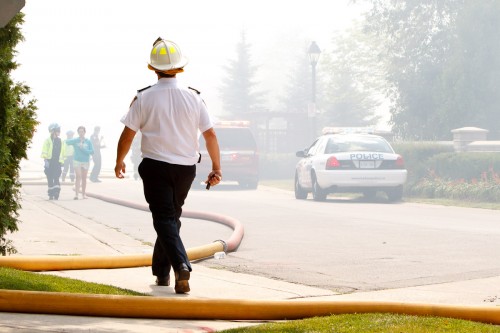
Haze as a benefit

When a shot of a distant scene is hazy, foggy, or smokey, this can be a bad thing. Low contrast can destroy that ice image of the distant scene.

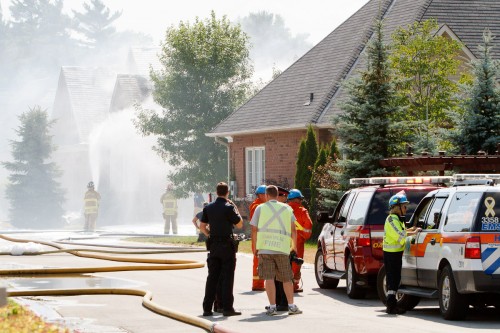
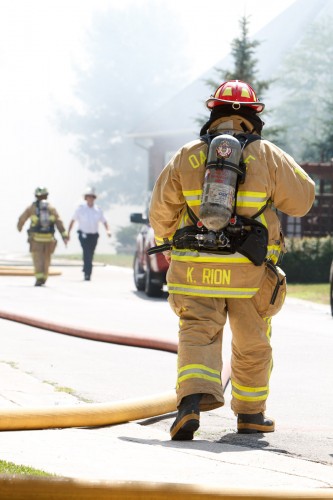
But you can also make it into a benefit. By putting sharp objects large in the foreground. Now the haze helps to accentuate and apparently sharpen the close object.

Fire scene (Photo: Michael Willems)

So now the disadvantage becomes an advantage.

Fire scene (Photo: Michael Willems)

Fire scene (Photo: Michael Willems)

So whether it is a fire you are photographing, or the Grand Canyon, or London: try to get a sharp object large in the foreground if the background is hazy.


Outdoor flash

Summer is still here, so I think it might be a good time to repeat a couple of flash tips for the summer. Especially as I plan to disappear into the sun for a week, Friday.

Outdoors you often need flash. Sunlight is harsh: so you need to fill in the shadows.

Outdoors you need max power. So keep your speed below the synch speed – 1/250th second on my 1Ds camera. Else you need to use high-speed flash, which loses power. Which you can ill afford on those sunny days.

Outdoors you can use direct flash, aimed at your subject. It is better to have studios and umbrellas and such – but outdoors you do not have that luxury, and you do not want to lose light.

So use a direct flash, and really, it can look very good. Especially if you take the flash intensity down a little (that’s what we call “fill flash” – 1-2 stops below ambient).

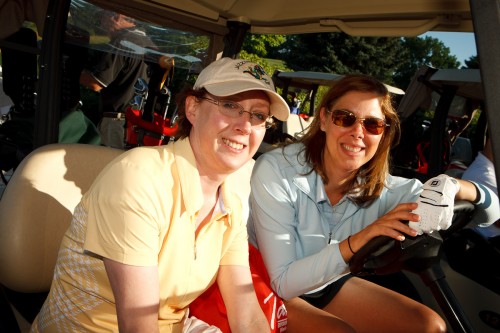
For a recent example of fill flash, see this image I shot at Minister Takhar’s Golf Open the other day.

Golfers (Photo: Michael Willems)

Not high art – but you can see the faces, and they are not half black. And often, that is all we want from a picture.


Size matters

Size – of your lens – matters. Like for travel, where you want a wide angle lens (10-20mm on a crop camera). Or on a portrait shoot, where you want the longest possible lens.

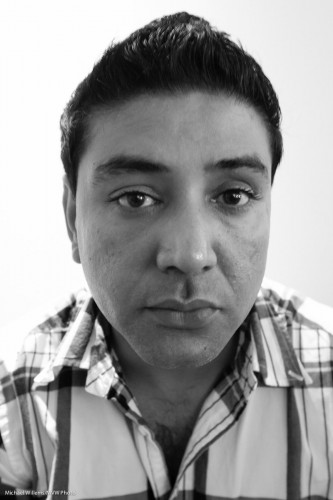
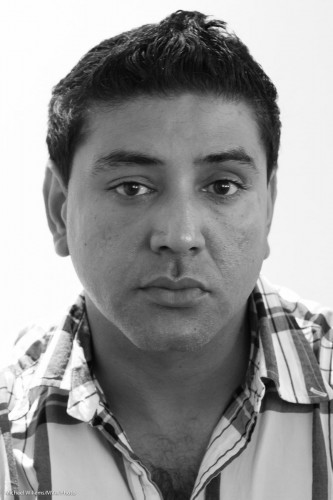
Why? Well, just look what happens when you use a wide angle lens for a portrait. To do thijs, you need to get close. Getting close means that what is cloer to you looks larger (hold your thumb in front of the moon: is your thumb really larger than the entire moon?)

So you get this:

Not bad, you say. Sure – but look whant happens when you use a longer lens; say, a 135mm lens:

See how much more neutral, “normal” that looks? So that is why you use a long, long lens for these “headshots” close-up portraits, when you can.

And the limiting factor? Simple – the size of your studio. A long lens means “stand back far”.

But if you have the space, that is exaclty what you should do.


On-camera softbox outdoors

When taking a picture outdoors on a sunny day, you may, as said many times here, want to use flash. Else you get this:
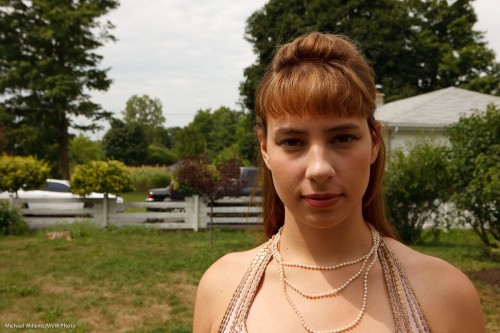
Sunlight bad. Shadows, brrr.

So instead, you use a flash.

But you all know that on-camera flash is bad. It has three major drawbacks:

  1. Harsh light.
  2. Non-directed – flat light.
  3. And the speedlite is not powerful enough.

True. But you can solve these three problems – as follows:

Harshness: use a softbox on the on-camera flash. Like the Honl Photo Traveller 8 softbox. Flash on camera; softbox on flash; aim straight ahead.

Non-directionality: a-ha. So if your model is looking to the right, say, then you turn the camera to the right, so the light is coming from the right and hitting her in the face from there. Yes, that is contrary to the way you normally hold a camera in vertical orientation! The shutter is now below, instead of on top. Bad technique normally; but here, necessary!

Power: if you want a dark background on a sunny day, you need to shoot at 1/200th second (stay below your sync speed!), 200 ISO, f/16. the only way to use a flash with that small an aperture is to be close. So you get very close!

So that is:

  1. 1/200th second, 200 ISO, f/16
  2. flash on camera
  3. softbox on flash
  4. flash aimed straigh ahead
  5. camera turned so that the flash is on the side of your subject’s face
  6. get close

And that gives you:

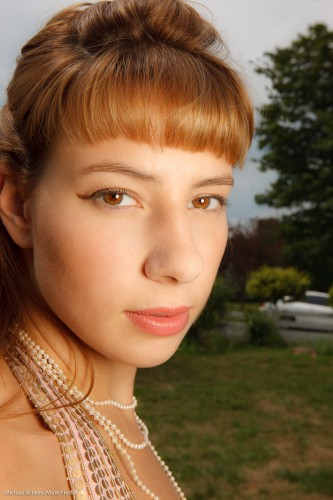
Jenna Fawcett, model (Photo: Michael Willems)

Not bad for an on-camera flash snap, huh? I used a Honl Photo Traveller 8 softbox, which was essential in this shot. It also gives you those wonderful round catchlights. Beautiful.

(I took this shot as a demo for students in the all-day Creative Light workshop we did Saturday. Stand by for more dates soon. ou can do this – it’s a matter of knowing the technique!)


Hay there girl!

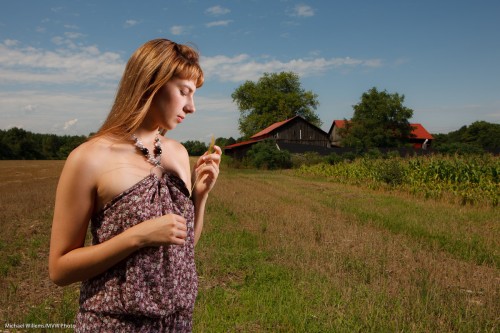
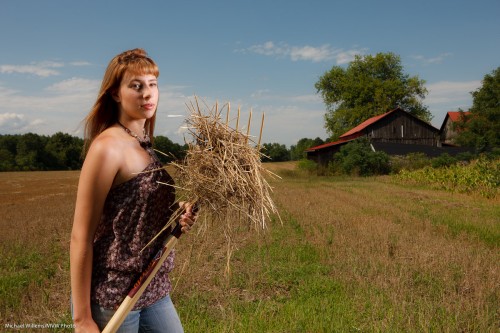
Here is model Jenna Fawcett, as I photographed her in yesterday’s Creative lighting workshop:

Model Jenna Fawcwtt (Photo: Michael Willems)

To make a picture like this, several things must come together.

Namely:

  1. A location. Simple, beautiful, with red and green and blue together. You have heard me before: red, green and blue in one shot, especially if saturated, make for a good picture.
  2. A subject. In this case a model, and clothing-make-up, props.
  3. The right equipment – camera and lens.
  4. Now, first of all, exposure set to expose the background properly.  Meaning nice and dark – “saturated” means “not overexposed; not mixed with white light”. The camera’s meter points at, say, -2.
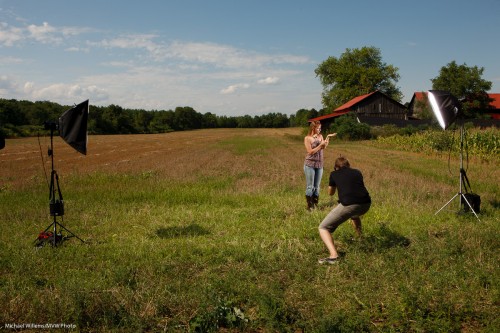
  5. Light to light up the subject. Meaning flashes-  in the case of a sunny day – biiig flashes, with octoboxes, umbrellas or softboxes. Battery-powered if you are in a field in Ontario. One on the right; one on the left.
  6. Proper exposure of this flash light (this may need a light meter). Becasue you underexposed the background, your subject, if exposed “normally”, will now stand out wonderfully.

And that’s the story. This setup looks like this:

Model Jenna Fawcwtt (Photo: Michael Willems)

Is a sunny day better for these shots? No – a sunny day is much more difficult. Nasty shadows, and you need very high power to be able to “nuke the sun”. So for a sunny day you need strobes, and power.

Why did I call this post “Hay there”? Here’s why:

Model Jenna Fawcwtt (Photo: Michael Willems)

Can I learn this? Yes. Easy – follow the rules above.

Yes, you need to learn lots of finicky stuff about aperture, shutter, and ISO – but it’s worth it. Read this blog daily. Try. Take a course. And take one of the workshops Joseph and I do – they are quite the experience, and include beer and wine and portfolio shots – and great images to take home!


Landscape

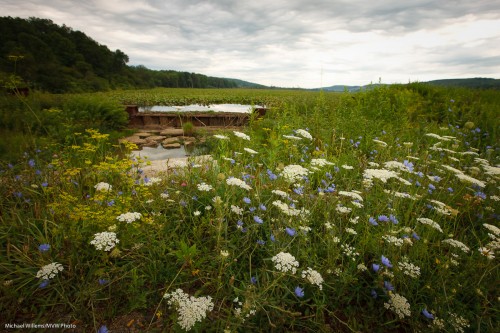
Why use wide angle lenses for landscapes like this?

Machias, NY (Photo: Michael Willems)

For various reasons. I have gone through them repeatedly, but here again, all at once:

  1. The wide angle lens gives you a feeling of being surrounded by the environment. That is because of simple geometry – if I look left, lines I am travelling along will look horizontal, while ahead of me they look vertical.
  2. I get more in.
  3. I can get depth into the image (get close to something and you get the “close-far” depth effect).
  4. It is easier to focus on “everything” – the wider the lens, the more extended depth of field.
  5. It is easier to shoot slow – a 200mm lens may need 1.200th second to be sharp, while a 16mm lens may be able to do a sharp picture at 1.15th second.

That’s why I always carry my 16-35 lens (on a full frame camera).


Excuses, excuses. Eat!

Every time I have dinner, I try to use that as an excuse to do some food photography, before I eat it.

And often I can. In those cases, as on the evening of August 10, I do the following:

  1. I whip out my 35mm or 50mm prime lens;
  2. I go to manual or aperture mode;
  3. I set a very large aperture – a small “F”-number, like f/2.0, or in this case, f/2.5;
  4. I compose carefully, to remove distractions. So I tilt, get close, move things, and blur out backgrounds, all to get a simple image;
  5. I get close! Cutting off half the plate is good. Fill the frame!
  6. But I include some of “plate, fork, glass”: things to indicate that this is food in a nice setting.
  7. I expose well, ensuring a fast shutter speed;
  8. I turn the plate, or reposition the food on the plate if needed;
  9. Ideally, I want open, soft light, and backlight. So I reposition the food to obtain that, if at all possible.

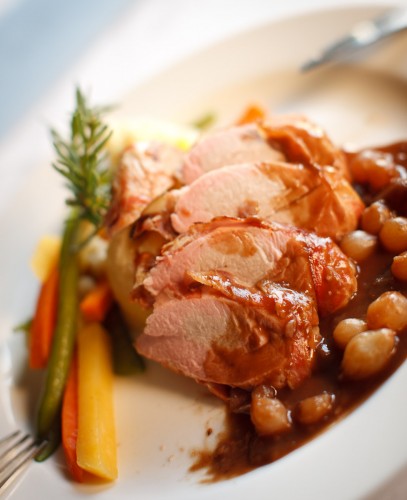
If I do this right, I now get this:

Pork Tenderloin ( ©2011 Michael Willems Photography)

And then I eat (Pork Tenderloin – yum).

And while the food lasts mere minutes (knowing me, seconds), the image lasts forever. I thus see restaurant food as an investment. I eat, and I get a stock photo into the bargain.


Trivia Question of the day: Why a “Stop”?

Q: Why is a stop called a stop?

A: Because on older cameras, the adjustments for shutter and aperture would “click”, ie come to a stop, for each halving or doubling of the light. Say from 1/125th second to 1/60th, or from f/8 to f/5.6. Click – click – click. This made it easier to adjust your exposures a known amount, just like a guitar with frets is easier than a violin with “continuous” adjustments.

Oh and bonus question:

Q: Why f/2.0, f/2.8, f/4.0, f/5.6, f/8.0, f/11, f/16, and so on?

A: First, note that it is not “f 8”, but “f/8”, meaning f (the focal length) divided by the subsequent number. And like the “main” shutter speed numbers, these main aperture numbers are also chosen to give you double, or half, the light with each subsequent number. And to halve the light coming through a circle you need to divide the radius not by 2 (that would give you a quarter of the light) but by the square root of 2, or 1.414. (Since area = Π r ²). So the ratio between these funny numbers is that, 1.4. Meaning each larger number (because we are dividing by this number) gives you half the light entering the lens.

And

Yesterday

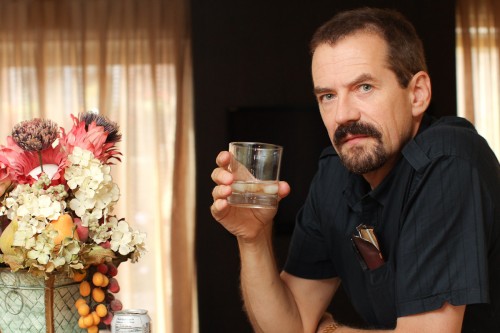
A student took this snap of me yesterday:

Photographer Michael Willems

He did this as follows:

  • He used his Canon 60D with my 50mm f/1.2 lens.
  • He used his new 580 EX II speedlight, bounced off the ceiling behind him.
  • The camera was set to manual exposure, f/5.6, 1/30th second
  • He selected 400 ISO.

Typical “indoors flash” settings.

The 50mm lens was set to f/5.6, so that means you could have done the same with any lens in the range of 50mm. This kind of lens length (meaning 80mm on a full frame body) is great for portraits. Which is why the 50mm (crop body) or 85mm (full-frame body) are such popular lenses.

If you do not yet own a 50mm prime lens, go get one. 50mm f/1.8, or if you can afford it, f/1.4 – or go all the way as I did, and get the 50mm f/1.2, but you will not using it at f/1.2 much.