Manual flash or TTL flash?

You know (if only because I have discussed it before) that you can set your flash to manual or TTL. I thought I would revisit this, and show you some shots I took Wednesday.

Manual means you set the power level; TTL means the camera fires a preflash and measures the return, and then sets the power level based on that. TTL (Nikon calls its version i-TTL, Canon calls its version e-TTL) is the default setting (the panel on the back of your flash says something like “TTL”).

An on-camera flash

An on-camera flash

Unlike David Hobby, I tend to use TTL most of the time, not  manual.

TTL is a major revolution in camera technology, because it allows you to shoot varying scenes without having to worry about distance. In particular, you can bounce anywhere you like, off a different wall for every shot, and you can use whatever modifiers you like, and not worry about measuring. And you can use “fast flash” to exceed the camera’s flash sync speed – useful on sunny days.

A sample, shot with TTL on Wednesday:

Pretty bartender at a reception

Bartender at a reception, shot using TTL

Indeed as David points out, TTL has drawbacks: the major one being that it’s not perfect. Its measuring is finicky. If you always aimed your viewfinder at an 18% grey surface you would be fine, but the meter is in evaluative mode, and on top of that it has an undocumented bias toward the focus point. All that means that if I focus on a black area I get grey (too bright), and if I focus on a white area I also get grey (too dark). So I need to use flash exposure compensation. And check the back of the display frequently.

TTL’s pluses, then, are:

  • You can use it anywhere, any time.
  • You do not need to meter or set anything.
  • You can do it when the subject varies.
  • You can bounce off varying surfaces, like when you shoot an event and both you and the subjects are constantly moving around.
  • You can exceed your camera’s flash sync speed by using “fast flash” (“auto FP flash”in Nikon terms)
  • You can use any modifiers you like

And its minuses:

  • It can be infuriatingly inconsistent.
  • Your subject’s brightness makes a difference.
  • Reflections can spoil a picture by underexposing it.
  • You’ll need to do more post-production work, as in a fast-moving event, where the setup changes with each shot, quite a few images will be half a stop under or over.
  • You’ll even miss a few images.

So TTL is great when things are predictable, but it is also very useful when things are not predictable (like when you, and they, move).

Now let’s move to manual flash. Manual is the opposite to TTL: it is utterly predictable and consistent but you need to do all the work, and it is totally useless when you and the subject move.

So I use manual when:

  • I want consistency, and I can ensure that nothing moves (like in studio portraits).
  • I have time to meter.
  • The flash is just adding light, like an accent, or like fill on a sunny day, when the exact power level is not that important (if the flash were a bit under or over it would not make a material difference to the image)
  • I am using Pocketwizards, e.g. for outdoors shots – which will therefore need to be predictable.

Don’t get me wrong, I love the predictability of manual flash firing, not to mention the predictability of the use of Pocketwizards.

So in fact I shoot manual flash if possible, and if not, then TTL.

Do I sound like I am contradicting myself? No. Because I shoot events. And events mean I need to be on my feet in a constantly changing environment. And that is when TTL shines (pun intended). Every shot I am in a different room, and I bounce off different surfaces. So that is why I usually use TTL.

And when using TTL, it is all about knowing how it is going to react, and being able to solve the problems. That is what I teach in my courses (e.g. at Henrys School of Imaging, and in the all-day course coming up on 30 May, and in Las Vegas on July 12+13, and many more times in between). There’s a lot of problem solving, involving tools like:

  • Flash lock (FEL/FVL)
  • Fast flash
  • Flash compensation
  • Knowing exactly what it will do

Remember, while a setup shot has to be right, in a fast-moving event, the objective is to get within half a stop to a stop, as long as you shoot RAW.  And believe me, this is eminently doable.

Another sample from Wednesday, where bright ambient light necessitated 1/400th second, which meant using Fast Flash:

Oakville's mayor Rob Burton and family

Oakville's mayor Rob Burton and family

Snacks, also from Wednesday:

Snacks at a high-end reception

Snacks at a high-end reception

Do try to bounce, and use you camera on manual settings (flash is still measured). The following may work, but only if you are lucky:

A photographer using popup flash

Photographer using popup flash

I would like to see her shots, but I know they would be better if she used an external flash and bounced it off the ceiling behind her!

Ten Portrait Tips

Here’s ten important portrait tips for you today:

  1. Use the right lens. A lens in the 35-100mm range is best (on a crop camera). A 50mm f/1.8 lens can be had very affordably, and this length (equivalent to 80mm) is great for headshots.
  2. Think about your lighting. Natural light is best (from a north facing window). Avoid direct flash: when using flash, bounce it off a white or near-white wall or ceiling or use other modifiers or off-camera flash. Use a hair light when needed to separate a person from the background. Consider adding a splash of colour. Match the light to the mood, and realise that good light is all about the shadows.
  3. Closest eye sharp. Ensure that the eyes are sharp. Nothing else needs to be sharp, but the closest eye in particular has to be in focus.
  4. Think about the environment. If this is an environmental portrait, use a wider angle lens and show the subject interacting with, or surrounded by, that background. But if the background is not meaningful, blur it.
  5. Get the Moment! Shoot a lot, so you will catch the right moment, not the cheesy expressions.
  6. Catchlight: ensure the eyes show a little catch-light. If not, they look lifeless.
  7. Off-centre composition: do not put your subject, or your subject’s eyes, in the centre of your photo: Uncle Fred does that. Instead, use off-centre composition (“the rule of thirds”).
  8. Directing: never tell your subjects you are posing them: say “positioning” instead.
  9. Positioning: Angle your subjects unless they are very thin. In multiple-person groups, make little groups, use a combination of “sit”, “stand” and “lean”, and use joiners to join the groups. having a subject lean into the camera is often flattering.
  10. Props – consider using props that are meaningful (an author holding a book, for instance).

An environmental portrait sample:

Victoria Fenner

Audio Expert Victoria Fenner in the studio

And another one: a headshot, but still environmental:

Christy Smith of Studio Moirae

Christy Smith of Studio Moirae

And here’s a traditional headshot:

A Female Soldier

Army Reserves Private

There are of course legion more tips and tricks, but the above will get you going. There will be more tips coming!

If you want to learn more, and “hands on”, then come for a short, effective, course – send me an email to hear when and where. Like the all-day Advanced Lighting course on May 30 in Mono, Ont: there are still spaces.

My shoot tonight

The second of two shoots: first I shot a politician,and then I shot lawyers. (No – with a camera).

I love shooting corporate events.

Glasses, ready for wine

Glasses, ready for wine

Food

Food.. aahh. excellent food

Veuve Cliquot

Veuve Cliquot

I get to shoot happy people and I even get to eat a snack or two. What’s not to like?

Tech: I used my 35mm prime lens on the 1Ds Mark II, and the 70-200 on the 1D Mark IV. Both cameras had a flash – aimed, of course, behind me.

What should I buy next?

As you know, I invite reader questions on this teaching blog, and I try to answer them on the blog.

A member of last weekend’s audience at the Photo Show wrote me some very kind words about how he enjoyed my seminars. He then added:

I am just entering the world of photography as a hobby and just have a quick question.  So far, my equipment consists of the Canon T1i with the kit lens.  I have also purchased an accessory kit for the camera that contained a bag, UV Haze filter, and a spare battery.  I was wondering what you would recommend as my next move.  I am interested in the 50mm 1.8 lens and plan on picking it up this week, but where should I go from there?  A polarizing filter?  An external flash? An additional lens?  Any input/advice you could provide would be greatly appreciated.

Interesting question – and a good one. As beginners in photography, there seems to us to be an infinite array of “must have” goodies, and it is important to decide where to spend our dollars.

So here’s my take on this. First of all, I think the choice is right:the Digital Rebel (any variety” XTI, XS, XSi, T1i, or T2i) is a great camera.

Canon T2i Digital SLR

Canon T2i Digital SLR

Not that there are bad cameras:today’s cameras are all great. While the Pros virtually all use Canon or Nikon, the offerings by Sony, Olympus, and Pentax are also great. It’s whatever you like best – how does it feel, how do the menus look to you: any small SLR will do exactly what a large expensive one does, so it is whatever you like.

So you have chosen a camera. And you have bought a spare battery (a must!) and hopefully also a few extra memory cards (I like 4GB cards: that size “fits on a DVD”).

More important than the camera is a lens. By all means start with the kit lens, but add the 50mm f/1.8 lens as soon as you can. (On Nikon starter cameras you need to manually focus that lens; on some others, there is no cheap 50mm lens availanel. This is one reason I like Canon). On a small DSLR, the 50mm f.1.8 lens works like an 80mm lens (50 x 1.6; a small sensor appears to magnify the lens length), and 80mm is perfect for portraits. And the large aperture (f/1.8, a low “f-number”) enables you to dramatically blur backgrounds and achieve very selective focus (“narrow depth of field”). Use this lens to take available light portraits and everyone will love their professional quality.

So what’s next? Here is my list.

  1. A flash. I would go for a 430EX II flash. You can read all about flash on this blog – and why you never aim it straight at the subject from on top of the camera (which is the worst possible place to mount a flash). Bounce the flash and you’re good with great light.
  2. A wide angle lens. A lens in the range of 10-20mm would be fabulous. Search this blog for “Wide Angle” to see why, and to see what these lenses can do.
  3. Then a long lens (say in the 70-200mm range), especially if you shoot things like sports, wildlife, or if you do a lot of studio portraits or other photos that need “zooming in”.

Then, and in no particular order, I would think of adding utilities, such as:

  1. A sturdy tripod
  2. A good camera bag (or “photography bag”: my camera does not go in a bag!)
  3. Lens hoods for each lens
  4. A circular polarizer filter
  5. A Hoodman Hood Loupe
  6. Perhaps some flash modifiers, like Honl bounce cards.

And from that point on, “it depends”. On what you like – and by then you will have a good idea.

The list goes on, but the good news: in the past, we used to spend $20 every time we used our camera. Today, that is gone: no more film or developing, So take that same money and use it for stuff that lasts, instead. In the end, you still spend less, and you end up with great equipment.

And keep in mind that lenses last forever: a good lens (with a low “F”-number”, i.e. a “fast lens”) will keep its value for decades. The same applies to flashes.

And above all – take some training. Even with one camera and lens, once you know how it works, you can do miracles!

Soon: review of the Honl Softbox

I have been using the Honl Photo Traveler 8 softbox, and will post a review soon: in the next week, if I can.

Here’s the softbox, packed in its optional traveling case:

Honl Photo Traveler 8 softbox

Honl Photo Traveler 8 softbox

And here, unpacked, assembled, and attached to a speedlite:

Honl Photo Traveler 8 softbox

As always, the convenience and sturdiness is what sets these Honl products apart. We can all do things in a thousand ways, but:

  • When your customer (or worse, your customer’s personal assistant or PR person) is tapping their fingers and getting visibly impatient and you know you have an hour to go to even set up your shoot, every second counts.
  • When you have to personally carry everything you use, every gram counts.
  • When it has to fit into bags, every fraction of an inch counts.
  • When you shoot for a living and hence throw things about, every bit of sturdiness counts.
  • And when you are far from home, every bit of reliability counts.

I think that is why I like these Honl products so much: it is obvious that Dave Honl lives in the same world as I do. And I suspect, the same world many of you live in. And no, Dave is not paying me for this; and yes, I plan to do more workshop together with him like the one I did in Phoenix in March: stay tuned.

But first, a review, soon, of the softbox, and some tips for its use.

Why use a hair light?

One of my favourite ways to use a light is a hair light. Add it to almost any picture to add some interest, contract, and separation from the background.

So you go from this picture of a very nice student in one of my classes recently:

A picture showing good lack of a hair light

Lacking a hair light

…to this subsequent picture of the same young lady:

A picture showing good use of a hair light

Using a hair light

Much nicer, no? And look, even the smile improves!

OK, I am kidding about t he smile. But the picture is better. A dark-haired person against a dark background particularly needs a hair light.

It is aimed directly at the subject from the back, usually diagonally. Use a grid (like the Honl Speed Grid) or a snoot for even more controlled light (like the Honl Speed Snoot).

Wide angles, and why?

I like wide angle lenses, as this shot, taken the other night at an event I was shooting, shows:

A wide angle shot

A wide angle shot

I used a bounced flash and set the camera to manual mode and opened up the aperture, slowed down the shutter, and increased ISO enough to allow the available light to d some work as well.

And wide angle means:

  1. I can focus easily on “everything”
  2. I can use a slow shutter speed without blur
  3. I can get close to someone or something, zoom out, and thus introduce depth.

And that is what I did there.

What's in YOUR bag?

What do I carry in my photo bag? I am often asked this question. I was asked it again a few times at the Henry’s Photography and Digital Imaging Show this past weekend, where by the way I spoke to, and with, thousands of people, and loved every minute.

(By the way, if you visited the show and have questions, do feel free to email them to me and I shall answer them on the blog – and sign up for email).

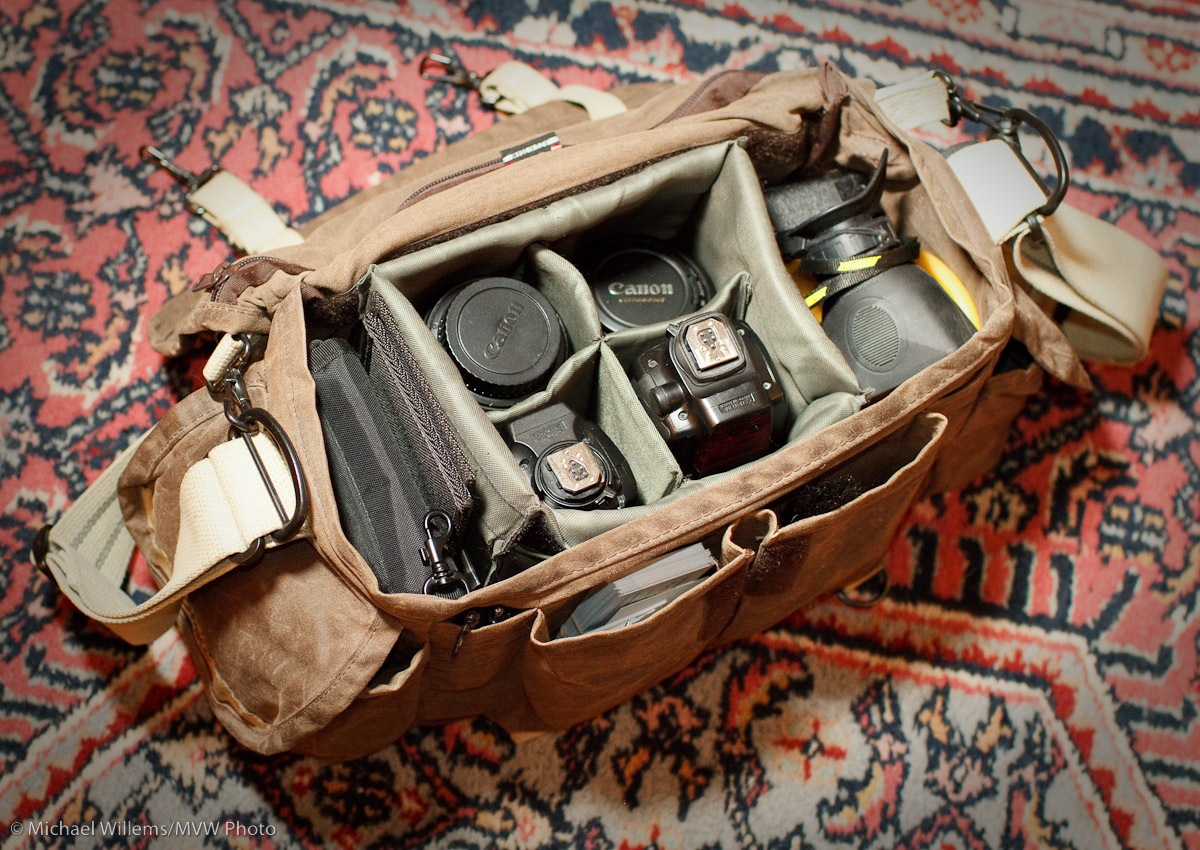
So my bag looks like this:

A photojournalist's camera bag and contents

Camera bag and contents

What does it not contain? A camera. This is on my shoulder, for fast convenient access. Always, even when I am travelling. I do not put the camera in a bag.

What this Domke bag does contain is:

  • Two spare lenses, at least one of them a fast prime like the 35mm f/1.4 or the 50mm f/1.4
  • Lens hoods, one for each lens
  • A 580EX II flash
  • A 430EX II flash
  • Flash Modifiers: A Honl grid and a set of Honl bounce cards and a Honl gel set in a roll container, as well as a Gary Fong lightsphere
  • A Hoodman Hood Loupe
  • A container full of memory cards
  • A small grey card
  • Wallet
  • Note pad
  • Spare batteries for cameras and flashes
  • Business cards
  • A small brush
  • Pens
  • Pills (headache, throat)
  • Plastic bags
  • Shower caps, elastic bands, etc

You can never be too prepared. Be like NASA (“do I really need each gram of this weight?”), but once you decide you need it: bring it!

Regrets, I've had a few…

…but then again, too few to mention. Except one, at the show: namely, that I don’t get to see the actual exhibition. I’m always presenting!

Michael Willems presenting, shot by Ray of RPW Photo

That said: I love the work.What could be better than educating thousands of people in a hobby (or profession) that is exciting, creative, fun, and extremely rewarding in almost every sense?

Those of you new to the blog: a few important tips.

  • Sign up for emails (on the right) so that you get an email every time I post. I write at least one learning post every day.
  • Search, using the search field
  • Go back – this blog is almost like a book: a post of a year ago is still entirely valid today!
  • Use the category cloud to search for key words.
  • Ask me questions – I’ll answer them on the blog!

And above all.. go shoot some nice pictures.. shoot a lot. And never stop learning.

Reiterated Trick

I mentioned this once before as an aside, but it is worth a post: a trick that tells you which flash is casting what light in your images.

Say I am lighting a person (like me) with a flash outside. Nice:

Subject lit with an off-camera flash

Subject lit with an off-camera flash

But how can I be sure this light is from the flash? I mean, is that really all the flash? Or is the subject in the sun? Or in a mix of light?

Solution: put a coloured gel onto the flash. Now you see:

Subject lit with an off-camera gelled flash

Subject lit with an off-camera gelled flash

Ah. So it was the flash! Not only that – you can see exactly where it is -and importantly, where it is not – illuminating the subject.

Useful trick, eh? One more reason to always carry gels along with you.