Yesterday’s snap of the day was about b/w. Today’s is about colour. Colour can be subtle:

Toronto, September 2009
Yesterday’s snap of the day was about b/w. Today’s is about colour. Colour can be subtle:
Toronto, September 2009
Excellent session tonight: I did a training session with two truly excellent wedding photographers: Ruby from Phoenix and Baz from Ottawa. The subject was modern-but-complex flash technologies: multi flash, custom settings, dramatic flash, modern modifiers, and more.
Believe me, wedding photography is a tough job that takes enormous talent – and these two people have it in droves. If I have been able to contribute even the slightest amount to their excellent shoots becoming even more successful, that is enormously gratifying. And we had fun.
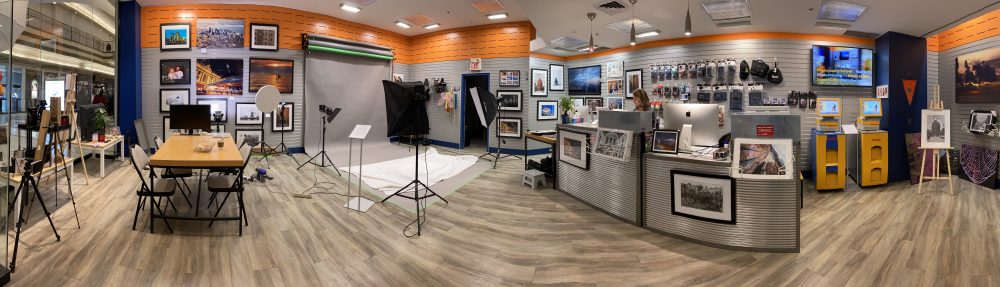
A snap of my office I just took:

Like that? It’s a snap, but it looks… well, three-dimensional. Doesn’t it?
Do you know why? Those who have been in my classes do. It is because I am using the “close-far” technique. I zoom all the way out to the widest angle I can (which was 16mm on the 7D, meaning about 25mm), and then I get close to something. Very close. As close as I can.That makes the close object look extra big – hence extra close, while the background looks small – hence, far away.

Ft Worth, Texas, Sept 2009
People talk about the 7D’s noise, I hear. Well, I saw that too – my first impression was, it seems noisy in Lightroom. On the other hand:
And look how a 3200 ISO JPG looks:

Real size sample:

Well, real sized when you click on it.
Noisy? I think that is great. Remember, this is full sized detail; shot at 3200 ISO, and taken from a JPG! A few years ago, 800 ISO would have been unacceptably noisy.
…is the most important control after focus, if you use your camaera’s semi-automatic modes.
What does it do? It makes the picture darker and light.er But how? Does it change the pixels? Adjust the ISO? Change aperture? Do processing in the chip? What?
Actually it is very simple.
You use exposure compensation (the +/- button on your camera) only in modes where the camera is already adjusting something.
If you are in aperture mode (A/Av), the camera constantly adjusts the shutter speed to match the light. If you are in shutter speed mode (S/Tv), the camera adjusts the aperture. In Program mode (P), the camera adjusts either/both.
All you are saying with +/1 is “I want you to do that as usual, but to do it slightly differently to how you’d normally set it. + means do what you do but make it brighter than you’d normally do; – means do what you do but make it darker than you’d normally do (like in the picture below).

So in Av/A mode, it adjusts the time as usual but to a slightly different value. In Tv/S mode, ditto for the aperture. In P mode, either.
No magic, then.
…just locked up. Out of nowhere. I was not even doing anything. Even turning it off did not do anything – I had to remove the battery.
I’m not concluding anything from this, but have to wonder: if this that famous Canon QC again? I shall await the software update…. months from now, presumably.

Or maybe it was the early 1970s. I wish I knew where it was.. a real 6×6 camera.

Since I have not been on an airplane for a year, I thought it might be time to tell you how to take pictures from one. And in sort, it is like this:
Finally: you will find many aerial shots to be somewhat hazy. That can be fixed if the problem is not extreme. In Photoshop, do a “levels” adjustment to ensure the histogram goes from black to white.
It is as simple as that!
Wide angles are nice. And so are the colours we see in cities when buildings reflect light. Like in Toronto the other day, on my way to work on Queen and Church:

For a handheld picture like this, I do the following:
It’s simple – set it up that way, and then you just snap away.